03-1 Specialization "is a" Drawing Names and Objects A - - PDF document

03 1
SMART_READER_LITE
LIVE PREVIEW

03-1 Specialization "is a" Drawing Names and Objects A - - PDF document

Composition: "has a" Classes and objects can be related in several ways One way: composition , aggregation , or reference Dog has-a owner, dog has legs, dog has collar, etc. CSE 143 Java In java: one object refers to


slide-1
SLIDE 1

03-1

1/29/2003 (c) University of Washington 03-1

CSE 143 Java

Inheritance Reading: Ch. 9, 14

1/29/2003 (c) University of Washington 03-2

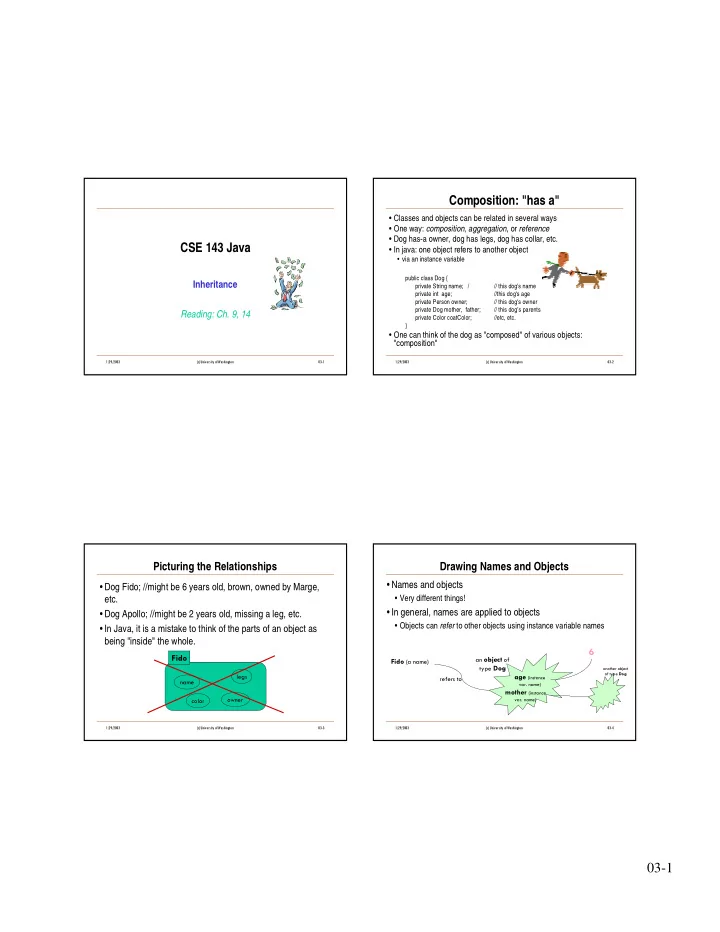
Composition: "has a"

  • Classes and objects can be related in several ways
  • One way: composition, aggregation, or reference
  • Dog has-a owner, dog has legs, dog has collar, etc.
  • In java: one object refers to another object
  • via an instance variable

public class Dog { private String name; / // this dog's name private int age; //this dog's age private Person owner; // this dog's owner private Dog mother, father; // this dog’s parents private Color coatColor; //etc, etc. }

  • One can think of the dog as "composed" of various objects:

"composition"

1/29/2003 (c) University of Washington 03-3

Picturing the Relationships

  • Dog Fido; //might be 6 years old, brown, owned by Marge,

etc.

  • Dog Apollo; //might be 2 years old, missing a leg, etc.
  • In Java, it is a mistake to think of the parts of an object as

being "inside" the whole.

name legs

  • wner

color

Fido

1/29/2003 (c) University of Washington 03-4

Drawing Names and Objects

  • Names and objects
  • Very different things!
  • In general, names are applied to objects
  • Objects can refer to other objects using instance variable names

Fido (a name)

an object of type Dog refers to

age (instance

  • var. name)

mother (instance

  • var. name)

6

another object

  • f type Dog
slide-2
SLIDE 2

03-2

1/29/2003 (c) University of Washington 03-5

Drawing Names and Objects

  • A name might not refer to any object
  • One object might have more than one name
  • i.e., might be more than one reference to it
  • An object might not have any name
  • “anonymous”

Fido

an object of type Dog refers to

age mother

6

another object

  • f type Dog

MyDoggie Fifi

anonymous

  • bject of type

Dog 1/29/2003 (c) University of Washington 03-6

Specialization – "is a"

  • Specialization relations can form classification hierarchies
  • cats and dogs are special kinds of mammals;

mammals and birds are special kinds of animals; animals and plants are special kinds of living things

  • lines and triangles are special kinds of polygons;

rectangles, ovals, and polygons are special kinds of shapes

  • Keep in mind: Specialization is not the same as composition
  • A cat "is-an" animal vs. a cat "has-a" tail

1/29/2003 (c) University of Washington 03-7

"is-a" in Programming

  • Classes &/or interfaces can be related via specialization
  • one class/interface is a special kind of another class/interface
  • Rectangle class is a kind of Shape
  • So far, we have seen one Java technique to capture this

idea: interfaces

  • Java interfaces are one special case of a more general

design approach: Inheritance

1/29/2003 (c) University of Washington 03-8

Inheritance

  • Java provides direct support for “is-a” relations
  • likewise C++, C#, and other object-oriented languages
  • Class inheritance
  • one class can inherit from another class,

meaning that it's is a special kind of the other

  • Terminology
  • Original class is called the base class or superclass
  • Specializing class is called the derived class or subclass
slide-3
SLIDE 3

03-3

1/29/2003 (c) University of Washington 03-9

Inheritance: The Main Programming Facts

  • Subclass inherits all instance variables and methods of the

inherited class

  • All instance variables and methods of the superclass are

automatically part of the subclass

  • Constructors are a special case (later)
  • Subclass can add additional methods and instance variables
  • Subclass can provide different versions of inherited

methods

1/29/2003 (c) University of Washington 03-10

A B

A's stuff B's stuff A's stuff B's stuff

B extends A

A's stuff is automatically part of B

1/29/2003 (c) University of Washington 03-11

Interfaces vs. Class Inheritance

  • An interface is a simple form of inheritance
  • If B implements interface A, then B inherits the stuff in A

(which is nothing but the method signatures of B)

  • If B extends class A, then B inherits the stuff in A (which can

include method code and instance variables)

  • To distinguish the two, people sometimes say “interface

inheritance” vs. “class inheritance”.

  • What if you heard the phrase “code inheritance”?

1/29/2003 (c) University of Washington 03-12

Example: Representing Animals

  • Generic Animal

public class Animal { private int numLegs; /** Return the number of legs */ public int getNumLegs( ) { return this.numLegs; } /** Return the noise this animal makes */ public String noise( ) { return "?"; } }

slide-4
SLIDE 4

03-4

1/29/2003 (c) University of Washington 03-13

Specific Animals

  • Cats

public class Cat extends Animal { // inherit numLegs and getNumLegs() // additional inst. vars and methods …. /** Return the noise a cat makes */ public String noise( ) { return “meow"; } }

  • Dogs

public class Dog extends Animal { // inherit numLegs and getNumLegs() // additional inst. vars and methods …. /** Return the noise a dog makes */ public String noise( ) { return “WOOF!!"; } }

1/29/2003 (c) University of Washington 03-14

Animal

Animal's stuff

Cat

Animal's stuff Cat's stuff

Dog

Animals's stuff Dog's stuff

Cat extends Animal / Dog extends Animal

1/29/2003 (c) University of Washington 03-15

More Java

If class D extends B /inherits from B...

  • Class D inherits all methods and fields from class B
  • But... "all" is too strong
  • constructors are not inherited
  • same is true of static methods and static fields

although these static members are still available in the subclass

  • Class D may contain additional (new) methods and fields
  • But has no way to delete any

1/29/2003 (c) University of Washington 03-16

Never to be Forgotten

If class D extends/inherits from B...

  • a D can do anything that a B can do (because of inheritance)
  • a D can be used in any context where a B is appropriate

Every object of type D is also an object of type B

slide-5
SLIDE 5

03-5

1/29/2003 (c) University of Washington 03-17

Method Overriding

  • If class D extends B, class D may provide an alternative,

replacement implementation of any method it would

  • therwise inherit from B
  • The definition in D is said to override the definition in B
  • An overriding method cannot change the number of

arguments or their types, or the type of the result [why?]

  • can only provide a different body
  • Can you override an instance variable?
  • Not exactly... ask me in person if you're really curious

1/29/2003 (c) University of Washington 03-18

Polymorphism

  • Polymorphic: "having many forms"
  • A variable that can refer to objects of different types is said

to be polymorphic

  • Methods with polymorphic arguments are also said to be

polymorphic

public void speak(Animal a) { System.out.println(a.noise( )); }

  • Polymorphic methods can be reused for many types

1/29/2003 (c) University of Washington 03-19

Static and Dynamic Types

  • With polymorphism, we can distinguish between
  • Static type: the declared type of the variable (fixed during execution)
  • Dynamic type: the run-time class of the object the variable currently refers to (can

change as program executes) public String noise() { // this has static type Animal ... } Cat foofoo = new Cat( ); foofoo.noise (foofoo); //inside noise(), this has dynamic type Cat Dog fido = new Dog( ); foofoo.noise (fido); // inside noise(), this has dynamic type Dog

1/29/2003 (c) University of Washington 03-20

Dynamic Dispatch

  • "Dispatch" refers to the act of actually placing a method in

execution at run-time

  • When types are static, the compiler knows exactly what

method must execute.

  • When types are dynamic... the compiler knows the name of

the method – but there could be ambiguity about which version of the method will actually be needed at run-time.

  • In this case, the decision is deferred until run-time, and we refer to it

as dynamic dispatch

slide-6
SLIDE 6

03-6

1/29/2003 (c) University of Washington 03-21

Method Lookup: How Dynamic Dispatch Works

  • When a message is sent to an object, the right method to invoke is the
  • ne in the most specific class that the object is an instance of
  • Makes sure that method overriding always has an effect
  • Method lookup (a.k.a. dynamic dispatch) algorithm:
  • Start with the run-time class of the receiver object (not the static type!)
  • Search that class for a matching method
  • If one is found, invoke it
  • Otherwise, go to the superclass, and continue searching
  • Example:

Animal a = new Cat( ); System.out.println(a.noise( )); a = new Dog( ); System.out.println(a.getNumLegs( ));

1/29/2003 (c) University of Washington 03-22

Summary

  • Object-oriented programming is hugely important
  • Lots of new concepts and terms
  • Lots of new programming and modeling power
  • Used more and more widely
  • Ideas (so far!)
  • Composition ("has a") vs. specialization ("is a")
  • Inheritance
  • Method overriding
  • Polymorphism, static vs. dynamic types
  • Method lookup, dynamic dispatch