0 Disclaimer Forward-Looking Statements This document may contain - - PDF document

0
SMART_READER_LITE
LIVE PREVIEW

0 Disclaimer Forward-Looking Statements This document may contain - - PDF document

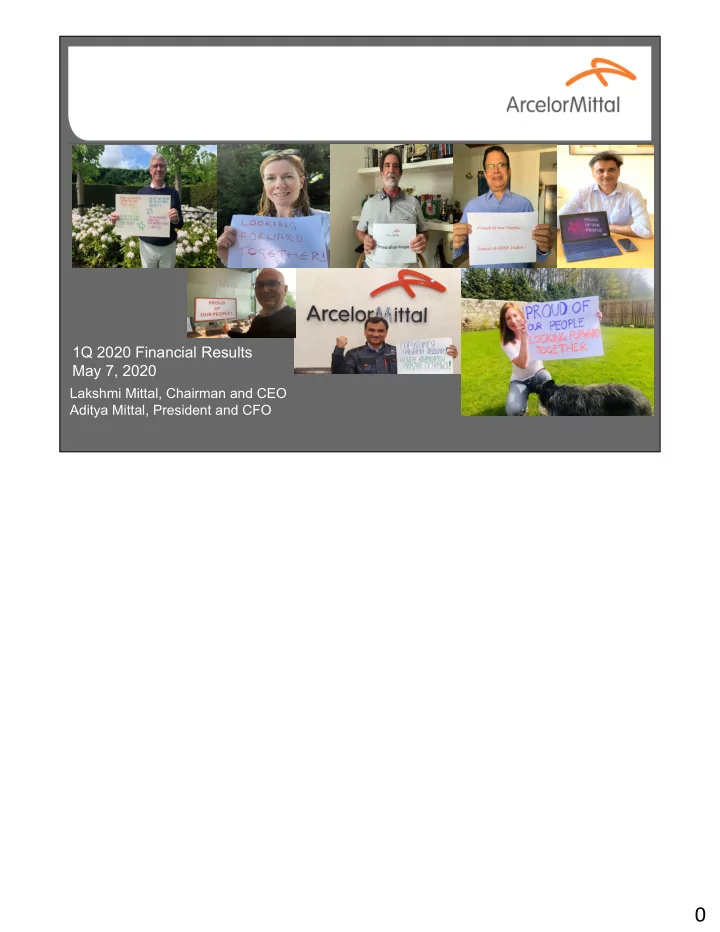
1Q 2020 Financial Results May 7, 2020 Lakshmi Mittal, Chairman and CEO Aditya Mittal, President and CFO 0 Disclaimer Forward-Looking Statements This document may contain forward-looking information and statements about ArcelorMittal and its


slide-1
SLIDE 1

Lakshmi Mittal, Chairman and CEO Aditya Mittal, President and CFO

1Q 2020 Financial Results May 7, 2020

slide-2
SLIDE 2

Disclaimer

Forward-Looking Statements This document may contain forward-looking information and statements about ArcelorMittal and its subsidiaries. These statements include financial projections and estimates and their underlying assumptions, statements regarding plans, objectives and expectations with respect to future operations, products and services, and statements regarding future performance. Forward-looking statements may be identified by the words “believe”, “expect”, “anticipate”, “target” or similar expressions. Although ArcelorMittal’s management believes that the expectations reflected in such forward-looking statements are reasonable, investors and holders of ArcelorMittal’s securities are cautioned that forward-looking information and statements are subject to numerous risks and uncertainties, many of which are difficult to predict and generally beyond the control of ArcelorMittal, that could cause actual results and developments to differ materially and adversely from those expressed in, or implied or projected by, the forward-looking information and statements. These risks and uncertainties include those discussed or identified in the filings with the Luxembourg Stock Market Authority for the Financial Markets (Commission de Surveillance du Secteur Financier) and the United States Securities and Exchange Commission (the “SEC”) made or to be made by ArcelorMittal, including ArcelorMittal’s latest Annual Report on Form 20-F on file with the SEC. ArcelorMittal undertakes no obligation to publicly update its forward-looking statements, whether as a result of new information, future events, or

  • therwise.

Non-GAAP/Alternative Performance Measures This document includes supplemental financial measures that are or may be non-GAAP financial/alternative performance measures, as defined in the rules of the SEC or the guidelines of the European Securities and Market Authority (ESMA). They may exclude or include amounts that are included or excluded, as applicable, in the calculation of the most directly comparable financial measures calculated in accordance with IFRS. Accordingly, they should be considered in conjunction with ArcelorMittal's consolidated financial statements prepared in accordance with IFRS, including in its annual report on Form 20-F, its interim financial reports and earnings releases. Comparable IFRS measures and reconciliations of non-GAAP/alternative performance measures thereto are presented in such documents, in particular the earnings release to which this presentation relates.

Page 1

1

slide-3
SLIDE 3

Safety is our priority: Remain committed to the journey towards zero harm

Health & Safety of the Company’s workforce is of paramount importance

* LTIF = Lost time injury frequency defined as Lost Time Injuries per 1.000.000 worked hours; based on own personnel and contractors; A Lost Time Injury (LTI) is an incident that causes an injury that prevents the person from returning to his next scheduled shift or work period. ** ArcelorMittal Italia previously known as ILVA. 1Q’20 LTIF rate of 1.01x (incl. ArcelorMittal Italia) vs 1.25x in 4Q’19 and 1.14x in 1Q’19; LTIF excluding ArcelorMittal Italia of 0.72x in 1Q’20 vs. 0.84x in 4Q’19 and 0.66x in 1Q’19.

0.85 0.85 0.81 0.82 0.78 0.69 1.21 1.01 2012 2014 2007 2010 2008 2009 2011 2018 2013 2015 2016 3.1 2017 1.9 2019 1Q’20 2.5 1.8 1.4 1.0

  • Following the spread of COVID-19 pandemic, where possible, employees are working remotely and where assets

continue to operate, we are following the recommendations of local governments as well as the World Health Organization

  • We continue to ensure extensive monitoring, sanitation and social distancing measures applied at all operations,

alongside provision of essential personal protective equipment

  • Robust planning to ensure facilities can operate and protect health of our people
  • The Company’s efforts to improve the Group’s Health and Safety record will continue to focus on further reducing

the rate of severe injuries and fatality prevention

ArcelorMittal including ArcelorMittal Italia Page 2

0.72 0.75 ArcelorMittal excluding ArcelorMittal Italia

The improved operating performance in the first quarter has been considerably

  • vershadowed by the COVID-19 crisis. Faced with a significant humanitarian challenge,

the Company’s first priority has been to take all the necessary actions to safeguard the wellbeing of our people and to provide support to the extent required in the communities in which we operate. Where possible, employees are working remotely from home. At all global manufacturing

  • perations we are following government and World Health Organisation advice and

guidelines in order to protect employees and prevent the spread of infection. Before the Company started to address the business disruption we are facing, we first had to ensure that our manufacturing facilities were safe places to work. We have therefore introduced practical changes to our facilities which fall into three distinct, but equally important areas: enhanced cleaning and hygiene, social distancing and personal protective equipment (PPE). With the dedicated support of our employees and stakeholders, the Company has been able to adapt decisively to protect the business in the face of this completely unprecedented scenario and meet remaining customer demand from a reduced level of production.

2

slide-4
SLIDE 4

2

slide-5
SLIDE 5

3

Focused on resilience in face of exceptional market circumstances

Protect health and safety of our people; swift, disciplined response; focus on cash management

* As of March 31, 2020, the Company had liquidity of $9.8bn, consisting of cash and cash equivalents of $4.3bn and $5.5bn of available credit lines. On May 5, 2020, ArcelorMittal signed with a syndicate of banks a new $3bn credit facility (with tranches of $0.7bn and €2.1bn) hence supplementing its March 31, 2020 total liquidity of $9.8bn.

Exceptional market conditions Swift disciplined response Balance sheet strength and resilient cashflow Focussed on strategic targets

  • Improved performance in 1Q’20 reflected positive market developments prior to the

escalation of the COVID-19 pandemic in March

  • COVID-19 having profoundly negative impact on economic activity leading to exceptionally

weak demand  suddenness of impact similar to the 2008/2009 crisis

  • Priority given to the safety and well being of our people and adapting quickly, securing

assets, and reducing production in line with the lower orderbook

  • Measures taken rapidly to temporarily reduce fixed costs commensurate with lower

production volumes; 2Q’20 fixed costs expected to be 25-30% below 1Q’20 level

  • Cash needs reduced by $1bn to $3.5bn (including capex reduction to $2.4bn)
  • Strong cash management in 1Q’20: working capital investment limited to $0.1bn; gross debt

reduced by $0.5bn to $13.8bn; marginal increase in net debt to $9.5bn

  • Focus on working capital management as a source of cash in 2020
  • $9.8bn liquidity as of Mar 31, 2020 plus new $3bn credit line* commitment
  • Focus on health and safety of our people; cost competitiveness and rapid reaction to changing

market conditions; this includes assets being ready to respond quickly to demand recovery

  • Achievement of $7bn net debt remains a priority; asset optimization program on track
  • Against the backdrop of significant cost savings measures being taken across the business,

the Board determined it both appropriate and prudent to suspend dividend payments until such a time as the operating environment normalizes.

Page 3

The Company performance improved in the 1Q’20, with EBITDA increasing by 4.5% to $1.0bn vs 4Q’19. This improvement reflects the positive momentum in our markets at the beginning of the year, following the end of destock activity that had negatively impacted our core markets in the latter part of 2019. This positive momentum, however, came to an abrupt halt from mid-March, as the global escalation of the COVID-19 pandemic, and subsequent measures introduced by governments worldwide to contain it, negatively impacted economic activity and industrial supply chains in many parts of the world. We see strong parallels with the impact faced during the global financial crisis in 2008/2009 and draw on our experience of successfully navigating this period. As discussed on the previous slide, our first and most important priority is to ensure the health and wellbeing of our people in this challenging environment. The Company has rapidly adapted production in-line with the demand environment. We continue to remain agile in terms of adapting production to demand and ensuring that our assets are maintained appropriately to enable them to restart when the situation improves. In order to mitigate in part, the effect of weaker demand, the Company has temporarily reduced fixed costs in line with lower production as well as implement other cost saving measures. We have seen governments worldwide announce unprecedented measures to provide support for which we are thankful. We have made use of such schemes before but never in such a comprehensive way. The Company has also cut its spending and the cash needs of the business have been reduced by $1bn. The largest part of this is the reduction of capex plans for FY’20 to $2.4bn. All non-essential capex has been suspended, while certain high return projects like the Mexico hot strip mill project, agreed Italian projects and certain projects to reduce CO2 emissions will continue. And the overall maintenance capex expense is expected to be lower due to reduced

  • perating rates.

The Company has entered this unprecedented period with a far stronger balance sheet than previous crisis environments, reflecting its deleveraging priority in recent periods. Due to effective cash management in 1Q’20, net debt remained near the historical low levels at the end of 2019. Further, we have supplemented our already strong $9.8bn liquidity position at March 31, 2020 with a new $3bn credit facility. The $7bn net debt target remains a key priority. And despite the COVID-19 pandemic challenges, the Company’s $2bn asset portfolio optimisation program is progressing on track. Against the backdrop of significant cost savings measures being taken across the business, the Board determined it both appropriate and prudent to suspend dividend payments until such a time as the operating environment

  • normalizes. As a result, no dividend from 2019 results will be proposed to shareholders at the Annual General Meeting

now scheduled in June 2020.

3

slide-6
SLIDE 6

3

slide-7
SLIDE 7

Supporting the COVID-19 response

Proud of our collective response to support people in the Covid-19 pandemic, both in our workforce and our communities

Responses across our operations: Brazil, Argentina, USA, Mexico, Canada, Liberia, S Africa, India, Ukraine, Kazakhstan, Spain, France, Germany, Poland, Belgium, Italy

Financial and in-kind contributions to COVID-19 response globally

  • Purchasing, producing and donating ventilators, test kits, face masks

and shields

  • Coordinating mobilisation of private sector contributions in W Africa
  • Cash and in-kind donations to community responses e.g. donations to

food banks, laptops and resources for home-schooling, providing meals and food kits for communities Leveraging our product, facilities and R&D skill

  • Global R&D: 3D printing expertise used to design / print respirators for

Spanish Ministry of Health; 3D printed face shields for healthcare workers and use in industry attached to helmets. Share designs with 3D networks in other countries

  • Brazil: worked in partnership to produce face shields, 150,000 delivered

in April

  • Donated steel for construction of temporary healthcare centres, and our
  • wn facilities for the same purpose; our vehicles for use as ambulances

Click for video

For more information, see https://corporate.arcelormittal.com/covid-19-coronavirus-arcelormittal-response

Page 4

4

On this slide we highlight the responses and contributions ArcelorMittal has contributed in the collective effort to fighting the COVID-19 pandemic across the globe, not only in our workplace but through our support for public health efforts and community support programmes. First and foremost, where our operations continue, we have made extensive efforts to adapt our safety philosophy to cover all the aspects of hygiene, personal protection, social distancing and shared vigilance needed to protect our workforce. Secondly, we have made tremendous efforts to support the public response to care for people struck by the virus, with donations of vast amounts of medical and protective equipment to local hospitals, to nursing homes and community organisations across Europe, Africa, and the Americas. We engage with local communities to understand their needs and concerns. For example, in Brazil, we have made a donation to enable the Joao Monlevade hospital to double its number of intensive care beds. In Liberia, made cash donations to the Ministry of Health to purchase medical equipment, and we are working with a local NGO to tackle social stigmas associated with COVID-19. Across West Africa we are coordinating efforts to mobilise the resources of the private sector to support efforts against the coronavirus, as we did during the Ebola crisis. In India, we are supporting the Prime Minister’s CARES fund and donated food kits for over 30,000 people. And in many countries, we are also supporting thousands of children who are being schooled at home, developing online videos and educational tools in Ukraine, and donating 5000 laptops in Spain. Thirdly, the Company has leveraged its global R&D capabilities in adapting its 3D printing expertise to design ventilators with the Spanish authorities. These designs will be shared so that 3D printing networks across the world can use them. As well as 3D printing ventilators for Spanish hospitals, we are also producing 3D printed face shields in Spain, Mexico and Brazil, both for use by health workers and by those working in essential industries such as steel. All these contributions have been designed by ArcelorMittal people who are taking the time to listen, and to respond with care, often going far outside their normal responsibilities. For all this the Company is truly grateful and proud.

slide-8
SLIDE 8

5/ xx

  • Our programme to certify integrated sites in Europe against the ResponsibleSteel™

site standard started in 1Q’20 but will be delayed due to COVID-19

Sustainable development – key to our resilience

Driven by our vision to make steel the material of choice for the low carbon and circular economy

Page 5

  • European target to reduce CO2 emissions by 30% by 2030 and be carbon neutral by

2050  continue our drive towards low-emissions steelmaking.

  • Our broad-ranging low-emissions technology programme, has led CDP to place

ArcelorMittal top among steelmakers for climate transition opportunities, and award us an A- grade in their annual climate survey

  • This innovation programme is based on three basic routes:
  • Circular carbon (using bio-energy in place of coal, and CCU);
  • Clean power (for hydrogen-based or direct electrolysis ironmaking); and
  • CCS (to negate the residual CO2)
  • Our second Climate Action report, with our new global CO2 target, is expected in 2H’20

Pausing for a moment to reflect on the sustainable development progress during 1Q’20. ArcelorMittal’s ambition is to invent smarter steels for a better world, and vital to this is the pursuit of sustainable development. In 2015, we launched ten sustainable development outcomes for our business, which describe the business we need to become, if we are to bring optimal long-term value to

  • ur people, our stakeholders and the environment. The Company highlights the progress of two

particular programmes during 1Q’20 that demonstrate its commitment to becoming that business. Firstly, ArcelorMittal began in the first quarter of 2020 its program to certify all our Europe Flat sites against the first ever ResponsibleSteel standard by the end of 2020. The standard covers 12 environmental, social and governance principles including climate, water stewardship and human rights, and we believe certification will reassure our customers of the high sustainability standards we uphold at

  • ur sites. The timing of this certification program may be somewhat delayed as we adapt our work

program in response to COVID-19 but nonetheless, we hope to receive our first site certifications this year. Secondly, our commitment to the Paris climate agreement remains unwavering, with our ambition to significantly reduce our carbon footprint and become carbon neutral in Europe by 2050. Our Europe Flat segment is working towards its medium-term target of reducing Scope 1 carbon emissions by 30% by 2030 over 2018, and the Company plans to publish its roadmap to achieving this target shortly. ArcelorMittal’s transition strategy is based on both a broad and flexible low-emissions innovation program - which led CDP to award us top place in their ranking of transition opportunities - and our work to develop effective forms of policy support. We outlined our thinking on this in our first Climate Action Report last year, and we were pleased to see that our governance, strategy and progress on climate gained us an ‘A-’ score in the 2019 CDP Climate Survey in January this year. Work on our low emissions innovation program continues. Key to our ability to roll these technologies

  • ut in our steel plants will be the introduction of appropriate policy support measures that ensure, in

effect, that low-emissions steel becomes more competitive than high-emissions steel. One such

5

slide-9
SLIDE 9

measure is a form of carbon border equalization: We believe this to be an important mechanism which could even motivate other regions in the world to implement a carbon price, avoid circumnavigation, create a fair market and, crucially, encourage investment in lower-emissions steel production. Another key aspect of policy will be measures that accelerate the sustainable financing both of these new technologies and the energy infrastructure to support them.

5

slide-10
SLIDE 10
  • EBITDA: $1.0bn up 4.5% QoQ; 41.5%

lower YoY

  • Steel shipments stable QoQ: End of

supply chain destock in core markets; escalation of COVID-19 pandemic impacting from mid-March

  • Strong cashflow management: Working

capital investment limited to $0.1bn in 1Q’20 vs $0.6bn in 1Q’19

  • Low net debt maintained at $9.5bn as of

Mar 31, 2020 ($1.7bn lower YoY; $0.2bn higher vs Dec 31, 2019)

  • Strengthened liquidity: $9.8bn liquidity as
  • f Mar 31, 2020 plus new $3bn credit line*

Operating results for 1Q’20

Positive market developments prior to COVID-19 escalation in March; strong cashflow management

QoQ refers to 1Q’20 v 4Q’19 * As of March 31, 2020, the Company had liquidity of $9.8bn, consisting of cash and cash equivalents of $4.3bn and $5.5bn of available credit lines. On May 5, 2020, ArcelorMittal signed with a syndicate of banks a new $3bn credit facility (with tranches of $0.7bn and €2.1bn) hence supplementing its March 31, 2020 total liquidity of $9.8bn.

1.7 0.9 1.0 1Q’19 4Q’19 1Q’20

  • 41.5%

+4.5% EBITDA ($bn) Steel shipments ($Mt) 21.8 19.7 19.5 4Q’19 1Q’19 1Q’20 stable

Page 6

Turning to the financial performance, ArcelorMittal reported EBITDA of $1.0bn for 1Q’20. This is an improvement from 4Q’19 performance (+4.5%). Despite the negative impacts

  • f COVID-19 from March onwards, our 1Q’20 steel performance improved by 7.3% QoQ,

with improvement in NAFTA, Europe and ACIS offset by seasonally weaker Brazil. Mining segment EBITDA was stable in 1Q’20, with the effect of lower seaborne iron ore shipments (-11% QoQ, in part due to COVID 19 impact but also unplanned maintenance and seasonality in AMMC) being offset largely by the benefit of lower freight costs. We reported net loss of $1.1bn in 1Q’20. Adjusting for the impact of impairment charges (impairment of Florange coke battery following its closure to reduce costs) and exceptional items (including inventory related charges in NAFTA and Europe due to weaker pricing outlook due to COVID-19) the adjusted net loss would have been $0.6bn. In terms of cashflow performance, the Group has performed well. We had a small investment of $0.1bn in working capital during 1Q’20. This follows the normal seasonal pattern of the business, but given the Company’s focus on working capital management, the investment this quarter is less pronounced than in prior years. Net debt increased marginally to $9.5bn as of March 31, 2020 as compared to $9.3bn as

  • f December 31, 2019. This is $1.7bn lower as compared to March 31, 2019.

As of March 31, 2020, the Company had liquidity of $9.8bn, consisting of cash and cash equivalents of $4.3bn and $5.5bn of available credit lines which was strengthened further in early May by a new $3bn credit facility.

6

slide-11
SLIDE 11

COVID-19 impact and actions: Rapid adjustment of production

Significant demand impacts met with exceptional responses

  • COVID-19 impact on operations and demand felt

initially in Europe and subsequently in other key regions

  • Rapid adjustment of production and capacity

utilization

  • Major steps taken by region:
  • NAFTA: Idling BF No.3 Dofasco, Canada; BF No.6

Cleveland and BF No.4 Indiana Harbor, US

  • Brazil: Idling Tubarão’s BF No.3; long product

capacity in Brazil

  • Europe: Production idling/reductions undertaken in

Italy, France, Spain, Germany, Belgium and Poland

  • ACIS: Production cuts in CIS countries and across all

South African operations (Vanderbijlpark and Newcastle)

Page 7

2Q’20F 1Q’20 NAFTA 13.5 to 14.5 Europe Brazil ACIS 19.5 Steel shipments (Mt)

As highlighted on slide 3, the Company has acted swiftly and rapidly to adapt production in-line with the reduced demand environment caused by COVID-19. Production has been impacted across all segments and regions, with the main impacts detailed on the slide. Given these impacts the Company expects steel shipments in 2Q’20 to be within the range of 13.5Mt to 14.5Mt. The Company remains agile and flexible in adapting production to changes in demand. Robust plans and maintenance practices will ensure that our assets are able to increase production quickly as and when demand improves.

7

slide-12
SLIDE 12

COVID-19 impact and actions: Variabilisation of fixed cost

Initiatives undertaken to reduce fixed cost in line with reduced production

  • Company temporarily reducing fixed cost in line with lower production rates
  • 2Q’20 fixed cost expected to be 25-30% below 1Q’20 level  As a result fixed cost per

tonne relatively stable

  • Steps taken to reduce fixed cost:

 Temporary labour cost savings

  • Senior management / BOD salary reduction
  • Utilizing available economic unemployment schemes
  • Temporary layoffs; federal and state subsidy/grants; reduction/elimination of

contractors, overtime reduction etc.  Reduce in R&M expenses: Spend expected to be lower due to lower operating rates  Reduce SG&A expenses: IT, travel, sales and marketing expenses, consultancy fees etc.

Page 8

8

During this exceptional demand situation, an essential action is to reduce costs as quickly as possible, to a level consistent with the reduced output. The concept of “variablising” fixed costs is a strategy the Company has effectively deployed in previous exceptional environments. The largest component of our fixed cost base is labour. The Board of Directors and the Senior Management of the Company have reduced salaries. Where available, economic unemployment schemes have been utilised to match workforce to operating rates whilst protecting incomes. Further steps have been taken where necessary. After labour, the largest fixed cost is repairs and maintenance (R&M). Clearly during a period of lower asset utilisation the spend on R&M falls - normal per tonne R&M spend continues but the aggregate spending is significantly reduced due to low operating rates. Finally fixed cost savings have been achieved from countries in which we operate where the currency has depreciated, as well as reduced SG&A expenses such as IT, travel, sales and marketing expenses, consultancy fees etc. As a result of the actions taken, fixed costs have, on a temporary basis, been reduced in line with lower production rates and as a result fixed costs per tonne in 2Q’20F should be similar to 1Q’20 levels.

slide-13
SLIDE 13

Capital spending reduced to minimum levels

Capex cuts with focus on asset preservation, Mexico and environmental 1.0

  • Given these exceptional circumstances the

Company has made significant cuts to its planned capex

  • FY 2020 capex reduced to $2.4bn from

previous guidance of $3.2bn

  • All non-essential capex has been

suspended

  • Mexico hot strip mill project, Italy

projects and certain projects to reduce CO2 emissions to continue

  • Maintenance capex spend expected to

be lower to match reduced operating rates

Page 9

2016-2020F capex ($ billions) 2.4 2.8 3.3 3.6 3.2 2.4 2016 2017 2018 2019 2020F 2020F previous guidance

  • 1.2

9

In addition to the steps taken to reduce operating expenses, the Company has also reduced capital expenditures to minimum levels. All non-essential capex has been suspended, with the only non-maintenance capital spend being on the close-to-completed Mexico hot strip mill project, agreed projects in Italy and certain projects to reduce CO2 emissions continue. The aggregate maintenance capex spend falls naturally with the lower operating rates. Consequently, 2020 FY capex is now expected to be $2.4bn, compared to the initial guidance of approximately $3.2bn. This is a level comparable to the spend in the most recent steel downturn in 2016.

slide-14
SLIDE 14

Cash needs adapted

FY 2020 cash needs reduced by $1bn to $3.5bn

* Cash needs of the business consisting of capex, cash paid for interest and other cash payments primarily for taxes and excluding for these purposes working capital investment ** Estimates for cash taxes are based on current 1Q20 EBITDA rate as reported in May 2020

1.0

  • 2020 cash needs reduced to $3.5bn

from previous guidance of $4.5bn

  • Reduction of FY 2020 capex to $2.4bn

from previous guidance of $3.2bn

  • Cash taxes and others** reduced to

$0.6bn from previous guidance of $0.8bn

  • Interest costs remain at $0.5bn
  • Remaining 9 months of 2020 cash

needs of $2.4bn (c $0.8bn per quarter)

  • The Company still expects to release

$1 billion working capital as previously anticipated.

Taxes**, pension and other Net interest Capex

Below-EBITDA cash needs ($ billions)

Page 10

3.2 2.4 0.8 0.6 2020F 0.5 0.5 2020 previous guidance 4.5 3.5

  • 1.0

1.1 3.5 2.4 1Q’20 Remaining 9 months

  • f 2020

2020F Average cash needs

  • f $800m/qtr

10

Given the lower planned capex, as well as the impact of expected lower cash taxes, the Company now expects the cash needs of the business (including capex, interest, cash taxes, pensions and certain other cash costs but excluding working capital movements) to total $3.5bn in 2020 versus $4.5bn previous guidance. The cash needs of the business were $1.1bn in 1Q’20, implying that the average over the next three quarters should be approximately ~$0.8bn per quarter. The Company continues to expect working capital to be a source of cash in 2020, targeting a efficiency driven release of $1bn.

slide-15
SLIDE 15

11/ xx

Balance sheet strength maintained

Moderate increase in net debt with working capital investment limited to low level

* As of March 31, 2020, the Company had liquidity of $9.8bn, consisting of cash and cash equivalents of $4.3bn and $5.5bn of available credit lines. On May 5, 2020, ArcelorMittal signed with a syndicate of banks a new $3bn credit facility (with tranches of $0.7bn and €2.1bn) hence supplementing its March 31, 2020 total liquidity of $9.8bn.

Mar 31, 2017 Mar 31, 2016 Mar 31, 2018 Mar 31, 2019 Mar 31, 2020

11.2

Net debt target

11.1 9.5 7.0 17.3 12.1

  • 1.7

Net debt $bn

  • Achievement of the $7bn net debt
  • bjective remains a key priority
  • Net debt of $9.5bn as at March 31, 2020
  • Contrary to seasonal trend, no major

increase in net debt in 1Q’20

  • Investment in working capital limited to

$0.1bn in 1Q’20

  • Liquidity of $9.8bn* as at March 31, 2020

plus new $3bn credit line commitment

  • Strong financial position provides for

strategic continuity whilst navigating market challenges

Page 11

0.5 0.8 1.4 1.8 3.7 1.1 1.4 0.7 0.5 0.8 0.6 0.3 2022 2020 ≥2024 2021 2024 2023 0.2 Other loans Commercial paper Bonds

Debt maturity profile $bn

11

Moving to the balance sheet. Due to the Company’s focus on working capital efficiency, particularly as the impacts of COVID-19 became apparent, the investment in working capital during 1Q’20 was limited to $0.1bn. As a result, net debt increased marginally (by $0.2bn) to $9.5bn as of March 31, 2020. The net debt as of March 31, 2020 was $1.7bn lower as compared to $11.2bn in March 31, 2019. Liquidity remains healthy and is an important strength for the Company as it navigates this exceptional environment. As of March 31, 2020, the Company had liquidity of $9.8bn, consisting of cash and cash equivalents of $4.3bn and $5.5bn of available credit lines (maturing December 2024, this facility may be further extended for an additional year in December 2020). Additionally, the Company has secured a further $3bn credit facility since the quarter end. As of March 31, 2020, the average debt maturity was 5.2 years.

slide-16
SLIDE 16

12/ xx

$2bn asset portfolio optimization progressing despite COVID-19

Asset divestment program ongoing to unlock $2bn of value by June 2021

  • In the 2Q 2019 results, the Company announced plans

to unlock up to $2bn of value from its asset portfolio over next 2 years

  • Good progress made to date: $0.6bn of value unlocked

 Gerdau stake sale ($116m cash collected in 3Q’19)  Shipping JV formed: overall net debt impact $0.5bn with $0.1bn received in 1Q’20

  • Despite the challenges caused by COVID-19,

the Company’s $2bn asset portfolio optimisation program continues to progress

  • Given suitable and viable buyers have expressed serious

interest in certain assets, the Company remains confident in completing the program by mid-2021

Page 12

12

As previously announced in the 2Q’19 results and in line with our ongoing efforts to optimize

  • ur asset portfolio, we have identified opportunities to unlock $2bn of value from the portfolio
  • ver the next 2 years. The Company has made good progress to date including stake sale in

Gerdau ($0.1bn) and sale of a 50% interest in the shipping business (total $0.5bn net debt impact), of which $0.4bn achieved in 4Q’19 and a further $0.1bn in 1Q’20. Despite the challenges caused by COVID-19, the asset portfolio optimisation program continues to progress. Given suitable and viable buyers have expressed serious interest in certain assets, the Company remains confident in completing the program as expected by mid- 2021.

slide-17
SLIDE 17

13/ xx

AM/NS India update

Good cash generation; Secured low cost financing from Japanese banks

Page 13

Performance

  • Despite COVID-19 impacts: 1Q’20 crude steel production

1.7Mt (7.0Mt annualized run rate) and EBITDA $140m ($560m annualized)

  • Cash needs of the business (i.e. capex, interest and taxes)

less than $250m pa

  • Signed 10Yr $5.1bn loan with JBIC and 4 Japanese banks

to refinance in full the bridge loan at very competitive rates Progress on value chain integration

  • Early Mar’20 AMNS declared preferred bidder for Thakurani

iron ore mine, Odisha – 5.5Mtpa mine; acquisition cost $15m; royalty payment based on published domestic price

  • Bhander power plant, Hazira acquired for $70m (Mar’20)

– 500 MW natural gas based power plant – provides up to 60% of the Hazira power requirement

Thakurani iron ore mine in Odisha

13

An important development in 2019 was ArcelorMittal’s partnership with Nippon steel to acquire Essar Steel India. The calendar year 2020 began well with AM/NS India achieving strong production and shipment performance in January and February. AMNS India’s operations were impacted in March by the COVID-19 pandemic and lockdown measures introduced in India. Despite these impacts, AMNS India reported crude steel production of 1.7Mt (7.0Mt annualized run rate) and EBITDA of $140m ($560m annualized) for 1Q’20. Given the cash needs of the business (i.e. maintenance capex, interest and tax) are less than $250m per annum, the JV is in a good position to translate EBITDA to cashflow. The JV has made good strategic progress during 1Q’20. Beginning first with the new ten-year term loan agreement with Japanese banks. The proceeds of the loan have been used to refinance in full the amounts borrowed by AMNS in connection with the acquisition of ArcelorMittal Nippon Steel India Limited. Secondly, AMNS India received NCLT Cuttak approval for its resolution plan for OSPIL (Odisha Slurry Pipeline Infrastructure Ltd) that connects the iron ore beneficiation plant in Dabuna to the pellet plant in Paradip, Odisha. Furthermore, AMNS India announced the acquisition of the Bhander Power Plant, which will remain captive to AMNS India’s steel manufacturing operations at Hazira, and was selected as the preferred bidder for the long-life Thakurani iron ore mine.

slide-18
SLIDE 18

AM Investco (Italy): New agreement

  • New amended agreement signed in March 2020 with the Ilva Commissioners amending lease and purchase  In

future, Govt (and certain Ilva creditors) may become an investor, sharing upside and downside risk – Deferral of rental payment by 50% – Remaining liability will be swapped for a direct equity stake in AM InvestCo. (Investment level at least equal to the remaining outstanding payable (less adjustments))

  • For now, no change to the labour agreement – but both parties agreed to cooperate on the use of publicly funded

social measures as and when required and a revised labour agreement is a new CP to closing of the acquisition

  • New investment agreement to be signed by Nov 30, 2020
  • Industrial plan

– 8Mt production target including a new 2.5Mt EAF (subject to a new DRI plant owned by third party); ramp up of existing BF capacity – Capex broadly similar to previous commitments €2.1bn over next 6 years

Page 14

  • Status update

– Terms of government equity investment still to be derived by third party valuation – AM InvestCo has a withdrawal right if agreement not signed by Nov 30, 2020 (subject to payment of an agreed amount) – Final closing of the lease and purchase agreement is now scheduled by May 2022, subject to various conditions precedent

Taranto Feb 20: LHS ongoing Coal yard where we are also erecting the new stacker reclaimers; RHS is finished iron ore yard

Moving to an update on the Company’s activities in Italy. On March 4, 2020, ArcelorMittal announced that AM InvestCo and the Ilva Commissioners had signed an amendment to the original lease and purchase agreement for Ilva. The Agreement outlines the terms for a significant investment by the Italian Government, equal at least to the remaining liabilities payable by AM InvestCo’s against the original purchase price for Ilva. The amendment Agreement is structured around a new industrial plan for Ilva, which involves investment in lower-carbon steelmaking technologies. In the event that the Investment Agreement is not executed by November 30, 2020, AM InvestCo has a withdrawal right, subject to an agreed payment.

14

slide-19
SLIDE 19

Organic brownfield opportunities and measures to optimise cost Targeting $7bn net debt*– supporting positive FCF** and IG credit metrics at all points of the cycle

Capital allocation

Building resilience and strong foundations for future returns

* Previous target of $6bn adjusted to reflect impact of IFRS 16 ** Free cash flow refers to cash flow from operations less capex

Building the strongest platform for consistent capital returns to shareholders

Robust balance sheet Invest in strengths Returns to shareholders

Progressively increase base dividend with a commitment to returning a percentage

  • f FCF on attainment of debt target

Resilient platform To grow FCF potential Consistently return cash

Page 15

Moving to the topic of capital allocation. Our principle here is to allocate capital in such a way as to provide resilience and a strong platform for consistent capital returns. This begins with a robust balance sheet. So the Company will continue to target a net debt level of $7bn. This is the level that the Company believes will support positive FCF and investment grade credit metrics through the cycle. We will invest in our strengths… but following the acquisitions made in recent periods, the focus of investment will now be on organic brownfield opportunities, such as our Mexico HSM project, as well as measures to optimise our cost base. And ultimately we are working to return more cash to shareholders. We remain committed to returning a proportion of annual free cash flow once we achieve the $7bn net debt objective. Against the backdrop of significant cost savings measures being taken across the business, the Board has determined it both appropriate and prudent to suspend dividend payments at this time. But once the operating environment normalizes, the intention of the Board is to resume dividends and progressively increase this over time.

15

slide-20
SLIDE 20

16/ xx

Conclusion

ArcelorMittal is resilient and responding rapidly to manage the impacts of COVID-19

  • COVID-19 is an unprecedented crisis with

profound humanitarian and demand impacts. The safety and well-being of our people is our priority.

  • The Company has moved swiftly to secure our

assets and match production to the evolving

  • rderbook
  • Actions have been taken to reduce all costs, both
  • perating expenses and capital spending, in line

with the reduced activity levels

  • Together with a continued focus on working capital

management, this is expected to protect cash flows from the impacts of COVID-19

  • The balance sheet and liquidity position remain

strong, allowing the Company to navigate this crisis whilst appropriately maintaining our assets so that we are ready and able to respond to the demand recovery

Page 16

  • 2Q’20 steel shipments expected within the

range of 13.5Mt to 14.5Mt

  • Reduction in fixed costs by 25%-30% in 2Q’20,

essentially maintaining fixed costs per-tonne at the 1Q’20 level

  • 2Q’20 EBITDA expected to be within the range
  • f $0.4bn to $0.6bn

2020 guidance update

  • FY 2020 steel shipments expected to be lower

than FY 2019

  • FY 2020 iron ore marketable shipments to

decline 5-10% YoY

  • Cash needs of the business expected at $3.5bn
  • Working capital release of $1bn expected

FY 2020 guidance

16

To conclude. COVID-19 is an unprecedent challenge. The Company’s priority has been to take all the necessary actions to safeguard the wellbeing

  • f our people and to provide support to the extent required in the communities in which we
  • perate

Following that, the Company has rapidly adapted production in-line with the demand environment. Cash preservation is key in a crisis environment. The Company has again shown its flexibility by reducing the cash needs of the business and reducing capex. The balance sheet and liquidity position remain strong, allowing the Company to navigate this crisis whilst appropriately maintaining our assets so that we are ready and able to respond to the demand recovery The remainder of this year will be challenging, but the Company remains confident it has the experience and inherent resilience, to navigate these extraordinary times, securing the wellbeing of our people and ensuring that ArcelorMittal emerges from this crisis as it entered it – as the world’s leading steel Company.

slide-21
SLIDE 21

ArcelorMittal IR Tools and Contacts

Team contacts London Daniel Fairclough – Global Head Investor Relations (London) daniel.fairclough@arcelormittal.com +44 207 543 1105 Hetal Patel – UK/European Investor Relations (London) hetal.patel@arcelormittal.com +44 207 543 1128 Donna Pugsley– Investor Relations Assistant (London) Donna.pugsley@arcelormittal.com +44 203 214 2893 ArcelorMittal investor relations app available free for download

  • n IOS or android devices

Factbook & Climate Action report available to download

  • nline

Team contacts Global Maureen Baker – Fixed Income/Debt IR (Paris) maureen.baker@arcelormittal.com +33 1 71 92 10 26

Page 17

17