0 0 0 x a f x ( ) L - - PowerPoint PPT Presentation

0 0 0 x a f x l dr margaret adams
SMART_READER_LITE
LIVE PREVIEW

0 0 0 x a f x ( ) L - - PowerPoint PPT Presentation

1 0 0 0 x a f x ( ) L Dr. Margaret Adams Assistant Professor of Mathematics Northern State University Aberdeen, South Dakota NCTM Exposition April 15, 2016


slide-1
SLIDE 1
  • Dr. Margaret Adams

Assistant Professor of Mathematics

Northern State University

Aberdeen, South Dakota NCTM Exposition April 15, 2016 Margaret.adams@northern.edu

1
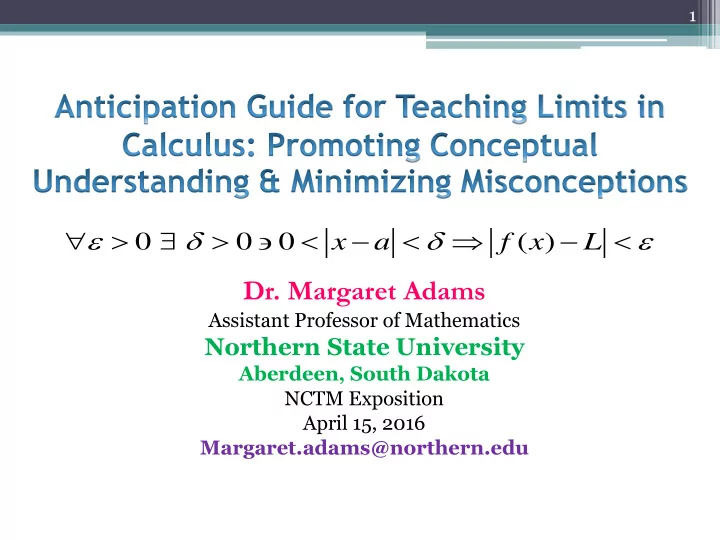
( ) x a f x L               

slide-2
SLIDE 2

Instructions

  • Take 3-5 minutes to answer the questions.
  • Answer BEFORE column now.

2

slide-3
SLIDE 3

Scenario High School

End of Quarter Exam Calculus Review

3

slide-4
SLIDE 4

“PLOPPPS” Lesson Plan Model

Anticipation Guide

  • Prior Learning: Functions & Limits
  • Objectives:

▫ Reduce misconceptions ▫ Develop “appropriate schemas (Piaget)” ▫ Improve conceptual understanding

  • Pre-test (collaborative) BEFORE column
  • Present information on topic
  • Post-test (collaborative) AFTER column
  • Summary

4

slide-5
SLIDE 5

Rationale

  • Previous Research
  • Unique perceptions of limits
  • Identify potential misconceptions prior to
  • instruction.
  • formative assessment.
  • Promote
  • appropriate schema development.
  • relational understanding.
  • Reduce teacher opportunities passing on

misconceptions to students.

slide-6
SLIDE 6

Common Core State Standards for Mathematics

▫ New emphasis placed on students’ ability to engage in mathematical practices.

 understanding problems.  reading and critiquing arguments.  making explicit use of definitions (CCSSI 2010).

6

slide-7
SLIDE 7

Conceptual Understanding of Limits

Shared Knowledge Structures Appear in the Intersections (Adams, 2013 Dissertation Study)

Inappropriate Schemas Instrumental Understanding

  • r

No Understanding (action schemes) Altered Schemas “Semi- Relational” Understanding (changing action schemes) Appropriate Schemas Relational Understanding

7

slide-8
SLIDE 8

Anticipation Guide

Definition:

▫ A pre-post measure of content knowledge and conceptual understanding. ▫ A written instrument using True/False responses. ▫ Teacher-made.

8

slide-9
SLIDE 9

How its used & more information

  • Every topic or unit.
  • With lesson plan.
  • Collaborative pairs.
  • Individually.
  • Graphing calculator.
  • ANTICIPATION GUIDES: A TOOL FOR SCAFFOLDING

MATHEMATICS READING

  • http://www.nctm.org/Publications/mathematics-

teacher/2015/Vol108/Issue7/Anticipation-Guides_-Reading-for- Mathematics-Understanding/

9

slide-10
SLIDE 10

Implementation

  • In-service PD for instructors.
  • Any instructor, before taking a calculus refresher

course.

  • College students after being taught limits—

before a test.

  • High school students after being taught limits—

but before a test.

10

slide-11
SLIDE 11

Purpose & Goals

  • Identify potential misconceptions.
  • Assimilate & accommodate correct schema

content.

  • Promote conceptual understanding.

▫ Instrumental Understanding (what algorithms or processes needed to problem solve) ▫ Relational Understanding (why they work)

11

slide-12
SLIDE 12

Lecture on Limits

  • Content in Anticipation Guide
  • Utilize graphing calculators.
  • Complete the “After” column during lecture.

12

slide-13
SLIDE 13

13

Before Given Statement After

  • 1. A limit is a number that represents the behavior of function values.
  • 2. A limit “approaches” a function value but never reaches it.
  • 3. A limit can never equal a function value because limits are only about

what a function is “approaching”.

slide-14
SLIDE 14

14

  • 4. When asked to “find the limit”, the limit refers to

the x-value under the notation. For instance,

3

1 lim 3

x

x



  , the limit is -3 in this case.

  • 5. The arrow in the limit notation implies direction

from the left only. For example:

2

1 lim( 2)

x

x

 means as x approaches 2 from the left only.

slide-15
SLIDE 15

15

  • 6. In the graph below, the limit does not exist

because of the hole at (2,4).

  • 7. The infinity symbol  represents a very large number.
  • 8. If a limit equals infinity, “  ”, then the limit exists. (Ex:

lim 2 x

x

e



  )

slide-16
SLIDE 16

16

  • 9. The solution and interpretation to the problem below for

1 lim

x

x



 is correct and hence, a good example of an

infinite limit.

slide-17
SLIDE 17

17

10.

3

1 lim . . . 3

x

d ne x



 

, because left hand limit does not equal the right hand limit: 

slide-18
SLIDE 18

18

  • 11. Given the graph of

2

1 lim

x

x

, the limit exists and equals infinity, because the left hand limit and right hand limit both equal plus infinity.

  • 12. In the graph above for

2

1 lim

x

x

, the vertical asymptote at x=0 is a limit because it is like a brick wall that you can’t go past.

slide-19
SLIDE 19

19

  • 13. The graph of limcos



has 2 limits: 1 and -1.

slide-20
SLIDE 20

20

  • 14. The limit is the horizontal asymptote for:

2 2

9 2 lim 3 2 5

x

x x x

 

  

slide-21
SLIDE 21

21

  • 15. The graph below is classified as a quadratic function.
  • 16. Above, the point (2,6) is not on the graph of the function.
  • 17. The domain of the function above is (0,4) and range is (

,6] 

slide-22
SLIDE 22

22

  • 18. Even though

1 limcos

x

x

is not defined at 0, due to symmetry of being an even function, the limit exists and converges to 0.

slide-23
SLIDE 23

Further Exploration

23

slide-24
SLIDE 24

24

  • 19. The function on a finite interval domain [-1,1], the

limits are pi and 0.

lim arccos , and lim arccos

x x

x x 

 

 

20.

limarccos

x

x

, there is no limit (or hole) at pi/2 because you can walk right over it.

slide-25
SLIDE 25

25

Answers

  • 1. T 2. F 3. F 19. F
  • 4. F
  • 5. F 6. F 20. F
  • 7. F 8. F 9. F
  • 10. F 11. F 12. F
  • 13. T 14. F 15. F
  • 16. F 17. F 18. F
slide-26
SLIDE 26

Anticipation Guide

  • What have you learned today?
  • Have your answers changed?

26

slide-27
SLIDE 27

Proposed Explanations for Unique Perceptions

  • What you teach what they learn.
  • Individual differences occur in perception

& learning.

  • Math content:

▫ Assimilated into knowledge structures ▫ Organized into:

 appropriate  altered  inappropriate schemas.

27

slide-28
SLIDE 28

Teaching Recommendations

  • Identify potential misconceptions.
  • Incorporate into lesson plans.
  • Use Anticipation Guide for Limits.

▫ Daily with 90 minute block throughout the topic. ▫ Twice during a 4 day topic in college.

  • Enhance quantitative literacy.

▫ Graphic Organizers (visual & KLW’s)

  • Utilize cooperative groups and inquiry-based

learning to engage diverse learners.

28

slide-29
SLIDE 29

Teaching Recommendations Use Separate Anticipation Guides

  • Functions
  • Limits at a Point
  • Limits at Infinity
  • Infinite Limits and Limits that Do Not Exist

29

slide-30
SLIDE 30

Summary Anticipation Guide for Limits

30

Instrument: What it is Rationale: Why it is useful Method: How to implement it Goal: Reduce misconceptions Develop Appropriate Schemas & Conceptual Understanding

slide-31
SLIDE 31

31

slide-32
SLIDE 32

Rate this presentation on the conference app! Search “NCTM 2016” in your app store

  • r follow the link at nctm.org/confapp

to download Join in the conversation! #NCTMannual Download available presentation handouts from the online planner at nctm.org/planner