
SLIDE 1
Your presenters today……
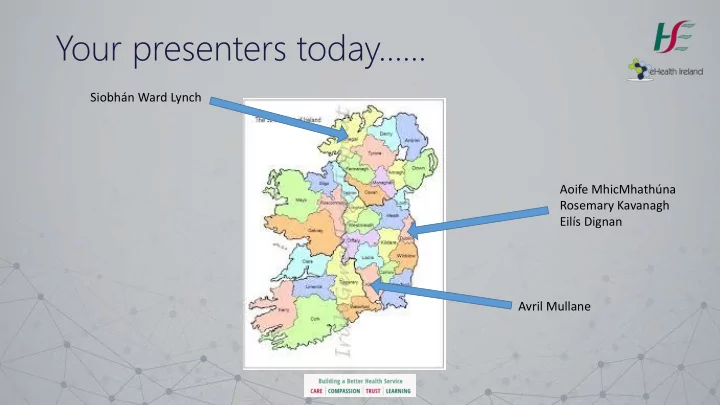
Siobhán Ward Lynch Aoife MhicMhathúna Rosemary Kavanagh Eilís Dignan Avril Mullane
Your presenters today Siobhn Ward Lynch Aoife MhicMhathna Rosemary - - PowerPoint PPT Presentation
Your presenters today Siobhn Ward Lynch Aoife MhicMhathna Rosemary Kavanagh Eils Dignan Avril Mullane Transition to video-enabled care March-October 2020 Access to information Focus on via shared Basic drive hardware +
Siobhán Ward Lynch Aoife MhicMhathúna Rosemary Kavanagh Eilís Dignan Avril Mullane
Access to information via shared drive Basic hardware + VPN Phone appointments
Video platforms: Attend Anywhere, Webex
Telehealth guidelines Policies and Procedures Regular staff meetings to review practice and policies Focus on well-being of staff
Eilís Dignan Senior Speech and Language Therapist Community Health East, Dublin South East
eilis.dignan@hse.ie
Person-centredness ….. recognises the uniqueness of every individual whether availing of or providing a service. This approach is possible through the development of relationships that enable everyone to achieve their personal best and flourish.
A National Framework for Person Centred Planning in Services for Persons with a Disability (HSE 2018)
What are your best hopes from us talking together? What difference would that make? What has been better since we last met? What have you been doing that has helped those changes to happen? What have you heard yourself say in our conversation that could end up being useful to you?
Our SLT team in Dublin South East use a solution focused approach. There is a lot of interest nationally. Since 2014 some of my colleagues and I have facilitated 24 workshops nationally to 565 SLTs in a variety of settings. These workshops take time – preparation time and travel time. So we have often had to turn down requests to facilitate workshops. COVID 19 is providing us with an opportunity to think differently about how we might promote solution focused practice. Here are two initiatives we are trying………
We contacted everyone who attended our solution focused workshops
forum. Using the cisco webex platform, we had our first hour-long meeting in July and our second in October. We plan another one for early 2021. This online platform allows SLTs from different work-settings and different parts of Ireland to discuss solution focused practice, to share ideas and to discuss cases.
I valued hearing perspectives from
It's great to have this
solution focused ideas I like the mix of cases and also the video yesterday was really helpful. I would love to hear from others who are successfully using solution- focused therapy in challenging circumstances One thing I have found since starting to ask the question regarding best hopes is that it has completely changed the SLT/school relationship in addition to the SLT/family relationship.
Within our SLT team in Dublin South East, I have experimented with the flipped classroom concept. I recorded two 10-minute webinars for colleagues to watch in their own time. I then followed up with a one- hour online discussion linked to the content of those videos. It was targeted particularly to colleagues new to solution focused practice although other colleagues found them useful. It went well and I plan to record some more short webinars based on the feedback that they gave me. I have been in contact with SLTs from 4 different teams who are interested in trying this type of workshop-delivery with their team.
teas/coffees /travel expenses
from different teams and different parts
webex which is a very useful feature
work from home and use my VPN
that onsite groups allow.
features of the platform and still be prepared for IT glitches to happen.
Rosemary Kavanagh Primary Care, Dublin South East Rosemary.kavanagh1@hse.ie
Trialled on 30th September Pre-registration required 30 minute timeslot Attend Anywhere Cisco Webex Links and guidelines emailed the day before 10 families attended
Conversation
What are your best hopes from
What concerns do you have? What are you already doing that’s helping
Observation
Observe the child in play with parent or alone – device choice mattered! Screen speech (age dependant) Finish conversation with Next
cases
Anonymous feedback questionnaire via Survey Monkey We asked…
and language therapist?
minutes)
Scale 1 (not at all) 2 3 4 5 (very well) Responses 1 person 1 person 2 people
Specific to video- enabled drop in
Child in his own environment Relaxed, able to play with his
Able to chat to the therapist without the child noticing Because parent was holding the phone she couldn’t interact with the child herself
General comments
✓Happy with format as an ‘initial consultation’ ✓Short waiting time ✓Clear information ✓Follow-up email
become another ‘business as usual’ part of our service
Avril Mullane CHO 5 Kilcreene Children’s Services, Kilkenny avril.mullane@hse.ie
adults with intellectual disability in Ireland in the early 1980s
young child (approx 6m to 2 years) to introduce them to Lámh and to set up a Lámh environment at home at an early age
Little Lámh workshop on the AA platform
teaching of 26 Lámh signs
we had issues with connection
lower numbers than if face to face
couldn't see them while they could see me
checking signs challenging
2 written feedback forms received - mixed feelings “I would still prefer to do workshop in person, you can see better and ask questions without laptop being slow and waiting for answer especially when all us mums had issues virtually it delays class” “even with a slight time delay due to my wifi I learned all signs and was signing with my baby that day. Cant wait to do the next one!” Both rated the workshop 5 (scale 1-5) as being very helpful
control
training and address the caseload needs
and go to plan b!
to face?
Siobhan Ward Lynch CHO 1, Donegal Aoife Mhic Mhathúna CHO 6, Dublin South East
to face appointments Placement Shortage
Evidence for Telehealth placements
COVID-19: A Practice Educator Guide to a Blended Approach’, IASLT 13th August 2020 IASLT
Donegal
and complex primary care clients.
throughout placement.
Anywhere calls with PE in Donegal clinic and parent with client at home. Dublin South East
weekly).
placement when room available.
Anywhere calls from a separate clinic
the time.
direct client work and case study discussions etc.
A new perspective on the client Sense of joint learning with technology Placement could continue, even when PE had to restrict their movements! Learning was very
feedback time allowed for efficient discussion. Developed student’s ability to be flexible Enhanced students’ focus on empowering parents
‘It encouraged me as a student to be flexible in my learning, and reminded me to constantly be ready to step it up and down within activities, and have to move between activities quickly if one wasn’t working.’ ‘you are teaching the parents the most simple ways for them to carry
with their child, encouraging compliance and promoting progress at home.’ ‘it reminded me to constantly remember the actual reasons behind carrying out the variety of therapy activities with the child, and keeping it as simple as possible.’ ‘It drew on my interpersonal skill development further as engagement through a screen with a young child can be different to the ‘in person’
form a rapport with the child to develop a relationship.’
Technology
Therapy activities
Learning
Be open with students that you are learning too. Gives a good example of ongoing professional development. Be familiar with the platform. Encourage the student to observe sessions and become familiar with the need for adapting resources Ensure the client / carer have consented to the student being present / managing the session. Allow additional time for pre-briefing and post-session reflection, particularly at the beginning of the placement when PE and students are not familiar with each other. Students can be a valuable resource to research and explore ways of using video enabled care.