
SLIDE 1
Young Adult Brain Development
Raphael Mizrahi, B.S.
Young Adult Brain Development Raphael Mizrahi, B.S. Lets start - - PowerPoint PPT Presentation
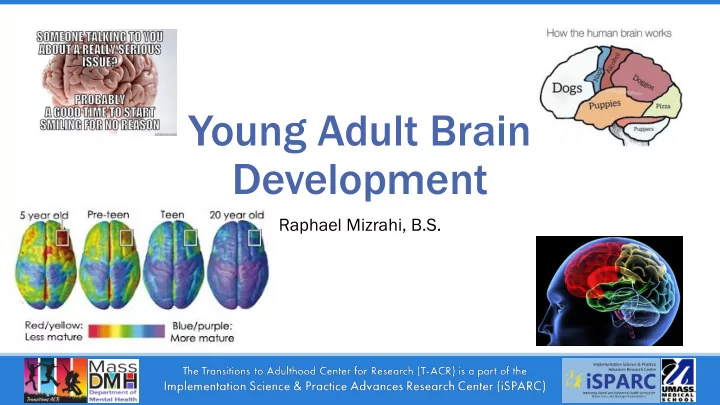
Young Adult Brain Development Raphael Mizrahi, B.S. Lets start with the basics Brain development almost finished by 20yo The only exceptionthe Pre-Frontal Cortex (PFC) The PFC finishes developing around 25yo (or later)
Raphael Mizrahi, B.S.
finished by 20yo
Pre-Frontal Cortex (PFC)
developing around 25yo (or later)
the executive functioning
knowledge
skills
Skills that allow a person to learn rules/norms
appropriate to shake someone’s hand when you meet them
you answer the phone
necessary to plan ahead, stay
goals via actions (everything needed to achieve short and long term goals)
recruits/develops more and more brain circuits to resist self-destructive behaviors
pre-frontal cortex, the easier it becomes to resist self-destructive behaviors
self- awareness and introspection, a typically developing 18 year old’s capacity to be aware
going to be premature
a young adult’s declining mental health and encourage them to seek help but since young adults start gaining independence, they may not have (or want) to rely on others to notice when they are struggling
hinders the brain’s ability regulate emotions appropriately
seem as if the brain’s on/off switch is stuck in the on position
as the brain’s primitive survival skills taking over the rest of the brain’s ability to function properly in an attempt to survive
rates of child victims in the nation with an estimated 23.3 child victims per 1000 children.
Baker, we were able to reduce this rate to an estimated 18.3 victims per 1000 children in 2017 (2017 Child Maltreatment Report from HHS)
burden of morbidity and mortality (Gee & Ford, 2015)
mutually reinforcing systems of housing, education, employment, earnings, benefits, credit, media, health care, and criminal justice (Bailey, et al. 2017)
post-traumatic stress symptoms and more school functioning problems
functioning problems
family violence exposure
Some things the literature has found: 1. Childhood Emotional Abuse causes dysregulation in the stress response system- children can present as hyporeactive or hyperreactive (Yates, 2007) 2. Young adults should be encouraged to exercise control over their actions and to practice self-organization if they have an abusive past (Panzer, 2008)
are both associated with diminished cognitive flexibility in adolescents (Spann et al. 2012)
trauma makes an adolescent more likely to engage in risk- taking behaviors (Kerig, 2019)
hyperarousal later in life → difficulty in regulating affect → difficulty in social settings because these individuals may be unable to differentiate, manage and/or express emotions, and control impulses. Cognition may also be compromised (less able to focus on consequences)
abuse their children
have access to school-based services
situations
(e.g., unsafe sex and substance abuse)
Carlos is a 19 y.o. M who has been in psychiatric hospitals since he was sectioned at 5 years old. Carlos has a history of childhood trauma including abuse and neglect Carlos also has a history of depression, anxiety, self- harm behaviors (non life- threatening) and struggles with low self-esteem Carlos received his GED last year by going to school while he was in treatment (this was a big deal for him- it wasn’t easy). Carlos’ family wants him to get a job but he’s not sure what he wants Carlos is now out of the hospital and is being referred to DMH for case management
How do we set Carlos up for Success?
YA’s figure out if/how they want to improve their lives
i. Journaling feelings ii. Meditation- Guided body scans are great for beginners- available on YouTube
lungs)
think about reaching out BEFORE they get into crisis mode. For some YA’s this is going to be especially hard but it’s not impossible!
i. Think about times of crisis/relapses by asking the client what happened when they relapsed, what did or didn’t help then?
breathing, pausing and counting to 10, removing/reducing stressful environments when possible
emotions! Research has shown that this may not only lead to increases in the quality of their social support, it may also make them more willing to use it when they are struggling (Rickwood et al. 2005)
that can take a lifetime to master, starting to practice this skill at a young age may give YA’s a head start in learning to respect and take care of themselves. This in turn, can help increase their self-efficacy and translate their desire to improve their lives into action
i. Teach basic calendaring skills ii. Teach basic memory skills (how to use mnemonics, rhyming, visual imagery and association to better remember information)
needs/desires, basic social norms, racial/ethnic/religious/cultural diversity)