SLIDE 1 You have a Ph.D. ... Who Cares?
The value of your Ph.D in industry and to the public
Brian W. Mulligan
7 Nov 2014 Graduate Student & Post-Doc Seminar, Universtiy of Texas at Austin
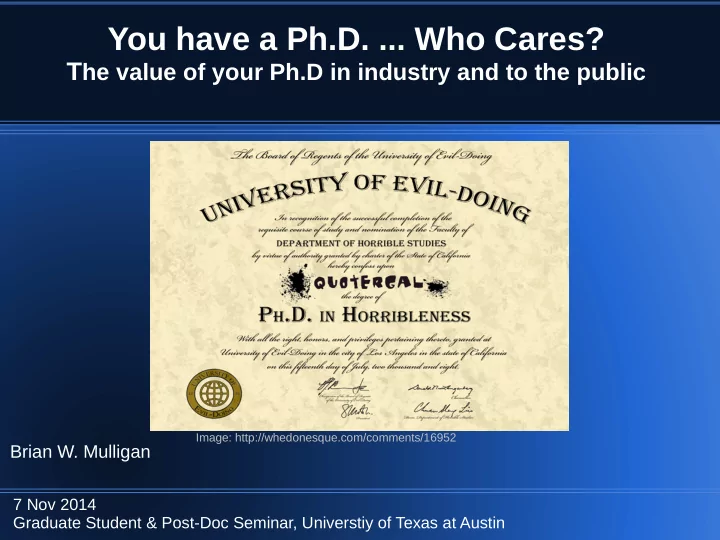
Image: http://whedonesque.com/comments/16952
SLIDE 2
This talk
Consider some benefits of having a Ph.D. Consider how the public views a Ph.D. Identify possible career paths in industry Caveat: this talk is largely anecdotal Caveat to caveat: so is industry
SLIDE 3
My Background
12+ years in software industry Friends from a variety of fields in industry with Ph.D (mostly Chem. Eng.)
Science Channel: How it's made - flight simulators
SLIDE 4
Why did I go back to grad school?
B.S. would have been sufficient
Better opportunities and higher pay Opportunity to do research
SLIDE 5
Why might industry care?
Proven research record
Understands not only how to pose a research question, but how to use a thorough process to answer it.
Proven ambition Willing to follow a project through to completion. Collaboration
Can clearly work with a group of people
SLIDE 6
Why?
The public values a Ph.D. even if they don't value academics. ~2% of the population have a Ph.D. (U.S.) ~12% have Masters or higher ~32% have a Bachelor's degree
All they really know is that you are “smart” and were in school a long time.
SLIDE 7
Public perception of Ph.D.
Just as the public has a poor understanding of science, they also have a poor understanding of what a Ph.D. means. Example: John Hagelin http://en.wikipedia.org/wiki/John_Hagelin Why is he given any credence? He has a Ph.D. so he “must” understand what he is talking about. Ethics isn't part of a Ph.D. Please don't use your Ph.D. to manipulate people.
SLIDE 8
Why Not?
Overeducated / overexperienced Only if you are demanding pay far higher than they can afford, or don't fit culturally within the company. Do your research on the specific company before applying. College grads don't know anything about industry when they start, either.
SLIDE 9
How does industry value a Ph.D.?
Depends on the size of and type of company Large manufacturing companies generally have a spe- cific structure in place Example: 3M High school: entry level (0) B.S.: Level 2 M.S.: Level 4 Ph.D.: Level 6 CEO: Level ~10 Large manufacturing companies will probably have more stringent requirements for type of degree and thesis topic
SLIDE 10
How does industry value a Ph.D.? Consulting
Consulting will vary significantly Technical consulting services may be better fit than business consulting, but also depends on your personal interests. Having a Ph.D. on staff looks good for them. The actual type of Ph.D. may matter very little.
SLIDE 11
Government bidding
Ex: Defense contractors in flight simulation When bidding for contracts, contractors list all of their employees. Each one is assigned points based on their experience and education. Someone with years of experience and no B.S. = 0 points Someone with B.S. and no experience = 2 points Someone with Ph.D. in a “related technical field” and no experience ~ 10 points
SLIDE 12
Small – mid size firms
Startups
May have more disposable income May want your Ph.D. expertise without caring about field / thesis Have an idea? Start your own!
Your business may have a competitive edge since you understand how to interpret data. Most small business owners have little to no background in business B.S. Business or MBA is really about understanding business data.
SLIDE 13 Small – mid size firms
Small and mid-size established firms
Most likely to overlook Ph.D. Most likely to actually read your cover letter even if you don't fit the listed job criteria. Networking helps a lot. May have more limited budget, but good growth potential and influence on the direction
SLIDE 14 What are some industries that may value an astronomy Ph.D.?
Financial
Mathematical skills Rachael? BTW: Rachael is Awesome.
“Big Data”
Talk to John J., Chris L. Working with and reducing large data sets.
SLIDE 15 What are some industries that may value an astronomy Ph.D.?
(Medical) imaging
Understanding how light propagates and
interacts with material, and how those interactions can affect the image.
Aerospace
Satellite control and design. Engineers do
much of this stuff, but they may want a scientist on staff – recall Gov't bidding process.
SLIDE 16 What are some industries that may value an astronomy Ph.D.?
High end computing (e.g. TACC)
Need people who understand how scientists
do their work.
May still get research time!
Latter point may be true of other industry jobs
as well!
Many large company jobs at Ph.D. level have
some sort of personal research time available. May be 10-15% of job time.
SLIDE 17 Statistics for UT
1960 1970 1980 1990 2000 2010 2020
0.1 0.2 0.3 0.4 0.5 0.6 0.7 0.8
Non academic alumni by year
%
Year Fraction of non-academic alumni (2014)
The academic climate may not be as bad as we think it is. Data courtesy Rachael Walker /UT Astronomy
SLIDE 18 Summary
Public values a Ph.D. even if they don't know
what it is.
Research ability, ambition, and collaboration
are proven skills.
Some segments of industry value any Ph.D.,
not necessarily just specific Ph.D.
~25% of UT graduates are currently in industry.
[Have list available – will make available soon]