World Drug Report 2019 Prerelease to Member States Vienna, 19 June - - PowerPoint PPT Presentation

world drug report 2019 pre release to member states
SMART_READER_LITE
LIVE PREVIEW

World Drug Report 2019 Prerelease to Member States Vienna, 19 June - - PowerPoint PPT Presentation

Placeholder WDR 2019 Picture World Drug Report 2019 Prerelease to Member States Vienna, 19 June 2019 DRUG USE Globa obal trends nds in t the e estimat mated numbe d number Global tre trends i in th the e esti timated of of pe


slide-1
SLIDE 1

Vienna, 19 June 2019
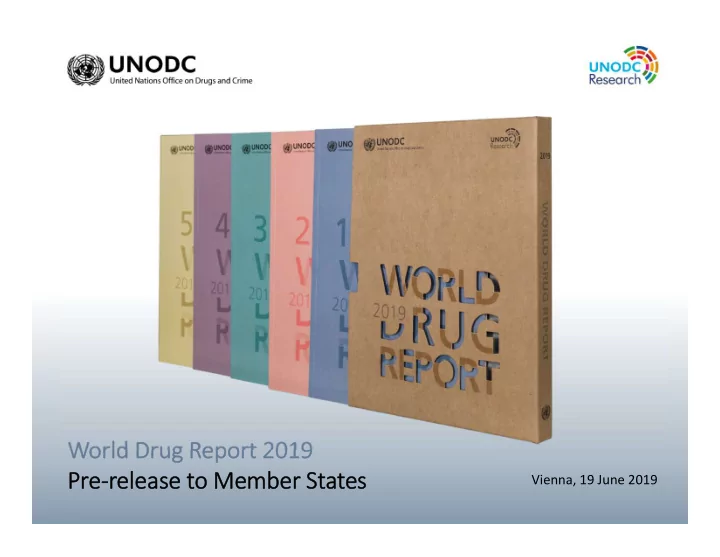
World Drug Report 2019 Pre‐release to Member States

Placeholder WDR 2019 Picture

slide-2
SLIDE 2

Globa

  • bal trends

nds in t the e estimat mated numbe d number

  • f
  • f pe

peopl

  • ple who us
  • use dr

drug ugs a and t nd thos hose with d drug u use d disorders, 2006– 2006–2017 2017 Global tre trends i in th the e esti timated pr prevalence of dr

  • f drug

ug us use a and dr nd drug ug us use disorders, 2006– 2006–2017 2017

DRUG USE

slide-3
SLIDE 3

2016 estimates 2017 estimates Annual opiate users 19.4 ml 29.2 ml Annual opioid users 34.3 ml 53.3 ml People with drug use disorder 30.5 ml 35 ml PWID 10.6 11.3 ml

Impact of new data in global estimates

slide-4
SLIDE 4

2016 estimates 2017 estimates South Asia Annual opiate users

  • 13 ml

Annual opioid users

  • 18.7 ml

Asia Annual opiate users 11.2 ml 21.7 ml Annual opioid users 13.6 ml 29.5 ml

Impact of new data in regional estimates

2016 estimates 2017 estimates Annual opiate users 2 ml 1.5 ml Annual opioid users 2.2 ml 6 ml

Asia Africa

slide-5
SLIDE 5

Long Long-term t m trends nds i in injecting dr drug ug us use a and H nd HIV a V among

  • ng pe

peopl

  • ple w

who ho inject dr drug ugs, s selected c coun

  • untries, v

various

  • us y

years covering ng the ov

  • verall

period 1992– 1992–2017 2017

slide-6
SLIDE 6

PRISONS AND DRUGS

slide-7
SLIDE 7

PRISONS AND DRUGS

slide-8
SLIDE 8

TRENDS IN PRODUCTION AND INTERCEPTIONS

Globa

  • bal opi
  • pium

m pr produc

  • duction
  • n and

nd globa

  • bal

qua quantities of he

  • f heroin a

and of nd of opi

  • piates (in

n

  • pium equivalents) s

seized, 1980– 1980– 2018 2018 Global al c cocaine m manufac acture an and global q quantit itie ies o

  • f cocain

ine seiz ized, 1980– 1980–2018 2018

slide-9
SLIDE 9

Internationally c controlled drugs i in 2018 2018 and identified n new p psychoactive s substances a at t the g global l level, 2005– 2005–2018 2018 (cumul umulat ative)

slide-10
SLIDE 10

Propor

  • portion
  • n of s
  • f surveyed I

Internet us users us using dr drug ugs (in n the pa past y year) w who ho pur purchased dr drug ugs ov

  • ver t

the da darkne net, 2014– 2014–2019, 2019, s selected regions a and subregions

slide-11
SLIDE 11

DARKNET: C Cons

  • nseque

quenc nces of s

  • f shut

hutdow down of

  • f

AlphaBay a and H Hansa m markets in 2017 2017 as r reported by d drug u users ( (internet s survey) i in J January 2018 2018

slide-12
SLIDE 12

OPIOIDS

slide-13
SLIDE 13
slide-14
SLIDE 14

Drug ug us use a among

  • ng s

seconda

  • ndary s

school hool s stude udents in Egypt, 2016 2016 In Nigeria, 4.6 ml persons non-medical annual users of opioids (mainly tramadol)

slide-15
SLIDE 15

Globa

  • bal qua

quantities of pha

  • f pharmaceutical opi
  • pioi
  • ids

ds s seized, , 2013– 2013–2017 2017

slide-16
SLIDE 16

Reported seizures, diversion and trafficking routes of tramadol (based on reported seizures), 2013-2017

The boundaries and names shown and the designations used on this map do not imply official endorsement or acceptance by the United Nations. Dashed lines represent undetermined boundaries The dotted line represents approximately the Line of Control in Jammu and Kashmir agreed upon by India and Pakistan. The final status of Jammu and Kashmir has not yet been agreed upon by the parties. The final boundary between the Republic of Sudan and the Republic of South Sudan has not yet been determined. A dispute exists between the Governments

  • f Argentina and the United Kingdom of Great Britain and Northern Ireland concerning sovereignty over the

Falkland Islands (Malvinas).

slide-17
SLIDE 17

Opioid use in Chile

Non-

  • n-me

medi dical us use of

  • f pha

pharmaceutical

  • pioids, C

Chile, 2002– 2002–2016 2016 Non-

  • n-me

medi dical us use of

  • f opi
  • pioi
  • ids

ds b by sex a and nd age g group, C

  • up, Chile,

, 2010 a 2010 and 2016 2016

slide-18
SLIDE 18

Opioid overdose deaths in Sweden, 2014-2017

slide-19
SLIDE 19

Identifi fied ne new synthe hetic opi

  • pioi
  • id

d receptoragonists, 2009– 2009–2017 2017 Globa

  • bal qua

quantities of f

  • f fentanyl

and nd its a analog

  • gue

ues s seized, b , by region, 2010– 2010–2017 2017 Just 4 countries reported seizures in 2013, 12 countries in 2016 and 16 countries in 2017.

slide-20
SLIDE 20

Trends in in a availa ilabilit ility of o

  • pioid a

analgesics f for r consumption, b by r region, 1994– 1994–2016 016

slide-21
SLIDE 21

Diversion or illicit manufacturing of synthetic opioids for the non medical use market?

In North America, diversion of Oxycodone Fentanyl illicitly manufactured Tramadol manufactured and/or packaged for non medical market Codeine?

slide-22
SLIDE 22

Opium poppy m poppy c cultivat ation a

  • n and pr

nd produc

  • duction of opi
  • n of opium,

um, 1998– 1998–2018* 2018*

slide-23
SLIDE 23

Signif ific icant in individual h l heroin in s seiz izures January 2013– 2013–April 2019 2019

Source: UNODC and Paris Pact, Drugs Monitoring Platform.

slide-24
SLIDE 24

Op Opiate u use i in Western a and C Central E Europe, 2003– 2003–2017 017

slide-25
SLIDE 25

Ranki nking of

  • f sedat

datives a and nd tranqui nquilliz llizers in in o

  • rder

r of p prevalence (based on n national q qualitative information), 2017 2017

Source: UNODC.

The boundaries and names shown and the designations used on this map do not imply official endorsement or acceptance by the United Nations. Dotted line represents approximately the Line of Control in Jammu and Kashmir agreed upon by India and Pakistan. The final status of Jammu and Kashmir has not yet been agreed upon by the

  • parties. A dispute exists between the Governments of Argentina and the United Kingdom of Great Britain and Northern Ireland concerning sovereignty over the Falkland Islands (Malvinas).
slide-26
SLIDE 26

Globa

  • bal c

cocaine ma manuf nufacture and nd global q quantities of c cocaine s seized, 2007– 2007–2017 017

slide-27
SLIDE 27

Main c cocaine t trafficking r routes a as d described by reported s seizures, 2013– 2013–2017 2017

Sources: UNODC. * A darker shade indicates a larger amount of cocaine being seized with the country as transit/destination. The size of the route is based on the total amount seized on that route, according to the information on trafficking routes provided by Member States in the annual report questionnaire, individual drug seizures and other official documents, over the period 2013–2017. The routes are determined on the basis of reported country of departure/transit and destination in these sources. As such, they need to be considered as broadly indicative of existing trafficking routes while several secondary routes may not be reflected. Route arrows represent the direction of trafficking: origins of the arrows indicate either the area of departure or the one of last provenance, end points of arrows indicate either the area of consumption or the one of next destination of trafficking. Therefore, the trafficking origin does not reflect the country in which the substance was produced. The main countries mentioned as transit or destination were identified on the basis of both the number of times they were identified by other Member States as departure/transit or destination of seizures, and the annual average amount that these seizures represent during the period 2013–2017. For more details on the criteria used, please see the Methodology section of this document. The boundaries and names shown and the designations used on this map do not imply official endorsement or acceptance by the United Nations.

slide-28
SLIDE 28

Benz nzoy

  • ylecgoni
  • nine

ne ( (coc

  • caine

ne me metabol bolite) found i

  • und in w

wastewat ater in 7 78 c cities i in Europe, 2011– 2011–2018 2018

slide-29
SLIDE 29

Cocaine a and “ nd “ crack” c cocaine us use a among

  • ng s

seconda

  • ndary

school hool s stude udents in E Egypt a and Mor nd Morocco, by by s sex, 2016 2016

slide-30
SLIDE 30

Globa

  • bal qua

quantity of a

  • f amphe

phetami mine ne-type stimul ulants seized, 1998– 1998–2017 017

slide-31
SLIDE 31

Distribut bution

  • n by s

substanc nce of t

  • f the av

average annua nnual qua quantity of

  • f

amphetamine-type s stimulants seized, b by s subregion, 2013– 2013–2017 2017

slide-32
SLIDE 32

Quantity of

  • f me

methamphe phetami mine ne s seized in C China a and S nd Sout

  • uth-

h-East Asia, 2013– 2013–2018 2018

slide-33
SLIDE 33

Repor ported s d seizur ures a and nd traffi fficking r rout

  • utes of
  • f “

captagon”

  • n”

tablets, 2013– 2013–2017 2017

slide-34
SLIDE 34

Quantities of

  • f amphe

phetami mine nes f found

  • und in wastewat

ater, , in 80 c 80 cities i in E Europe, 2011– 2011–2018 2018

slide-35
SLIDE 35

Non-

  • n-me

medi dical us use of s

  • f stimul

ulants among

  • ng s

seconda

  • ndary

school hool s stude udents in 1 13 c coun

  • untries i

in t the C Caribbe bbean, , 2016 2016

Source: Inter-American Drug Abuse Control Commission A Report on Students’ Drug use in 13 Caribbean Countries: 2016

slide-36
SLIDE 36

Quantities of recently controlled stimulant NPS seized (mephedrone and MDPV), 2010–2017

Source: UNODC, responses to the annual report questionnaire.

slide-37
SLIDE 37

Cannabis seizures / trafficking

Globa

  • bal qua

quantities of ma

  • f main c

canna nnabi bis pr produc

  • ducts

seized, 1998– 1998–2017 017

slide-38
SLIDE 38

Global trends in the quantity of cannabis herb seized and trends in cannabis trafficking, 2007-2017

Source: UNODC, responses to the annual report questionnaire

slide-39
SLIDE 39

Global trends in number of cannabis users and qualitative information on trends in cannabis use,a 1998–2017

Source: UNODC, responses to the annual report questionnaire

a The index is based on information of, on average, 74 countries per year over the period 2007‒2017. Two points were given for “large increase”, 1 point for “some increase”, 0 for “stable”, -1 for “some decrease” and -2 for “large decrease”. For reference, if all countries had reported each year “some increase” in cannabis use over the period 2007-2017, the cannabis use perception index would have reached 811 points in 2017. For details on the perception index calculations, refer to the methodological annex, available in the online version of the present report.

slide-40
SLIDE 40
slide-41
SLIDE 41

Trends in the number of users aged 18 and older and estimated quantity (tons) of cannabis flower consumed in Colorado, 2014–2017

Sources: Adam Orens and others, “Market size and demand for marijuana in Colorado: 2017 market update” , prepared for the Colorado Department of Revenue (Denver, Colorado, Marijuana Policy Group, August 2018).; and United States, Substance Abuse and Mental Health Services Administration, Center for Behavioral Health Statistics and Quality, National survey on drug use and health – state level estimates of cannabis users. Note: The United States Substance Abuse and Mental Health Services Administration reports prevalence among those aged 12 or older or 18 years or older; in this case the latter age category has been used a proxy of number of cannabis users 21 years and older.

slide-42
SLIDE 42

Global quantities of substances with hallucinogenic properties seized, expressed in kilogram equivalents, 1998–2017

Source: UNODC, responses to the annual report questionnaire

slide-43
SLIDE 43

Distribution of quantities seized in doses

Source: UNODC, responses to the annual report questionnaire

slide-44
SLIDE 44

Trend in global quantities of substances with hallucinogenic properties seized, expressed in doses, 1998–2017

Source: UNODC, responses to the annual report questionnaire