World Bank Sanctions Program: Compliance and Enforcement - - PowerPoint PPT Presentation

world bank sanctions program compliance and enforcement
SMART_READER_LITE
LIVE PREVIEW

World Bank Sanctions Program: Compliance and Enforcement - - PowerPoint PPT Presentation

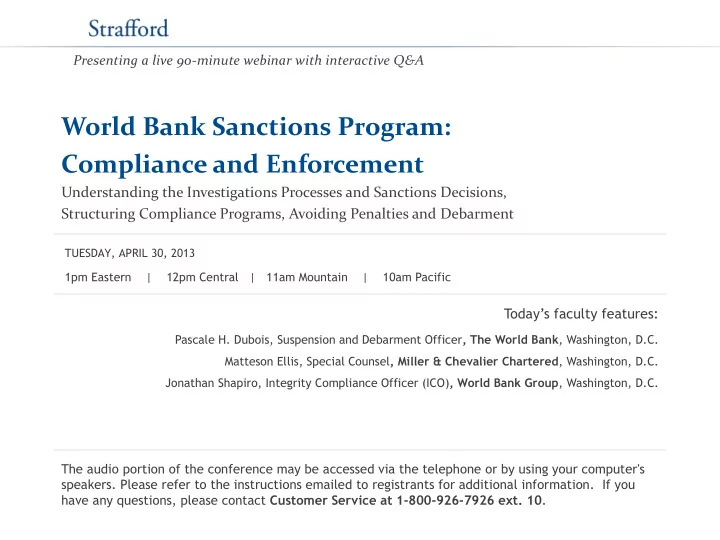
Presenting a live 90-minute webinar with interactive Q&A World Bank Sanctions Program: Compliance and Enforcement Understanding the Investigations Processes and Sanctions Decisions, Structuring Compliance Programs, Avoiding Penalties and


slide-1
SLIDE 1

World Bank Sanctions Program: Compliance and Enforcement

Understanding the Investigations Processes and Sanctions Decisions, Structuring Compliance Programs, Avoiding Penalties and Debarment

Today’s faculty features:

1pm Eastern | 12pm Central | 11am Mountain | 10am Pacific

The audio portion of the conference may be accessed via the telephone or by using your computer's

  • speakers. Please refer to the instructions emailed to registrants for additional information. If you

have any questions, please contact Customer Service at 1-800-926-7926 ext. 10.

TUESDAY, APRIL 30, 2013

Presenting a live 90-minute webinar with interactive Q&A

Pascale H. Dubois, Suspension and Debarment Officer, The World Bank, Washington, D.C. Matteson Ellis, Special Counsel, Miller & Chevalier Chartered, Washington, D.C. Jonathan Shapiro, Integrity Compliance Officer (ICO), World Bank Group, Washington, D.C.

slide-2
SLIDE 2

Sound Quality If you are listening via your computer speakers, please note that the quality of your sound will vary depending on the speed and quality of your internet connection. If the sound quality is not satisfactory and you are listening via your computer speakers, you may listen via the phone: dial 1-866-320-7825 and enter your PIN when prompted. Otherwise, please send us a chat or e-mail sound@straffordpub.com immediately so we can address the problem. If you dialed in and have any difficulties during the call, press *0 for assistance. Viewing Quality To maximize your screen, press the F11 key on your keyboard. To exit full screen, press the F11 key again.

slide-3
SLIDE 3

For CLE purposes, please let us know how many people are listening at your location by completing each of the following steps:

  • In the chat box, type (1) your company name and (2) the number of

attendees at your location

  • Click the word balloon button to send

FOR LIVE EVENT ONLY

slide-4
SLIDE 4

World Bank Sanctions Program: Compliance & Enforcement April 30, 2013

Matteson Ellis Special Counsel Miller Chevalier Pascale Hélène Dubois

Suspension and Debarment Officer Office of Suspension and Debarment (OSD)

Jonathan Shapiro Integrity Compliance Officer Integrity Vice Presidency

slide-5
SLIDE 5

The World Bank Group

  • Multilateral Development Bank (MDB) – 188 countries
  • Financial & technical assistance to developing countries
  • FY 12: $52.6 billion in credits, loans, grants, guarantees

5

slide-6
SLIDE 6

Why does the World Bank care?

slide-7
SLIDE 7

7

slide-8
SLIDE 8

8

slide-9
SLIDE 9

Preventing Fraud & Corruption Through Administrative Sanctions

9

slide-10
SLIDE 10

10

World Bank sanctions and system highly influential internationally More sanctions systems and use

  • f suspensions

and debarments Changes coming in procurement and country systems

Changing Landscape

slide-11
SLIDE 11

World Bank Enforcement Making an Impact

11

Since 1999…

 610 firms and individuals publicly debarred  218 firms and individuals temporarily suspended  At least 30 criminal convictions based on referrals

slide-12
SLIDE 12

Sanctions Process

INT:

Investigations

OSD: Temporary Suspension & Adjudication (if no appeal) SANCTIONS BOARD:

Adjudication (if appeal)

ICO (within INT): Compliance

12

39% 61%

slide-13
SLIDE 13

13

Evaluates Accusation and Evidence Temporarily Suspends Recommends Sanction Reviews Explanation Sanctions (if no appeal)

Suspension & Debarment Officer

slide-14
SLIDE 14

The Sanctions Phase: The World Bank’s Two-Tier Sanctions System

  • Conducts investigation
  • Investigates allegations of fraud, corruption,

collusion, coercion, and obstruction

  • Prepares and submits a Statement of

Accusations and Evidence (SAE) to OSD

  • Evaluates evidence presented by INT
  • Issues Notice of Sanctions Proceedings to respondent
  • Temporarily suspends respondent
  • Recommends a sanction (becomes effective if respondent

does not contest)

  • 61% of cases are resolved at this level
  • Comprised of 4 external members and 3 Bank staff
  • Reviews case ‘de novo’
  • May hold a hearing with parties and witnesses
  • Imposes sanctions (not bound by SDO’s

recommendation)

  • Decisions are final and not appealable
  • 39% of cases are resolved at this level

Sanctions Board

Suspension and Debarment Officer Integrity Vice Presidency Adjudicative Investigative

slide-15
SLIDE 15

Sanctionable Practices

Fraud Corruption Collusion Coercion Obstruction

Consultant and Procurement Guidelines; Sanctions Procedures; Anti-Corruption Guidelines for Borrowing Countries

15

slide-16
SLIDE 16

Range of Sanctions

  • Debarment with Conditional Release

(‘baseline’ or default)

  • Indefinite or Fixed-Term Debarment

(without conditions)

  • Conditional Non-Debarment
  • Letter of Reprimand
  • Restitution or other Remedy

16

slide-17
SLIDE 17

Impact of Sanctions (Part I)

  • Public
  • Published
  • Ineligible
  • Cross-debarred
  • May affect affiliates
  • Conditional release

17

slide-18
SLIDE 18

Sanctions are Public

www.worldbank.org/debarr

slide-19
SLIDE 19

Sanctions are Published

slide-20
SLIDE 20

Sanctions are Published

Sanctions Board Digest

20

  • Law Digest in December

2011 - key data on Sanctions Board role, caseload and case law

  • Contains over 250 points
  • f legal principle and

findings

  • Decisions Released May

2012 - will be updated to reflect new decisions

slide-21
SLIDE 21

Impact of Sanctions (Part II)

  • Public
  • Published
  • Ineligible
  • Cross-debarred
  • May affect affiliates
  • Conditional release

21

slide-22
SLIDE 22

MDB Cross-Debarment

22

  • In March 2010 the WBG and four other MDBs

signed an agreement for the mutual enforcement of debarment decisions

  • Covers debarments that are public, over one

year

  • Harmonized definitions of sanctionable practices
  • Cross-debarment automatic, subject to ‘opt out’

in exceptional cases on legal/policy grounds

slide-23
SLIDE 23

23

Three Choices

VDP SANCTIONS SETTLEMENTS

slide-24
SLIDE 24

The Voluntary Disclosure Program

Allows participating firms to

  • Voluntarily disclose information about their misconduct in

Bank-financed or supported projects or contracts

in exchange for

  • No debarment
  • Confidentiality

provided that they

  • Cease misconduct
  • Voluntarily and fully disclose information about Bank-

related Misconduct for past 5 years

  • Conduct an internal investigation
  • Implement a Compliance Program
  • Engage a Compliance Monitor (3 years)
  • Pay most costs associated with participation
  • r face a 10-year debarment

24

slide-25
SLIDE 25

The VDP Effect

Firms Enter VDP Better Informed Investigations More Bank Sanctions Increased Risk for Non-VDP Firms

25

slide-26
SLIDE 26

www.worldbank.org/vdp

26

slide-27
SLIDE 27

27

Three Choices

VDP SANCTIONS SETTLEMENTS

slide-28
SLIDE 28

Settlements

28

slide-29
SLIDE 29

Sanctions and Compliance

29

slide-30
SLIDE 30

Thank you!

30

  • 1. Prohibition of Misconduct
  • 2. Responsibility (leadership,

individual, compliance function)

  • 3. Program Initiation, Risk

Assessment, and Reviews

  • 4. Internal Policies (vetting

employees, conflict of interest, gifts, hospitality, entertainment, travel, political contributions, charity, facilitation payments, recordkeeping, and fraudulent, collusive and coercive practices)

  • 5. Business Partners (due diligence,

informing partner of integrity commitment, reciprocal commitment, proper documentation, appropriate remuneration, monitoring/oversight)

  • 6. Internal Controls ( financial,

contractual obligations, decision-making processes)

  • 7. Training &

Communication

  • 8. Incentives (positive, disciplinary

measures)

  • 9. Reporting (duty to report, advice,

whistle blowing/hotlines, periodic certification)

  • 10. Remediate Misconduct

(investigating procedures, respond)

  • 11. Collective Action

World Bank Group Integrity Compliance Guidelines*

* Guidelines continually updated to reflect global best practice.

slide-31
SLIDE 31

Baseline Sanction

31

Board endorsed in September 2010 START

DEBARMENT PERIOD (usually 3 years) END

Free to re-engage in WBG business

Debarment continues until conditions met

SDO or Sanctions Board Issue Decision

slide-32
SLIDE 32

Condition: Adopt an “Integrity Compliance Program”

32

F&C Policies & Practices

Prevent Detect Investigate Remediate

slide-33
SLIDE 33

Maintain same ethics commitment—but adapt entity-specific measures

33

Big Company Adopt systemic measures SME Adopt less formalized measures

WBG Guidelines

Location? Industry? Size? Risk?

World Bank Group Integrity Compliance Guidelines: http://siteresources.worldbank.org/INTDOII/Resources/IntegrityComplianceGuidelines_2_1_11 web.pdf

slide-34
SLIDE 34

The Conditional Release Process

34

SDO or Sanctions Board Issue Decision Notify of Condition & Release Process Evaluate Program & Provide Guidance Monitor Program Implemen- tation Release Decision:

WBG Eligible

  • r

Application Rejected; may appeal to Sanctions Board

Office of the Integrity Compliance Officer

slide-35
SLIDE 35

For more information:

www.worldbank.org/integrity

35

slide-36
SLIDE 36

For more information:

www.worldbank.org/sanctions

36

slide-37
SLIDE 37

For more information:

37

www.worldbank.org/vdp

slide-38
SLIDE 38
  • Matteson Ellis, Miller Chevalier:

mellis@milchev.com

  • Pascale Dubois, World Bank:

pdubois@worldbank.org

  • Jonathan Shapiro, World Bank:

jshapiro1@worldbank.org

38

Questions?

slide-39
SLIDE 39

WORLD BANK SANCTIONS PROGRAM

The Practitioner’s Perspective

Matteson Ellis Miller & Chevalier

Strafford Publications April 30, 2013

slide-40
SLIDE 40

40

Common Corruption and Fraud Activity in World Bank-Financed Projects

Common activity indicating corruption:

  • Procurement officials require bidders to hire “consultants” who provide no legitimate services.
  • Companies disguise direct payments to procurement officials as legitimate payments.
  • Companies hire “experts” who previously worked for the procurement authority to assist with bid

preparation.

  • Authorities narrowly design project specifications to benefit one company.
  • Authorities include complicated technical features in the tender to give themselves discretion in the

selection process.

  • Companies gain access to confidential information about tender specifications or competitors’ bid prices.
  • Procurement authorities fully vet and disqualify one bid while giving a less rigorous review to another.
  • Companies “entertain” procurement officials to win favor and develop complicated schemes to hide bribe

payments.

Common activity indicating fraud:

  • Bidders misrepresent their qualifications in bid documents.
  • Bidders submit false performance certificates or other documentation to support their bids.
  • Individuals set up fictitious companies to obtain contracts.
  • Companies submit false invoices.
slide-41
SLIDE 41

41

The Respondent’s Considerations

Internal Investigations:

  • Should address more than just corrupt acts (investigation plans should aim to identify fraud,

collusion, and coercion as well).

  • Transactions related to MDB-financed projects should be delineated from other transactions.
  • Heavy emphasis / focus on public procurement processes.

Voluntary Disclosure and Cooperation:

  • Participants in Voluntary Disclosure Program commit to (1) not engage in misconduct in the future;

(2) disclose to the Bank the results of an investigation; and (3) implement a robust internal compliance program.

  • In return, participants avoid debarment for disclosed past misconduct, keep their identities

confidential, and may continue to compete for Bank-supported projects.

Negotiated Resolution Agreement:

  • Bank demands (1) acknowledgement of wrongdoing; (2) adoption of compliance measures; (3)

cooperation.

  • Can occur at any stage of investigation.
  • Might include monetary penalty or debarment or both.
  • Avoids costs and uncertainties associated with sanctions proceedings.
slide-42
SLIDE 42

42

The Respondent’s Considerations

INT’s Investigative Powers:

  • Cannot compel production of documents, interviews of witnesses, or search of premises.
  • But might have contractual audit rights.
  • INT looks for ways to leverage its resources.
  • Limited powers offset by lower standard of proof.

Coordination with National Authorities:

  • Referrals to national authorities (even when no sanction is imposed).
  • Sharing of evidence (in both directions).
  • Encouraging national authorities to act (SNC Lavalin).
  • Joint operations.
  • Conditioning support.
  • Relevant because international bribery schemes can touch multiple countries.
  • National authorities’ reasons for acting on World Bank evidence can be diverse.

Broad Impacts of Debarment and Cross-Debarment:

  • Reputation of company.
  • Due diligence / red flag effects.
slide-43
SLIDE 43

43

Guidance for Practitioners

Relationship Between World Bank Rules and National Laws:

  • National laws do not directly apply.
  • National laws can be relevant and persuasive.

Compliance Programs Should Address All Sanctionable Practices

  • Not only corruption risk, but fraud and collusion as well.
  • Implications for policies, internal controls, training, etc.

Helpful Resources:

  • World Bank Sanctions Board Law Digest.
  • Sanctions Board Decisions now published on-line.
  • Sanctions procedures, procurement guidelines, and other key

documents available on-line.

slide-44
SLIDE 44

44

THANK YOU

Matteson Ellis Special Counsel Miller & Chevalier Chartered mellis@milchev.com 202.626.1477