Work Students: A Transnational Critical Reflection Dr Nonie - - PowerPoint PPT Presentation

work students a transnational
SMART_READER_LITE
LIVE PREVIEW

Work Students: A Transnational Critical Reflection Dr Nonie - - PowerPoint PPT Presentation

T eaching Research Methods to Social Work Students: A Transnational Critical Reflection Dr Nonie Harris, Professor Ilango Ponnuswami and Dr Desley Harvey Research assistant Ms Aileen Sorohan developing the online Teaching and Doing Research


slide-1
SLIDE 1

T eaching Research Methods to Social Work Students: A Transnational Critical Reflection

Dr Nonie Harris, Professor Ilango Ponnuswami and Dr Desley Harvey

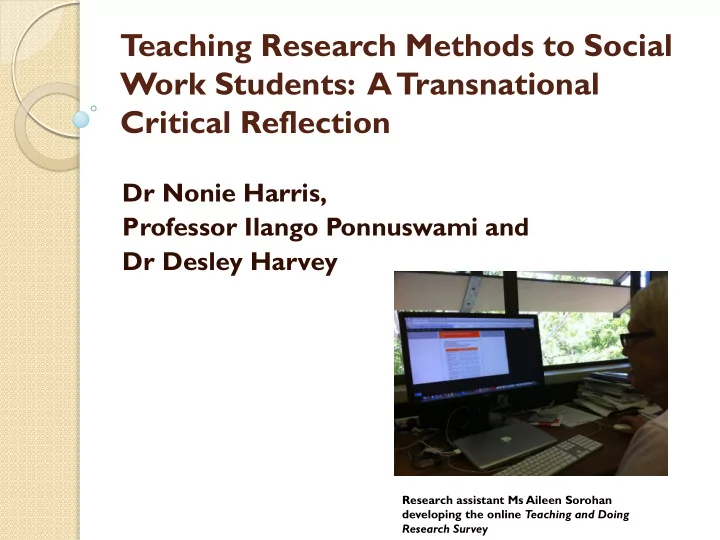
Research assistant Ms Aileen Sorohan developing the online Teaching and Doing Research Survey

slide-2
SLIDE 2

T

  • day’s Presentation

 Background and Context  Why is this T

  • pic Important?

 T

eaching Research Methods – Issues and Dilemmas

 What Does the Literature Say?  The Study  What did we Learn?

slide-3
SLIDE 3

Background and Context

 Professor Ilango was a Cairns

Institute Visiting Scholar at James Cook University (JCU) in 2012

 Dr Harris has taught research

methods at JCU for 20 years

 They shared a mutual interest in

teaching research methods to social work students

 Recognised that many challenges

and dilemmas were relevant in both the Indian and Australian contexts and that a meaningful cross-national collaboration would potentially enrich the research learning experience of students in both locations

Sue McGinty, centre, Professor and Acting Director, The Cairns Institute, James Cook University, Townsville, Australia, having a word with P.Illango, Professor and Head, Department of Social Work, Bharathidasan University Photo courtesy of: http://www.thehindu.com/news/cities/Tiruchirapalli/mental-health-of- children-ensures-overall-wellbeing-of-society/article4322820.ece

slide-4
SLIDE 4

Further, Dr Desley Harvey, Senior Research Fellow with Queensland Health, recently contacted Dr Harris to discuss the possibilities of a collaboration around student perceptions of research

Dr Harvey was interested in obtaining information about student understanding of research, new practitioner readiness for research and student perceptions of the role of research in practice.

Valued the opportunity this research presents for greater collaboration between sectors (health and education as an example) as a way of building an evidence base for social work.

Practitioner Research Capacity: A Survey of Social Workers in Northern Queensland (2013) By Desley Harvey, David Plummer, Alison Pighills & Tilley Pain

slide-5
SLIDE 5

Why is this T

  • pic Important?*

 The real purpose of research in social work as an evidence-

base for policy and practice decisions begins to dawn in the minds of social workers after some experience in the field and after acquiring a broader and more inclusive world-view and understanding of the inter-connectedness of everything we do with some form of research activity, however rudimentary that might be.

 Unlike teaching social work methods, teaching of research

methodology to social work students has been rather difficult and challenging because of the apprehensions in the minds of both the teacher and the taught.

 * Reflections from Professor Ilango

slide-6
SLIDE 6

Social Work Practice Standards

 The Australian Association of Social

Workers (AASW) Practice Standards particularly address the need for research: Research is key to the continued develo pment of the theory and knowledge base

  • f social work practice. Research is a key

area of social work practice and is one of the six objectives included in the AASW Practice Standards for Social Workers which identifies that “client needs,

  • rganizational goals and social policy are

addressed through the application of the social worker’s values, knowledge and skills in the research process” (AASW , 2010, p. 6).

slide-7
SLIDE 7

T eaching Research Methods – Issues and Dilemmas

 A pronounced separation of teaching and research in

Indian Higher Education. Cutting edge and world class research does take place in Indian research institutions as well as the central universities and is supported centrally by the government. It also happens in the university departments of some state universities (where graduate students have historically been taught), but the research process is far removed from the teaching of undergraduates…

 In Australia research methods are a mandatory part

  • f the social work curriculum and many students approach

their research subjects with trepidation and reluctance (Fook, 2003; Harder, 2012). Harvey, Plummer, Pighills and Pain (2013) in their recent study supported this assertion and “identified research anxiety and research avoidance as significant challenges for research capacity building”.

slide-8
SLIDE 8

What Does the Literature Say?

Research and Social Work

  • “Practitioner research is potentially the most useful and relevant source of new

knowledge for social work and service innovations” (Harvey, Plummer, Pighills and Pain, 2013, p. 2).

  • Respondents in Beddoe’s (2011) qualitative study indicated that they saw the importance
  • f research informed practice, but they lacked confidence in undertaking research

themselves – vital to the ongoing professionalisation of social work.

  • Srinivasa Murthy (2011) specifically acknowledges the contribution of research to our

understanding of mental disorders and notes that: ‘This new knowledge has continuously supported the development of mental health programs’ (p. 104).

  • In the health sector – “Given the rise of evidence based practice, there are potentially

serious implications for social work in terms of how it positions itself as a contributor to new knowledge within health” (Brough, Wagner & Farrell, 2013, p. 1).

Measuring Good T eaching Practice (literature examples)

  • Measuring Student's Perceptions of Teaching: Dimensions of Evaluation (1986), Burdsell and

Bardo;

  • Conceptualising and measuring student engagement through the Australasian Survey of

Student Engagement (AUSSE): a critique (2011) Hagel, Carr & Devlin;

  • The development and validation of a knowledge, attitude and behaviour questionnaire to

assess undergraduate evidence-based practice teaching and learning (2003) Johnston, Leung, Fielding, Tin & Ho

  • Seven Principles for Good Practice in Undergraduate Education

By Chickering and Gamson

slide-9
SLIDE 9

The Study

 Title: T

eaching Research Methods to Social Work Students

 Aims:

  • To gather data from social work students in Australia

and India in order to seek students' reflections on the experience of studying research, how prepared they feel they are to be practitioner researchers.

  • To ascertain students’ views on how the teaching

process may be improved.

  • To use the research data to inform the development
  • f strategies for improving the quality of research

methodology teaching and learning, and enhancing readiness for practice based research.

slide-10
SLIDE 10

 Methodology  This research project used a

quantitative methodology and data was gathered by

  • questionnaire. The questionnaire

was created online* using SurveyGizmo and included questions on social work students’ experiences of studying research methods, readiness to use research in practice and their recommendations on how the teaching of research methods could be improved. * McGinty, Koo & Saeidi (2010) A Cross-Country

Study on Research Student’s Perceptions of the Role of Supervision and Cultural Knowledge in Thesis Development

Cairns - Townsville - Brisbane – Singapore CRICOS Provider Code 00117J

INFORMATION SHEET PROJECT TITLE: Teaching Social Work Research You are invited to take part in a research project that seeks social work students' reflections on the experience of studying research within their degree, how prepared they feel they are to be practitioner researchers and, also, to ascertain their views on how the research teaching process may be improved. The study is being conducted by Dr Nonie Harris, Professor Ilango Ponnuswami and Dr Desley Harvey, and will contribute to research methodology teaching and learning in the Bachelor of Social Work and Master of Social Work at James Cook University and Bharathidasan University. If you agree to be involved in the study, you will be invited to complete an online questionnaire. The questionnaire that you may complete, asks you about your experiences of studying research methods, readiness to use research in practice and your recommendations on how the teaching of research methods could be improved. The questionnaire should only take 15 minutes to complete. Taking part in this study is completely voluntary and you can stop taking part in the study at any time without explanation

  • r prejudice. Further you can choose not to answer specific questions within the questionnaire itself.

Your responses will be strictly confidential. No individual can be identified from the questionnaire that they have

  • completed. The data from the study will be used in research publications and conference presentations. You will not be

identified in any way in these publications. If you consent to participating in this survey please click the button below labelled ‘I agree to continue’. If you do not consent to participate in this study please click the button below labelled ‘I wish to exit’. If you have any questions about the study, please contact Dr Nonie Harris (Australia) or Professor Ilango Ponnuswami (India). Principal Investigator: Dr Nonie Harris School of Arts and Social Sciences James Cook University, Australia Phone: 4781 4898 Email: Nonie.Harris@jcu.edu.au Co-Investigator Details: Professor Ilango Ponnuswami Department of Social Work, Bharathidasan University, Tamil Nadu, India Phone: 91-431-21062 Email: pon.ilango@gmail.com Co-Investigator Details: Dr Desley Harvey Senior Research Fellow, Health Practitioner Capacity, Queensland Health, Cairns, Australia Email: Desley_Harvey@health.qld.gov.au

If you have any concerns regarding the ethical conduct of the study, please contact: Human Ethics, Research Office James Cook University, Townsville, Qld, 4811 Phone: (07) 4781 5011 (ethics@jcu.edu.au)
slide-11
SLIDE 11

THE SURVEY

Teaching and Doing Research

slide-12
SLIDE 12

What did we Learn?

 Population: 80 final

year BSW and MSW students from JCU, Australia

 Sample: 15 (18.75%) as

at 1/11/13

 Gender: Female 13,

Male 2

 Age Range: 22-56,

Mean = 31.46

 Study Mode: External

53%, Internal 47%

 Studied more than one

research subject: 96%

slide-13
SLIDE 13

Research Confidence Level

 Highest Confidence

Levels:

  • Finding relevant literature
  • Writing a research proposal
  • Formulating a research

question

  • Use of qualitative methods
  • Writing a research report
slide-14
SLIDE 14

Research Confidence Level

 Lowest Confidence

Levels:

  • Applying for research

funding

  • Use of quantitative

methods

  • Interpreting quantitative

results

slide-15
SLIDE 15

Tell us how you believe you will be able to use the research skills that you have learned during your time at university when you are in professional practice

 Quotes from students:

  • Gathering information on cases and presenting it to colleagues.
  • Identify gaps in service provision.
  • I was asked by the CEO of my organisation to analyse data and put

together graphs based on the data, and I was able to do so!

  • A baseline ability to develop.
  • In all fields of social work research is required.
  • I would use research skills to: understand prevailing ideology; service

user perspectives; to help develop strategies to respond to service user needs more effectively; learn from others experiences; minimize errors

  • f personal experience and advance professional knowledge to suit the

changing context of practice.

  • I would like to conduct more research in my work to show it's efficacy

and look forward to doing this in the future now that I have the knowledge and confidence to do it.

slide-16
SLIDE 16

The following teaching skills were most valued*

 Availability of the lecturer to

answer questions

 Classes were well organised

and lecturer well prepared

 Enthusiastic staff  Staff were accessible, helpful

and caring

 Linking learning to previously

learned skills and expanding

  • n them

 Real examples to back up

theory

 *from quantitative and

qualitative data

slide-17
SLIDE 17

Final thoughts

 The very beginning of this research investigation –

with much promise as it expands internationally (the challenges of international research collaborations)

 The Social Work Degree can offer a sound basis

for research skill development (high confidence levels across a range of research skills)

 Students can articulate how research can be part

  • f their future practice

 Students can identify teaching practices that make

a difference to their research learning

 Accessible, enthusiastic, knowledgeable and well

  • rganised research teachers make a difference!