Work ork-lif life e balanc lance e in the e UK pol olice ice - - PowerPoint PPT Presentation

work ork lif life e balanc lance e in the e uk pol olice
SMART_READER_LITE
LIVE PREVIEW

Work ork-lif life e balanc lance e in the e UK pol olice ice - - PowerPoint PPT Presentation

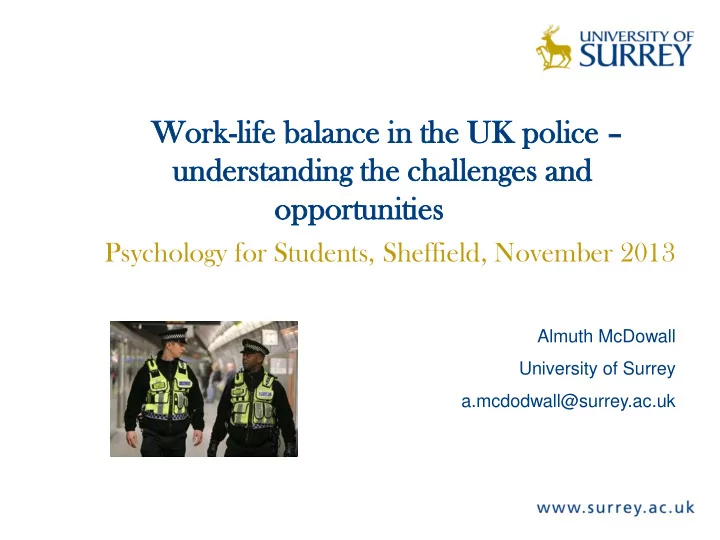
Work ork-lif life e balanc lance e in the e UK pol olice ice understand derstanding ing the e challenge llenges s and d op opportuni ortuniti ties es Psychology for Students, Sheffield, November 2013 Almuth McDowall


slide-1
SLIDE 1

Work

  • rk-lif

life e balanc lance e in the e UK pol

  • lice

ice – understand derstanding ing the e challenge llenges s and d

  • p
  • pportuni
  • rtuniti

ties es

Psychology for Students, Sheffield, November 2013

Almuth McDowall University of Surrey a.mcdodwall@surrey.ac.uk

slide-2
SLIDE 2

Who of you has thought about work-life balance?

Work-life Balance

slide-3
SLIDE 3

A child’s view

slide-4
SLIDE 4

WLB – a Definition

“The individual perception that work and non- work activities are compatible and promote growth in accordance with an individual’s current life priorities” (Kalliath and Brough, 2008, p.326)

slide-5
SLIDE 5

Why am I concerned with WLB in my research?

  • Big concern to employers – more important as

a health concern than work-related stress (GriD, 2012)

  • Regional variation in UK!
  • Decades of research don’t equal decades of

good solutions

slide-6
SLIDE 6

UK Police: Challenges for WLB

Spending review → Operational and Organizational changes, regional variation High risk job, work-family conflict potential cause for burnout Bad press Need to develop research with practical implications, “things are dire” mind-set not helpful for individuals Need prevention and cure

slide-7
SLIDE 7

An officer in his words

slide-8
SLIDE 8
  • Focus on conflict: linked to work and non-work outcomes,

health and performance

  • Little research on actual interventions
  • Need more specific research on organisational contexts –

much focus on professional dual earners

  • Promising new areas:
  • Boundary styles. Volleyers, Integraters (Kossek et al.,

2012)

  • Facilitation (Frone, 2003): apply skills in different areas of

your life, transfer of learning

Gaps in WLB research

slide-9
SLIDE 9

Current research

  • Understanding work-life balance as KSAs: what

skills, knowledge and abilities do people need?

  • Any difference between groups?
  • Which KSAs are most important for the

police?

  • What can people do to facilitate their WLB?
slide-10
SLIDE 10

Method

Large modernising UK force

Behaviour elicitation through interviews Card sort to cluster and refine

Survey analysis for initial validation

slide-11
SLIDE 11

Findings in summary

  • Competencies ranged from broad to narrow
  • Context specific: for instance NOT taking work

home effective boundary management in this population – potentially confidential and also intrusive work

  • All competencies important, for instance

managing (others’) expectations, managing flexibility, keeping things in perspective

  • Separate competence for line managing WLB in
  • thers
slide-12
SLIDE 12

Implications

  • Theoretical: WLB understood as KSAs, gap in the

literature so far. Competencies models widely used in practice, not reflected in research to date

  • Practical: screening, training, raising self awareness.

Empowering, not limiting

  • Future research: further validation, different
  • ccupations, is there a ‘global WLB KSA model’?
slide-13
SLIDE 13

The opportunities for the Police

  • Practical applications of this research:

– Screening – Training – Raising self awareness

  • Empowering, not limiting
  • Onus on the person and the organisation
slide-14
SLIDE 14

What I learned from this research

  • Had to persevere to get it published

– Can be tricky to try something new!

  • Reflection on my WLB, and also reflection on

assisting other organisations

  • Renewed appreciation that policing is not an

easy job!

slide-15
SLIDE 15

Bit about me

  • Fulltime academic &

consultant

  • Chartered

Psychologist

  • Editor
  • Chair Division of

Occupational Psychology

  • Set up working

group on Work-life Balance in 2009 with Professor Gail Kinman

slide-16
SLIDE 16

My path to psychology

Psychology

Dance

Love Business

Time in Recording Studio Personal Instruction

Brief stint in retail

slide-17
SLIDE 17

My three top tips

  • Study into psychology if you love people
  • Consider occupational psychology if you love

business

  • Persevere and frame challenges as
  • pportunities!
slide-18
SLIDE 18

Thank you!

  • A.mcdowall@surrey.ac.uk