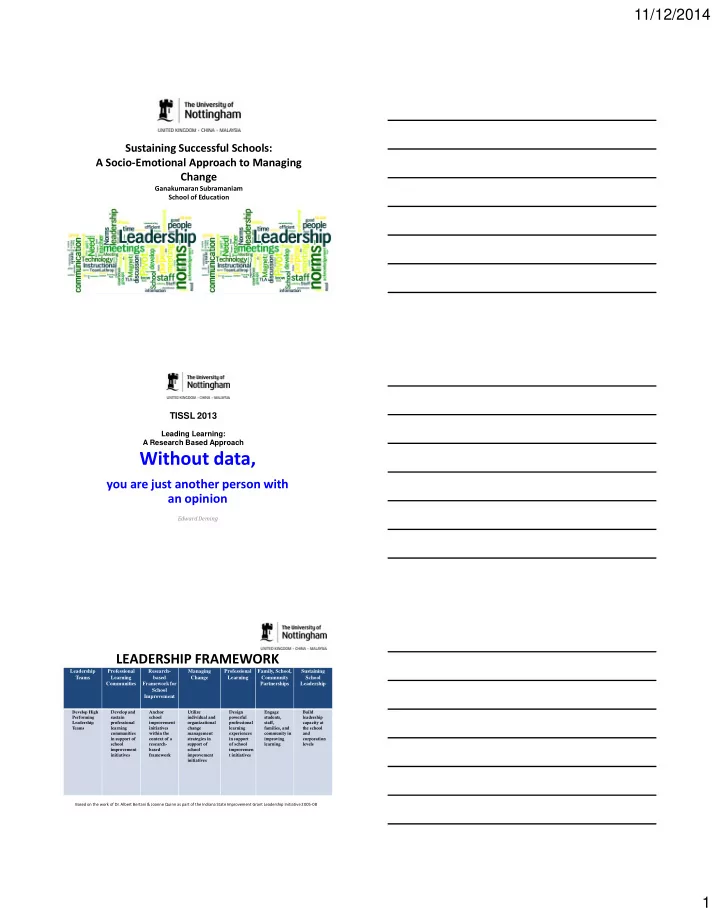
Without data, you are just another person with an opinion Edward - - PDF document

without data
SMART_READER_LITE
LIVE PREVIEW

Without data, you are just another person with an opinion Edward - - PDF document

11/12/2014 Sustaining Successful Schools: A Socio-Emotional Approach to Managing Change Ganakumaran Subramaniam School of Education TISSL 2013 Leading Learning: A Research Based Approach Without data, you are just another person with an


slide-1
SLIDE 1

11/12/2014 1

Sustaining Successful Schools: A Socio-Emotional Approach to Managing Change

Ganakumaran Subramaniam School of Education

you are just another person with an opinion

Edward Deming

Without data,

TISSL 2013

Leading Learning: A Research Based Approach

LEADERSHIP FRAMEWORK

Leadership Teams Professional Learning Communities Research- based Framework for School Improvement Managing Change Professional Learning Family, School, Community Partnerships Sustaining School Leadership

Develop High Performing Leadership Teams Develop and sustain professional learning communities in support of school improvement initiatives Anchor school improvement initiatives within the context of a research- based framework Utilize individual and

  • rganizational

change management strategies in support of school improvement initiatives Design powerful professional learning experiences in support

  • f school

improvemen t initiatives Engage students, staff, families, and community in improving learning Build leadership capacity at the school and corporation levels Based on the work of Dr. Albert Bertani & Joanne Quinn as part of the Indiana State Improvement Grant Leadership Initiative 2005-08

slide-2
SLIDE 2

11/12/2014 2

Sustaining Successful Schools: A Socio-Emotional Approach to Managing Change

Goals

  • To provide an understanding of a need for a

people centred approach in leading and managing change

  • To draw awareness of the need for leaders to

consider social and emotional people centred approaches to change management

  • To highlight some key areas and related

questions for change leaders to consider

A General Framework

  • Leadership is about a vision of the future and

the ability to energize others to pursue it.

  • Management is about getting results and doing

so efficiently so that a material gain is created.

  • Administration is about rules and procedures

and whether or not they are being followed and how they are executed.

It is very important to have clear understanding about these so that we confuse the issues discussed.

slide-3
SLIDE 3

11/12/2014 3 DO YOU KNOW ? OR DO YOU THINK YOU KNOW ?

What do your people think of YOU

What employees want

  • Honesty - 90% say they want honesty and
  • integrity. Lies and secrets kill credibility.
  • Fairness. 89% want fairness and equity among

employees, accountable to the same standards.

  • Trust. More than 86% want to trust—and be

trusted.

  • Respect. 84% want to respect—and be respected.
  • Responsiveness. 74% want their leader to listen,

understand and respond. To respect their knowledge and experience.

What employees want

  • Dependability. 81% say they want to be able

to count on their leader when needed.

  • Collaboration. 77% want to be a part of their

leader’s team and be asked to contribute ideas and solutions.

  • Genuineness. 76% want their leader to be a

genuine person.

  • Appreciation. 74% want their leader to

appreciate them for who they are and what they do.

slide-4
SLIDE 4

11/12/2014 4

What Employees Say…

Good Leadership

Visionary Humorous Kind Appreciative Good communicator Hard worker Empathetic Good team builder Positive Ethical Results-oriented (vs. process)

Bad Leadership

Disrespectful Belligerent Demeaning Moody Negative Unethical Incompetent Discouraging Self-absorbed Inconsistent direction Vindictive Ego-maniac Prideful Manipulative Paranoid

How employees feel…

Good Leadership

Empowered Enthusiastic Valued Energized Hopeful Confident Safe Relaxed Mutual admiration Respected Motivated to excel

Bad Leadership

Little, small, demeaned Hopeless Stupid Drained Very Stressed Angry Fearful Depressed Unappreciated Incompetent Rebellious Withdrawn Uncooperative Unproductive Eager to sabotage

Most schools have been designed to solve yesterday’s problems, rather than capitalizing on today’s

  • pportunities to effectively confront

the issues of tomorrow. Do You Agree?

slide-5
SLIDE 5

11/12/2014 5 That which got us where we are is not very likely to get us where we want to go! Do You Agree?

If You Disagree with those two statements…

then change in unnecessary . Now what does that say about your

  • wn beliefs about change and the

conditions that necessitate change! Change is Inevitable, Growth is Optional

It is not the strongest of the species that survive, nor the most intelligent, but the one most responsive to change.

Darwin

slide-6
SLIDE 6

11/12/2014 6

Systems don’t resist change, people do, why?

  • Comfort zone
  • Need for stability
  • Need for predictability and routine
  • Fear of the unknown
  • Lack of competence or the fear of it
  • Lack of confidence
  • Anxiety
  • Others

Change – How, When, What, Why, Who

EXISTING SYSTEM INNOVATIONS ARE ADJUSTED TO FIT THE SYSTEM EXISTING SYSTEM IS CHANGED TO SUPPORT THE EFFECTIVENESS OF THE INNOVATION EFFECTIVE INNOVATION

PEOPLE

Leading People to Manage Change

=CHANGE =CONFUSION =ANXIETY

=GRADUAL

CHANGE

=FRUSTRA-

TION

=FALSE

STARTS + + + + + + + + + + + + + + + + + + + + + + +

VISION SKILLS RESOURCES INCENTIVES ACTION PLAN SKILLS INCENTIVES ACTION PLAN RESOURCES INCENTIVES RESOURCES VISION VISION VISION VISION SKILLS SKILLS SKILLS INCENTIVES INCENTIVES RESOURCES RESOURCES ACTION PLAN ACTION PLAN ACTION PLAN

(Hweiman, 2010)

slide-7
SLIDE 7

11/12/2014 7 Leading People to Manage Change

As a leader you can only bring about sustainable change practices if you undertake change management in a structured, comprehensive and systematic manner. The matrix above is just one way to make sure that critical components have been addressed

Managing Change with Social and Emotional Intelligence Changing face of leadership

  • Qualities traditionally associated with

leadership—such as intelligence, toughness, determination, and vision—are insufficient to support leadership.

  • Effective leaders are distinguished by a high

degree of emotional intelligence, which includes self-awareness, self-regulation, motivation, empathy, and social skill.

slide-8
SLIDE 8

11/12/2014 8

Definition

  • Emotional Intelligence - refers to the capacity

for recognizing our own feelings and those of

  • thers, for motivating ourselves and for

managing emotions well in ourselves and in our

  • relationships. (Goleman, 1998, 2005)
  • Social Intelligence is the ability to determine the

requirement for leadership in a particular situation and select an appropriate response. Behavioural flexibility, to meet situational

  • requirements. (Yuki, 2006, Goleman 2005)

Leadership Intelligence

Intellectual Social -Emotional

Social and Emotional Intelligence

Self Awareness Self Management Social Awareness Social Skills

Emotional self awareness Accurate self assessment Self confidence Emotional self control Transparency Adaptability Achievement Initiative Optimism Empathy Organisational awareness Service Inspirational Influence Developing

  • thers

Change catalyst Conflict management Building bonds Teamwork and collaboration

Goleman 1996, 2005

slide-9
SLIDE 9

11/12/2014 9 Components of Social - Emotional Intelligence

Source: Daniel Goleman, Primal Leadership and other materials

Awareness Management Self Others

Self-Awareness/ Assessment Social Awareness/ Empathy Self-Control/ Adaptability Relationship-Building/ Teamwork

Social & Emotional Intelligence Leadership

  • Self-Awareness
  • Social Awareness
  • Self Management
  • Relationship

Management

  • Purpose
  • Presence
  • Practice
  • People & Partners

Purpose

  • What is my goal?
  • Who am I when I am my best self?
  • What prevents me from being that person 100% of the

time?

  • Am I the subject of my own desires or the object of
  • thers’?
  • How do I self-sabotage and take myself out of the

game?

  • Do I inspire those around me to stay in the game?
slide-10
SLIDE 10

11/12/2014 10

Presence

  • How do others perceive and experience me?
  • Is my presence consistent with my

purpose/goal?

  • What is my personal brand?

– Is it relevant? – Is it unique? – Is it consistent?

Practice

  • What gaps currently exist between my

purpose/goal and my presence?

  • What behaviors do I need to demonstrate in
  • rder to develop the presence that will

facilitate my purpose?

  • What commitments am I willing to make on a

daily, weekly, monthly basis?

Partners / People

  • Who will I rely on to hold and deliver my goal, to

get behind me and move me toward my purpose?

  • Am I reliant on a few or many?
  • Am I willing to demonstrate vulnerability in
  • rder to share and pursue my purpose?
  • Am I comfortable with social and emotional

engagement?

  • Where and when do I need to emotionally

detach and let go?

slide-11
SLIDE 11

11/12/2014 11

What Research Says

Self-Regulation & Leadership Effectiveness

An socially and emotionally intelligent person is always monitoring his/her actions and also the acts of others according to the norms and values of the organizations, so that he/she could get better outcomes.

Self awareness & Leadership Effectiveness:

  • Leaders who have a high degree of self

awareness have been found to have positive impact as effective leaders compared to those who are unaware of themselves.

  • Leaders who are able to understand the

emotions and abilities of their followers works with more zeal and can effectively persuade followers to produce the desired results

slide-12
SLIDE 12

11/12/2014 12 Motivation & Leadership Effectiveness

  • The passion to achieve goals i.e. motivation

and its appropriate use is one of the component of emotional intelligence.

  • Research has found that socially and

emotionally intelligent leaders have the ability to boost the morale of the employees by motivating them to get the work completed more efficiently and effectively.

Empathy and Leadership Effectiveness

  • Goleman, defined empathy as, “The ability to

understand the emotional make-up of other people”.

  • It is found that leaders who are aware of the

emotions of followers are more effective in the ability to use empathetic ability to harness and re-orientate emotional states to bring positive results.

Social Skills & Leadership Effectiveness

  • Social networking and strong interpersonal and

intrapersonal skills make a person successful in the

  • rganizational environment.
  • Social expressiveness is the ability to communicate

verbally and the skill in engaging others in social interaction and collective problem-solving. When co-worker and employees feel like stake-holders in solution development, they invest heavily in making it work.

  • Research has found that social skills and effective

leadership are significantly and positively related with each other.

slide-13
SLIDE 13

11/12/2014 13

Its tough,

PPTA Education Change Management Toolkit 2012

In Change Management, You need everyone in your team

slide-14
SLIDE 14

11/12/2014 14

Sustainable Success

“In the past, if you asked someone in a

successful enterprise what caused the success, the answer was ‘it’s the people.’ Today, it has become evident that this is

  • nly partially true: “it is actually the

relationships that make the difference.”

Fullan, Michael, Leading in a Culture of Change

People Make Change Possible & Pleasant Thank You

References/Resources

  • Fullan, Michael. Leading in a Culture of Change, Josey-Bass, 2001
  • Guskey, Thomas R., Five-Level Model for Evaluating Professional Development
  • Hall, Gene E. & Hord, Shirley M. Implementing Change: Patterns, Principles and Potholes, 2nd

Ed., Pearson, 2006

  • Henderson, Anne T., Mapp, Karen L., Johnson, Vivian R. & Davies, Don. Beyond the Bake Sale:

The Essential Guide to Family-School Partnerships, The New Press, 2007

  • Joyce, Bruce & Showers, Beverly. Student Achievement through Staff Development,3rd Ed., ASCD,

2002

  • Katzenbach, Jon R. & Smith, Douglas K. The Wisdom of Teams: Creating High-Performance

Organizations, Harvard Business School Press, 1993

  • Lambert, Linda. Leadership Capacity for Lasting School Improvement, ASCD, 2003
  • National Implementation Research Network, http://www.fpg.unc.edu/~nirn/ Brett E. Bollinger,

Ed.D. bebollin@indiana.edu

  • Indiana’s Vision of Response to Intervention website: http://www.doe.in.gov/indiana-rti
  • Cherniss, C., Goleman, D., Emmerling, R., Cowan, K. & Adler, M. (1998). Bringing emotional

intelligence to the workplace: A technical report issued by the Consortium for Research on Emotional Intelligence in Organizations. Available on-line : www.eiconsortium.org/research/technical_report.htm

  • Goleman, D. (1998). What Makes A Leader? Harvard Business Review. November-December.
  • Goleman, D. (1998). Working With Emotional Intelligence. New York: Bantam.
  • Goleman,D. (2005). Social Intelligence. New York: Bantam