WISCONSIN TAX UPDATE Passthrough entities Corporations Withholding - - PDF document

wisconsin tax update
SMART_READER_LITE
LIVE PREVIEW

WISCONSIN TAX UPDATE Passthrough entities Corporations Withholding - - PDF document

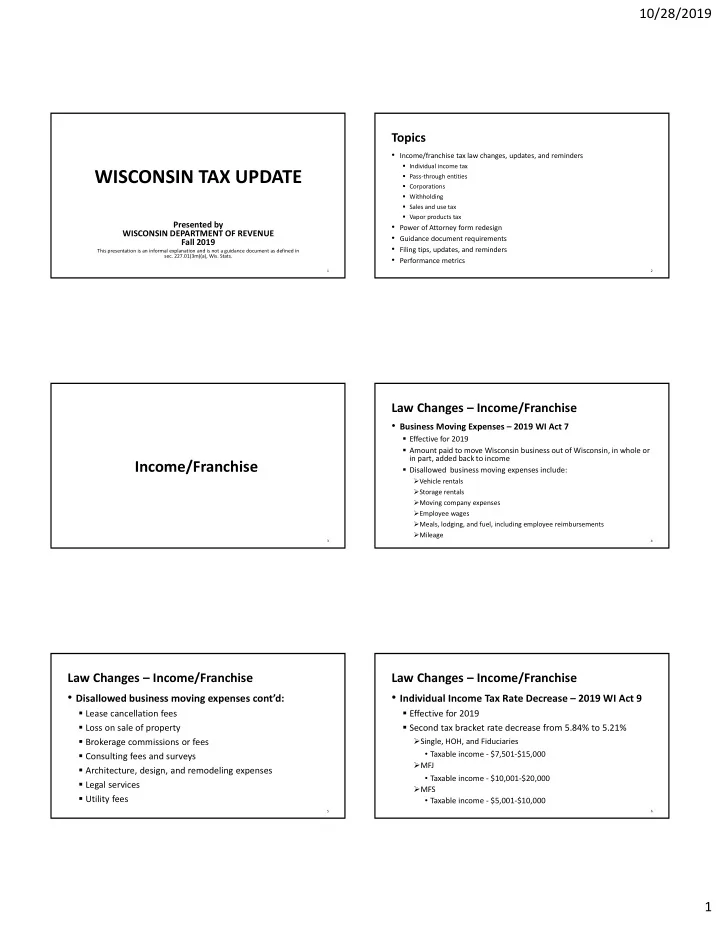
10/28/2019 Topics Income/franchise tax law changes, updates, and reminders Individual income tax WISCONSIN TAX UPDATE Passthrough entities Corporations Withholding Sales and use tax Vapor products tax Presented by


slide-1
SLIDE 1

10/28/2019 1

WISCONSIN TAX UPDATE

Presented by WISCONSIN DEPARTMENT OF REVENUE Fall 2019

This presentation is an informal explanation and is not a guidance document as defined in

  • sec. 227.01(3m)(a), Wis. Stats.

1

Topics

  • Income/franchise tax law changes, updates, and reminders
  • Individual income tax
  • Pass‐through entities
  • Corporations
  • Withholding
  • Sales and use tax
  • Vapor products tax
  • Power of Attorney form redesign
  • Guidance document requirements
  • Filing tips, updates, and reminders
  • Performance metrics

2

Income/Franchise

3

Law Changes – Income/Franchise

  • Business Moving Expenses – 2019 WI Act 7
  • Effective for 2019
  • Amount paid to move Wisconsin business out of Wisconsin, in whole or

in part, added back to income

  • Disallowed business moving expenses include:
  • Vehicle rentals
  • Storage rentals
  • Moving company expenses
  • Employee wages
  • Meals, lodging, and fuel, including employee reimbursements
  • Mileage

4

Law Changes – Income/Franchise

  • Disallowed business moving expenses cont’d:
  • Lease cancellation fees
  • Loss on sale of property
  • Brokerage commissions or fees
  • Consulting fees and surveys
  • Architecture, design, and remodeling expenses
  • Legal services
  • Utility fees

5

Law Changes – Income/Franchise

  • Individual Income Tax Rate Decrease – 2019 WI Act 9
  • Effective for 2019
  • Second tax bracket rate decrease from 5.84% to 5.21%
  • Single, HOH, and Fiduciaries
  • Taxable income ‐ $7,501‐$15,000
  • MFJ
  • Taxable income ‐ $10,001‐$20,000
  • MFS
  • Taxable income ‐ $5,001‐$10,000

6

slide-2
SLIDE 2

10/28/2019 2

Law Changes – Income/Franchise

  • Additional Individual Income Tax Rate Decrease –

2019 WI Act 10

  • Rate reductions to first and second tax brackets
  • Two rate reductions: 2019 and 2020. Rate in effect in 2020

will continue thereafter.

  • Rate reductions based on additional estimated sales and use

tax revenue from out‐of‐state retailers and marketplace providers as a result of U.S. Supreme Court decision in South Dakota v. Wayfair Inc. and 2019 WI Act 10

7

Law Changes – Income/Franchise

  • Additional Income Tax Rate Decrease (cont.)
  • Department determines rate reduction no later than

October 20 of 2019 and 2020

  • Review by Legislative Audit Bureau by November 10 of 2019

and 2020

  • No change to withholding tables

8

Law Changes – Income/Franchise

  • Tax‐Exempt Bonds – 2019 WI Act 9
  • Wisconsin Health and Education Facilities Authority
  • Interest on bonds and notes issued for $35 million or less
  • WI Alternative Minimum Tax
  • No longer applies for 2019 and later years (2017 WI Act 59)
  • Multiple line changes to Form 1 and 1NPR to remove

references

9

IRC Reminder ‐ Depreciation/Amortization

  • Wisconsin computes depreciation and amortization using IRC

in effect on January 1, 2014 (with certain exceptions)

  • Wisconsin has not adopted federal bonus depreciation

provisions

10

IRC Reminder ‐ Section 179 Expense

  • Wisconsin follows federal changes to Section 179 expensing
  • Section 179 expense limitation
  • Increased in 2018 from $500,000 to $1,000,000
  • Expense limit phase‐out
  • Increased in 2018 from $2 million to $2.5 million

11

IRC Reminder ‐ FTCJA Provisions Not Adopted

  • Business interest expense limitation
  • Changes to meals and entertainment expense limitation
  • Net operating loss deduction limited to 80% of taxable income
  • 20% deduction for domestic qualified business income for

noncorporate taxpayers

  • Limitation on business losses for noncorporate taxpayers

12

slide-3
SLIDE 3

10/28/2019 3

Staudenmaier – Limitation on Itemized Deductions

  • L. William Staudenmaier v. Wisconsin Department of

Revenue, WTAC No. 17‐I‐022 (issued January 22, 2019)

  • Charitable contributions limited by department (IRC section

68)

  • Taxpayer argument
  • No limitation due to Colton case
  • Computation of FAGI
  • US government interest income
  • Social security income
  • State tax refunds

13

Staudenmaier – Limitation on Itemized Deductions

  • Commission decision
  • WI definition of "federal internal revenue code" includes IRC

section 68 limitation

  • Taxpayer subject to federal limitation
  • WTAC upheld department's assessment
  • Taxpayer did not appeal the decision

14

Lawton – Research Credit Carry‐Forward

  • The C. A. Lawton Co. vs. Wisconsin Department of Revenue,

WTAC No. 17‐I‐234 (issued February 1, 2019)

  • Issue
  • When must the WI research credit be computed and reported to

the department for any unused amount to be carried forward?

  • DOR's Position
  • In order for a research credit to be carried forward, the

underlying "claim therefor" must be filed within 4 years of the unextended due date of the tax return for the tax year in which the qualified research expense is incurred.

  • WTAC ‐ partial summary judgement – not concluded

15

Example – DOR Position

  • A corporation incurred research expenses during

calendar year 2010 and qualified for a WI research credit.

  • The unextended due date for the 2010 WI Form 4 is

March 15, 2011.

  • The corporation must have filed its 2010 Form 4 and

reported the WI research credit by March 15, 2015 in

  • rder for any unused credit to be carried forward.

16

Deere & Co. – Dividends Received Deduction

  • Deere & Company v. Department of Revenue, WTAC No. 18‐I‐

135, (issued August 21, 2019

  • Taxpayer owned interest in foreign limited partnership
  • Taxpayer elected to treat LP as a corporation for federal

income tax purposes

  • Taxpayer received distributions from LP and claimed

dividends received deduction for federal and WI

  • WTAC upheld taxpayer’s deduction
  • DOR appealed the decision

17

Section Tax 2.82 – Nexus Rule

  • "Usual or frequent" replaced with "regular"
  • "Regular and regularly" defined as 15 or more days of

activity

  • Calculation: 1 person for 15 days or 15 persons for 1

day, or any combination thereof

  • Clarification that owning tangible property in Wisconsin

creates nexus

  • Effective date: TBD

18

slide-4
SLIDE 4

10/28/2019 4

Homestead Credit Disability Qualification

19

Homestead Credit Disability Qualification

  • Beginning with the 2017 tax year, a claimant, or in some

cases the claimant's spouse, must meet one of the following qualifications to claim the homestead credit:

  • Must be 62 or older by the end of the claim year
  • Must be disabled
  • Must have earned income

20

Homestead Credit Disability Qualification

  • Disability qualification
  • "Disabled" means an individual who is unable to engage in any

substantial gainful employment by reason of a medically determinable physical or mental impairment which has lasted or is reasonably expected to last for a continuous period of not less than 12 months.

  • Similar definition to that used for Social Security Disability Income (SSDI) and

Supplemental Security Income (SSI) qualifications.

21

Homestead Credit Disability Qualification

  • Disability qualification (cont.)
  • If the claimant is not disabled, but married to a disabled

spouse, the spouse must be part of the household

  • Proof of disability is required each year and must be sent in

with Schedule H or H‐EZ (submit Form W‐RA, if electronically filed)

22

Homestead Credit Disability Qualification

  • Disability qualification (cont.)
  • The Schedule H instructions list the acceptable forms of

proof

  • Document from Social Security Administration
  • Showing date SSA disability benefit began
  • Statement from the Veteran's Administration
  • Showing claimant receiving VA benefit due to 100% disability
  • Statement from physician
  • Stating date disability began
  • Stating whether disability is temporary or permanent

23

Veterans and Surviving Spouses Property Tax Credit

24

slide-5
SLIDE 5

10/28/2019 5

Veterans and Surviving Spouses Property Tax Credit

  • Property taxes
  • Based on when property taxes are paid to municipality, not

when accrued

  • Payments for mobile home taxes are based on when paid to

municipality

  • Department may verify via county website for date of

payment to municipality

25

Veterans and Surviving Spouses Property Tax Credit

Tax Credit Property Taxes Paid Property Taxes Accrued School Property Tax Credit X Homestead Credit (Schedule H) X Veterans and Surviving Spouses Property Tax Credit X Farmland Preservation Credit (Schedule FC) X

  • Property taxes
  • Various credits provide for different treatment

26

Individuals and Fiduciaries 2019 Form Changes

27

Form 1 & 1NPR

  • Updated federal line references
  • Added reference to the new federal Form 1040‐SR
  • Alternative Minimum Tax (AMT) lines removed; no

longer applies

  • Consolidated nonrefundable credits on one line

28

Form 1 & 1NPR

  • Added code 23 for business moving expense addback
  • n line 4
  • Added 2 new codes for lines 4 & 11 for the pass‐

through entity level taxation items

  • Code 57 is for tax‐option (S) corporations
  • Code 58 is for partnerships

29

Schedule M (Form 1NPR) ‐ Additions to and Subtractions from Income

  • Line 1 removed; referenced federal AGI
  • Additions are totaled and reported on Form 1NPR, line

15

  • Subtractions are totaled and reported on Form 1NPR,

line 29, column B

30

slide-6
SLIDE 6

10/28/2019 6

Schedule CR, Other Credits

  • Removed lines / references related to AMT
  • Removed super research and development credit

carryforward line

  • Removed reference to Schedule TC, Wisconsin

Technology Zone Credit

  • Added total lines for column A

31

Form 2, Fiduciary Return

  • Description changes
  • "Number of Beneficiaries" is now "Schedules 2‐K1 issued"
  • "Number of Nonresident Beneficiaries" is now "Schedules 2‐

K1 issued to nonresidents"

  • Added a check box for when lower‐tier, pass‐through

entities make an election to pay tax

32

Form 2, Fiduciary Return

  • Line 6 expanded
  • Line 6a: tax on income from line 5
  • Line 6b: ESBT tax from line 21 of Schedule ESBT
  • Line 6c: gross tax
  • Removed lines for changes to Schedule CR and AMT

33

New Schedule ESBT

  • Computation of Wisconsin Taxable Income for Electing

Small Business Trusts

  • Instructions for computations were previously in Form 2

instructions; developed schedule to make computations and reporting clearer

34

Schedule ESBT

35

Pass‐Through Entity Level Tax (ELT) Election

36

slide-7
SLIDE 7

10/28/2019 7

What is the ELT election?

  • It allows a tax‐option (S) corporation or partnership to pay tax on items that would
  • therwise be reported by the owner(s)
  • Tax‐option (S) corporations
  • Taxable years beginning on or after January 1, 2018
  • Must have consent from shareholders who hold an aggregate of more than 50% of the

shares on the day of election

  • Partnerships
  • Taxable years beginning on or after January 1, 2019
  • Must have consent from partners who hold an aggregate of more than 50% of the

capital and profits on the day of election

37

What is the purpose of the election?

  • To provide a federal tax benefit
  • The Federal Tax Cuts and Jobs Act limits how much an individual can

deduct for state and local taxes (SALT)

  • Practitioners and taxpayers are taking a position that these taxes are

deductible as business expenses if paid by an entity, and therefore are not subject to the limitation for individuals

  • The State of Wisconsin does NOT determine if SALT paid by a

pass‐through entity are allowed as a deduction on the entity's federal return

38

When must the election be made?

  • The election must be made each year by the extended due

date of the entity's franchise or income tax return (Form 5S or Form 3)

  • If an entity wants to revoke an election, the revocation must be

made by the extended due date of the Form 5S or Form 3

39

How does an electing entity determine if income is taxable to WI?

  • It is the intent of the law that electing entities shall pay

tax on items that would otherwise be taxed if the election was not made

  • Determine the situs of income as if election was not

made

40

How are capital gains and losses treated?

41

  • Long‐term capital gain exclusion (30%/60% for farmers in WI)
  • Allowed for partnerships
  • Not allowed for tax‐option (S) corporations
  • Net capital loss – deduction limitations
  • Partnerships are limited to $500
  • Tax‐option (S) corporations are limited to $3,000

Credit for Taxes Paid to Other States

  • Other state taxes paid by an electing entity are available

as a TPOS credit only against the entity’s WI taxes due

  • The owners may not use taxes paid by the electing

entity to compute a credit for TPOS

  • Therefore, an electing entity should not report a credit

for TPOS on the owners' Schedules 5K‐1 or 3K‐1

42

slide-8
SLIDE 8

10/28/2019 8

Pass‐Through Withholding

  • An electing entity is exempt from withholding tax on

income that is otherwise reportable by nonresident

  • wners
  • Entity can request to have pass‐through withholding

payments applied to its entity‐level tax, or

  • Request a refund of overpayments by filing a Form PW‐1

reflecting $0 withholding tax due

  • The total withholding entered on Schedules 5K‐1 and

3K‐1 must equal the withholding tax on Form PW‐1

43

Pass‐Through Entity 2019 Form Changes

44

Form 3, Partnership Return

  • Added check box for partnership to make entity‐level

tax election

  • Added check box to indicate when lower‐tier entities

make an election to pay tax

  • Also added check boxes to Schedule 3K‐1

45

Form 3, Partnership Return

  • Added lines 1‐11 on page 1 to reflect tax, payments,

interest, penalties, amount due, etc.

  • Line 1 is entity‐level tax computed on Schedule 3‐ET;

this new schedule is very similar to Schedule 5S‐ET

  • Line 11 allows overpayment to be applied to 2020

46

Form 3

47

Schedule 3‐ET

48

slide-9
SLIDE 9

10/28/2019 9

Forms 3‐ES / 3‐EPV

  • Form 3‐ES is a voucher to make an estimated tax

payment

  • Form 3‐EPV is a voucher to make an electronic payment

with a return that has been filed (form will be available soon)

49

Form 5S, Tax‐Option (S) Corporation Return

  • Added a check box to indicate when lower‐tier entities

make an election to pay tax

  • Change also made on Schedule 5‐K1
  • Removed columns (c) and (d) from lines 15a – 15f of

Schedule K, as AMT is no longer applicable

  • Several changes to line text (also applies to Schedules

5S‐ET and ET‐OS)

50

Forms 1‐CNP/1‐CNS, Composite Nonresident Income Tax Returns

  • Must be electronically filed.
  • Bar codes (used for scanning) removed and watermark

added to PDF form on website

  • Removed lines 3 & 4 on Schedule 1 and column H on

Schedule 2 to reflect elimination of AMT

51

Schedule HR‐5

52

Schedule HR‐5

  • Federal historic rehabilitation tax credit
  • Claimed over 5‐year period as a result of federal Tax Cuts

and Jobs Act

  • Transitional rule for projects starting before June 20, 2018
  • Sale of WI credit comes with greater risk

53

Schedule HR‐5

  • New Schedule HR‐5
  • Used to claim all 5 years for purposes of selling or

transferring the credit

  • Submitted with Form HR‐T to DOR Technical Services
  • Attached in taxpayer’s account
  • Notice of Certification given to seller

54

slide-10
SLIDE 10

10/28/2019 10

Corporate 2019 Form Changes

55

Forms 4 & 6

  • Added check boxes related to income from real estate

mortgage investment conduit (REMIC)

  • Form 4, line 15
  • Form 6, page 1, line 11, and page 8, line 8
  • Ensures that REMICs can’t use net business loss

carryforward to offset excess inclusion income

56

Apportionment Schedules

  • Ten different apportionment formulas/methods were

computed on Forms A‐1 and A‐2

  • Form A‐1 previously had 4 parts (4 pages)
  • Part 1, Single Sales Apportionment, was most common
  • Form A‐2 previously had 6 parts (7 pages)
  • Not very common; software companies didn’t want to

support

57

Apportionment Schedules

  • Reasons for change:
  • Returns were filed with taxpayer errors or missing info
  • Processing returns was inefficient
  • Law change effective for tax year 2019 adds a new

apportionment method for broadcasters

58

Apportionment Schedules

  • Forms A‐1 & A‐2 are eliminated for tax year 2019
  • Schedules A‐01 through A‐11 are created
  • Each apportionment method is on its own schedule
  • Many lines remain unchanged
  • Schedules are numbered according to projected frequency of

use

  • Software companies will be asked to support Schedules A‐01

through A‐06 for tax year 2019

59

Apportionment Schedules – NEW

TY2018 TY2019 Description A‐1, Part I A‐01 Single Sales Factor Apportionment Data for Nonspecialized Industries A‐1, Part II A‐02 Apportionment Percentage for Interstate Financial Institutions A‐2, Part I‐C A‐03 Apportionment Percentage for Interstate Motor Carriers A‐2, Part 1‐F A‐04 Apportionment Percentage for Interstate Telecommunications Companies A‐1, Part IV A‐05 Premiums Factor for Insurance Companies A‐1, Part III A‐06 Receipts Factor for Interstate Brokers‐Dealers, Investment Advisers, Investment Companies, and Underwriters A‐2, Part 1‐A A‐07 Apportionment Percentage for Interstate Air Carriers NEW for TY19 A‐08 Apportionment Percentage for Broadcasters A‐2, Part 1‐D A‐09 Apportionment Percentage for Interstate Railroads A‐2, Part 1‐E A‐10 Apportionment Percentage for Interstate Pipeline Companies A‐2, Part 1‐B A‐11 Apportionment Percentage for Interstate Air Freight Forwarders Affiliated with a Direct Air Carrier 60

slide-11
SLIDE 11

10/28/2019 11

Withholding Form Changes

61

Federal Form W‐4

  • The Internal Revenue Service is in the process of

redesigning Form W‐4 for the year 2020

  • DRAFT – https://www.irs.gov/pub/irs‐dft/fw4‐‐dft.pdf
  • The number of federal withholding allowances have

been removed from the DRAFT Form W‐4

62

Federal Form W‐4

  • Prior to these changes, an employee could use Form W‐

4 for WI purposes if the employee's federal allowances equaled his or her WI exemptions

  • The redesigned Form W‐4 cannot be used for WI

purposes

63

Wisconsin Form WT‐4

  • An employee will be required to provide Wisconsin

Form WT‐4 to his or her employer, regardless of what is claimed on the redesigned federal Form W‐4

  • The department has updated Form WT‐4 to reflect

these changes

64

Form PW‐1, Pass‐Through Withholding

  • Background:
  • A pass‐through entity is required to withhold tax on WI

income allocable to a nonresident owner, unless an exemption applies

  • An owner of a pass‐though entity can file Form PW‐2 to

request an exemption

65

Form PW‐1, Pass‐Through Withholding

  • Added Lines A‐E on page 1 to reflect when a pass‐

through entity has made an election to pay tax at the entity level

  • Bar codes removed; watermark added directing

taxpayer to "File Electronically"

66

slide-12
SLIDE 12

10/28/2019 12

Redesigned Form PW‐2

  • Form PW‐2 is used by a nonresident owner to request DOR

approval for an exemption from withholding

  • Form changes include:
  • Allow nonresident owner to submit one Form PW‐2 for multiple

pass‐through entities

  • Nonresident owner may submit Form PW‐2 before estimated

payments are due for the year of the request

  • Redesigned form is available at:

https://www.revenue.wi.gov/TaxForms2017through2019/20 19‐FormPW‐2.pdf

67

Sales and Use Tax

68

Sales and Use Tax Update

  • Tax Rate Changes
  • 0.5% county tax begins in Outagamie County
  • January 1, 2020
  • 0.1% baseball stadium tax could end (AB73/SB67)
  • in Milwaukee, Ozaukee, Racine, Washington, and Waukesha

counties, awaiting legislation

69

One‐Time Sales Tax Reduction in Field Audit

  • 2019 WI Act 10
  • Effective with final determinations made on or after

October 1, 2019

  • One‐time reduction of additional sales tax (not use tax)

discovered during a field audit

  • Reduction is 10% of state sales tax (not county or

stadium taxes)

70

One‐Time Sales Tax Reduction in Field Audit

  • 10% reduction only allowed for years in the audit period

in which the gross sales are less than $5 million

  • Upon notice of field audit, the taxpayer must have filed

all returns required under Ch. 77, Wis. Stats., for the entire audit period (includes local expo tax, premier resort area tax, and state rental vehicle fee returns)

  • Reduction not allowed in subsequent field audits

71

Marketplace Providers and Sellers 2019 Wis. Act 10 – Effective January 1, 2020

  • Marketplace provider is required to collect and remit

tax on all sales of taxable products and services.

  • Reverses the effect of the Orbitz decision.
  • Marketplace providers that facilitate sales of lodging

services are required to collect and remit tax on the entire amount charged to a purchaser.

72

slide-13
SLIDE 13

10/28/2019 13

Marketplace Providers and Sellers

2019 Wis. Act 10 – Effective January 1, 2020 (cont.)

  • Marketplace provider is:
  • Required to notify sellers that it is collecting and remitting the tax.
  • Required to maintain exemption certificates.
  • Only the marketplace provider can be audited and held liable for

the tax, unless:

  • The marketplace provider can demonstrate the error is due to

insufficient or incorrect information provided by the marketplace seller. NOTE: For sales made prior to January 1, 2020, both the marketplace and third‐party seller may be liable on taxable sales.

73

Marketplace Provider Q & A

  • Q: Does a marketplace provider file separate sales tax

returns for each marketplace seller?

  • A: No. A marketplace provider reports its sales, and the

sales made on behalf of all of its marketplace sellers, on its own sales tax return.

74

Marketplace Provider Q & A

  • Q: If a marketplace provider charges additional fees for

facilitating a sale, what amount is subject to tax?

  • A: A marketplace provider is required to collect and

remit Wisconsin sales and use tax on the entire amount charged to a purchaser, including any amount charged by the marketplace provider for facilitating the sale, as provided in sec. 77.52(3m)(a), Wis. Stats.

75

Marketplace Provider Q & A

  • Q: Can a marketplace provider request a waiver from

collecting and remitting tax?

  • A: Yes, the department may grant a waiver to a marketplace

provider that facilitates sales on behalf of hotels, motels, or restaurants that share the same brand name with the marketplace provider. The application for waiver, Form S‐ 102, is available at reveue.wi.gov

Note: The department may grant waivers to other types of marketplace providers, as provided in sec. 77.52(3m)(c), Wis. Stats., if there is evidence that the marketplace seller will reliably collect and remit the tax to the department.

76

Marketplace Provider Q & A

  • Q: Can a marketplace provider that is a remote seller

qualify for the small seller exception in sec. 77.51(13gm), Wis. Stats.?

  • A: Yes. In determining if a marketplace provider

qualifies for the small seller exception, the annual gross sales amount and number of transactions include sales into Wisconsin made by the marketplace on its own behalf or on behalf of other sellers.

77

Marketplace Seller Q & A

  • Q: Is a marketplace seller required to register if all sales

are made through a marketplace provider?

  • A: A marketplace seller is not required to register for

Wisconsin sales or use tax if all of the marketplace seller's taxable sales in Wisconsin are facilitated by a marketplace provider. However, the marketplace seller is required to register for and collect Wisconsin sales or use tax on its taxable sales in Wisconsin that are not made through a marketplace provider.

78

slide-14
SLIDE 14

10/28/2019 14

Marketplace Seller Q & A

  • Q: How does a marketplace seller report its sales if it

makes Wisconsin sales on its own and through a marketplace provider?

  • Answer: The marketplace seller reports all of its sales,

including sales facilitated on its behalf by a marketplace provider, on Line 1, "Total Sales," of the marketplace seller's Wisconsin Sales and Use Tax Return (Form ST‐12). The marketplace seller then takes a subtraction on Line 5, "Other," for the sales amounts that are made through the marketplace provider.

79

Marketplace Seller Q & A

  • Q: If a marketplace provider is granted a waiver from

collecting and remitting the tax, is the marketplace seller required to collect and remit?

  • A: If a marketplace provider has been granted a waiver

from collecting and remitting Wisconsin sales or use tax by the department, the marketplace seller is required to collect and remit the tax on the entire sales price charged to the purchaser for taxable sales made in Wisconsin through that marketplace provider.

80

Effect on Wisconsin Purchasers

  • Q: What is the effect on Wisconsin purchasers?
  • A: The law has not changed with regards to purchasers.

Purchasers owe use tax on the storage, use, or consumption

  • f taxable products and services in Wisconsin, unless they

can show an invoice from the seller with Wisconsin taxes properly collected and paid. As a result of 2019 Wis. Act 10, purchasers in Wisconsin may see an increased number of invoices from marketplace providers showing charges for Wisconsin sales and use tax.

81 82

Marketplace Providers and Sellers

See the department's website for resources for marketplace providers and sellers, including additional answers to common questions.

82

Wayfair Update

  • Identified the largest (top 1,000) retailers in the nation
  • Verified whether they were already registered and in

compliance

  • If not registered, sent letter informing them of filing

requirements and inquiring about their status under Wayfair

  • Following up directly as needed

83

Wayfair & Alcohol Beverages

  • Received records for shipments of alcohol beverages into

Wisconsin

  • Verified whether out‐of‐state shippers held appropriate Excise

and Sales/Use tax permits

  • If not, sent letters educating them on their obligation to hold

permits and register

84

slide-15
SLIDE 15

10/28/2019 15

Painting and Staining Contractors

  • Discovered that subcontractors were not charging sales

tax to a general contractor when hired to paint or stain unattached trim and baseboards for a building

  • Sent educational letter outlining the issues
  • Published article in the April 2019 Wisconsin Tax

Bulletin to explain the tax treatment

  • Sent a follow‐up, self‐audit letter in July

85

Wisconsin Court Cases

  • Zimmer US, Inc.
  • Issue – Are tools used to insert a prosthetic device exempt from

sales and use tax under sec. 77.54(22b), Wis. Stats.?

  • TAC stated the tools are physically and functionally separate

from the prosthetic device; are not accessories to the prosthetic device

  • The tools fall within the definition of durable medical

equipment, but are not used in a person's home. Therefore, the tools are not exempt

  • Taxpayer did not appeal the decision

86

Wisconsin Court Cases

  • State Bar of Wisconsin
  • Issue ‐ On‐demand seminars
  • Tax Appeal Commission ruled the sale of on‐demand

seminars which accomplishes accrual of Supreme Court‐ approved continuing legal education credits, legal competence, and the ability to maintain good standing with his or her law license, as the sale of a service, with the digital good being incidental to the performance of the service.

87

Vapor Products Tax

88

Vapor Products Tax

  • Effective October 1, 2019 (first return due November

15, 2019)

  • Excise tax imposed on the sale of vapor products at the

rate of 5 cents per milliliter of the liquid or other substance based on volume listed by manufacturer (sec. 139.75, Wis. Stats.)

  • No inventory floor tax

89

Vapor Products Tax

  • "Vapor product" is a noncombustible product that

produces vapor or aerosol for inhalation from the application of a heating element, regardless of whether the liquid or substance contains nicotine

  • Equipment and devices not containing the liquid or
  • ther substance are not subject to the tax

90

slide-16
SLIDE 16

10/28/2019 16

Vapor Products Tax

  • Those required to pay the tax and hold a distributor permit

(Form CTP‐129) include:

  • Distributors that sell and ship untaxed vapor products to retailers

in WI

  • Retailers that sell and ship untaxed vapor products to consumers

in WI

  • Manufacturers that produce vapor products in WI for sale in WI
  • Consumers who purchase untaxed vapor products are

required to pay the tax

91

Vapor Products Tax

  • Tax is due when the untaxed vapor product is received

in WI

  • Tobacco products distributor permit‐holders do not

need to apply for another permit

92

Vapor Products Tax

  • Additional resources:
  • DOR's vapor products Common Question web page
  • Fact Sheet 3501, Vapor Products Tax
  • Tobacco and Vapor Products Tax Forms and Instructions
  • Contact DOR's Excise Tax Unit:
  • Email: DORExciseTaxpayerAssistance@wisconsin.gov
  • Phone: 608‐266‐6701

93

Power of Attorney Form Redesign

94

Power of Attorney Form Redesign

  • Add and revoke representative
  • Easy check box to grant full authority
  • Electronic or stamped signature accepted
  • Notices
  • Automatically generated notices to taxpayer only
  • Other notices and letter to taxpayer or POA

95

Power of Attorney Form Redesign

96

slide-17
SLIDE 17

10/28/2019 17

Power of Attorney Form Redesign

97

Power of Attorney Form Redesign

98

Power of Attorney Form Redesign

99

Power of Attorney Form Redesign

100

Guidance Documents

101

Guidance Documents – 2017 Act 369

  • New Requirement
  • All guidance documents created on or after March 21, 2019,

must go through the adoption process

  • Adoption Process
  • A guidance document must be submitted to the Legislative

Reference Bureau (LRB) to be published in their register for presentation to the public for a 21‐day comment period

102

slide-18
SLIDE 18

10/28/2019 18

Guidance Documents – 2017 Act 369

  • Guidance documents issued by the department prior to

March 21, 2019, that do not go through the adoption process are rescinded

  • Guidance document examples:
  • Common Questions
  • Publications
  • Wisconsin Tax Bulletins

103

Guidance Documents – 2017 Act 369

  • Certification by Secretary of Revenue
  • Every guidance document submitted for adoption must have

a statement from the Secretary that the document complies with the law

104

Guidance Documents – 2017 Act 369

  • Citation Requirement
  • Beginning August 30, 2019, state agencies are required to identify the

applicable federal or state law or administrative code provision that supports any statement or interpretation of law that the agency makes in any publication including forms, pamphlets, and other informational materials

105

Filing Tips

106

Disregarded Entities

  • Income/franchise tax ‐ A single−owner enty that is disregarded as a

separate entity under IRC 7701 is a disregarded entity for Wisconsin

  • The owner should submit Schedule DE with their income/franchise tax return
  • Withholding tax – A single−owner enty that is disregarded as a

separate entity under IRC 7701 is not a disregarded entity for Wisconsin (i.e., the entity is the employer)

107

Disregarded Entities

  • Excise tax ‐ A single‐owner entity that is disregarded as a separate entity

for Wisconsin income/franchise tax purposes is a disregarded entity for Wisconsin

  • Sales/use tax ‐ A single‐owner entity that is disregarded as a separate

entity for Wisconsin income/franchise tax purposes is a disregarded entity for Wisconsin

  • Sec. 77.61(19m)(a), Wis. Stats.

108

slide-19
SLIDE 19

10/28/2019 19

Disregarded Entities

  • Sales tax returns may be filed in one of two ways:
  • The owner includes all of its disregarded entities'

information on owner's sales/use tax return, or

  • The owner may elect to file separate sales/use tax returns

for each of its disregarded entities

109

Filing Tips – Individual Income Tax

  • If documents requested by the department are

submitted online, allow up to 3 weeks for review

  • As long as client has a confirmation number, we have the

documents

  • File appeals online
  • Taxpayers can print/view most letters online

110

Filing Tips – Individual Income Tax

111

Filing Tips – Individual Income Tax

  • Estimated and extension payments may be verified
  • nline:

https://www.revenue.wi.gov/Pages/Apps/TaxPaymentIn quiry.aspx

  • If pass‐through withholding is reported on Schedule 3K‐

1 or 5K‐1, report this as withholding on IIT return (not as estimated payments)

112

Filing Tips – Individual Income Tax

  • Use correct payment type and period. If payment type or

period is incorrect, it can be corrected by submitting a written request (email)

  • Use 2020 Form 1‐ES for 2020 estimated payments
  • Use 2020 Form 1‐ES for 2020 extension payments if paying by check, or

select "Extension payment" type if using My Tax Account

  • Use 2020 Form EPV voucher for 2020 return payments
  • Be sure vouchers provided to clients contain complete

information, including scanline

113

Filing Tips – Individual Income Tax

  • Do not use partial Social Security numbers on returns,

schedules, or vouchers submitted to DOR

  • Do not file Form 804, Claim for Decedent's Wisconsin

Income Tax Refund, until the refund check is received

114

slide-20
SLIDE 20

10/28/2019 20

Filing Tips – Individual Income Tax

  • Form 1NPR filers completing Schedule U:
  • If no Wisconsin return was filed in prior year, do not

complete line 7 (prior year tax)

  • Use value from line 4 on line 8

115

Filing Tips – Schedule OS

  • Include complete copy of other state return
  • .pdf copy of e‐filed return is sufficient
  • Cannot process without copy of other state's return

116

Filing Tips – Credit Schedules

  • Submit the proper credit schedule and/or Schedule CF

for EACH credit claimed on the CR

  • If submitting supporting schedules, include name(s) of

credit schedule on supporting schedules

  • Fill in amounts on credit schedules, do not write "See

statement"

  • Attach credit verification forms or Schedules 2K‐1, 3K‐1,
  • r 5K‐1 to support credit being claimed

117

Filing Tips – Corporate Franchise

  • Form 6 returns must include all members and

designated agent

  • Use correct year return for tax period. We will not

accept current year returns on prior year forms.

  • Do not send checks without payment voucher or Form

Corp‐ES

118

Filing Tips – Sales & Withholding

  • Once an account is ceased, the filing requirement is

ceased as well

  • Do not file "zero" returns for closed accounts
  • If amending Form WT‐7:
  • Send corrected Forms W‐2/1099 that have changed

withholding amounts

  • Do not send Forms W‐2/1099 if withholding did not change

119

My Tax Account Updates

120

slide-21
SLIDE 21

10/28/2019 21

MTA

  • Email confirmations
  • MTA users can now choose to receive a confirmation email

after submitting returns and payments

  • Automated username inactivation
  • MTA will inactivate a username if it has not been accessed in

the past 18 months. User will need to call Customer Service to re‐activate

121

MTA

  • Submit Information Returns in MTA
  • Key in Form W‐2/1099 information at any time during the

year in My Tax Account

  • Log in to My Tax Account and select "Enter Form W‐2/1099

Information"

122

MTA

123

MTA ‐ Helpful Hints

  • Submit all Forms WT‐6 for 2019 prior to submitting Form

WT‐7

  • Request more frequent filing than required by statute by

selecting the appropriate link under "I Want To"

  • May not request less frequent filing
  • Remember to update profile information when there are

changes (i.e., cell provider, cell number, email address)

  • DOR will annually ask you to review profile and update

124

Unclaimed Property

125

Unclaimed Property

  • Holder Reports
  • Make sure business clients are reporting unclaimed property

if required

  • Includes uncashed payroll checks, accounts payable checks,

loan collateral, deposits, credit balances, refunds, etc.

  • Reports are due November 1st each year for prior fiscal year

(July 1 – June 30)

126

slide-22
SLIDE 22

10/28/2019 22

Unclaimed Property

  • Holder Reports
  • Provide complete and accurate owner information on holder

report

  • Holder reports must be submitted electronically (My Tax

Account upload or third‐party software)

  • Once report and payment are submitted, there is no

additional work required

  • See Publication 82, Holder Report Guide, for more

information

127

Unclaimed Property

  • Holder Payments
  • If you pay online when submitting holder report, do not

submit a second standalone payment; will result in two payments

  • Add confirmation number or FEIN of holder if sending paper

check

128

My Tax Account

  • Unclaimed Property Reminder
  • My Tax Account users will be presented with a prompt,

asking if they have unclaimed property to report

  • Plan is to roll out in spring 2020
  • Only the first user to log in to business account is prompted
  • First user could be third party

129

Processing

130

TY2018 Filing Statistics

Tax Type Returns Filed Efile Rate Corporation Franchise Tax (4, 4H, 5, 6) 44,832 80.6% Fiduciary (2, 4T, Schedule CC) 63,783 68.2% Individual Income (1, 1A, 1NPR, WI‐Z, Schedule H, H‐EZ, & X‐NOL) 3,160,478 86.9% Pass‐Through (1CNS/1CNP, 3, 5S, PW‐1) 190,693 89.6% Sales (ST‐12) 894,786 94.7% Withholding (WT‐6, WT‐7) 338,326 94.2%

131

Filing Season Opening

  • The IRS has already announced the opening dates for

Modernized eFile

  • January 7th, 2020, for Business Type Returns
  • January 21st, 2020, for Individual Income Tax Returns
  • Most 2019 Wisconsin forms have been posted to our

website

132

slide-23
SLIDE 23

10/28/2019 23

E‐File Mandates ‐ 2019

  • E‐filing is required for Forms 1CNS, 1CNP, and PW‐1 for

TY2019 (all available in My Tax Account)

  • E‐filing is also required for Form 6, Combined

Franchise/Income Tax Return (since form introduction in 2014)

  • DOR will reject paper filed returns for these form types

133

E‐File Mandates ‐ 2019

  • Forms 3 & 5S must be filed electronically
  • Letters are being sent to TY2018 paper filers
  • Waivers will be considered for TY2019

134

E‐File Mandates ‐ 2019

  • E‐File Mandate for Sales (Form ST‐12) & Withholding

(Forms WT‐6 and WT‐7) returns will be implemented in 2020 for quarterly, monthly, semi‐monthly, and early monthly filers (everyone EXCEPT annual)

  • Warning letters will be sent to impacted taxpayers
  • Paper returns will be rejected after warning letters are

issued

  • My Tax Account is a free filing option

135

E‐File Updates

  • Form 2 will no longer be available for filing through

Wisconsin eFile

  • Software testing is now required for XML filing of

Forms W‐2, 1099, WT‐6 and WT‐7

  • Testing is not required for EFW2 uploads

136

Software Vendor Update

  • New message for software vendors

when their software hasn't been approved OR isn't ready for release:

"We are working to get forms ready for filing in Wisconsin. Please check again later."

  • Messages provided were misleading for

tax year 2018

137

Required Forms – IIT Vendors

138

slide-24
SLIDE 24

10/28/2019 24

Software Vendor Update

  • Binary attachment requirement
  • Vendors must support a standalone .pdf

attachment (binary attachment in this context means .pdf)

  • Primarily an issue for DIY software

139

Required Forms – Business Vendors

140

Required Forms – Fiduciary Vendors

141

Form WT‐11 Update

  • Form WT‐11, Non‐Resident Entertainer Withholding

Report, is available in My Tax Account

  • 519 of 1,243 Forms WT‐11 have been filed via My Tax

Account as of 9/18/2019

  • Taxpayers must file on DOR prescribed forms
  • E‐file mandate likely in future

142

5S Election Update

  • Law enacted 12/14/2018 allowing tax‐option (S)

corporations to elect to be taxed at the entity level for tax year 2018 and thereafter

  • New 2018 forms posted in January 2019 and available

for filing/processing starting July 2019

  • As of 9/18/2019, 1,337 Form 5S returns have made the

election, out of 82,781 filed

143

Withholding Update

  • "Missing Information Returns" letter updated to provide

better information on what is missing or incomplete

  • Current process automatically sends letter when counts

reported on Form WT‐7 do not match Forms W‐2 or 1099 submitted

  • $10 penalty per information return is assessed if Forms W‐2
  • r 1099 not received

144

slide-25
SLIDE 25

10/28/2019 25

Withholding Update

  • DOR is required to hold returns for individual income

taxpayers until March 1st if their employer hasn't submitted either the Form WT‐7 or Forms W‐2

145

Information Returns – 2018 vs 2019

  • In 2018, e‐file threshold changed from 50 to 10 and changed due

date to January 31 for ALL Forms W‐2 & 1099.

2018 2019 January only 5.88 million 6.21 million February only 0.61 million .60 million January – September 7.08 million 7.38 million eFile Rate 94.5% 96.5%

146

Information Returns

  • Intuit (QuickBooks)
  • Desktop product (and partner product Tax 1099)
  • E‐filed Forms 1099 contain Wisconsin Taxpayer ID
  • Printed Forms 1099 contain Wisconsin Taxpayer ID
  • Online product
  • E‐filed Forms 1099 contain Wisconsin Taxpayer ID
  • Printed Forms 1099 do not contain Wisconsin Taxpayer ID
  • May be subject to penalty if mailing more than ten printed Forms 1099
  • Online users may request reimbursement of penalty from Intuit

147

Performance Metrics

148

DOR Initiatives

FY19 FY18 FY17 FY16 Returns Evaluated 3,087,501 3,075,709 3,058,791 3,061,766 Quizzes Required 2,591 5,088 8,674 31,259 PINs Required 49,919 75,053 47,453 12,055 ID Docs Required 7,725 9,518 8,251 14,566 Total ID Verification Actions Required 60,235 89,659 64,378 57,880 % of Returns Evaluated Requiring ID Verification 1.95% 2.92% 2.10% 1.89% Refunds Denied for Failure to Verify ID 23,481 19,202 20,298 21,698 Refunds Reinstated on Appeal 2,495 2,302 2,754 8,112

  • Fraud Prevention ‐ ID Verification

149

Fraud Prevention

  • Bad Refunds Stopped ‐ Historical

Fraud Detection With Analytics Processing Fraud ‐ OCI Processing Fraud ‐ Tax Ops Earned Income Credit Homestead Credit Total for Specific Initiatives FY19 $8,595,686 $5,970,625 $6,020,804 $20,436,036 $14,358,603 $55,381,754 FY18 $7,052,669 $5,869,413 $5,628,995 $17,943,046 $14,862,551 $51,356,674 FY17 $9,300,745 $6,059,255 $8,044,070 $20,115,117 $16,046,799 $59,566,026 FY16 $11,149,599 $8,092,817 $6,849,591 $19,946,592 $17,004,928 $63,043,527 FY15 $11,050,119 $7,335,531 $6,889,513 $16,682,990 $15,828,093 $57,786,246 FY14 $3,550,473 $4,904,089 $8,195,222 $17,710,656 $15,299,425 $49,659,865 FY13 $3,434,613 $14,257,838 $12,480,794 $30,173,245 FY12 $1,702,300 $9,341,511 $14,694,458 $25,738,269 FY11 $3,324,200 $13,510,224 $12,219,984 $29,054,408

150

slide-26
SLIDE 26

10/28/2019 26

Performance Metrics

FY19 ‐ Post Audit Survey Results

Auditor was professional 93.92% Auditor was knowledgeable 89.23% I understood the notices I received 92.01% The timeline and process were clearly explained 84.51%

151

Performance Metrics

Total Customer Call Center Contacts Customer Service 358,893 Tax Operations 30,585 Audit 35,863 Compliance 294,276 Total 719,617

152

Performance Metrics

FY18 ‐ Call Centers

Bureau Inbound Answer Rate Average Hold H:MM:SS Customer Service 97.49% 0:01:34 Tax Operations 99.32% 0:00:14 Audit 98.76% 0:00:13 Compliance 99.76% 0:00:17 Total 98.54% 0:00:55 Goal 97.80% 0:01:30

153

Performance Metrics

Call Center Surveys Professional Knowledgeable Customer Service 98.88% 98.85% Compliance 98.62% 99.15% Tax Operations 98.91% 98.51% Audit 98.61% 97.93%

154

This document provides statements or interpretations of the following laws and regulations in effect as of October 1, 2019: Chapters 71, 73, 77, 139, and 177, Wis. Stats.

155

DOR Resources

  • Practitioner Assistance
  • Email

dortaxpractitioners@wisconsin.gov

  • Phone

608‐261‐5199

**Do Not Share This Information**

156

slide-27
SLIDE 27

10/28/2019 27

Questions?

157

DOR Resources

Wendy Bailey

Revenue Agent Supervisor 608/261‐8989 wendym.bailey@wisconsin.gov

Andrea Northwood

Income Tax Section Chief 608/266‐3120 andrea.northwood@wisconsin.gov

Speaker Contact Information

Jennifer Chadwick

Income Tax Specialist 608/266‐8253 jennifer.chadwick@wisconsin.gov

Van Warren

Revenue Agent Supervisor 608/267‐1347 vant.warren@wisconsin.gov

158