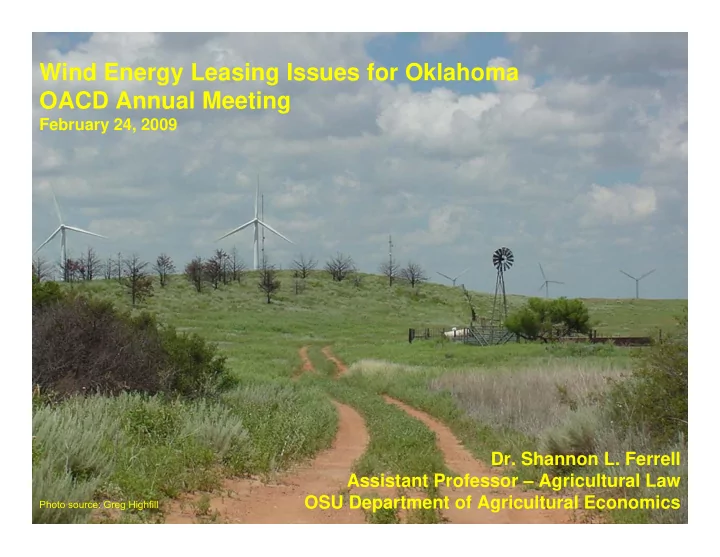
Wind Energy Leasing Issues for Oklahoma OACD Annual Meeting OACD - - PowerPoint PPT Presentation

wind energy leasing issues for oklahoma oacd annual
SMART_READER_LITE
LIVE PREVIEW

Wind Energy Leasing Issues for Oklahoma OACD Annual Meeting OACD - - PowerPoint PPT Presentation

Wind Energy Leasing Issues for Oklahoma OACD Annual Meeting OACD Annual Meeting February 24, 2009 D Dr. Shannon L. Ferrell Sh L F ll Assistant Professor Agricultural Law OSU Department of Agricultural Economics Photo source: Greg


slide-1
SLIDE 1

Wind Energy Leasing Issues for Oklahoma OACD Annual Meeting OACD Annual Meeting

February 24, 2009

D Sh L F ll

Photo source: Greg Highfill

  • Dr. Shannon L. Ferrell

Assistant Professor – Agricultural Law OSU Department of Agricultural Economics

slide-2
SLIDE 2

Wind in Oklahoma

(as a force of nature and an industry, too)

slide-3
SLIDE 3

Power is a function of air density, swept area and wind speed area, and wind speed

  • Doubling rotor length gets

2 3

1

Doubling rotor length gets us 22 = four times the swept area and thus four

2 3

2 1 r v P Π = ρ

swept area and thus four times the power

  • Since power increases as

a cubic function of velocity, we see 23 = eight times the power. eight times the power.

Source: http://www.windpower.org/en/tour/wres/enerwind.htm,

slide-4
SLIDE 4

A sense of turbine scale A sense of turbine scale

Source: Paul Gipe, Wind Energy Basics (Chelsea Green Publishing Co., 1999)

slide-5
SLIDE 5

Ooooooklahoma, where the wind comes sweeping down the plain the plain...

  • Noted climatologists Richard Rogers

and Oscar Hammerstien II

slide-6
SLIDE 6

Oklahoma Wind Resource Map

D&E D&E

  • •A

D&E D&E

  • C
  • B

Current Wind Farms Current Wind Farms A – Oklahoma (Woodward) B – Blue Canyon (Lawton) C – Weatherford D – Centennial (Fort Supply) E – Sleeping Bear (Fort Supply) Source: Oklahoma Wind Power Initiative / Keith Tracy PLLC

slide-7
SLIDE 7

Oklahoma’s Installed Utility-Scale Wind Power Capacity Wind Power Capacity

Source: Oklahoma Wind Power Initiative

slide-8
SLIDE 8

Dewey County’s Wind Resource Wind Resource

Source: Oklahoma Wind Power Initiative

slide-9
SLIDE 9

Location location location Location, location, location

Source: http://www.greenspec.co.uk/html/energy/windturbines.html

slide-10
SLIDE 10

Profitability in Wind Profitability in Wind

  • It’s a function of several variables:

It s a function of several variables:

– Quality of the wind resource Available incentives – Available incentives – Market for power Costs incurred in capturing and selling power – Costs incurred in capturing and selling power

  • Transmission costs?
  • Landowner Payments?
  • Landowner Payments?

– Financing (not much in the news about credit markets lately though) markets lately, though)

slide-11
SLIDE 11

Southwest Power Pool (SPP’s) “X Plan” “X-Plan”

Source: Southwest Power Pool, available at: http://www.spp.org/publications/SPP_Wind_Integration_QA.pdf

slide-12
SLIDE 12

U d t di i d l Understanding wind energy leases

slide-13
SLIDE 13

Developer realm of realm of

  • perations

Landowner Landowner realm of

  • perations

p

Source: Stephanie Buway, Oklahoma Wind Power Initiative

slide-14
SLIDE 14

Comparative Lease Length (in pages) (in pages)

Source: Ferrell’s files

slide-15
SLIDE 15

Wind energy projects: Wh t’ d d f th l d ? What’s needed from the landowner?

  • Short version: the ability to access the

y wind, convert it to electricity, and send the electricity off-site. U ll li h d i i f

  • Usually accomplished via series of

easements coupled with an overlying lease lease.

– Access – Construction Co s uc o – Transmission – “Non-obstruction” – Overhang – Noise

slide-16
SLIDE 16

Access Easement: An easement allowing the developer to travel g p across the property to reach the turbine areas.

Source: Google Earth

slide-17
SLIDE 17

Construction Easement: Often tied to access easement. Gives access for construction of turbines and support systems. May also allow for a “lay-down” area(s)

Source: Google Earth

slide-18
SLIDE 18

Transmission easement: gives access for transmission lines between turbines, substation, and transmission lines.

Source: Google Earth

slide-19
SLIDE 19

Non-obstruction easement: You agree not to engage in any g g g y activity that interferes with wind speed or direction.

Source: Google Earth

slide-20
SLIDE 20

Overhang/encroachment easement: You agree to allow g turbine blades to overhang your property, even if turbines are on adjoining property adjoining property.

Source: Google Earth

slide-21
SLIDE 21

Noise easement: Allows for noise from operations up to a p p certain level (usually measured in decibels [dB]), often within a specific radius specific radius.

Source: American Wind Energy Association, available at http://www.awea.org/pubs/factsheets/092308_Sound_Factsheet.pdf

slide-22
SLIDE 22

The Top 5 Questions to Ask about Wind Leases about Wind Leases

1 How will your current uses of the property be 1. How will your current uses of the property be affected by the project? 2. How long will agreement last? 3. What are your obligations under the agreement? g 4. How will you be compensated? 5. What happens when the project ends?

slide-23
SLIDE 23

How will your current uses of the property be affected by the project? be affected by the project?

  • American Wind

¼ section

Energy Association estimates total area

  • f ≈ 60 acres/MW of

¼ section (160 acres)

  • f ≈ 60 acres/MW of

capacity.

  • ≈ 3 acres (5%) to

actual physical

  • ccupation of land.
  • ≈57 acres (97%) to
  • ≈57 acres (97%) to

exclusion area for windflow preservation.

Image from Google Earth

slide-24
SLIDE 24

The Exclusion Zone: Not entirely exclusive Not entirely exclusive

slide-25
SLIDE 25

How long will the agreement last? How long will the agreement last?

  • Agreements typically run from 30 – 99

Agreements typically run from 30 99 years (150!) BUT

Leases have to be carefully reviewed for – Leases have to be carefully reviewed for renewal clauses

  • Is renewal automatic?

Is renewal automatic?

  • Will notice of renewal be provided?
  • Is there any opportunity to re-open

lease terms at renewals?

slide-26
SLIDE 26

What are your obligations under the agreement? under the agreement?

  • Surface uses – what will be required to

q satisfy “non-obstruction” requirements?

  • Indemnity(!)

Indemnity(!)

– Will increased insurance be required? – What about third-party waivers? – What about third-party waivers?

  • Who is responsible for increases in

property taxes? property taxes?

  • What about compliance with government

(CRP EQIP WHIP)? programs (CRP, EQIP, WHIP)?

slide-27
SLIDE 27

How will you be compensated? How will you be compensated?

  • What are your payments for easements?

What are your payments for easements?

– One-time, up-front, or periodic? What unit is used? – What unit is used?

  • What are your lease payments?

“ ? – Per turbine, per megawatt, or a “royalty?” – Definitions matter! – How will accuracy be verified?

slide-28
SLIDE 28

What happens when the project ends? the project ends?

  • After project term is

After project term is completed, will the agreement provide for:

– disassembly and l f i t removal of equipment – restoration of grades and soils a d so s – replacing vegetation?

  • What assurances are

in place?

slide-29
SLIDE 29

The questions that remain The questions that remain...

slide-30
SLIDE 30