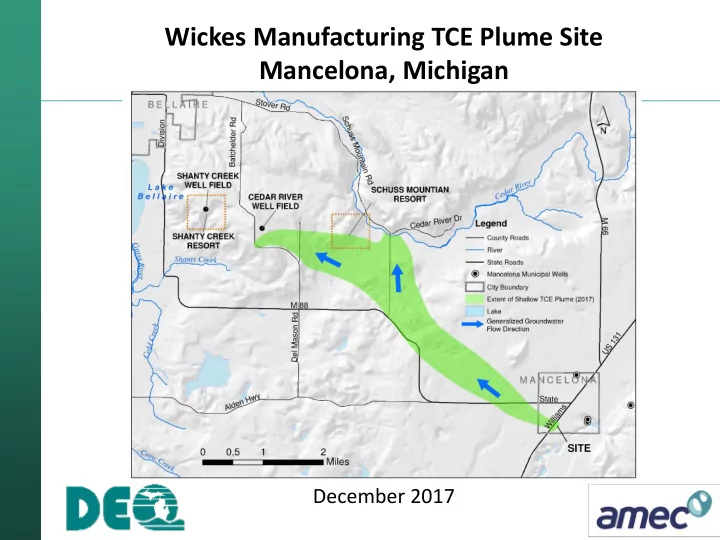
Wickes Manufacturing TCE Plume Site Mancelona, Michigan December - - PowerPoint PPT Presentation

wickes manufacturing tce plume site mancelona michigan
SMART_READER_LITE
LIVE PREVIEW

Wickes Manufacturing TCE Plume Site Mancelona, Michigan December - - PowerPoint PPT Presentation

Wickes Manufacturing TCE Plume Site Mancelona, Michigan December 2017 What is TCE ? Trichloroethylene (TCE) Common Industrial Solvent Known Human Carcinogen Federal and State Safe Drinking Water of 5 g/L or 5 ppb


slide-1
SLIDE 1

Wickes Manufacturing TCE Plume Site Mancelona, Michigan

December 2017
slide-2
SLIDE 2

What is TCE ?

  • Trichloroethylene (TCE)
  • Common Industrial Solvent
  • Known Human Carcinogen
  • Federal and State Safe Drinking Water of 5 µg/L or 5 ppb
  • State Surface Water Protection Standard of 200 µg/L or 200 ppb
  • Tier I vapor intrusion groundwater screening level is under review

(Proposed level is 0.073 µg/L per Draft September 2017 guidance; however, the typical laboratory detection level for TCE in groundwater ranges from 0.5 to 1 µg/L)

slide-3
SLIDE 3

Just How Much is 1 ppb ?

  • 1 inch in 16,000 miles
  • 1 second in 32 years
  • 1 cent in $10,000,000
  • 1 pinch of salt in 10 tons of potato chips
  • 1 square foot in 36 square miles
slide-4
SLIDE 4

History of Site

  • Mount Clemens Industries, Inc. – auto parts manufacturing (1947-1967).
  • TCE was discarded on the ground where it seeped through the soil and

into the groundwater below the property

  • After 1967 Site operated as Wickes Manufacturing, then Dura

Automotive

  • Site is an ‘orphaned’ site; DEQ and EPA involved following the discovery
  • f TCE in groundwater (1986).
  • DEQ stepped in so that a key local employer was not liable.
  • Early stage State funds were used to:

 Sample residential wells for TCE  Supply bottled water to impacted residents in Mancelona  Support municipal water infrastructure system / creation of Mancelona Area Water and Sewer Authority (MAWSA)

slide-5
SLIDE 5

1962 Aerial Photograph

FORMER UNTREATED WASTE SEEPAGE LAGOONS FORMER FINAL EFFLUENT POND

slide-6
SLIDE 6

1981 Aerial Photograph

FORMER FINAL EFFLUENT POND FORMER UNLINED INDUSTRIAL WASTE LANDFILL FORMER TREATED WASTE SETTLING LAGOONS USE OF UNTREATED WASTE SEEPAGE LAGOON DISCONTINUED IN 1972

slide-7
SLIDE 7

1992 Aerial Photograph

FORMER FINAL EFFLUENT POND FACILITY EXPANSION COVERS FORMER UNTREATED WASTE SEEPAGE LAGOON LOCATIONS FORMER TREATED WASTE SETTLING LAGOONS AND INDUSTRIAL WASTE LANDFILL REMOVED IN 1988/89 FORMER FINAL EFFLUENT POND MONITORING WELLS INSTALLED BY THE EPA IN 1986

slide-8
SLIDE 8

Source Area Removal – Similar to Work Performed at Former Treated Waste Settling Lagoons in 1988/1989

slide-9
SLIDE 9

DEQ Partners

  • Environmental Assessment (AMEC)

– Source Area Evaluations (e.g., 2017 soil gas assessment) – Remedial Investigations (e.g., 2017 monitoring well network expansion & downgradient vapor intrusion assessment) – Risk Assessment: Protection of Human Health and Environment – Feasibility Study / Evaluation of Remediation Options – Ongoing Groundwater and Pore Water/Surface Water Sampling – Ongoing Hydrogeologic characterization – Ongoing Public Outreach Support

  • On-going Residential Well Sampling Program (Health

Department) & Well First Policy

  • Expansion of the Municipal Water System (MAWSA)
slide-10
SLIDE 10

DEQ Past Investigations

  • DEQ worked with community and then-current property owner

to define extent of problem and replace impacted groundwater supply in and around Mancelona

  • DEQ groundwater investigations begin in 1999
  • Investigations began at the plant and moved northwesterly,

which is the direction of the groundwater flow

  • No significant residual sources found during investigations at

the Site

  • 129 existing permanent monitoring wells installed
  • Extensive vertical groundwater profiling (e.g., 2004, 2007 and

2015)

slide-11
SLIDE 11

DEQ Current Investigations

  • Annual Groundwater Monitoring Program:
  • Sample select monitor wells in Spring and Fall of each year
  • Gauge depth to water / generate groundwater flow maps
  • Sample the Cedar River and pore water near the river annually
  • Sample annually / semi-annually residential wells near the plume
  • Additional 2017 Activities
  • Expand sentinel monitoring well network (Windy Hill Trail & Shanty Creek)
  • Soil Gas evaluation (Source Area – follow up to expanded groundwater

sampling in source area in 2016 & Downgradient)

  • Assess groundwater discharge to Shanty Creek
  • Assess affect of Cedar River Well Field (CRWF) pumping regime on

aquifer(s) following 2016 high pressure water line installation (Mancelona well fields to the CRWF)

slide-12
SLIDE 12

TCE Plume Evaluation - Challenges

Challenges

  • Footprint exceeds 4,000

acres;

  • North Lobe vents to

Cedar River (TCE levels are below 200 µg/L)

  • West Lobe moves

toward Lake Bellaire / Shanty Creek

SITE SCHUSS Mtn.

From upnorthlive.com - archive

  • TCE occurs in three different water bearing zones in the

glacial soils: Shallow, Intermediate and Deep.

  • TCE has been found as deep as 500 feet below ground surface.
  • No significant natural degradation of TCE is observed
slide-13
SLIDE 13

Conceptual Site Model

MANCELONA WELL FIELD

X

VOLATILIZATION (WATER TABLE)

VOLATILIZATION (SOIL)

SOURCE: TCE RELEASED ON THE GROUND AND/OR IN UNLINED SEEPAGE LAGOONS OVER A PROLONGED PERIOD

“Clean Water Blanket” low Volatilization potential

slide-14
SLIDE 14

2008 Feasibility Study

  • Risk Evaluation

– TCE presents a drinking water risk; TCE is human carcinogenic (EPA, 2011). The drinking water criteria is 5 µg/L. – TCE is a threat to macroinvertebrates where groundwater vents to surface water (GSI) above the GSI criteria of 200 µg/L. – Evaluate potential for TCE to off-gas from groundwater and create an inhalation risk.

MANCELONA WELL FIELD

X

VOLATILIZATION

(WATER TABLE)

VOLATILIZATION (SOIL) SOURCE

“Clean Water Blanket” low Volatilization potential

slide-15
SLIDE 15

2008 Feasibility Study

  • Options Considered:

–In-situ Destruction/Degradation Remedies

Elevated dissolved oxygen and low total organic carbon in saturated zones prevent effective in-situ treatment, for example:

  • Nanoscale iron
  • Enhanced Bioremediation

–Groundwater Extraction and Ex-situ Treatment (via Carbon or Air Stripper) –Hydraulic Control – Extract groundwater and pump back into the aquifer(s) to “steer” plume away from specific receptors –Monitor; restrict installation of new wells, replace or treat water supply wells

slide-16
SLIDE 16

Groundwater Risks - TCE in Shallow Groundwater

MAWSA Wells: Upgradient of Wickes Site

CRWF Does not withdraw water from this zone Residential Wells use water from different depths within this zone – Health Department Monitoring / municipal water replacement per FS.

Shallow

slide-17
SLIDE 17

TCE Groundwater Zones - Shallow

Shallow Zone

Plume is ~160 feet ABOVE the CRWF screens. Shallow groundwater flows to the northwest near the CRWF but to southwest at leading edge of the plume. TCE is estimated to move at ~450- 625 feet per year 2017 Wells

Based upon data to date, science shows TCE will move past the well field without ever impacting the drinking water.

2016 2012 2008 2005

Regularly Sampled wells

2017- New wells at Shanty Creek Headwaters (Not shown) ~600’

DEQ funded service area expansion (2017)

slide-18
SLIDE 18

Intermediate Zone TCE moves at ~100 feet per year (slower because there is more silt and clay). This zone is ~80 feet ABOVE CRWF screens. Intermediate Zone is separated from the Deep Zone by an aquitard (low permeability layer) that varies in thickness (5-feet to 50+feet) The DEQ continues to monitor the intermediate zone and the underlying CRWF aquifer

TCE in Groundwater – Intermediate Zone

2017 Well

Routinely Sampled wells

MW-X: Max. TCE in Intermediate Zone (190 ppb, 2016)

slide-19
SLIDE 19

TCE in Groundwater – Deep Zone

Deep Zone TCE moves at less than 50 feet per year (more clay and silt). Very low levels of TCE (1.0 to 1.2 ppb) have been detected at MW- Xd, where clays are very thin. Sampling shows TCE detected at MW-Xd is not related to TCE detected to the southwest

TCE concentrations show declining trends MW-Xd

The DEQ continues to monitor pumping stresses and TCE extent in the Deep Zone, particularly near the CRWF. MAWSA also samples CRWF wells for TCE (never detected)

slide-20
SLIDE 20

Cedar River Well Field (CRWF)

  • Supplies drinking water to the

MAWSA.

  • CRWF service area decreased after

high pressure line upgrade from Mancelona in 2016 (less use).

  • Is located lateral to current position of

the west lobe of the shallow TCE plume (turning toward Shanty Creek).

  • CRWF well screens, depth where

water is pumped from the ground, are located in the Deep Zone or the “CRWF Aquifer” (575-feet below ground surface).

Deep (CRWF Water Source) Shallow 2017 Activities: To Shanty Creek?

slide-21
SLIDE 21

Measuring Pumping Response in Shallow, Intermediate and Deep Wells near the CRWF – Pre-Water Main Expansion

CRWF

<1’ >6’ >13’ No measurable Change Water Source for the CRWF

slide-22
SLIDE 22
  • Pumping at the CRWF

causes water levels in the Deep Zone to drop.

  • Potential movement of

water from Intermediate Zone to Deep Zone is enhanced by water level drop (downward vertical gradient).

  • CRWF operates at 100 – 200

gallons per minute (gpm);

  • ccasionally 900 gpm

Hydraulic Testing – Groundwater Connections at the CRWF

  • 20
  • 15
  • 10
  • 5

5 1 2 3 4 5 6 7 8 9 10 11 12 13

Pressure change (ft of head) Monitoring Period (days)

Drawdown at the CRWF (OW-2)

Oct 26 - Nov 8, 2017 Oct 10 - Oct 17, 2016

  • No pumping-related water level drops observed in the Shallow Zone.
  • Pumping tests concluded the water level in the Intermediate Zone dropped

slightly when the CRWF was pumped at maximum capacity of (~900 gpm).

slide-23
SLIDE 23
  • In 2016 a high pressure

water main was extended from Mancelona to the CRWF to:

  • Reduce volume of

CRWF water used

  • Reduce pumping

frequency

  • Plans in place to

increase water storage capacity at the CRWF to further reduce need for high pumping rates.

Hydraulic Testing – Water Main Extension

  • 6
  • 4
  • 2

2 4 6 1 2 3 4 5 6 7 8 9 10 11 12 13

Pressure change (ft of head) Monitoring Period (days)

Drawdown in Well MW-6uCRWF

Oct 26 - Nov 8, 2017 Sept 26 - Oct 14, 2016

High rate event (hydrant flushing) High rate events common (Pre-Expansion)

slide-24
SLIDE 24
  • In 2017 Nine new monitoring wells were installed strategically between

potential downgradient receptors and the leading edge of the TCE plume (3 along Windy Hill, 5 near Shanty Creek and 1 along Del Mason Road).

  • The new well nests will allow monitoring of “first detection” of TCE in

each zone to continue as TCE moves beyond the CRWF area into areas where more residential wells occur.

  • Early detection monitoring wells are being sampled twice a year.
  • The new wells provide greater control on groundwater flow direction to

enhance projection of plume movement in the future.

  • As an additional safe guard, MDEQ contracts the Health Department to

sample residential wells near the leading edge of TCE in groundwater.

Early Detection

slide-25
SLIDE 25
  • Cedar River Sampling (Fall 2017) - TCE “Vents” to the Cedar

River TCE is not detected in downstream river samples because TCE moves from the river to the air readily. Biological surveys find no adverse affects on the river’s ecology. TCE is not detected across the river. TCE in groundwater near the Cedar River is below 200 ppb.

Surface Water – Cedar River

slide-26
SLIDE 26

Surface Water - Shanty Creek

  • Four Stream Gauging & Flow Measurement Locations
  • Seasonal flow variation assessed December 2016, May

2017 and September 2017 to evaluate average groundwater flux into Shanty Creek.

  • Shanty Creek discharges to the Grass River

SG-2 Pond outfall SG-4 Upstream of M-88 Crossing SG-3 Measured profile (Typ.)

slide-27
SLIDE 27

Measuring Point Approximate Flow (GPM) Approximate Gain (GPM) SG-2 90 90 SG-3 3295 3205 SG-4 3670 375 M-88 3850 180

Surface Water - Shanty Creek

Results: In only ~1,200 feet Shanty Creek’s flow increases by ~3,200 gpm (continuously)

Toe of Plume

  • Leading edge of plume

~3200 feet to northeast (~5-7 years travel time)

  • TCE in groundwater above

200 ppb is ~2.1 miles upgradient (~18-25 years travel time)

slide-28
SLIDE 28

Soil Vapor – 2017 Source Area

VOLATILIZATION (WATER TABLE)

VAPOR INTRUSION

  • Soil & water table sources?
  • Geophysical Survey
  • Installed soil vapor probes at

23 locations (typ. depth 5 feet)

  • Nested soil vapor probes &

paired groundwater samples to assess volatilization from water table

  • Collected soil samples at soil

vapor probe depths

  • Installed temporary points to

assess vapor cloud extent

N

slide-29
SLIDE 29

Soil Vapor – 2017 Source Area Preliminary Summary

  • Soil vapor cloud under the former building exceeds

non-residential screening levels.

N

  • Additional

results pending

  • TCE in vapor
  • typ. increases

with depth (water table)

  • Low-level soil TCE

results (consistent with 2006 source area investigation results)

Soil Gas Probe Monitoring Well 2006 Boring Former degreaser

slide-30
SLIDE 30

12 Vapor and 11 Water sample locations. Vapor intrusion less likely when:

  • TCE not at

water table

  • Increasing

Depth to groundwater TCE NOT detected in soil vapor above new, lower screening levels

Soil Vapor – 2017 Downgradient Plume Assessment

VOLATILIZATION (WATER TABLE) VAPOR INTRUSION?

“Clean” Water Table

X

MW-31R

slide-31
SLIDE 31

DEQ has set aside funding to:

  • Continue groundwater investigations to track the TCE’s

movement in the groundwater

  • Sample existing private drinking water wells near the TCE

impacted groundwater area

  • Provide bottle water to affected residents (as needed)
  • Extend the public water system
  • Connect residences to the extended public water system
  • Continue to monitor conditions at the Cedar River and

Shanty Creek

  • Continue to assess the potential soil vapor pathway

Future Activities

slide-32
SLIDE 32

Questions

Interactive website: https://ifrastructure.amecfw.com/wickes/