Why Update OSHA updated 2nd Leading cause of Workplace fatalities - - PDF document

why update
SMART_READER_LITE
LIVE PREVIEW

Why Update OSHA updated 2nd Leading cause of Workplace fatalities - - PDF document

6/25/2018 Why Update OSHA updated 2nd Leading cause of Workplace fatalities Walking Working Standard $70 Billion Workers Comp Cost - US 100+ Million lost workdays/year - US Cari Gray, CSP Safety Consultant Ohio BWC


slide-1
SLIDE 1

6/25/2018 1

OSHA updated Walking Working Standard

Cari Gray, CSP Safety Consultant Ohio BWC Cari.Gray@bwc.state.oh.us

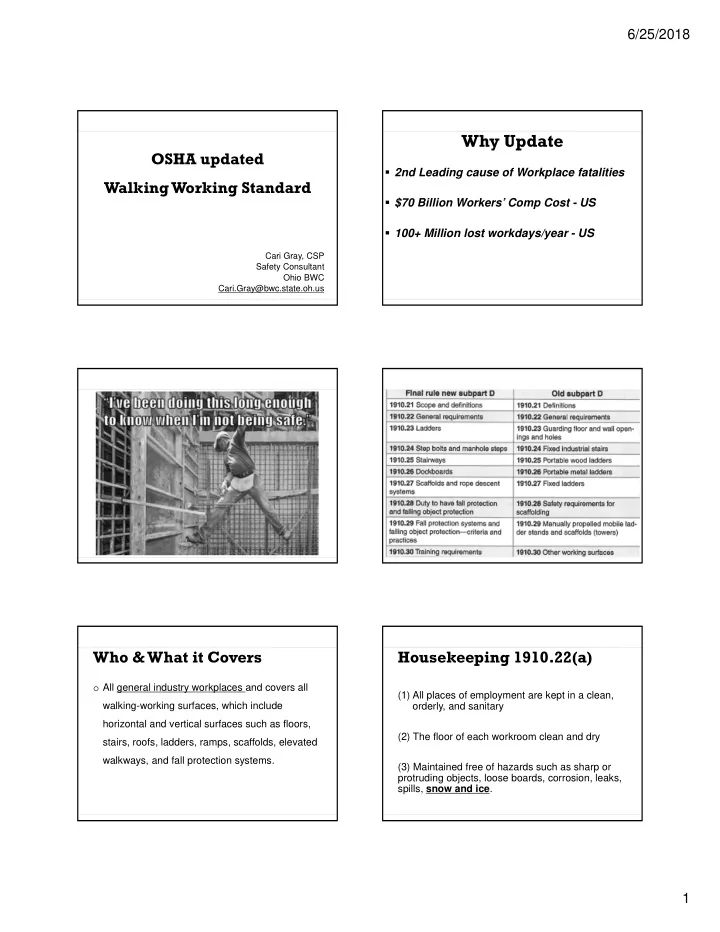
Why Update

  • 2nd Leading cause of Workplace fatalities
  • $70 Billion Workers’ Comp Cost - US
  • 100+ Million lost workdays/year - US

Who & What it Covers

  • All general industry workplaces and covers all

walking-working surfaces, which include horizontal and vertical surfaces such as floors, stairs, roofs, ladders, ramps, scaffolds, elevated walkways, and fall protection systems.

Housekeeping 1910.22(a)

(1) All places of employment are kept in a clean,

  • rderly, and sanitary

(2) The floor of each workroom clean and dry (3) Maintained free of hazards such as sharp or protruding objects, loose boards, corrosion, leaks, spills, snow and ice.

slide-2
SLIDE 2

6/25/2018 2

1910.22 (b) and (c)

  • Can Support the Load
  • Safe Access to and from

surfaces

Inspections and repair

(1) Inspected, regularly and as necessary, and maintained in a safe condition; (2) Hazardous conditions on walking-working surfaces are corrected before use. If the correction cannot be made immediately, the hazard must be guarded to prevent use (3) When any correction or repair involves the structural integrity of the walking-working surface, a qualified person performs or supervises the correction or repair.

OSHA’s Definition of Qualified

“Qualified" means one who, by possession

  • f a recognized degree, certificate, or

professional standing, or who by extensive knowledge, training, and experience, has successfully demonstrated his ability to solve

  • r resolve problems relating to the subject

matter, the work, or the project.

Ladders

  • Specific telecommunications requirements
  • Design requirements, uniform, spacing,
  • Step stools included
  • Ladders are inspected before initial use in each

work shift, and more frequently as necessary, to identify any visible defects that could cause employee injury;

  • Tagged “Dangerous” for defects
slide-3
SLIDE 3

6/25/2018 3

Ladders – Reqt for use

  • Face ladder
  • Must use at least 1

hand

  • Cannot carry load that

could cause employee to loose balance.

Portable ladder

  • Specific on “good condition”
  • Open spreader
  • Not overloaded
  • Stable surface
  • Cannot move while in use
  • Secured
  • Temporary barricade
  • 3 feet above landing surface

Fixed Ladders

  • Not overloaded
  • Design

requirements

  • Requirements for

grab bars, side- step ladders, through ladders and end in hatch

Mobile Ladder Stand Platform

  • Design requirements –

uniform, slip resistant, support 4 times intended load, handrails,

  • Max surface height cannot

exceed 4 X shortest base dimension with out additional safety device

  • Cannot move while in use

Step bolts and manhole steps

  • Anti corrosion material, anti slip, uniform spacing
  • Support intended max load (4 X if installed after

Jan 2017)

Stairways 1910.25

  • Design reqt – similar
  • Support 5X intended load (not less than

1000lbs)

  • Specific on tread width depth and riser height
slide-4
SLIDE 4

6/25/2018 4

Dock Boards1910.26

  • Dock boards put into initial service on or after

January 17, 2017 are designed, constructed, and maintained to prevent transfer vehicles from running off the dock board edge;

  • Exception to paragraph (b)(1) of this section.

When the employer demonstrates there is no hazard of transfer vehicles running off the dock board edge, the employer may use dock boards that do not have run-off protection.

Dock Boards

  • Dock boards are capable of supporting the

maximum intended load

  • Portable dock boards are equipped with

handholds or other means to permit safe handling of dock boards

Scaffolding 1910.27 meet 1926

  • Must be capable of supporting four times

the maximum intended load

  • Do not alter or move while in use
  • Protect workers on scaffolds from
  • verhead hazards
  • If higher than 10 ft., use guardrails, mid

rails and toe boards

  • Use wire mesh between the toe board and

guardrail if people work or pass underneath

  • Must be equipped with access ladder or

equivalent

Rope Descent System 1910.27

  • The rope descent system is used in

accordance with instructions, warnings, and design limitations set by the manufacturer or under the direction of a qualified person;

  • The rope descent system is inspected at the

start of each work shift that it is to be used

slide-5
SLIDE 5

6/25/2018 5 Duty to Have Fall Protection & Falling Object Protection 1910.28

Does Not Apply to:

  • To portable ladders
  • When employers are inspecting, investigating, or

assessing workplace conditions

  • entertainment stages and rail-station platforms
  • To powered platforms or aerial lifts
  • To telecommunications
  • To electric power generation, transmission, and

distribution work

Fall prevention 1910.28

Each employee on a walking-working surface with an unprotected side or edge that is 4 feet (1.2 m)

  • r more above a lower level is protected by:
  • Guardrail systems;
  • Safety net systems; or
  • Personal fall protection systems, such as

personal fall arrest, travel restraint, or positioning systems. (ANSI Z359)

Head protection 1910.28

  • When an employee is exposed to falling
  • bjects, the employer must ensure that each

employee wears head protection that meets the requirements of subpart I of this part.

Fixed Ladders 1910.28

  • For fixed ladders that extend more than

24 feet (7.3 m) above a lower level, the employer must ensure

  • Each fixed ladder installed before November

19, 2018 is equipped with a personal fall arrest system, ladder safety system, cage, or well;

slide-6
SLIDE 6

6/25/2018 6

Fixed Ladders 1910.28

  • Each fixed ladder installed on and after November

19, 2018, is equipped with a personal fall arrest system or a ladder safety system (see 1910.29)

  • On and after November 18, 2036, all fixed ladders

are equipped with a personal fall arrest system or a ladder safety system

Stairways

Flights of stairs with four or more risers must have standard stair railings or handrails.

Work on low slope roofs

  • Less than 6’ – must provide fall protection or

prevention

  • 6’-15” can use designated areas
  • More than 15’ – can train and restrict and not

provide fall protection

Standard Railings 1910.29

  • Top rail, mid rail, and posts.
  • Height 42 inches (+/– 3 in).
  • Mid rails are installed at a height midway
  • Toe boards minimum 3.5 inches
  • Outward force of 200#, 150# and 50#

Training 1910.30

  • Employer MUST provide training to each

employee who will use a Personal Fall Protection System

  • Training MUST be conducted by

qualified person

slide-7
SLIDE 7

6/25/2018 7

Training shall include

  • Nature of the fall hazards and how to recognize

them

  • Procedures to minimize hazards
  • Procedures for installing, inspecting, operating,

maintain and disassembling fall protection systems

  • Correct use of fall protection systems including

roper hook-up, anchoring, and tie-off techniques, and methods of equipment inspection and storage

Training

  • n or before May 17, 2017
  • Proper care, inspection, storage, and use of

equipment before use.

  • Employees who use dockboards
  • Employees who use rope decent systems
  • Employees who use designated areas

Retraining

  • Changes in workplace
  • Changes in equipment
  • Employee no longer has

the requisite understanding or skill necessary to use equipment or perform the job safely

  • The employer must provide information

and training to each employee in a manner that the employee understands

Subpart I - 1910.140

  • Changed as well
  • Set performance, care and use criteria for

personal fall protection systems

  • Competent person
  • Qualified person
  • Training

Beyond Compliance

  • Analyze
  • Audit
  • Correct
  • Engineering

Controls

  • Foot wear
  • Reporting
  • Training
  • Accountability
slide-8
SLIDE 8

6/25/2018 8

Because…