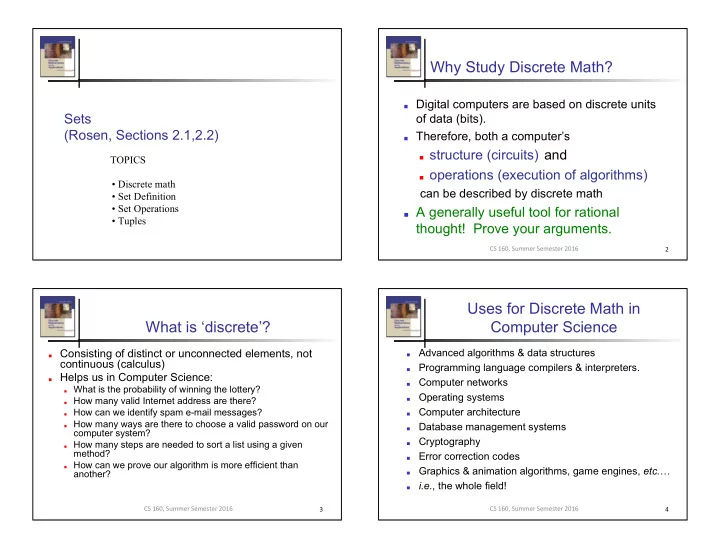
Why Study Discrete Math? Digital computers are based on discrete - - PowerPoint PPT Presentation

why study discrete math
SMART_READER_LITE
LIVE PREVIEW

Why Study Discrete Math? Digital computers are based on discrete - - PowerPoint PPT Presentation

Why Study Discrete Math? Digital computers are based on discrete units Sets of data (bits). (Rosen, Sections 2.1,2.2) Therefore, both a computers structure (circuits) and TOPICS operations (execution of algorithms)


slide-1
SLIDE 1

Sets (Rosen, Sections 2.1,2.2)

TOPICS

  • Discrete math
  • Set Definition
  • Set Operations
  • Tuples

Why Study Discrete Math?

■ Digital computers are based on discrete units

  • f data (bits).

■ Therefore, both a computer’s ■ structure (circuits) and ■ operations (execution of algorithms)

can be described by discrete math

■ A generally useful tool for rational

thought! Prove your arguments.

2 CS 160, Summer Semester 2016

What is ‘discrete’?

■ Consisting of distinct or unconnected elements, not

continuous (calculus)

■ Helps us in Computer Science:

■ What is the probability of winning the lottery? ■ How many valid Internet address are there? ■ How can we identify spam e-mail messages? ■ How many ways are there to choose a valid password on our

computer system?

■ How many steps are needed to sort a list using a given

method?

■ How can we prove our algorithm is more efficient than

another?

3 CS 160, Summer Semester 2016

Uses for Discrete Math in Computer Science

Advanced algorithms & data structures

Programming language compilers & interpreters.

Computer networks

Operating systems

Computer architecture

Database management systems

Cryptography

Error correction codes

Graphics & animation algorithms, game engines, etc.…

i.e., the whole field!

4 CS 160, Summer Semester 2016

slide-2
SLIDE 2

What is a set?

■ An unordered collection of objects

■ {1, 2, 3} = {3, 2, 1} since sets are unordered. ■ {a, b, c} = {b, c, a} = {c, b, a} = {c, a, b} = {a, c, b} ■ {2} ■ {on, off} ■ { }

5 CS 160, Summer Semester 2016

What is a set?

■ Objects are called elements or members of

the set

■ Notation ∈

■ a ∈ B means “a is an element of set B.” ■ Lower case letters for elements in the set ■ Upper case letters for sets ■ If A = {1, 2, 3, 4, 5} and x ∈ A, what are the

possible values of x?

6 CS 160, Summer Semester 2016

What is a set?

Infinite Sets (without end, unending)

N = {0, 1, 2, 3, …} is the Set of natural numbers

Z = {…, -2, -1, 0, 1, 2, …} is the Set of integers

Z+ = {1, 2, 3, …} is the Set of positive integers

Finite Sets (limited number of elements)

V = {a, e, i, o, u} is the Set of vowels

O = {1, 3, 5, 7, 9} is the Set of odd #’s < 10

F = {a, 2, Fred, New Jersey}

Boolean data type used frequently in programming

B = {0,1}

B = {false, true}

Seasons = {spring, summer, fall, winter}

ClassLevel = {Freshman, Sophomore, Junior, Senior}

7 CS 160, Summer Semester 2016

What is a set?

■ Infinite vs. finite

■ If finite, then the number of elements is called

the cardinality, denoted |S|

■ V = {a, e, i, o, u}

|V| = 5

■ F = {1, 2, 3}

|F| = 3

■ B = {0,1}

|B| = 2

■ S = {spring, summer, fall, winter} |S| = 4

8 CS 160, Summer Semester 2016

slide-3
SLIDE 3

■ Alphabet ■ All characters ■ Booleans: true, false ■ Numbers:

■ N = {0,1,2,3…}- Natural numbers ■ Z = {…,-2,-1,0,1,2,…} - Integers ■ Q = - Rationals ■ R, Real Numbers

■ Note that:

■ Q and R are not the same. Q is a subset of R. ■ N is a subset of Z.

Example sets

9 CS 160, Summer Semester 2016

Venn Diagram

■ Graphical representation of

set relations:

U

10

A B

CS 160, Summer Semester 2016

What is a set?

■ Defining a set:

■ Option 1: List the members ■ Option 2; Use a set builder that defines set of x that

hold a certain characteristic

■ Notation: {x ∈ S | characteristic of x} ■ Examples:

■ A = { x ∈ Z+ | x is prime } – set of all prime

positive integers

■ O = { x ∈ N | x is odd and x < 10000 } – set of

  • dd natural numbers less than 10000

11 CS 160, Summer Semester 2016

Equality

■ A = B is used to show set equality ■ Two sets are equal when they have

exactly the same elements

■ Thus for all elements x, x belongs to A

if and only if (iff) x also belongs to B

■ The if and only is a bidirectional

implication that we will study later

12 CS 160, Summer Semester 2016

slide-4
SLIDE 4

Set Operations: Union

  • Operations that take as input sets and

have as output sets

  • The union of the sets A and B is the set that

contains those elements that are either in A or in B, or in both. – Notation: A∪B – Example: union of {1, 2, 3} and {1, 3, 5} is?

13 CS 160, Summer Semester 2016

Answer: {1, 2, 3, 5}

Set Operations: Intersection

  • The intersection of sets A and B is the set

containing those elements in both A and B.

  • Notation: A∩B
  • The sets are disjoint if their intersection

produces the empty set.

  • Example: {1, 2, 3} intersection {1, 3, 5} is?

14 CS 160, Summer Semester 2016

Answer: {1, 3}

Set Operations: Difference

  • The difference of A and B is the set of

elements that are in A but not in B.

  • Notation: A - B
  • Aka the complement of B with respect to A
  • Can you define difference using union,

complement and intersection?

  • Example: {1, 2, 3} difference {1, 3, 5} is?

15 CS 160, Summer Semester 2016

Answer: {2}

Set Operations: Complement

  • The complement of set A is the

complement of A with respect to U, the universal set.

  • Notation:
  • Example: If N is the universal set, what is

the complement of {1, 3, 5}? Answer: {0, 2, 4, 6, 7, 8, …}

16 CS 160, Summer Semester 2016

slide-5
SLIDE 5

Identities

17 CS 160, Summer Semester 2016

Subsets

■ The set A is a subset of B iff for all

elements x of A, x is also an element of B. But not necessarily the reverse…

■ Notation: A ⊆ B

■ {1,2,3} ⊆ {1,2,3} ■ {1,2,3} ⊆ {1,2,3,4,5}

■ What is the relationship of the cardinality between sets if A ⊆ B ?

18 CS 160, Summer Semester 2016

|A| <= |B|

Subset

■ Subset is when a set is contained in

another set. Notation: ⊆

■ Proper subset is when A is a subset of B,

but B is not a subset of A. Notation: ⊂

■ ∀x ((x ∈ A) → (x ∈ B)) ∧ ∃x ((x ∈ B) ∧ (x ∉ A)) ■ All values x in set A also exist in set B ■ … but there is at least 1 value x in B that is not in A ■ A = {1,2,3}, B = {1,2,3,4,5}

A ⊂ B, means that |A| < |B|.

except for infinite sets, e.g., N ⊂ Z, but |N| = |Z| = infinity

19 CS 160, Summer Semester 2016

Empty Set

■ Empty set has no elements and therefore is

the subset of all sets: { } or Ø

■ Is Ø ⊆ {1,2,3}? - Yes! ■ The cardinality of Ø is zero: |Ø| = 0. ■ Consider the set containing the empty set:

{Ø}

■ Yes, this is indeed a set:

Ø ∈ {Ø} and Ø ⊆ {Ø}.

20 CS 160, Summer Semester 2016

slide-6
SLIDE 6

Set Theory

Quiz time:

  • A = { x ∈ N | x ≤ 2000 } What is |A|?
  • B = { x ∈ N | x ≥ 2000 } What is |B|?
  • Is {x} ⊆ {x}?
  • Is {x} ∈ {x,{x}}?
  • Is {x} ⊆ {x,{x}}?
  • Is {x} ∈ {x}?

21 CS 160, Summer Semester 2016

2001 Infinite Yes Yes Yes No

Powerset

■ The powerset of a set is the set containing

all the subsets of that set.

■ Notation: P(A) is the powerset of set A. ■ Fact: | P(A) | = 2|A|.

■ If A = { x, y }, then P(A) = {∅, {x}, {y}, {x,y} } ■ If S = {a, b, c}, what is P(S)?

22 CS 160, Summer Semester 2016

Powerset example

  • Number of elements in powerset = 2n where n = #

elements in set

  • S is the set {a, b, c}, what are all the subsets of S?

■ { } – the empty set ■ {a}, {b}, {c} – one element sets ■ {a, b}, {a, c}, {b, c} – two element sets ■ {a, b, c} – the original set

and hence the power set of S has 23 = 8 elements: {{}, {a}, {b}, {c}, {a, b}, {b, c}, {c, a}, {a, b, c}}

23 CS 160, Summer Semester 2016

Example

■ Consider binary numbers

■ E.g. 0101

■ Let every bit position {1,…,n} be an item

■ Position i is in the set if bit i is 1 ■ Position i is not in the set if bit i is 0

■ What is the set of all possible n-bit numbers? ■ The powerset of {1,…n}. 24 CS 160, Summer Semester 2016

slide-7
SLIDE 7

Example (contd.)

■ n= 4, i.e, 4 bits, each representing 1 item 25 CS 160, Summer Semester 2016

1 2 3 4 {}, No item present 1 {1}, Item 1 present 1 {2}, Item 2 present 1 1 {1, 2}, Items 1, 2 present 1 1 1 {1, 2, 3}, Items 1, 2, 3 present 1 1 1 1 {1, 2, 3, 4}, All items present …… …… ……

Why sets?

■ Programming - Recall a class… it is the set of all

its possible objects.

■ We can restrict the type of an object, which is

the set of values it can hold.

■ Example: Data Types

int set of integers (finite) char set of characters (finite)

■ Is N the same as the set of integers in a computer? ■ Is Q or R the same as the set of doubles in a

computer?

26 CS 160, Summer Semester 2016

Order Matters

■ What if order matters?

■ Sets disregard ordering of elements ■ If order is important, we use tuples ■ If order matters, then are duplicates

important too?

27 CS 160, Summer Semester 2016

Tuples

■ Order matters ■ Duplicates matter ■ Represented with parens ( ) ■ Examples

■ (1, 2, 3) ≠ (3, 2, 1) ≠ (1, 1, 1, 2, 3, 3) 28 CS 160, Summer Semester 2016

slide-8
SLIDE 8

Tuples

■ The ordered n-tuple is the

  • rdered collection that has as its first

element as its second element … and as its nth element.

■ An ordered pair is a 2-tuple. ■ Two ordered pairs (a,b) and (c,d) are equal

iff a=c and b=d (e.g. NOT if a=d and b=c).

■ A 3-tuple is a triple; a 5-tuple is a quintuple.

29 CS 160, Summer Semester 2016

Tuples

■ In programming?

■ Let’s say you’re working with three integer values, first

is the office room # of the employee, another is the # years they’ve worked for the company, and the last is their ID number.

■ Given the following set {320, 13, 4392}, how many

years has the employee worked for the company?

■ What if the set was {320, 13, 4392}?

Doesn’t {320, 13, 4392} = {320, 4392, 13} ?

■ Given the 3-tuple (320, 13, 4392) can we identify the

number of years the employee worked?

30 CS 160, Summer Semester 2016

Why?

■ Because ordered n-tuples are found as lists

  • f arguments to functions/methods in

computer programming.

■ Create a mouse in a position (2, 3) in a

maze: new Mouse(2,3)

■ Can we reverse the order of the

parameters?

■ From Java, Math.min(1,2)

31 CS 160, Summer Semester 2016

Cartesian Product

  • Let A and B be sets. The Cartesian Product of

A and B is the set of all ordered pairs (a,b), where b ∈ B and a ∈ A

  • Cartesian Product is denoted A x B.
  • Example: A={1,2} and B={a,b,c}. What is

A x B and B x A?

32 CS 160, Summer Semester 2016

slide-9
SLIDE 9

Cartesian Product

  • A = {a, b}
  • B = {1, 2, 3}
  • A X B = {(a, 1), (a, 2), (a, 3), (b, 1), (b, 2), (b, 3)}
  • B X A = {(1, a), (1, b), (2, a), (2, b), (3, a), (3, b)}

33 CS 160, Summer Semester 2016