
SLIDE 1
Why don’t we do better when we know better? A First Nations children case study
Universities: Social Sciences and Humanities: Where were we?
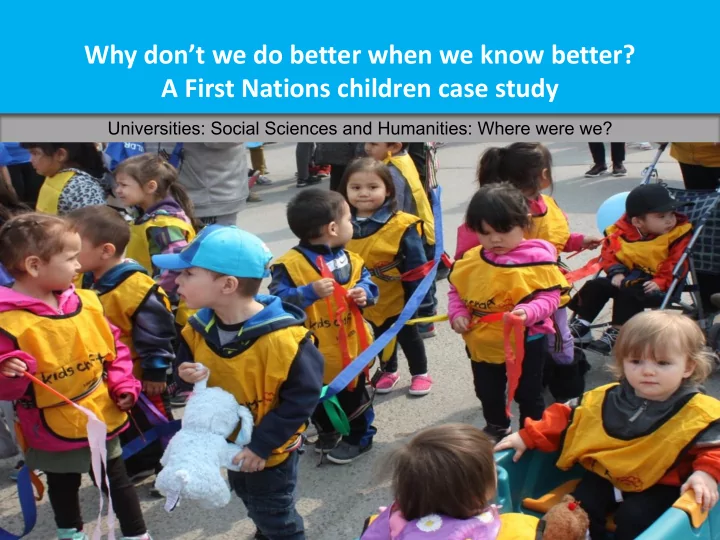
Why dont we do better when we know better? A First Nations children - - PowerPoint PPT Presentation
Why dont we do better when we know better? A First Nations children case study Universities: Social Sciences and Humanities: Where were we? Whereas the undersigned, Indian Agent, being satisfied that name of child, an Indian child between
Why don’t we do better when we know better? A First Nations children case study
Universities: Social Sciences and Humanities: Where were we?
Whereas the undersigned, Indian Agent, being satisfied that name
six and sixteen years of age, to wit, of or about the age of __ years, has not been properly cared for or educated, or cared for and educated…it has been shown to the satisfaction of the undersigned that adequate provision is not being made, and will not be made for the care... These are therefore to command and authorize you in her Majesty’s name forthwith to search for and apprehend (the child)
“Suffice it to say that of the 1537 pupils reported upon, 25% are dead of one school with an absolutely accurate statement 69%
description of the schools shows them to be veritable hotbeds for the propagation and spread of this disease.” Peter Henderson Bryce, MD
Dear Parent
We are going to tell you how we are treated. I am always hungry. We only get two slices of bread and
because they were hungry… I am not sick. I hope you are the same too. I am going to hit the teacher if she is cruel to me again. We are treated like pigs, some of the boys always eat cats and wheat. I never ask anyone to give me anything to eat. Some of the boys cried because they are hungry. Once I cry to because I was very hungry.
Edward B., December 14, 1923
Scott’s reaction to Edward’s letter? “99 percent of the of the Indian children at these schools are too fat” Scott served as President of the Royal Society from 1921-1922 (the same year as Bryce’s National Crime Report was published). He was awarded the Lorne-Pierce Medal and received honorary doctorates from 2 Universities.
Duncan Campbell Scott, Deputy Superintendent of Indian Affairs and Confederate Poet
“Although 80 percent of admissions in the 8 residential schools were for child welfare reasons, there is no social work staff at any stage..(p.67)” “Recommendation is that the agency will need to direct more resources and energy into services for children in their
alternative care is required, homes in the Indian community should be helped to provide this service.” (p. 149)
1967
“Can Ontario afford to wait for this glacial change? …Let someone hazard a guess as to what year or what century significant changes in the achievement of the children”
Immediate action: rehabilitation services preventive services continued reform of existing services
Aboriginal agencies have inherited many of the problems of the agencies they replaced. They struggle with ill-fitting rules made outside their communities; with levels of family distress and need beyond their limited resources…
RCAP, 1996
I am profoundly disappointed to note in Chapter 4 of this Status Report that despite federal action in response to
a disproportionate number of First Nations people still lack the most basic services that other Canadians take for granted.
Sheila Fraser, Auditor General of Canada (June 2011)
provision of child welfare and failure to properly implement Jordan’s Principle is discriminatory pursuant to the Canadian Human Rights Act
Government is discriminating against 163,000 children
compliance orders issued; more non-compliance hearings scheduled for March 2017
15, 295 Registered Witnesses
Ongoing Colonial Patterns in Political Thinking/Action
investments to come in year of election or year following;
to reject or minimize Indigenous calls for action
scholars actively involved in pro-colonial efforts over time.
specific calls to action for post-secondary and research.
demanding greater respect in HSS for Aboriginal knowledge, cultures and languages.
Why Should Universities and HSS engage in Reconciliation?
Touchstones of Hope Guiding Principles
determine what works for them)
contemporary understandings of HSS; promoting reconciliation across all post-secondary and at national, regional and local levels.
cultures and understanding cultural undercurrents of Universities and the humanities and social sciences).
diminishment of Aboriginal knowledge)
and partners are supported in working in respectful non-discriminatory ways)
Examples of Principles in Process
Relating
Working respectfully with partners and with Aboriginal peoples to design, implement, and monitor a reconciliation strategy within universities and the HSS
Restoring
Embed Touchstones of Hope in mission, values, administration and programs of the Fed. Promote partners to undertake similar activities. Develop
evaluation framework.
Truth Telling
Devaluation/negation of Aboriginal knowledge and peoples; roles of universities and HSS in perpetrating colonization and failing to take meaningful action on injustices.
Acknowledging
Taking responsibility for the role of the University and HSS in colonization and understanding the thinking that made it possible so as to rinse it from current ways of operating and relating. Developing plans for reform and ongoing contemplation.
Implementation
Increased Indigenous content in Congress Big Thinking Lectures by Indigenous Scholars on matters of concern to Indigenous peoples. Collaboration with 20th anniversary of RCAP and assistance with Indigenous scholarship in CIHR Further work: Entrenching philosophical approach throughout all FHSS operations. Increasing range of reconciliation supports for members
Jordan’s Principle
First Nations Child and Family Caring Society of Canada www.fncaringsociety.com @Caringsociety
Cindy Blackstock, PhD: Board Member, Federation of Humanities and Social Sciences First Nations Child and Family Caring Society and University of Alberta January 28, 2017