SLIDE 1 Adi Zolotov
Hebrew University
Alyson Brooks, Charlotte Christensen, Fabio Governato, Andrew Pontzen, Tom Quinn, Sijing Shen, James Wadsley Beth Willman
Why Baryons Matter: The Central Masses of Dwarf Galaxies
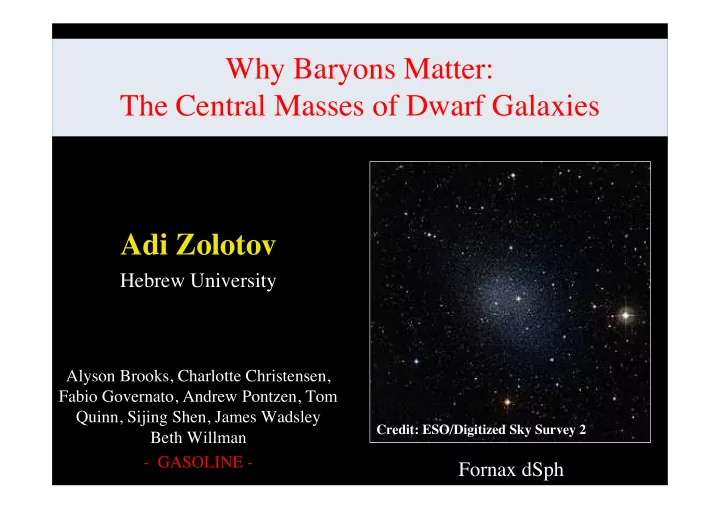
Credit: ESO/Digitized Sky Survey 2
Fornax dSph
SLIDE 2
- I. A challenge to CDM? DM cores
ρ∝ ρ∝ rα Oh et al. (2011)
Supernova Driven Outflows?
SLIDE 3
Resolving hi-density SF regions
ρ x Ceverino & Klypin (2009) Brook et al. (2011)
SLIDE 4 Cusp/Core Problem
Pontzen & Governato (2012) Star formation must be episodic
See also: Dekel & Silk (1986) Navarro et al (1996) Read & Gilmore (2005) Mashchenko et al. (2008), Teyssier et al. (2012) + …
SLIDE 5
Cusp/Core Problem
Isolated field Galaxies with M* > 107 Msun have shallow DM profiles Low luminosity field dwarfs have cusps? Cores in central unresolved regions? MW classical dSph Governato, Zolotov, et al. (2012)
SLIDE 6
- II. Another challenge to CDM:
Massive Failures
MW dSph CDM subhalos
Boylan-Kolchin et al. (2011, 2012) Moore et al. (1999) Klypin et al. (1999)
SLIDE 7
- II. A challenge to CDM: Massive Failures
Two MW-mass galaxies (Mvir ~ 7 - 8 x10¹¹) DM-only vs DM + baryons
- 1. Find all satellites at z=0 in SPH
run
- 2. Match to satellites in DM-only
run at hi-z & infall & z=0
- 3. Compare density& mass at hi-z,
at infall, and at z=0 between DM-only and DM+baryon sats
Zolotov, Brooks, et al. (2012) Brooks & Zolotov (2012)
SLIDE 8
The most luminous satellites experience a reduction of 2 - 16 km/s in the central DM Vc due to SNe feedback
1st Regime: Before Infall
Zolotov et al. (2012)
SLIDE 9
Before Infall: SNe Feedback
DM-only DM+baryons Zolotov et al. (2012) Weisz et al. (2012) - Dwarfs with M*< 107M are consistent with bursty SFHs
SLIDE 10
Only SPH satellites lose more than 90% of initial mass -> some satellites lose stars as well Due to baryonic disk+ DM density profile
2nd Regime: After Infall
Only SPH satellites undergo a reduction of more than 40 % in central Vc Bound mass fraction Zolotov et al. (2012)
SLIDE 11 2nd Regime: After Infall
- Disk presence results in more mass loss at each pericentric
passage for all satellites
- This effect is even stronger for cored satellites
No Disk M_disk = 0.1Mvir Core γ= 0.0 Cusp γ =1.0 Penarrubia et al. (2010)
SLIDE 12
After Infall: Tidal stripping
Disk effect: DM +baryon sat lost ~ 12% more mass Disk + core effect: DM +baryon sat lost ~ 23% more mass Satellite with DM cusp Satellite with DM cusp core
SLIDE 13
The Big Picture
Most Luminous satellites at infall Most massive DM subhalos at infall
SLIDE 14 Abundance matching works × The central DM masses at z = 0, however, do not match between satellites with baryons and DM-
× There is also gas loss and stellar mass loss in SPH satellites…
The Big Picture
SLIDE 15
Including baryons in cosmological simulations alleviates some of the tension between predictions of CDM model and observations of galaxies Supernova feedback in simulations that resolve high- density SF peaks naturally result in the flattening of DM cores into cusps (M* > 10^7 Msun) This is true for both field galaxies. For satellites, this results in *reduced* DM densities Tides result in more mass loss at pericentric passage for all satellites in simulations with baryons (baryonic disk + DM core in satellites)
Summary
SLIDE 16
Baryons Matter!