Who we are Introduction to Statistical Machine Chris = PhD student - - PDF document

who we are introduction to statistical machine
SMART_READER_LITE
LIVE PREVIEW

Who we are Introduction to Statistical Machine Chris = PhD student - - PDF document

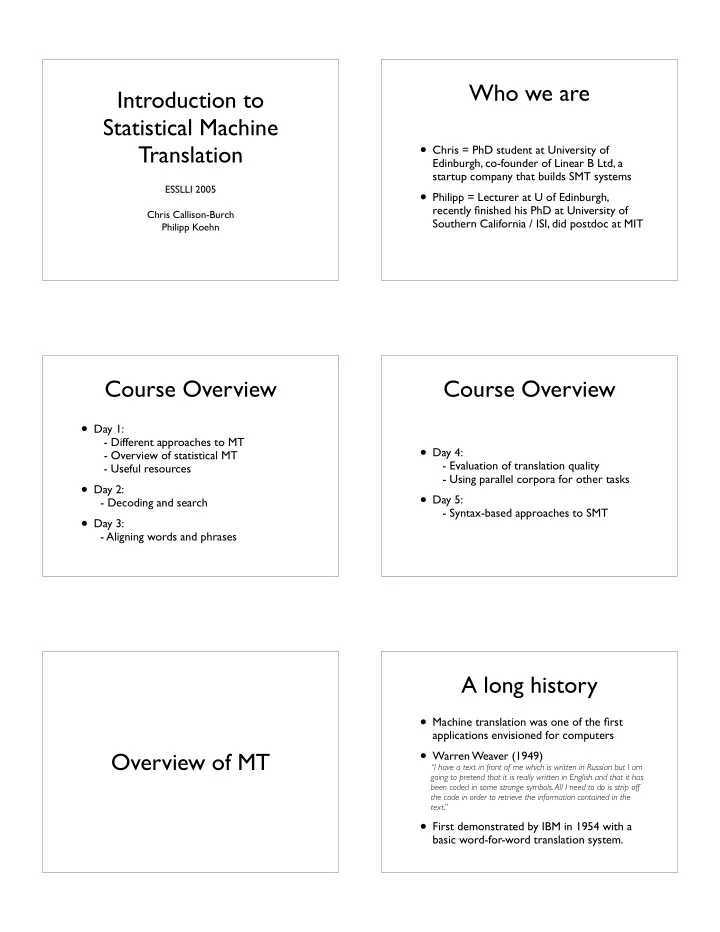
Who we are Introduction to Statistical Machine Chris = PhD student at University of Translation Edinburgh, co-founder of Linear B Ltd, a startup company that builds SMT systems ESSLLI 2005 Philipp = Lecturer at U of Edinburgh,


slide-1
SLIDE 1

Introduction to Statistical Machine Translation

ESSLLI 2005 Chris Callison-Burch Philipp Koehn

Who we are

  • Chris = PhD student at University of

Edinburgh, co-founder of Linear B Ltd, a startup company that builds SMT systems

  • Philipp = Lecturer at U of Edinburgh,

recently finished his PhD at University of Southern California / ISI, did postdoc at MIT

Course Overview

  • Day 1:
  • Different approaches to MT
  • Overview of statistical MT
  • Useful resources
  • Day 2:
  • Decoding and search
  • Day 3:
  • Aligning words and phrases

Course Overview

  • Day 4:
  • Evaluation of translation quality
  • Using parallel corpora for other tasks
  • Day 5:
  • Syntax-based approaches to SMT

Overview of MT

  • Machine translation was one of the first

applications envisioned for computers

  • Warren Weaver (1949)

“I have a text in front of me which is written in Russian but I am going to pretend that it is really written in English and that it has been coded in some strange symbols. All I need to do is strip off the code in order to retrieve the information contained in the text.”

  • First demonstrated by IBM in 1954 with a

basic word-for-word translation system.

A long history

slide-2
SLIDE 2
  • U.S. has invested in MT for intelligence

purposes

  • MT is popular on the web -- it is the most

used of Google's special features

  • EU spends more than 1,000,000,000 on

translation costs each year. (Semi-) automating that could lead to huge savings

Commercially Interesting Academically Interesting

  • Machine translation requires many other

NLP technologies

  • Potentially: parsing, generation, word sense

disambiguation, named entity recognition, transliteration, pronoun resolution, natural language understanding, and real-world knowledge

What makes MT hard?

  • Word order
  • Word sense
  • Pronouns
  • Tense
  • Idioms

Differing word orders

  • English word order is subject - verb - object

Japanese order is subject - object - verb

  • English: IBM bought Lotus

Japanese: IBM Lotus bought

  • English: Reporters said IBM bought Lotus

Japanese: Reporters IBM Lotus bought said

Word sense ambiguity

  • `Bank' as in river

`Bank' as in financial institution

  • `Plant' as in a tree

`Plant' as in a factory

  • Different word senses will likely translate

into different words in another language

Problem of pronouns

  • Some languages like Spanish can drop

subject pronouns

  • In Spanish the verbal inflection often

indicates which pronoun should be restored

  • o = I
  • as = you
  • a = he / she / it
  • amos = we
  • an = they
  • When should we use `she' or `he' or `it'?
slide-3
SLIDE 3

Different tenses

  • Spanish has two versions of the past tense:
  • ne for a definite time in the past, and one

for an unknown time in the past

  • When translating from English to Spanish

we need to choose which version of the past tense to use

Idioms

  • "to kick the bucket'' means "to die''
  • "a bone of contention" does not have

anything to do with skeletons

  • "a lame duck", "tongue in cheek", "to cave in"

Various Approaches to Machine Translation Various approaches

  • Word-for-word translation
  • Syntactic transfer
  • Interlingual approaches
  • Controlled language
  • Example-based translation
  • Statistical translation

Word-for-word translation

  • Use a machine-readable bilingual dictionary

to translate each work in a text

  • Advantages: Easy to implement, results give a

rough idea about what the text is about

  • Disadvantages: Problems with word order

means that this results in low-quality translation

Syntactic transfer

S NP (SUBJ) VP V S (OBJ) NP (SUBJ) VP V NP (OBJ) Reporters said IBM bought Lotus S NP (SUBJ) VP V S (OBJ) NP (SUBJ) VP V NP (OBJ) Reporters said IBM bought Lotus

  • Parse the sentence
  • Rearrange constituents
  • Then translate the words
slide-4
SLIDE 4

Syntactic transfer

TO TO MN VB PRP VB1 VB2 He adores listening VB to music

Syntactic transfer

TO MN TO music to VB PRP VB1 VB2 He adores listening VB

ha ga no desu kare

  • ngaku

wo kiku daisuki

Syntactic transfer

  • Advantages:

Deals with the word-order problem

  • Disadvantages:
  • Must construct transfer rules for each

language pair that you deal with

  • Sometimes there is syntactic mis-match
  • Example:

English: The bottle floated into the cave Spanish: La botella entro a la cuerva flotando = The bottle entered the cave floating

Interlingua

  • Assign a logical form to sentences
  • John must not go =

OBLIGATORY(NOT(GO(JOHN))) John may not go = NOT(PERMITTED(GO(JOHN)))

  • Use logical form to generate a sentence in

another language

Interlingua

  • Advantages:

Single logical form means that we can translate between all languages and only write a parser/generator for each language

  • nce
  • Disadvantages:

Difficult to define a single logical form. English words in all capital letter probably won't cut it.

Controlled language

  • Define a subset of a language which can be

used to compose text to be translated

  • Issued editorial guidelines that limit each

word to only one word sense, and which forbid certain difficult constructions

  • Apply syntactic transfer or interlingual

approaches

slide-5
SLIDE 5

Controlled language

  • Advantages: Results in more reliable, higher

quality translation for subset of language that it deals with

  • Disadvantages: Does not cover all language

use, so can only be applied in limited settings

Example-based MT

  • Fundamental idea:
  • People do not translate by doing deep

linguistics analysis of a sentence.

  • They translate by decomposing sentence

into fragments, translating each of those, and then composing those properly.

  • Principle of analogy in translation

Example of Example-Based MT

  • Translate:

He buys a book on international politics.

  • With these examples:

(He buys) a notebook. (Kare ha) nouto (wo kau). I read (a book on international politics). Watashi ha (kokusaiseiji nitsuite kakareta hon) wo yomu

  • (Kare ha) (kokusaiseiji nitsuite kakareta hon)

(wo kau).

Challenges

  • Locating similar sentences
  • Aligning sub-sentential fragments
  • Combining multiple fragments of example

translations into a single sentence

  • Determining when it is appropriate to

substitute one fragment for another

  • Selecting the best translation out of many

candidates

Example-based MT

  • Advantages: Uses fragments of human

translations which can result in higher quality

  • Disadvantages: May have limited coverage

depending on the size of the example database, and flexibility of matching heuristics

Statistical machine translation

  • Find most probable English sentence given a

foreign language sentence

  • Automatically align words and phrases

within sentence pairs in a parallel corpus

  • Probabilities are determined automatically

by training a statistical model using the parallel corpus

slide-6
SLIDE 6

Parallel corpus

sooner or later we will have to be sufficiently progressive in terms of own resources as a basis for this fair tax system . we plan to submit the first accession partnership in the autumn of this year . it is a question of equality and solidarity . the recommendation for the year 1999 has been formulated at a time of favourable developments and optimistic prospects for the european economy . that does not , however , detract from the deep appreciation which we have for this report . what is more , the relevant cost dynamic is completely under control. früher oder später müssen wir die notwendige progressivität der eigenmittel als grundlage dieses gerechten steuersystems zur sprache bringen . wir planen , die erste beitrittspartnerschaft im herbst dieses jahres vorzulegen . hier geht es um gleichberechtigung und solidarität . die empfehlung für das jahr 1999 wurde vor dem hintergrund günstiger entwicklungen und einer für den kurs der europäischen wirtschaft positiven perspektive abgegeben . im übrigen tut das unserer hohen wertschätzung für den vorliegenden bericht keinen abbruch . im übrigen ist die diesbezügliche kostenentwicklung völlig unter kontrolle .

Statistical machine translation

  • Advantages:
  • Has a way of dealing with lexical ambiguity
  • Can deal with idioms that occur in the

training data

  • Requires minimal human effort
  • Can be created for any language pair that

has enough training data

  • Disadvantages:

Does not explicitly deal with syntax

Choosing an Approach

  • Many challenges in MT, many different ways
  • f approaching the task
  • What approach you prefer will depend on

your background (i.e. logicians tend towards interlingua, linguists towards syntactic transfer)

  • Objectively choosing how to approach the

task is tricky

Some Criteria

  • Do we want to design a system for a single

language or for many languages?

  • Can we assume a constrained vocabulary or

do we need to deal with any text?

  • What resources already exist for the

languages that we're dealing with?

  • How long will it take us to develop the

resources, and how large a staff will we need?

Advantages of SMT

  • Data driven
  • Language independent
  • No need for staff of linguists of language

experts

  • Can prototype a new system quickly and at

a very low cost

Choosing SMT

  • Economic reasons:
  • Low cost; Rapid prototyping
  • Practical reasons:
  • Many language pairs don't have NLP

resources, but do have parallel corpora

  • Quality reasons:
  • Uses chunks of human translated as its

building blocks

  • When very large data sets are available

produces state of the art results

slide-7
SLIDE 7

Overview of SMT Probabilities

  • Find most probable English sentence given a

foreign language sentence

p(e|f) ˆ e = arg max

e

p(e|f) p(e|f) = p(e)p(f|e) p(f) ˆ e = arg max

e

p(e)p(f|e)

What the probabilities represent

  • p(e) is the "Language model"
  • Assigns a higher probability to fluent /

grammatical sentences

  • Estimated using monolingual corpora
  • p(f|e) is the "Translation model"
  • Assigns higher probability to sentences

that have corresponding meaning

  • Estimated using bilingual corpora

For people who don't like equations

e* = argmax p(e|f) e Source Language Text Target Language Text Preprocessing Preprocessing Global search p(e) p(f|e) Language model Translation model

Language Model

  • Component that tries to ensure that words

come in the right order

  • Some notion of grammaticality
  • Standardly calculated with a trigram

language model, as in speech recognition

  • Could be calculated with a statistical

grammar such as a PCFG

Trigram language model

  • p(I like bungee jumping off high bridges) =

p(I | <s> <s>) * p(like | I <s>) * p(bungee | I like) * p(jumping | like bungee) * p(off | bungee jumping) * p(high | jumping off) * p(bridges | off high) * p(</s> | high bridges) * p(</s> | bridges </s>)

slide-8
SLIDE 8

Calculating Language Model Probabilities

  • Unigram probabilities

p(w1) = count(w1) total words observed

Calculating Language Model Probabilities

  • Bigram probabilities

p(w2|w1) = count(w1w2) count(w1)

Calculating Language Model Probabilities

  • Trigram probabilities

p(w3|w1w2) = count(w1w2w3) count(w1w2)

Calculating Language Model Probabilities

  • Can take this to increasingly long sequences
  • f n-grams
  • As we get longer sequences it's less likely

that we'll have ever observed them

Backing off

  • Sparse counts are a big problem
  • If we haven't observed a sequence of words

then the count = 0

  • Because we're multiplying the n-gram

probabilities to get the probability of a sentence the whole probability = 0

Backing off

  • Avoids zero probs

.8 ∗ p(w3|w1w2) + .15 ∗ p(w3|w2)+ .001 .049 ∗ p(w3)+

slide-9
SLIDE 9

Translation model

  • p(f|e)... the probability of some foreign

language string given a hypothesis English translation

  • f = Ces gens ont grandi, vécu et oeuvré des

dizaines d'années dans le domaine agricole.

  • e = Those people have grown up, lived and

worked many years in a farming district.

  • e = I like bungee jumping off high bridges.

Translation model

  • How do we assign values to p(f|e)?
  • Impossible because sentences are novel, so

we'd never have enough data to find values for all sentences.

p(f|e) = count(f, e) count(e)

Translation model

  • Decompose the sentences into smaller

chunks, like in language modeling

  • Introduce another vairable a that represents

alignments between the individual words in the sentence pair

p(f|e) =

  • a

p(a, f|e)

Those people have Ces gens

  • nt

grandi , grown up , lived and vécu et worked many years in a farming district .

  • euvré

des dizaines d' années dans le domaine agricole .

Word alignment Alignment probabilities

  • So we can calculate translation probabilities

by way of these alignment probabilities

  • Now we need to define p(a, f | e)

p(f|e) =

  • a

p(a, f|e) p(a, f|e) =

m

  • j=1

t(fj|ei)

Calculating t(fj|ei)

  • Counting! I told

you probabilities were easy!

  • worked... fonctionné,

travaillé, marché, oeuvré

  • 100 times total 13

with this f. 13%

  • euvré

Those people have Ces gens

  • nt

grandi , grown up , lived and vécu et worked many years in a farming district . des dizaines d' années dans le domaine agricole .

= count(fj, ei) count(ei)

slide-10
SLIDE 10

Calculating t(fj|ei)

  • Unfortunately we don't have word aligned

data, so we can't do this directly.

  • OK, so it's not quite as easy as I said.
  • Philipp will talk about how to do word

alignments using EM on Wednesday.

Phrase Translation Probabilities

unter kontrolle under control what is more im übrigen ist die diesbezügliche the relative cost dynamic is kostenentwicklung völlig completely

Phrase Translation Probabilities

unter kontrolle we

  • we

it wir sind es den steuerzahlern to the taxpayers to keep schuldig die the costs in kosten check zu haben

Phrase Table

  • Exhaustive table of source language phrases

paired with their possible translations into the target language, along with probabilities

das thema the issue .51 the point .38 the subject .21

``Diagram Number 1''

e* = argmax p(e|f) e Source Language Text Target Language Text Preprocessing Preprocessing Global search p(e) p(f|e) Language model Translation model

The Search Process AKA ``Decoding''

  • Look up all translations of every source

phrase, using the phrase table

  • Recombine the target language phrases that

maximizes the translation model probability * the language model probability

  • This search over all possible combinations

can get very large so we need to find ways

  • f limiting the search space
slide-11
SLIDE 11

Looking up translations

  • f source
  • visit after (1)

ten days (0.7222) 10 days (0.2778) from visiting (0.8333) from seeing (0.0667) undertaken (0.273) carried out by (0.1546) made by (0.0987) conducted by (.07) foreign minister (0.8796) egyptian ahmad (1) comes (0.3636) coincides (0.1364) is (0.1364) visit (0.7285) his (0.1454) after (0.45) post (0.1096) yet (0.0829) ten (0.6391) 10 (0.2561) days (0.7595) day (0.1393)

  • f

(0.642) from (0.3076) visit (0.7583) visits (0.0554) , (0.238) has (0.0686) by (0.0657) by (0.3873) underta ken (0.0901) minister (0.8273) foreign (0.5241) external (0.3355) egyptian (0.7153) egypt (0.0945) ahmad (0.5823) ahmed (0.3844) maher (0.5387) mahir (0.2232) after ten (0.75) detonated (0.25) days of (1) visit (0.7143) his visit (0.1429) visit had (0.0714) visit undertaken (0.0714) egyptian foreign (1) ahmad maher (0.4286) ahmed maher (0.4286) ahmad mahir (0.1429) ten days after (1) visit (0.958) egyptian foreign minister (1) egyptian foreign minister ahmad maher (1)

The Search Space

E: F: -------------- Prob = 1.0 E: ten days after F: --+++--------- Prob = 0.00321 E: coincides F: +------------- Prob = .0005689 E: comes F: +------------- Prob = .0004596 E: his visit F: -+------------ Prob = .009183 E: comes F: ++------------ Prob = .000123 E: coincides F: ++------------ Prob = .0000523 E: ten days after F: +++++--------- Prob = 0.0000567

The Search Space

  • In the end the item which covers all of the

source words and which has the highest probability wins!

  • That's our best translation
  • And there was much rejoicing!

ˆ e = arg max

e

p(e)p(f|e)

Wrap-up: SMT is data driven

  • Learns translations of words and phrases

from parallel corpora

  • Associate probabilities with translations

empirically by counting co-occurrences in the data

  • Estimates of probabilities get more accurate

as size of the data increases

Wrap-up: SMT is language independent

  • Can be applied to any language pairs that we

have a parallel corpus for

  • The only linguistic thing that we need to

know is how to split into sentences, words

  • Don't need linguists and language experts to

hand craft rules because it's all derived from the data

Wrap-up: SMT is cheap and quick to produce

  • Low overhead since we aren't employing

anyone

  • Computers do all the heavy lifting /

statistical analysis of the data for us

  • Can build a system in around 2 weeks
slide-12
SLIDE 12

Example translations Spanish --> English

  • Sabemos muy bien que los tratados actuales no bastan y

que, en el futuro, será necesario desarrollar una estructura mejor y diferente para la unión europea, una estructura más constitucional que también deje bien claras cuáles son las competencias de los estados miembros y cuáles pertenecen a la unión.

  • We all know very well that the current treaties are

insufficient and that, in the future, it will be necessary to develop a better structure and different for the European Union, a structure more constitutional also make it clear what the competences of the member states and which belong to the union.

German --> English

  • Uns ist sehr wohl bewusst, dass die geltenden verträge

unzulänglich sind und künftig eine andere, effizientere struktur für die union entwickelt werden muss, nämlich eine stärker konstitutionell ausgeprägte struktur mit einer klaren abgrenzung zwischen den befugnissen der mitgliedstaaten und den kompetenzen der union.

  • We are well aware that the existing treaties are inadequate

and in the future, a different, more efficient structure for the union must be developed, namely a more pronounced institutional structure with a clear dividing line between the powers of the member states and the competences of the union.

Danish --> English

  • Vi ved udmærket, at de nuværende traktater ikke er

tilstrækkelige, og at det i fremtiden er nødvendigt at udvikle en anden og bedre struktur for unionen, en mere konstitutionel struktur, som også tydeligt viser, hvilke beføjelser medlemsstaterne har, og hvilke beføjelser unionen har.

  • We know perfectly well that the current treaties are not

sufficient, and that in the future it is necessary to develop a second and better structure for the union, a more constitutional structure, which clearly shows the powers of the member states, and what powers the union.

French --> English

  • Nous savons très bien que les traités actuels ne suffisent

pas et qu'il sera nécessaire à l'avenir de développer une structure plus efficace et différente pour l'union, une structure plus constitutionnelle qui indique clairement quelles sont les compétences des états membres et quelles sont les compétences de l'union.

  • We know very well that the current treaties are not

enough and that it will be necessary in future to develop a structure more effective and different for the union, a more constitutional structure which makes it clear what are the competence of member states and what are the powers of the union.

Spanish --> English (2)

  • Mensajes de preocupación en primer lugar ante las

dificultades económicas y sociales por las que atravesamos, y ello a pesar de un crecimiento sostenido, fruto de años de esfuerzo por parte de todos nuestros conciudadanos.

  • Messages of concern in the first place just before the

economic and social problems for the present situation, and in spite of sustained growth, as a result of years of effort on the part of our citizens.

slide-13
SLIDE 13

German --> English (2)

  • Dabei handelt es sich zunächst um botschaften der

beunruhigung angesichts der wirtschaftlichen und sozialen schwierigkeiten, mit denen wir trotz eines anhaltenden wachstums als ergebnis jahrelanger anstrengungen von seiten aller unserer mitbürger konfrontiert sind.

  • It is, first of all, embassies of the concern about the

economic and social problems, with which we, despite the continuing growth as a result of many years of effort from all of our fellow citizens are confronted.

Danish --> English (2)

  • Vi må videregive et budskab om bekymring set i lyset af de

økonomiske og sociale problemer, vi aktuelt oplever, uanset at der meldes om stabil økonomisk vækst, hvilket må ses som resultatet af den indsats, der de seneste år er ydet af eu's borgere.

  • We must convey a message of concern in the light of the

economic and social problems, we topical experiencing, regardless of the fact that there are reported on stable economic growth, which must be seen as the result of the efforts that the last few years done by the EU's citizens.

French --> English (2)

  • Messages d'inquiétude tout d'abord devant les difficultés

économiques et sociales que nous traversons, et ce malgré une croissance soutenue, fruit d'années d'efforts de la part de tous nos concitoyens.

  • Messages of concern firstly to the economic and social

problems that we are going through, despite sustained growth as a result of years of effort on the part of all our citizens.

English References

  • We know all too well that the present treaties are

inadequate and that the union will need a better and different structure in future, a more constitutional structure which clearly distinguishes the powers of the member states and those of the union.

  • These are, first and foremost, messages of concern at the

economic and social problems that we are experiencing, in spite of a period of sustained growth stemming from years

  • f efforts by all our fellow citizens.

Useful Resources Materials Needed to Build an SMT System

  • Parallel corpus
  • Word alignment software
  • Language modeling toolkit
  • Decoder
slide-14
SLIDE 14

Parallel Corpora

  • The Linguistics Data consortium sells many

parallel corpora including

  • UN data
  • Canadian Hansards
  • Hong Kong laws parallel text
  • Parallel newswires
  • http://www.ldc.upenn.edu/

Parallel Corpora

  • Philipp has the "Europarl Corpus"
  • Danish, Dutch, English, Finnish, French,

German, Greek, Italian, Portuguese, Spanish, Swedish

  • http://www.iccs.informatics.ed.ac.uk/

~pkoehn/publications/europarl/

Word alignment software

  • Giza++ (open source implementation of the

"IBM Models")

  • http://www.fjoch.com/GIZA++.html
  • Reference word alignments
  • Manually created "gold standard"
  • Useful for testing the quality of

automatically generated alignments

  • See ACL-05 / NAACL-03 workshops

Language modeling toolkit

  • SRILM
  • Developed for speech recognition
  • Used in SMT too
  • Estimates n-gram probabilities
  • Handles back-off in sophisticated ways
  • http://www.speech.sri.com/projects/srilm/

Decoder

  • Pharaoh
  • Phrase-based SMT decoder
  • Builds phrase tables from Giza++ word

alignments

  • Produces best translation for new input

using phrase table plus SRILM language model

  • http://www.isi.edu/licensed-sw/pharaoh/

Tomorrow

  • Decoding in depth
  • Including: How to use Pharaoh!