Who Defines MY Quality of Life?: Perspectives from disability - - PDF document

who defines my quality of life perspectives from
SMART_READER_LITE
LIVE PREVIEW

Who Defines MY Quality of Life?: Perspectives from disability - - PDF document

Who Defines MY Quality of Life?: Perspectives from disability advocates and their supporters Melissa Crisp-Cooper Katie Savin, MSW March 5-6 th , 2020 Office of Developmental Primary Care Improving health outcomes for people with


slide-1
SLIDE 1

Office of Developmental Primary Care

Who Defines MY Quality of Life?: Perspectives from disability advocates and their supporters

Melissa Crisp-Cooper Katie Savin, MSW March 5-6th, 2020

Office of Developmental Primary Care
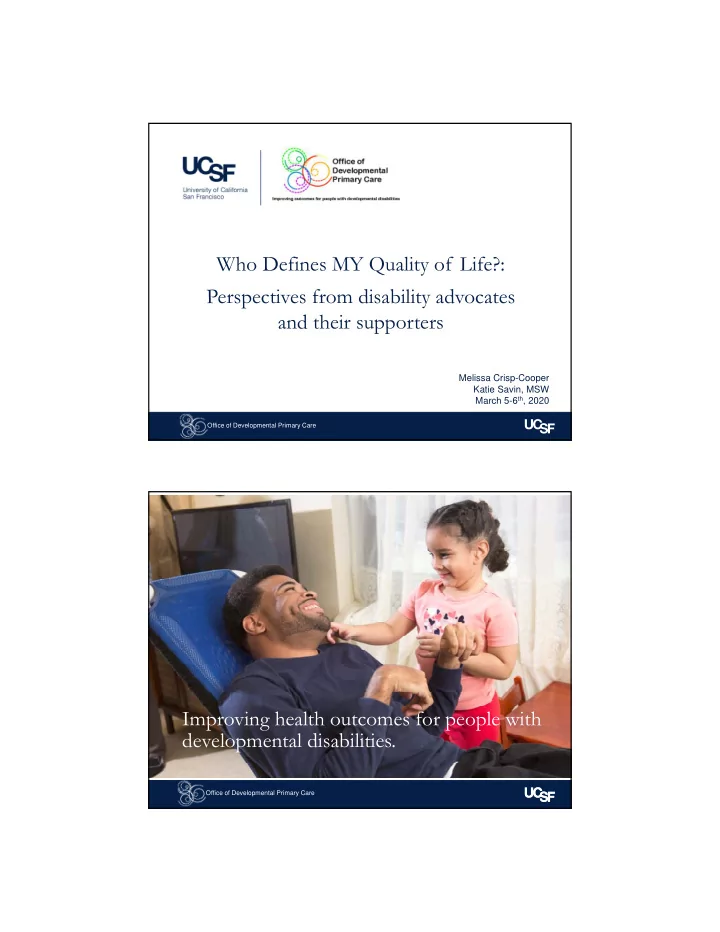
Improving health outcomes for people with developmental disabilities.

slide-2
SLIDE 2

Disclosures

Thank you to our funders:

Stupski Foundation, WITH Foundation, and Far Northern, Golden Gate, and Redwood Coast Regional Centers. Thank you to our project partners: Clarissa Kripke, MD, FAAFP; Jo Cummins; and Patricia Mejia

Office of Developmental Primary Care

Overview

  • Discussion group organization
  • Themes
  • Communication
  • Assumptions
  • Changes in or loss of function
  • Medical decision-making / Advanced Care

Planning

  • End of life care conversations
  • Healthcare for people with disabilities - video

Office of Developmental Primary Care

slide-3
SLIDE 3

Learning Objectives

  • Learn from the lived experience of disabled people

and their families in health care settings

  • Identify concerns of these people and families
  • Understand the variety in definitions of quality of life
  • Identify the best practices needed to engage in

effective health care discussions with disabled people throughout their lifespan

  • Recognize disability as one feature of an

intersectional identity

Office of Developmental Primary Care

14 Participants 7 parents / supporters 5 participants in-person discussion group 2 phone interviews 7 disabled adult “self advocates” 7 participants in- person discussion group

Quality Improvement Project Design

Aim: Learn more about the experiences of people with disabilities and their families in accessing the health care system.

slide-4
SLIDE 4

Communication

“When I have brought others, especially my parents, the providers tend to direct their questions to them and not me. They take them more seriously. It’s frustrating.”

Office of Developmental Primary Care

Communication

Recommendations:

  • Presume competence
  • Always address the disabled person
  • Explore different communication options, such

as visual aids, slowing down the conversation, and using plain language

Office of Developmental Primary Care

slide-5
SLIDE 5

Disabled and Beyond: Intersecting Identities

“My primary nurse practitioner sees me as a whole person, including my disability, sexuality, social life, and other medical needs unrelated to my disability.”

Office of Developmental Primary Care

Disabled and Beyond: Intersecting Identities

Recommendations:

  • Both advocates and supporters asked that

clinicians acknowledge and respect them as whole people when considering the impact of potential treatment.

  • Disability as a cultural identity

Office of Developmental Primary Care

slide-6
SLIDE 6

Avoiding Assumptions - 1

“I wish medical students had to work in the community so they could see for themselves what our lives can be. I would like them to see ‘life’. That it’s not all medical – we have fun!”

Avoiding Assumptions - 2

Participant Experiences

Negative messages regarding disability can be found everywhere, including medical literature and popular culture

Suggestions for Clinicians Refer patients to peer‐led groups and/or websites that promote positive disability identity

slide-7
SLIDE 7

Avoiding Assumptions - 2

Participant Experiences

Negative messages regarding disability can be found everywhere, including medical literature and popular culture

Suggestions for Clinicians Refer patients to peer‐led groups and/or websites that promote positive disability identity

Avoiding Assumptions - 3

Suggestions for Clinicians Ask patients to describe their baseline Participant Experiences Members of both groups cautioned clinicians not to confuse a patient’s health status in a hospital setting with their typical baseline

Office of Developmental Primary Care

slide-8
SLIDE 8

Avoiding Assumptions - 4

Participant Experiences

Participants expressed the need to respect privacy and personal boundaries

Suggestions for Clinicians Tell patients what they can expect to happen before starting an exam

Avoiding Assumptions - 5

Participant Experiences

People with disabilities want clinicians to avoid basing treatment options

  • n assumptions about their

quality of life

Suggestions for Clinicians Ask patients what brings value to their lives

slide-9
SLIDE 9

Decision-Making

“I brought in her communication device and they were shocked that she could do anything like that. They had assumed that she was a little lump.”

Office of Developmental Primary Care

Decision Making

Recommendations:

  • Increase opportunities for disabled patients’

autonomy as much as possible.

  • Disabled patients should be able to choose

trusted supporters to help them make medical decisions.

  • Decision-making as spectrum vs binary;

consider what supports or accommodations can

  • ptimize a patient’s capacity to participate in

decision-making

Office of Developmental Primary Care

slide-10
SLIDE 10

Cultural Humility & Respecting Patient Experiences

“Believe me. I may not have medical training, but I know a lot about my disability. Don’t give up on me.”

Office of Developmental Primary Care

Cultural Humility & Respecting Patient Experiences

Recommendations:

  • Recognize disabled people and their supporters

as experts in their care and abilities

  • Group members requested that clinicians trust

the information and history they provide and correct errors that may exist in the medical chart

  • Everyone has unconscious bias – be willing to

revise your ideas of what it means to be disabled

Office of Developmental Primary Care

slide-11
SLIDE 11

Adapting to Change in Function

“About 10 years ago, I became spinal cord

  • injured. It’s common with CP (cerebral palsy), but

no one spoke to me about it. I had to relearn

  • things. It was heavy.”

Office of Developmental Primary Care

Adapting to Change in Function

Recommendations:

  • All people have the capacity to adapt to change

and evolving circumstances

  • Many members of the advocate group spoke of

how aging with a significant developmental disability can be full of unknowns

  • Clinicians can help patients by educating them on

any disability-specific progressions based on literature and clinical experience

Office of Developmental Primary Care

slide-12
SLIDE 12

Visits to the Emergency Department - 1

“People I see more than once are almost always

  • kay. The problem is the ED or people who work

in the hospital. They don’t know who we are. They

  • nly see us for our problems and that’s a real

problem.”

Office of Developmental Primary Care

Visits to the Emergency Department - 2

Emergency visits pose unique challenges to disabled patients

  • Physicians and medical personnel may be

unfamiliar with a patient’s disability, medical history, baseline, or communication style

  • Sensory overload due to bright lights and

loud noises can impair a disabled person’s capacity to communicate

  • Some disabled people are survivors of

medical trauma

Office of Developmental Primary Care

slide-13
SLIDE 13

Visits to the Emergency Department - 3

Accommodations to consider:

  • Reduced wait time
  • Better coordination between departments
  • Streamlining discharge

Office of Developmental Primary Care

Advanced Care Planning

“Afterward, they kept talking about it, when I was doing well. A social worker came to my house and her first question was, “Do you want a DNR?” This is when I was doing fine. All I wanted to do was move away from that conversation.”

Office of Developmental Primary Care

slide-14
SLIDE 14

Advanced Care Planning

Recommendations:

  • Parents and supporters reported that they want to

know that their options are based on neutral medical advice

  • Patients want to know that their lives are valued
  • Promote opportunities for disabled people to make

decisions about what happens to them during a medical emergency and at the end of their lives

Office of Developmental Primary Care

End of Life

“I really appreciated how hard they tried to save her. They gave value to her life.”

Office of Developmental Primary Care

slide-15
SLIDE 15

End of Life

Recommendations:

  • All lives have value and all deaths will be grieved,

regardless of one’s level of functioning at the time of death.

  • Disabled people reported concerns that their wishes

would not be followed at the end of their lives.

  • Along with disability status, many factors impact

patients’ relationship to the death and dying process, e.g. religion, family structure and legacy of access to medical care.

Office of Developmental Primary Care

Bridging the Gap Improving Healthcare Access for People with Disabilities

Office of Developmental Primary Care

slide-16
SLIDE 16

Resources

  • White paper available from the ODPC information table, and on the

website: https://odpc.ucsf.edu/clinical/patient-centered-care/who- defines-my-quality-of-life-perspectives-from-disability-advocates

Office of Developmental Primary Care

Resources

Office of Developmental Primary Care

Office of Developmental Primary Care: http://odpc.ucsf.edu

My Health Passport: https://odpc.ucsf.edu/clinical/tips-for-organizing-visits/health-passport Supported Decision-Making: https://odpc.ucsf.edu/advocacy/supported-health-care-decision- making What I Wish My Doctor Knew About Non-Traditional Communicators: https://odpc.ucsf.edu/advocacy/advice-from-self-advocates/non- traditional-communicators#pdf What I Wish My Doctor Knew About People Who Accompany us to

  • ur Medical Appointments:

https://odpc.ucsf.edu/advocacy/advice-from-self-advocates/the- people-who-accompany-us-to-our-medical-appointments#pdf

slide-17
SLIDE 17

Office of Developmental Primary Care

Contact us:

Melissa Crisp-Cooper: crispmas@yahoo.com Katie Savin: katie_savin@berkeley.edu