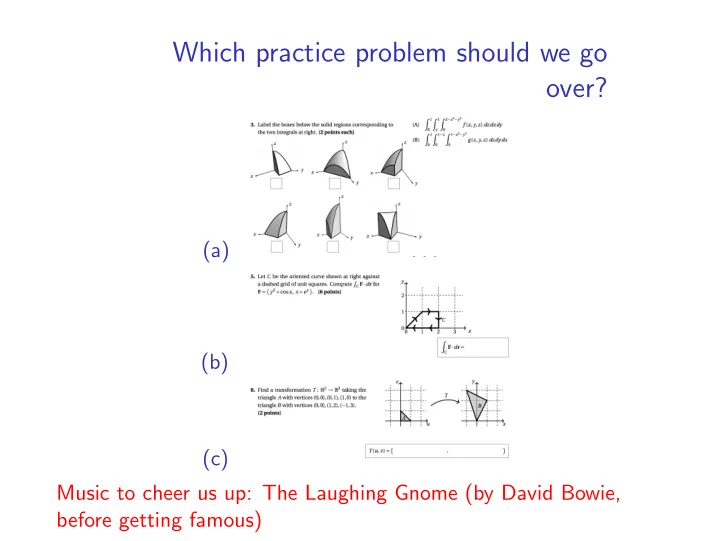
SLIDE 1 Which practice problem should we go
(a) (b) (c) Music to cheer us up: The Laughing Gnome (by David Bowie, before getting famous)
SLIDE 2
SLIDE 3
SLIDE 4
SLIDE 5 About the exam
∙ Consider the following integral:
∫︂ b
a
∫︂ d
c
g(x, y) dy dx.
- The function g(x, y) is called the integrand.
- Some questions will specifically ask you to set up the integral
- r find the integrand. Don’t waste your time evaluating the
integral if you’re not required to.
∙ Extra office hours today 2–3:20pm. ∙ More office hours tomorrow 11–12:20pm. ∙ No lecture on Wednesday.
SLIDE 6 Remarks on integrals over curves and surfaces
∙ For integrating over curves, we use the unit tangent vector.
- At a given point, there are only two choices of unit tangent
vector.
- A choice of orientation on the curve tells us which one to pick.
∙ But over a surface, there are infinitely many unit tangent
vectors attached to any point (all in the tangent plane of that point).
- But there aren’t infinitely many choices of normal vectors to
the tangent plane: there are only two—ru × rv and rv × ru = −ru × rv.
- A choice of orientation on the surface tells us which one to
pick at each point.
- For surfaces, there isn’t always a good choice! We’ll see
- examples. We will only be able to integrate vector fields over
surfaces with orientation.
SLIDE 7 Practice with surface orientation
Take a strip of paper, and tape the ends together (without twisting) to form a cylinder. Is it orientable? (a) Yes. (b) No. (c) I don’t know. (d) I’m so excited to find out what happens when we twist the paper that I can’t focus on this question. (e) I can’t answer this question, because I don’t have any tape or imagination.
- Yes. It has an inside and an outside.
SLIDE 8 Practice with surface orientation
Now tape the ends of the paper together with a half-twist. This is a M¨
- bius strip. Is it orientable?
(a) Yes. (b) No. (c) I don’t know.
- No. If you trace around the strip starting at one point, you will
come back around to the other side of the piece of paper. There is no inside and no outside.
SLIDE 9
Practice with integrating over a surface
Let S be the graph of a function f : D → R, oriented upward, and let F be a continous vector field on S. Find a formula for ∫︁∫︁
S F · dS as a double integral over D.
Step 1: Parametrize S We know what to do for graphs of functions: r(u, v) = ⟨u, v, f (u, v)⟩, (u, v) ∈ D. Step 2: Find ru × rv and compare it to n The first part is also probably review: ru = ⟨1, 0, fx⟩; rv = ⟨0, 1, fy⟩.
SLIDE 10
So ru × rv = ⃒ ⃒ ⃒ ⃒ ⃒ ⃒ i j k 1 fx 1 fy ⃒ ⃒ ⃒ ⃒ ⃒ ⃒ = i(−fx) − j(fy) + k(1) = ⟨−fx, −fy, 1⟩. Compare ru × rv to n, recalling that S is oriented upward. (a) ru × rv is positively oriented. (b) ru × rv is negatively oriented. (c) I don’t know. Answer: (a)
SLIDE 11
Step 3: calculate the integral
Working with your neighbour, find a formula for the integrand g(u, v) to write ∫︂∫︂
S
F(x, y, z) · dS = ∫︂∫︂
D
g(u, v) dA. (a) We’re working on it. (b) We’re stuck. (c) We have two answers and we don’t know which is right. (d) We’re done!
SLIDE 12
Solution
Since ru × rv is positively oriented, we can use the formula ∫︂∫︂
S
F(x, y, s) · dS = ∫︂∫︂
D
F(r(u, v)) · (ru × rv)dA. So g = F(r(u, v)) · (ru × rv) = ⟨P(u, v, f (u, v)), Q(u, v, f (u, v)), R(u, v, f (u, v))⟩ · ⟨−fx(u, v), −fy(u, v), 1⟩ = −P(u, v, f (u, v))fx(u, v) − Q(u, v, f (u, v))fy(u, v) + R(u, v, f (u, v))