Where do 1 they The Language of Politics stand? Unit 1 Michela - - PDF document

where do
SMART_READER_LITE
LIVE PREVIEW

Where do 1 they The Language of Politics stand? Unit 1 Michela - - PDF document

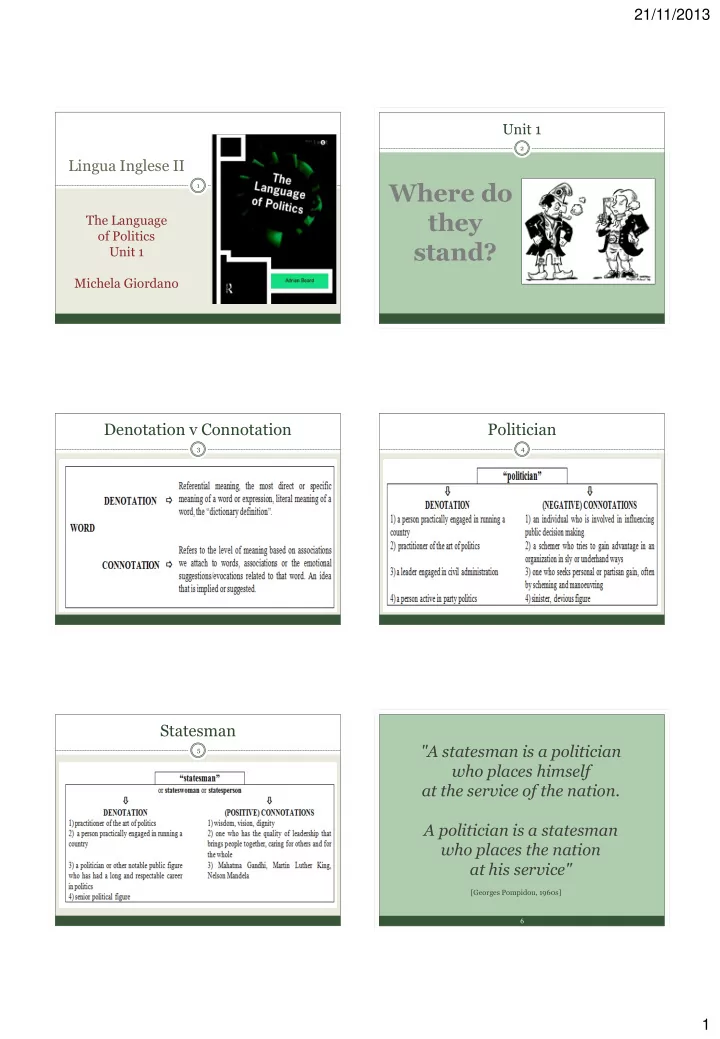
21/11/2013 Unit 1 2 Lingua Inglese II Where do 1 they The Language of Politics stand? Unit 1 Michela Giordano Denotation v Connotation Politician 3 4 Statesman "A statesman is a politician 5 who places himself at the service


slide-1
SLIDE 1

21/11/2013 1 Lingua Inglese II

The Language

  • f Politics

Unit 1 Michela Giordano

1

Unit 1

Where do they stand?

2

Denotation v Connotation

3

Politician

4

Statesman

5

"A statesman is a politician who places himself at the service of the nation. A politician is a statesman who places the nation at his service"

[Georges Pompidou, 1960s]

6

slide-2
SLIDE 2

21/11/2013 2

Connotation and Denotation: Political labels

DISAPPROVING/OPPOSING

  • narrow
  • inflexible
  • intransigent

APPROVING/FAVOURABLE

  • tough
  • decisive
  • resolute

Margaret Thatcher The Iron Lady

Political labels for policies: Reaganomics, Thatcherite, Blairite

7

Politics…

 root: Classical Greek polis = city,

citizen, civic

 concerned with people and the lives they

lead in organised communities

 Plato: politics is “nothing but corruption”  George Orwell in Politics and the English

Language (1946): “All issues are political issues” and “politics itself is a mass of lies, evasions, folly, hatred and schizophrenia”

8

Plato

9

George Orwell

10

Matching of definitions

11

Code

Politics has its own code: a language variety of a specific group VOCABULARY, GRAMMAR AND DISCOURSE: specific features of various political activities Idea of a battleground of party politics: NEGATIVE CONNOTATION, it also creates keywords for POLITICAL ALIGNMENT OF PARTIES

12

slide-3
SLIDE 3

21/11/2013 3

right-wingers  left-wingers

Right and Left cannot be described neutrally, without connotations.

during the French Revolution (1789– 1799)

LEFT  those who opposed the King‟s policies

RIGHT  those who supported the King‟s policies CENTRE  somewhere in between

13

The left-right spectrum

There are many gradations of right, left and centre. Match the definitions.

a) EXTREME 1) one who is not extreme in his opinions or views, conservative, temperate person, without strong convictions or beliefs b) MODERATE 2) of the greatest possible degree or extent or intensity, excessive c) RADICAL 3) having extreme political views

left-of-centre, right-of-centre, radical centre, radical middle, radical centrism, radically moderate, far left (aka the extreme left), centre left, radical left (synonym for the “farthest left”), radical right, far right (or extreme right), centre right

14

Wet and Dry

As political groupings emerge, new words are used to describe them.

 “Wet” and “Dry”: Metaphor of liquid

In the 1980s the Conservative party ruled Britain. Those in the party who did not support Thatcher‟s policies: “wets” (term of abuse, in public schools, those who lack courage). Mrs Thatcher‟s supporters: started to call themselves “dries”. Then the term “wets” became established and lost its negativity.

15

Tory

The word “Tory” was

  • riginally

used by English settlers in Ireland to refer to the Irish who were attacking them; then it was used as a term of abuse when applied to a group

  • f

British politicians in the 18th century; eventually it became the

  • fficial

name

  • f

the Conservative party.

16

“Hard Left” and “Soft left”

Metaphor of solidity

 In the Labour party, radical

members belonged to the “hard left”; the less radical were called “soft left”.

 In 1997 the new leaders of the

Labour party coined the term “New Labour” to describe the new policies.

 New Labour v Old Labour

17

Where do you stand?

Where you stand- the label which you attach to yourself,

  • r the label that is attached to you-

is very significant in politics

18
slide-4
SLIDE 4

21/11/2013 4

Nouns to describe forms of government

government regime junta democracy dictatorship faction

  • ne-man rule

Try to find definitions for these words

19

1) government 2) regime 3) junta /ˈdʒʊntə/ /ˈdʒʌntə/ 4) democracy 5) dictatorship 6) faction 7) one-man rule a) a military or political group that rules a country after taking power by force b) a small dissenting group, fighting for its

  • wn ideas and opposing those of a larger

group c) a form of government in which the people have a voice in the exercise

  • f

power, typically through elected representatives d) the system by which a state or community is governed; the action

  • r

manner

  • f

governing a state, organization, or people e) type of government controlled by one person, rather than by several people f) government by a dictator; very strict and harsh government g) despotism, unlimited rule; totalitarianism

Match the definitions

20

Nouns to describe opponents to those in power

revolutionary fundamentalist dissident zealot critic partisan militant separatist paramilitary protester liberator

Try to find definitions for these words

21

Matching of definitions

1) revolutionary a) a person who opposes official policy or a government, especially when it is undemocratic, a person who dissents from some established policy 2) fundamentalist b) a fanatical follower of a religion or policy;

  • ne with very extreme views and actions

3) dissident c) promoting,

  • r

relating to political revolution, one who attempts to overthrow a government or authority, one who takes part in a revolution 4) zealot ('zelət) d) one who strictly follows a system of beliefs (especially religious)

22

Matching of definitions

5) partisan e) a person who expresses an unfavourable opinion

  • f something

6) militant f) one who supports separation, one who supports secession or segregation of a group of people from a larger body on the basis of ethnicity, religion, or gender 7) separatist g) a strong supporter of a party, cause, or person; a member of an armed group fighting secretly against an occupying force 8) critic h) political activist; aggressive or vigorous, esp in the support of a cause

23

Matching of definitions

9) paramilitary i) someone who sets people free from a system, situation, or set of ideas that restricts them in some way 10) protester j) organized on similar lines to a military force 11) liberator k) people who protest publicly about an issue; a person who dissents from some established policy

24

slide-5
SLIDE 5

21/11/2013 5

Nouns to describe attitudes towards a political issue

hawk dove extremist radical moderate

Try to find definitions for these words

25

1) hawk 2) dove 3) extremist 4) radical 5) moderate

a) advocating complete political

  • r

social reform; politically extreme b) not radical or excessively right-

  • r left-wing

c) an advocate of an aggressive policy on foreign relations d) someone who prefers negotiations to armed conflict in the conduct of foreign relations f) a person who holds extreme political or religious views Match the definitions

26

Satire and parody

Politicians are

  • ften

seen in a negative light. Politics and politicians are often presented through the means of satire.

27

Satire

Humour: just evokes laughter 1) individual politicians SATIRE  RIDICULE OF  2) political parties/institutions/nations 3) the whole human race  uses laughter as a weapon  points out folly  suggests and implies that a certain political behaviour should

change

 makes reference to specific people and events  human or individual vices, follies, abuses, or shortcomings are

ridiculed by means of derision and irony

 its purpose is not primarily humour in itself, but an attack on

something of which the author/speaker strongly disapproves

28

Gulliver‟s Travels

 Jonathan Swift‟s “Gulliver‟s Travels”

 published in 1726; at the time, travel writing was a popular genre, through which travellers described their adventures in exotic and undiscovered locations. Swift used parody to write this book: he uses Gulliver as the narrator.

 Swift attacks political factions and

religious strife, and this remains relevant today, so the satire remains as powerful as the vices it attacks.

29

Parody

 PARODY  humorous, satiric or ironic imitation of the

language used by a particular writer or within a certain genre

 readers must recognize certain linguistic and structural

features of the genre being parodied

 they must also “translate” the ideas from the parody to a

different and more significant meaning.

30

slide-6
SLIDE 6

21/11/2013 6

Utopia

Thomas More‟s Utopia is a satirical work (1516). It introduced the word “utopian” into the English

  • language. It was originally

written in Latin and describes the political system

  • f an imaginary land. It also

comments on the politics of England at the time.

31

Dystopia

 Many satirical novels are DYSTOPIAN  they

depict, in an imaginative form, the worst of all worlds, and highlight the writer‟s fears about the politics

  • f

the time. Examples include George Orwell‟s novel „1984‟ and Aldous Huxley‟s book „Brave New World‟.

 A dystopia (anti-utopia) is the vision of a society

in which conditions of life are miserable and characterized by poverty, oppression, war, violence, disease, pollution, and the limitation of human rights, resulting in unhappiness, suffering, and other kinds of pain.

32

Animal Farm is an allegorical and dystopian novel by George Orwell, published in England on 17 August 1945. According to Orwell, the book reflects events leading up to the Russian Revolution

  • f 1917 and then on into

the Stalin era in the Soviet Union.

33 34

“Man serves the interests of no creature except himself.”

George Orwell, Animal Farm

“Whatever goes upon two legs is an

  • enemy. Whatever goes upon four

legs, or has wings, is a friend.”

George Orwell, Animal Farm

35

“Man is the only creature that consumes without producing. He does not give milk, he does not lay eggs, he is too weak to pull the plough, he cannot run fast enough to catch rabbits. Yet he is lord of all the

  • animals. He sets them to work, he gives

back to them the bare minimum that will prevent them from starving, and the rest he keeps for himself.”

George Orwell, Animal Farm

36

slide-7
SLIDE 7

21/11/2013 7

37

Questions Unit 1 (6 cfu)

Where do they stand? 1) Explain the difference between the two words politician and statesman. Why are they not usually synonyms? 2) When and where did the terms left, right and centre first originate? 3) Which two metaphors were used in the Thatcher years to describe the two factions, the supporters and opponents within the same party? Was the term used for opponents considered to be abusive? 4) Give examples of terms used to describe forms of government, opponents and attitudes towards a political issue. Give definitions. 5) What are humour, satire and parody? 6) What are utopia and dystopia? Look at the list of novels on p. 16. Can you briefly describe ONE and say what the novel is about?

38