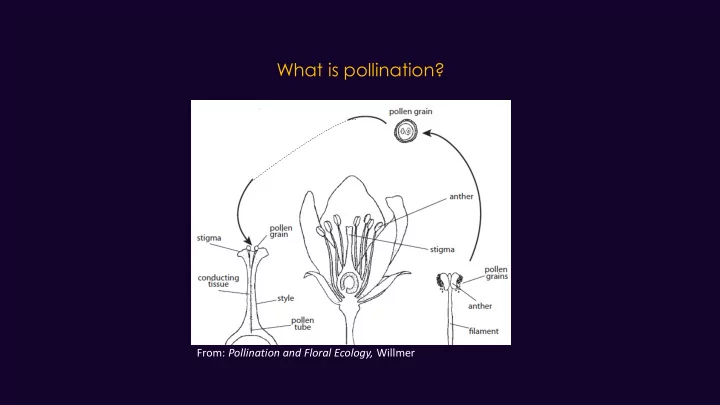
What is pollination? . From: Pollination and Floral Ecology, Willmer - - PowerPoint PPT Presentation

what is pollination
SMART_READER_LITE
LIVE PREVIEW

What is pollination? . From: Pollination and Floral Ecology, Willmer - - PowerPoint PPT Presentation

What is pollination? . From: Pollination and Floral Ecology, Willmer Why animal pollination? . Pollen Prey Nectar What is animal mediated pollination? U.S. Fish and Wildlife Service Headquarters T. Freiburger Scent Resin . Eltz Elena


slide-1
SLIDE 1

What is pollination?

.

From: Pollination and Floral Ecology, Willmer

slide-2
SLIDE 2

Why animal pollination?

.

slide-3
SLIDE 3

What is animal mediated pollination?

.

  • T. Freiburger

Elena Albertsen

Nectar

U.S. Fish and Wildlife Service Headquarters

Pollen

Eltz

Resin Scent Prey

slide-4
SLIDE 4

What isn’t animal mediated pollination?

.

Pollination by animals IS NOT an altruistic behavior. All mutualisms can (and should!) be thought of as “reciprocal parasitism’s”

(Judith Bronstein)

slide-5
SLIDE 5

Pollinators differ & plants differ

.

Pollinators

  • Morphology
  • Behavior
  • Resources sought
  • Effectiveness and

efficiency as pollinators

  • Etc, etc

Plants

  • Architecture / morphology
  • Mating system
  • Phenology
  • Rewards offered
  • Etc, etc

What is the upshot of this variation?

slide-6
SLIDE 6

Coevolution between plants and floral visitors

.

Coevolution between plants and flower visiting animals is well documented

Animals  Plant traits Darwin, C. (1888). The various contrivances by which orchids are fertilised by insects. J. Murray. Galen, C. (1996). Rates of floral evolution: adaptation to bumblebee pollination in an alpine wildflower, Polemonium viscosum. Evolution. Schemske & Bradshaw (1999). Pollinator preference and the evolution of floral traits in monkeyflowers (Mimulus). Proceedings of the National Academy of Sciences Strauss, S. Y., & Whittall, J. B. (2006). Non-pollinator agents of selection on floral traits. Ecology and evolution of flowersWhittall, J. B., & Hodges, S. A. (2007). Pollinator shifts drive increasingly long nectar spurs in columbine flowers. Nature Schiestl, F. P., & Johnson, S. D. (2013). Pollinator-mediated evolution of floral signals. Trends in Ecology & Evolution Plants  Animal traits Darwin, C. (1888). The various contrivances by which orchids are fertilised by insects. J. Murray. Borrell, B. J. (2005). Long tongues and loose niches: evolution of euglossine bees and their nectar flowers. Biotropica Miller-Struttmann, et al. (2015). Functional mismatch in a bumble bee pollination mutualism under climate change. Science Robert Clark, for Evolution

slide-7
SLIDE 7

Pollination syndromes

.

Floral characteristics predict the kinds

  • f pollinators that utilize the species

“Syndromes” are emergent properties

  • f plant—pollinator co-evolution

Florian P. Schiestl , Steven D. Johnson, https://doi.org/10.1016/j.tree.2013.01.019

slide-8
SLIDE 8

This concept can be useful

.

slide-9
SLIDE 9

.

David Inouye

This concept can be useful

slide-10
SLIDE 10

But it is not perfect

.

  • “Matches” aren’t really perfect
  • “Everything visits everything”
  • Many relationships too diffuse
  • Many other factors also drive

floral trait evolution

Strauss, S. Y., & Whittall, J. B. (2006). Non-pollinator agents of selection on floral traits. Ecology and evolution of flowers, 120- 138. Lehtilä, K., & Strauss, S. Y. (1999). Effects of foliar herbivory on male and female reproductive traits of wild radish, Raphanus

  • raphanistrum. Ecology, 80(1), 116-124.
slide-11
SLIDE 11

Today’s lab

.

  • Visit herbarium
  • Examine / take notes on specimens
  • Finish readings, answer assignment questions
slide-12
SLIDE 12

What is an herbarium?

.

slide-13
SLIDE 13

Figure captions

.

1 - What are we looking at?  Describe the data, not the results 2 - What does it mean?  Very brief statement of the take-home point 3 - How do you know?  Stats This is not the results nor is it the discussion section Be concise