
SLIDE 1
What is it? Instrument or ensemble?
Lars Bo Andersen, Humans and IT research seminar, 13/5-2015
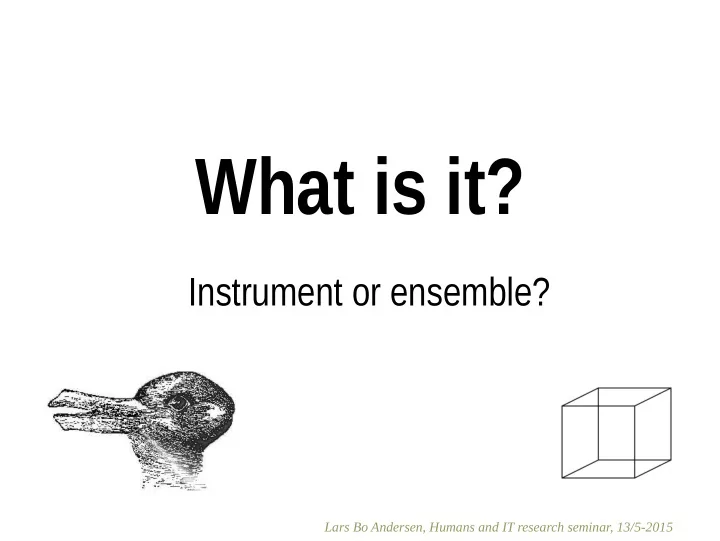
What is it? Instrument or ensemble? Lars Bo Andersen, Humans and IT - - PowerPoint PPT Presentation
What is it? Instrument or ensemble? Lars Bo Andersen, Humans and IT research seminar, 13/5-2015 Instrument <> Ensemble Our instruments Concepts and methods Empirical stuff Ensembles From French ensemble "all the parts of a thing
Lars Bo Andersen, Humans and IT research seminar, 13/5-2015
Concepts and methods
Empirical stuff
From French ensemblée "all the parts of a thing considered together,"
~ Ensembles do not reduce to one thing, they are always many ~ Ensembles are always different - even when they are the same ~ Ensembles are played out, they exist in performance, and we only really know them afterwards
OL OL OL OL
From French ensemblée "all the parts of a thing considered together," OL OL OL OL
From French ensemblée "all the parts of a thing considered together,"
(ensemble)
Humans as bodies Humans as networks
(concrete, ghettos, satelites, islam, poetry, politics, media, tables, cameras, tv viewers etc..)
Children’s participation
Report children overtaking the participation of workshop children
“I started writing mails to her because I always got her answerphone and she never called back (...) That was really annoying, that you couldn’t just call her and get through” ”I really want a computer so I can maintain contact with my friends, because it is difficult for me now” Children (partially) participated already in planning Teledialogue
A non-present but influential participant
Always part of children’s participation
Participation as partial and overtaken
with numerous others
relational and partial => Participation unfolds throughout the project in various forms.. it is never fully realised or completely absent
– What would happen if we treated our methods and
concepts as ensembles which we never really know until they unfold in performance?
– How do we unsettle them in relation to one another
(e.g. ANT and participation) and the world in which they unfold?