What is Frail? What is Frail? recent weight loss recent weight - - PowerPoint PPT Presentation

what is frail what is frail
SMART_READER_LITE
LIVE PREVIEW

What is Frail? What is Frail? recent weight loss recent weight - - PowerPoint PPT Presentation

What is Frail? What is Frail? recent weight loss recent weight loss self self- - reported exhaustion reported exhaustion poor grip strength poor grip strength slow walking speed slow walking speed low


slide-1
SLIDE 1

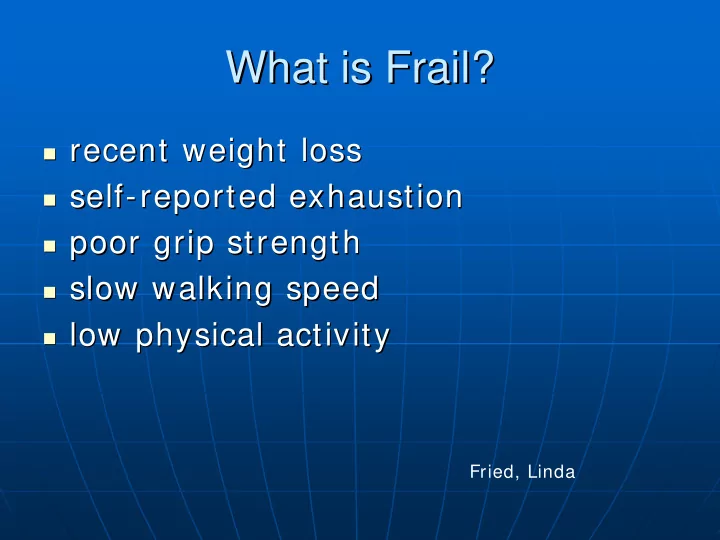
What is Frail? What is Frail?

  • recent weight loss

recent weight loss

  • self

self-

  • reported exhaustion

reported exhaustion

  • poor grip strength

poor grip strength

  • slow walking speed

slow walking speed

  • low physical activity

low physical activity

Fried, Linda

slide-2
SLIDE 2

Systolic vs. Diastolic Heart Failure Systolic vs. Diastolic Heart Failure

  • Type of ventricular dysfunction found

Type of ventricular dysfunction found different between elderly and different between elderly and younger younger

  • Approximately 40% to 50% of

Approximately 40% to 50% of elderly patients with heart failure elderly patients with heart failure have normal left ventricular systolic have normal left ventricular systolic function with predominantly diastolic function with predominantly diastolic dysfunction dysfunction

slide-3
SLIDE 3

Cardiac Cardiac Ischaemia Ischaemia and MI and MI

  • Angina and equivalents

Angina and equivalents

  • Exertional

Exertional angina angina -

  • most common

most common manifestation of myocardial ischemia in manifestation of myocardial ischemia in young and middle young and middle-

  • aged

aged

  • In elderly,

In elderly, dyspnea dyspnea also common also common

  • Asymptomatic, although silent ischemia

Asymptomatic, although silent ischemia also frequent also frequent -

  • demonstrable by stress

demonstrable by stress testing or testing or Holter Holter monitoring. monitoring.

slide-4
SLIDE 4

Cardiac Cardiac Ischaemia Ischaemia and MI and MI

  • Acute MI

Acute MI

  • 4 5 % of

4 5 % of MI s MI s w ere silent or unrecognized w ere silent or unrecognized

  • percentage increased w ith the patient's

percentage increased w ith the patient's age in m ales ( Fram ingham ) age in m ales ( Fram ingham )

  • I nstead of chest pain, elderly patients

I nstead of chest pain, elderly patients m ore com m only com plain of m ore com m only com plain of dyspnea dyspnea or

  • r

have vague sym ptom s of confusion, have vague sym ptom s of confusion, abdom inal pain, or generalized w eakness abdom inal pain, or generalized w eakness at the tim e of acute MI . at the tim e of acute MI .

  • Main cause of death in elderly patients

Main cause of death in elderly patients

slide-5
SLIDE 5

Factors that contribute to the atypical Factors that contribute to the atypical presentation of infection in the elderly presentation of infection in the elderly

  • Underreporting of illness

Underreporting of illness

  • Compromised cognition

Compromised cognition

  • Coexisting diseases

Coexisting diseases mask mask

  • Altered physiologic responses

Altered physiologic responses

slide-6
SLIDE 6