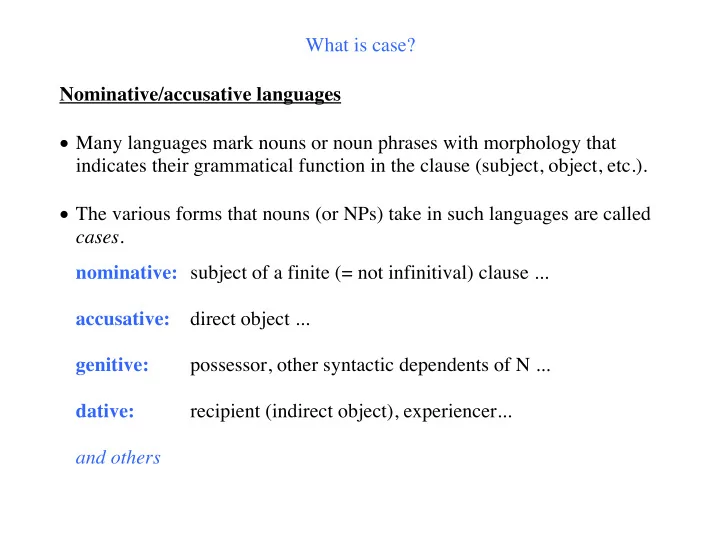
SLIDE 1 What is case? Nominative/accusative languages
- Many languages mark nouns or noun phrases with morphology that
indicates their grammatical function in the clause (subject, object, etc.).
- The various forms that nouns (or NPs) take in such languages are called
cases. nominative: subject of a finite (= not infinitival) clause ... accusative: direct object ... genitive: possessor, other syntactic dependents of N ... dative: recipient (indirect object), experiencer... and others
SLIDE 2
Nominative-Accusative case systems Russian: Ol'g-a dala [knig-u Maš-i] devušk-e. Olga-NOM gave book.ACC Masha-GEN girl-DAT subject direct object possessor indirect object 'Olga gave Masha's book to the girl.'
SLIDE 3 Nominative-Accusative case systems Latin:
in Galliā interfecit. Caesar.NOM all.ACC druids.ACC in Gaul.ABL killed 'Caesar killed all the Druids in Gaul.
Romam redire populus voluit. Caesar.ACC Rome-to return people.NOM wanted 'The people wanted Caesar to return to Rome.'
Caesari provinciam dedit. senate.NOM Caesar.DAT province.ACC gave 'The senate gave a/the province to Caesar.'
- d. Legiones Caesaris multas gentes
subegerunt. legions.NOM Caesar.GEN many.ACC peoples.ACC subjugated 'Caesar’s legions subjugated many peoples.'
SLIDE 4 Nominative-Accusative case systems Finnish:
book.NOM is table.ADESSIVE 'The book is on the table.' b. Pekka osti jonkin kirjan. Pekka bought some.ACC book.ACC 'Pekka bought a book.'
etsi sitä kampaa. probably (s)he.NOM looked-for that.PART comb.PART 'It was pretty clear that (s)he was looking for that comb.' d. Hänellä on vihreät silmät. (s)he.ADESSIVE is green.NOM.pl eye.NOM.pl ‘(S)he has green eyes.’
SLIDE 5 Ergative-absolutive case systems absolutive: direct object if the clause contains one, otherwise subject ergative: subject of a clause that also contains an absolutive object Basque:
joan da. Mary.ABS left has 'Mary left.'
liburua erosi du. Mary.ERG book-the.ABS bought has 'Mary bought the book.'
diot Mariri trikota ez eman. I.ERG have Mary.DAT sweater-the.ABS not given 'I did not give the sweater to Mary.'
SLIDE 6 Ergative-absolutive case systems absolutive: direct object if the clause contains one, otherwise subject ergative: subject of a clause that also contains an absolutive object Dyirbal (NE Australia, Pama-Nyungan):
yara baninu.
DEIC-I.ABS
man.ABS coming 'The man is coming.'
bangun dugumbiru balgan.
DEIC-I.ABS man.ABS DEIC-II.ERG woman.ERG hitting
'The woman is hitting the man.'
SLIDE 7
Ergative-absolutive case systems Split ergative systems Tense splits: past tense ERG/ABS, present tense NOM/ACC Aspect splits: perfective ERG/ABS, imperfective NOM/ACC Agreement splits: case ERG/ABS, verbal agreement NOM/ACC (never the reverse!) Person split: 3rd person ERG/ABS , [+participant] NOM/ACC and more!
SLIDE 8
Ergative-absolutive case systems In this class: we now return (permanently, alas) to NOM/ACC systems
SLIDE 9 Environments of Accusative case
- In languages like Russian, Latin, Japanese, and many others,
accusative case is found on the complements of V and some instances
- f P — but not on the complements of N and A.
- A complement of N and A either bears a case such as genitive or else
is a PP.
SLIDE 10
Environments of Accusative case Russian: (1) Complement to V (accusative) (2) Complement to P (accusative) [VP čitaet knigu] [PP v Moskvu] reads book-ACC to Moscow-ACC
SLIDE 11 Environments of Accusative case (3) Complement to N (*accusative)
- a. [NP kritika knigi]
- b. *[NP kritika knigu]
criticism book-GEN criticism book-ACC
- C. [NP ljubov' [PP k muzyke]]
- d. *[NP ljubov' muzyku]
love to music-DAT love music-ACC (4) Complement to A (*accusative)
- a. [AP dovolen obedom]
- b. *[AP dovolen obed]
satisfied dinner-INSTR
satisfied dinner-ACC
- c. [AP serdit [PP na menja]]
- d. *[AP serdit menja]
angry on me-ACC angry me-ACC
SLIDE 12 Environments of Accusative case Rules for accusative case in Russian (and similar languages)
- a. V and P may assign accusative case to an NP complement.
- b. N and A do not assign accusative case.
(simplified!)
SLIDE 13
Environments of Accusative case English: At first glance, case does not appear to be a part of English grammar. (though ask me about I vs. me, we vs. us)
SLIDE 14 Environments of Accusative case Rules for accusative case in Russian (and similar languages)
- a. V and P may assign accusative case to an NP complement.
- b. N and A do not assign accusative case.
Facts about the availability of NP complements in English
- a. V and P allow an NP complement.
- b. N and A do not allow an NP complement.
SLIDE 15 Environments of Accusative case English: (1) Complement to V (NP) (2) Complement to P (NP) [VP reads the book] [PP to the city] (3) Complement to N (*NP)
- a. [NP the criticism of the book]
- b. *[NP the criticism the book]
- C. [NP our love [PP of music]]
- d. *[NP our love music]
(4) Complement to A (*NP)
- a. [AP satisfied with dinner]
- b. *[AP satisified dinner]
- c. [AP fond [PP of the child]]
- d. *[AP fond the child]
SLIDE 16
Environments of Accusative case Russian: (1) Complement to V (accusative) (2) Complement to P (accusative) [VP čitaet knigu] [PP v Moskvu] reads book-ACC to Moscow-ACC
SLIDE 17 Environments of Accusative case (3) Complement to N (*accusative)
- a. [NP kritika knigi]
- b. *[NP kritika knigu]
criticism book-GEN criticism book-ACC
- c. [NP ljubov' [PP k muzyke]]
- d. *[NP ljubov' muzyku]
love to music-DAT love music-ACC (4) Complement to A (*accusative)
- a. [AP dovolen obedom]
- b. *[AP dovolen obed]
satisfied dinner-INSTR
satisfied dinner-ACC
- c. [AP serdit [PP na menja]]
- d. *[AP serdit menja]
angry on me angry me-ACC
SLIDE 18 Environments of Accusative case Generalization:
- Where Russian allows an accusative NP as a complement, English
allows an NP.
- Where Russian does not allow an accusative NP — but might allow an
NP with some other case — English simply does not allow an NP.
SLIDE 19 Environments of Accusative case
- In Russian, the following fact is obvious on the face of it, since any
NP that can show case morphology must show case morphology: Case Filter for Russian *[NP –case]
SLIDE 20 Environments of Accusative case
- In Russian, the following fact is obvious on the face of it, since any
NP that can show case morphology must show case morphology: Case Filter for Russian *[NP –case]
- Suppose the Case Filter is also true of English...
- and suppose the distribution of accusative case is governed by the
same rules that govern it in Russian. Rules for accusative case in Russian
- a. V and P may assign accusative case to an NP complement.
- b. N and A do not assign accusative case.
SLIDE 21 Environments of Accusative case Case Filter for Russian & English *[NP –case] Rules for accusative case in Russian & English
- a. V and P may assign accusative case to an NP complement.
- b. N and A do not assign accusative case.
Differences between English and Russian
- a. Case morphology in English is phonologically zero.
- b. English has rules assigning accusative case,
but lacks genitive, dative, instrumental, etc.
SLIDE 22 Environments of Accusative case The fact that English lacks such cases as genitive, dative, and instrumental, means the complement to N and A simply may not be an NP. This is why what looks like a restriction on accusative case in Russian looks like a restriction on the very existence of an NP in English. Case Filter for Russian & English *[NP –case] Rules for accusative case in Russian & English
- a. V and P may assign accusative case to an NP complement.
- b. N and A do not assign accusative case.
Differences between English and Russian
- a. Case morphology in English is phonologically zero.
- b. English has rules assigning accusative case,
but lacks genitive, dative, instrumental, etc.
SLIDE 23
Environments of Accusative case Is the idea of phonologically null case-marking absurd?
SLIDE 24
Environments of Accusative case Is the idea of phonologically null case-marking absurd? No.
SLIDE 25 Environments of Accusative case Indeclinable Russian kangaroos
- a. [VP vidit kenguru]
- b. [PP v kenguru]
sees kangaroo-ACC into kangaroo-ACC
- c. [NP kritika kenguru]
- d. [NP ljubov' [PP k kenguru]]
criticism kangaroo-GEN love to kangaroo 'criticism of the kangaroo' 'love for a kangaroo'
- e. [AP dovolen kenguru]
- f. [AP serdit [PP na kenguru]]
satisfied kangaroo-INSTR angry at kangaroo 'satisfied with the kangaroo' 'angry at a kangaroo'
SLIDE 26 Environments of Accusative case The indeclinable noun heads an NP that does bear case:
- a. [VP vidit mo-ego kenguru]
sees my-ACC kangaroo-ACC
- b. [NP kritika èt-ogo kenguru]
criticism this-GEN kangaroo-GEN c [AP dovolen krasiv-ym kenguru] satisfied beautiful-INSTR kangaroo-INSTR Declinable elements that agree with the head noun in case show the expected case suffix even when the head noun itself is indeclinable.
SLIDE 27
Environments of Accusative case
SLIDE 28 Environments of Accusative case The Adjacency Condition on Accusative Case Assignment We are developing a picture of a part of syntax called Case Theory. Case Theory distinguishes among the syntactic categories in two ways:
- 1. It distinguishes between accusative case assigners (V, P) and
categories that do not assign accusative case (N, A).
- 2. It distinguishes between NP, which needs case by the Case Filter,
and other categories such as PP and CP, which do not need case. Let us focus on distinction 2. The distinction between NP complements and PP and CP complements is visible in the morphology of languages like Russian. In Russian, nouns bear case morphology, but prepositions and complementizers do not.
SLIDE 29 Environments of Accusative case
- Interestingly, the distinction shows up in English as well. Consider
verbs like put and persuade that take more than one complement. When one of these complements is an NP, it is always the one that is next to the verb: (1) a. Sue put the book under the desk. (ok V NP PP)
- b. *Sue put under the desk the book.
(* V PP NP) (2) a. Bill persuaded his friends that the world is flat. (ok V NP CP)
- b. *Bill persuaded that the world is flat his friends. (* V CP NP)
SLIDE 30 Environments of Accusative case
- For verbs that take a PP and a CP complement, or two PPs, there may be
a slight preference for one order of complements over another, but it is nothing like the strong effect seen in Error! Reference source not found.) and Error! Reference source not found.). (1)a. Sue spoke to Tom about Bill. (ok V PP PP)
- b. Sue spoke about Bill to Tom.
(2)a. Sue shouted to her friends that it was snowing. (ok V PP CP)
- b. ?Sue shouted that it was snowing to her friends.
(ok V CP PP)
- The ordering effect also disappears in NP, where the complement that
would be accusative in VP is replaced by a PP. (3)a. the placement of the book under the desk (ok N PP PP)
- b. the placement under the desk of the book
SLIDE 31 Environments of Accusative case (4)a. her promise to her friends that she would leave
- b. ?her promise that she would leave early to her friends
SLIDE 32 Environments of Accusative case Accusative case assignment (version 1) a assigns accusative case to b only if:
- i. a is V or P (but not N or A);
- ii. b is the complement of a; and
- iii. a and b are adjacent.
(ask me about French) (ask me about English topicalization or wh-movement)
SLIDE 33
Environments of Accusative case The glory of this proposal: We do not need to suppose that any special rules besides the laws of Case Theory dictate the relative ordering of complements. We do not need to build this into subcategorization frames or stipulations about Merge, for example.
SLIDE 34
Nominative Case assignment T assigns nominative case to its specifier.
SLIDE 35 Nominative Case assignment Finite T assigns nominative case to its specifier.
- a. I am happy [that Mary left the room].
- b. *I am happy [ø Mary to leave the room].
SLIDE 36 Nominative Case assignment Finite T assigns nominative case to its specifier.
- a. I am happy [that Mary left the room].
- b. *I am happy [ø Mary to leave the room].
but what about:
- c. I would be happy [for Mary to leave the room].
SLIDE 37 Draw some conclusions:
- a. Sue thinks [that soon the class will have a party].
- b. I am happy [that soon the class will have a party].
- c. Sue arranged [for (*soon) the class to have a party].
- d. I would be happy [for (*soon) the class to have a party].
SLIDE 38 Accusative case assignment (version 2) a assigns accusative case to b only if:
- i. α is V or P or the complementizer for (not N or A);
- ii. α c-commands β with no CP barrier intervening; and
- iii. α and β are adjacent.
if complementizer for has prepositional features, we can simplify this: Accusative case assignment (version 2ʹ) a assigns accusative case to b only if:
- i. α is V or P (not N or A);
- ii. α c-commands β with no CP barrier intervening; and
- iii. α and β are adjacent.
SLIDE 39 "Exceptional case marking" (ECM) verbs
- a. Tom believed [Mary to have left the room].
- b. Sue considers [Jill to be the best candidate for the job].
What is case-marking Mary and Jill ?
SLIDE 40 Case assignment across a clause boundary "Exceptional case marking" verbs
- a. Tom believed [Mary to have left the room].
- b. Sue considers [Jill to be the best candidate for the job].
What is case-marking Mary and Jill ?
- c. Tom believed [that recently Mary had left the room].
- d. *Tom believed [recently Mary to have left the room].
SLIDE 41 Case assignment across a clause boundary "Exceptional case marking" verbs
- a. Tom believed [Mary to have left the room].
- b. Sue considers [Jill to be the best candidate for the job].
What is case-marking Mary and Jill ?
- c. Tom believed [that recently Mary had left the room].
- d. *Tom believed [recently Mary to have left the room].
- e. Tom's belief [that Mary left the room] ...
f. *Tom's belief [Mary to have left the room]...
SLIDE 42 Case assignment across a clause boundary Accusative case assignment (version 2') a assigns accusative case to b only if:
- i. α is V or P (not N or A);
- ii. α c-commands β with no CP barrier intervening; and
- iii. α and β are adjacent.
Stipulation: A clause that is a complement to an ECM verb is not a barrier to case assignment. (That is why such a clause is "exceptional"!)
SLIDE 43 Passive
- a. The pizza was devoured by the lion.
SLIDE 44 Passive
- a. The pizza was devoured (by the lion).
- b. The book was put under the desk (by Tom).
- c. Mary was persuaded [that the world was ending] (by her friends).
SLIDE 45 Passive
- a. [The pizza] was devoured __ (by the lion).
- b. [The book] was put __ [under the desk] (by Tom).
- c. [Mary] was persuaded __ [that the world was ending] (by her friends).
SLIDE 46 Passive Japanese
- a. Kuruma-ga 3-dai doroboo-ni nusum-are-ta.
car-NOM 3-cl thief-by steal-PASS-Past '3 cars were stolen by the thief.'
- b. Kuruma-ga doroboo-ni 3-dai nusum-are-ta.
- a. Kinoo, gakusei-ga 2-ri [ano otoko]-ni home-rare ta.
yesterday student- NOM 2-cl that man-by praise-PASS-Past 'Yesterday, 2 students were praised by that man.'
- b. Kinoo, gakusei-ga [ano otoko]-ni 2-ri home-rare ta.
'Yesterday, 2 students were praised by that man.'
SLIDE 47 Passive Japanese
- a. [Kuruma-ga 3-dai] doroboo-ni [NP __ ] nusum-are-ta.
car-NOM 3-cl thief-by steal-PASS-Past '3 cars were stolen by the thief.'
- b. Kuruma-ga doroboo-ni [NP__ 3-dai] nusum-are-ta.
SLIDE 48 Passive English idioms (1) a. Bill let the cat out of the bag.
- b. The cat was let out of the bag (by Bill).
('let the cat out of the bag' = 'reveal the secret') (2) a. John really took the wind out of our sails.
- b. The wind was really taken out of our sails (by John).
('take the wind out of someone's sails' = 'destroy someone's enthusiasm') (3) a. Sue kept close tabs on the opposition.
- b. Close tabs were kept on the opposition (by Sue).
('keep close tabs on...' = 'monitor closely') (4) a. John kept a close eye on the opposition.
- b. A close eye was kept on the opposition by (John).
('keep a close eye on ...' = 'monitor closely') (5) a. Our programmers really dropped the ball on that one.
- b. The ball was really dropped on that one (by the programmers).
('drop the ball on X' = 'screwed up by forgetting something X-related')
SLIDE 49
Passive
SLIDE 50 Passive Why does the NP complement have to move in a passive sentence, but not a PP or CP complement?
- a. The pizza was devoured __ (by the lion).
- b. The book was put __ [under the desk] (by Tom).
- c. Mary was persuaded __ [that the world was ending] (by her friends).
SLIDE 51 Passive Why does the NP complement have to move in a passive sentence, but not a PP or CP complement?
- a. The pizza was devoured __ (by the lion).
- b. The book was put __ [under the desk] (by Tom).
- c. Mary was persuaded __ [that the world was ending] (by her friends).
Hypothesis about passive morphology Passive morphology...
- 1. ...suppresses assignment of accusative case;
- 2. ...suppresses normal assignment of external semantic role
(θ-role)
(the role assigned to the subject in an active sentence)
SLIDE 52
Passive
SLIDE 53 Passive Accusative case assignment (version 2') a assigns accusative case to b only if:
- i. α is a V in the active voice or P (not N or A);
- ii. α c-commands β with no CP barrier intervening; and
- iii. α and β are adjacent.
Hypothesis about passive morphology Passive morphology...
- 1. suppresses assignment of accusative case;
- 2. suppresses normal assignment of external θ-role
SLIDE 54 Passive
- Notice also that English sentences need an overt specifier of TP.
- This requirement is sometimes called the Extra Peripheral Position
principle, abbreviated EPP: EPP TP must have a specifier.
(Note: You may meet linguists who tell you that the initials "EPP" stand for something else. If you do, report them promptly to me...)
SLIDE 55
Passive
SLIDE 56
Passive
SLIDE 57 Passive Two results from passivizing a verb with a CP complement:
- a. [That the world is round] was discovered __ by the ancient Greeks.
- b. It was discovered by the ancient Greeks [that the world is round].
But verbs that take an NP complement have only one passive:
- a. The book was put __ under the table (by Mary).
- b. *It was put the book under the table (by Mary).
Why?
SLIDE 58 Passive Two results from passivizing a verb with a CP complement:
- a. [That the world is round] was discovered __ by the ancient Greeks.
- b. It was discovered by the ancient Greeks [that the world is round].
EPP satisfied by expletive it. CP does not need to receive case. But verbs that take an NP complement have only one passive:
- a. The book was put __ under the table (by John).
- b. *It was put the book under the table (by John).
EPP satisfied by expletive it. But the book does need to receive case — and remains caseless
SLIDE 59
Passive
SLIDE 60 Passive ECM John believed [Mary to have left the room] Passive meets ECM
- a. Mary was believed [ __ to have left the room] (by her friends).
- b. *It was believed [Mary to have left the room] (by her friends).
Why?
SLIDE 61 Passive ECM
- a. John believed [Mary to have left the room]
Passive meets ECM
- b. Mary was believed [ __ to have left the room] (by her friends).
EPP satisfied by raising Mary to Spec,TP Mary, which needs case, is assigned NOM by finite T in the main clause.
- c. *It was believed [Mary to have left the room] (by her friends).
EPP satisfied by expletive it. Mary needs to receive case. In (a) the active form of believe assigns ACC, but in (b) the passive form does not (nor does to).
SLIDE 62 Passive Idioms Recall full-sentence idioms: (1) a. Bill let the cat out of the bag.
- b. The cat was let out of the bag (by Bill).
('let the cat out of the bag' = 'reveal the secret') (2) a. John really took the wind out of our sails.
- b. The wind was really taken out of our sails (by John).
('take the wind out of someone's sails' = 'destroy someone's enthusiasm') (3) a. Sue believed [the shit to have hit the fan on Thursday].
- b. The shit was believed to have hit the fan on Thursday (by John).
('The shit hit the fan.' = '<Contextually salient people> got in trouble.') (4) a. John believed [the tide to have turned].
- b. The tide was believed to have turned (by John).
SLIDE 63 Passive Passive meets ECM meets passive
- a. The pizza was believed [ __ to have been devoured __].
- b. The cat was believed [ __ to have been let __ out of the bag].
SLIDE 64 Passive Passive meets ECM meets passive
- a. The pizza was believed [ __ to have been devoured __].
- b. The cat was considered [ __ to have been let __ out of the bag].
SLIDE 65 Passive recall:
- a. Mary was believed [ __ to have left the room] (by her friends).
- b. The shit was believed [ ___ to have hit the fan].
- c. The pizza was believed [ __ to have been devoured __].
- d. The cat was considered [ __ to have been let __ out of the bag].
SLIDE 66 Raising
- a. Mary seems [ __ to have left the room]
- b. The shit appears [ ___ to have hit the fan].
- c. The pizza is likely [ __ to have been devoured __].
- d. The cat is certain [ __ to have been let __ out of the bag].
SLIDE 67 Raising
to have left the room] It seems [that Mary has left the room].
- b. The shit appears [ ___ to have hit the fan].
It appears [ that the shit has hit the fan].
[ __ to eat the meal]. It is likely [ that John will eat the meal].
SLIDE 68 Raising
to have left the room] It seems [that Mary has left the room]. *It seems [ Mary to have left the room].
- b. The shit appears [ ___ to have hit the fan].
It appears [ that the shit has hit the fan]. *It appears [ the shit to have hit the fan].
[ __ to eat the meal]. It is likely [ that John will eat the meal]. *It is likely [ John to eat the meal].