What is an Audiologist? Audiologists are health-care professionals - - PDF document

what is an audiologist
SMART_READER_LITE
LIVE PREVIEW

What is an Audiologist? Audiologists are health-care professionals - - PDF document

10/5/2018 What is an Audiologist? Audiologists are health-care professionals (aka clinical doctors like dentists or optometrists) who evaluate, HEARING LOSS & COGNITIVE diagnose, treat, manage: hearing loss, DECLINE tinnitus, and


slide-1
SLIDE 1

10/5/2018 1

HEARING LOSS & COGNITIVE DECLINE

2018 Laguna Woods Presentation by:

  • Dr. Stephani Rose of House-Providence

Hearing Health Centers

https://houseprovidence.org/our-locations/orange-county/

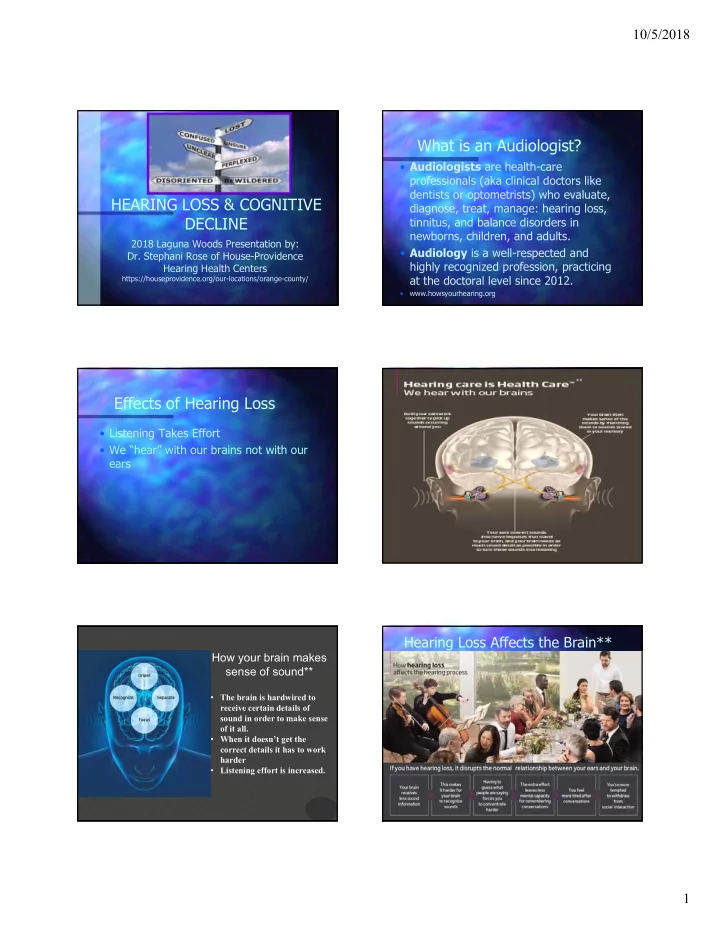
What is an Audiologist?

  • Audiologists are health-care

professionals (aka clinical doctors like dentists or optometrists) who evaluate, diagnose, treat, manage: hearing loss, tinnitus, and balance disorders in newborns, children, and adults.

  • Audiology is a well-respected and

highly recognized profession, practicing at the doctoral level since 2012.

  • www.howsyourhearing.org

Effects of Hearing Loss

  • Listening Takes Effort
  • We “hear” with our brains not with our

ears

**

How your brain makes sense of sound**

  • The brain is hardwired to

receive certain details of sound in order to make sense

  • f it all.
  • When it doesn’t get the

correct details it has to work harder

  • Listening effort is increased.

Hearing Loss Affects the Brain**

slide-2
SLIDE 2

10/5/2018 2 COMMON SIGNS OF HEARING DIFFICULTY**

People seem to be mumbling

It’s harder to follow a conversation in meetings, restaurants or noisy places

You tend to limit social activities because it’s difficult to hear or communicate

What is Mild Cognitive Impairment (MCI)

  • Mild Cognitive Impairment (MCI) is an

intermediate stage between the expected cognitive decline of normal aging and the more-serious decline of dementia.

  • It can involve problems with memory,

language, thinking and judgment that are greater than normal age-related changes

  • www.mayoclinic.org/diseases-conditions/mild-cognitive-

impairment/home/ovc-20206082

WHAT IS DEMENTIA?

  • Very common, More than 3 million US cases per year
  • Treatment can help, but it can't be cured
  • Chronic: can last for years or be lifelong
  • Requires a medical diagnosis: Lab tests or imaging
  • ften required
  • Not a specific disease, dementia is a group of

conditions characterized by impairment of at least two brain functions, such as memory loss and judgment.

  • Symptoms include forgetfulness, limited social skills, and

thinking abilities so impaired that it interferes with daily functioning.

  • Medications and therapies may help manage symptoms.

Some causes are reversible.

Role of the Audiologist & Cognitive Decline

  • Communication Difficulties= one of the

earliest signs of dementia.

  • Audiologists are responsible for making timely

and appropriate referrals

  • This can improve long term outcomes
  • Provide earlier diagnosis and

management of cognitive decline

  • -Audiology Today Magazine , Vol 28 No 5;

pg 16

Statistics on Hearing Loss & Dementia

  • Hearing loss- 3rd most common health problem in

the US next to Arthritis (#2) and Heart Disease (#1)

  • 1 in 3 people over 60 years old have hearing loss
  • 1 in 6 baby boomers have hearing loss
  • Very few people have no cognitive decline with

age

  • 2010, 4.7 million people in US over 65 years old had

most common form of dementia, Alzheimer’s disease.

  • 2016, this number grew to 5.4 million
  • By 2050, 13.8 million Americans expected to have

Alzheimer’s disease

  • Large overlap of older adults with both hearing loss &

cognitive decline

  • Audiology Today Magazine , Vol 28 No 5; pg 16

TYPES OF DEMENTIA

  • Alzheimer’s Disease
  • Dementia with Lewy Bodies (DLB)
  • Vascular Dementia
  • Frontotemporal Dementia
  • Parkinson’s Disease
  • Huntington’s Dementia
  • Traumatic Brain Injury
  • Wernicke-Korsakoff Syndrome
  • Mixed Dementia
  • Post-operative Cognitive Dysfunction

(POCD)

slide-3
SLIDE 3

10/5/2018 3

TYPES OF DEMENTIA

  • Alzheimer’s Disease
  • Most common form of dementia (2/3 of all cases)
  • Caused by plaques and tangles which disrupt normal

nerve cell function in the brain.

  • First symptom: Short-term memory loss
  • Other symptoms: difficulty learning new info, problems

thinking and organizing, poor judgment, confusion, difficulty speaking and personality & behavior changes

  • These changes from AD occur in the brain many

years before symptoms appear.

  • Average life expectancy = 8-12 years after

diagnosis.

  • www.Silveradocare.com/dementia

TYPES OF DEMENTIA

  • Dementia with Lewy Bodies (DLB)
  • 20% of all dementia cases, 2nd most common type.
  • Abnormal protein structures called Lewy Bodies appear in

brain causing brain cells to die.

  • Can develop after many years of Parkinson’s disease

(Parkinson’s Disease Dementia).

  • Symptoms: Vivid complex visual hallucinations, fluctuating

alertness and motor symptoms of Parkinson’s disease: unsteady gait, stiffness, flexed posture.

  • People with DLB are at increased risk for falls.
  • Average life expectancy is 7 years after symptoms

appear.

  • Vascular Dementia-
  • Caused by cerebrovascular problems.
  • Like several small strokes or one large stroke
  • www.Silveradocare.com/dementia

TYPES OF DEMENTIA

  • Frontotemporal Dementia
  • 10-15% of all dementia cases.
  • A group of neurodegenerative disorders affecting the frontal and

temporal lobes of brain.

  • Typically affects younger people ages 45-60 years old.
  • “Tau” protein collects in brain, creating tangles, causing cell

damage.

  • Parkinson’s Disease
  • Neurological disorder affects brain, spinal cord & nerves
  • Destroys nerve cells that make dopamine (a chemical that helps

get messages between cells in the brain)

  • Brain changes caused by abnormal deposits of alpha-synulein

protein, called Lewy Bodies.

  • Symptoms: begin with movement issues (resting tremor, shuffling

gait, and stooped posture) and progresses to memory loss, the inability to pay attention and to make sound judgments.

  • Develops gradually, starts after age 50 and affects more men than
  • women. -www.Silveradocare.com/dementia

TYPES OF DEMENTIA

  • Huntington’s Dementia
  • AKA Huntington’s Chorea- a hereditary progressive brain disorder caused by

a defective gene.

  • Causes changes in the central area of the brain, affecting movement, mood

and thinking skills.

  • Symptoms develop between 30-50 years old.
  • Average life expectancy is 15 years after diagnosis.
  • Traumatic Brain Injury
  • Caused by impact to the head, disrupts normal brain function (often caused

by falls and car accidents)

  • May affect cognitive abilities including learning and thinking skills.
  • 3 classifications: Mild, Moderate or Severe
  • Symptoms may include: unconsciousness, confusion and disorientation,

difficulty remembering new info, headache, dizziness and blurry vision, nausea and vomiting, ringing in the ears (tinnitus), trouble speaking coherently and changes in emotions and sleeping patterns.

  • www.Silveradocare.com/dementia

TYPES OF DEMENTIA

  • Wernicke-Korsakoff Syndrome
  • Two different stages of the same condition: caused by vitamin B1

(Thiamine) deficiency, associated with malnutrition and alcoholism.

  • Treatment is medically monitored: person must stop drinking

alcohol and take vitamin B1; this will resolve many symptoms except for memory loss which is permanent.

  • Mixed Dementia
  • Symptoms and damage are characteristic of more than one type
  • f dementia and occur at same time.
  • Most common types which occur together are: Alzheimer’s

disease, Vascular dementia, and dementia with Lewy Bodies.

  • More common than previously thought- Autopsies have shown

that 45% of people with dementia have both Alzheimer’s disease and Vascular dementia.

  • Average life expectancy depends on the types of dementias
  • diagnosed. -www.Silveradocare.com/dementia

TYPES OF DEMENTIA

  • Post-operative Cognitive Dysfunction (POCD)
  • A decline in cognitive function that lasts for weeks, months, or

may become permanent after surgery.

  • People with undiagnosed dementia or Mild Cognitive

Impairment at greater risk for developing POCD

  • May cause impairment in memory, concentration,

comprehension or language ability

  • Currently, specific causes are unknown and research shows:
  • No difference whether local or general anesthesia is used
  • Length of surgery is NOT a factor
  • Open heart surgery patients have greater risk of developing POCD vs those

who had other long and complicated surgeries

  • People experiencing POCD at their discharge have an increased

risk of dying within first three months following surgery.

  • www.Silveradocare.com/dementia
slide-4
SLIDE 4

10/5/2018 4

CAUSES of Hearing Loss

  • Presbycusis- Age Related
  • Sociocusis- Noise Induced
  • Damage to hair cells and cochlea, sudden or gradual
  • ~26 million Americans from 20-69 years old have high-frequency

hearing loss due to exposure to loud sounds or noise at work or leisure activities

  • Congenital- Genetic
  • Due to a family history or predisposition
  • Ototoxicity- Drug Related
  • Results in sensorineural hearing loss.
  • Some ototoxic drugs include
  • Some anticancer drugs (chemotherapy, radiation)
  • Aspirin in high quantities
  • Quinine
  • Certain antibiotics

HL RISK FACTORS

  • SMOKING- 70% higher

risk to have hearing loss than nonsmokers

  • DIABETES- hearing loss

is twice as common vs nondiabetics

  • Pre-diabetics show 30%

higher rate of hearing loss vs those with normal blood sugar.

  • HEART HEALTH-

Inner ear extremely sensitive to blood flow.

  • Studies show inadequate

blood flow and trauma to blood vessels of inner ear can contribute to hearing loss.

  • HYPERTENSION-

Significant association between high blood pressure & untreated hearing loss.

  • Hypertension can be

accelerating factor of hearing loss in older adults

EFFECTS OF UNTREATED HEARING LOSS

  • Memory- More likely to develop problems thinking and

remembering vs adults with normal hearing. Degraded hearing may force brain to devote too much energy to processing sound

  • Dementia- more on this next
  • Falling- People with mild hearing loss are 3x more likely to

have history of falling, for every 10 dB more of hearing loss, this increased the chace of falling by 1.4 times

  • Mental Health- Adults 50+ with untreated HL more likely

to report depression, anxiety, anger and frustration, emotional instability and paranoia, are less likely to participate in social activities vs those who wear hearing aids. Degree of depression

  • r other emotional or mental health issues also increases with

severity of hearing loss.

  • Tinnitus- 90% of people with tinnitus (ringing in the ears)

also have hearing loss.

Hearing Loss Linked to Accelerated Brain Tissue Loss

  • Johns Hopkins and the National

Institute on Aging 1/22/2014

  • As a part of the Baltimore

Longitudinal Study on Aging with 126 participants

  • Looked at yearly fMRI imaging over

10 year period

Hearing Loss Linked to Accelerated Brain Tissue Loss

  • Frank Lin, M.D., Ph.D. and colleagues studied 126 people

(75 with normal hearing and 51 with at least mild hearing loss)

  • Faster rates of brain atrophy vs normal hearing

group.

  • Hearing impaired group lost more than one cubic

centimeter of brain tissue each year vs normal

  • hearing. [Superior, Middle, and Inferior Temporal

Gyri]

  • Significantly more shrinkage in brain areas for processing

sound and speech

  • Areas also play role in memory and sensory

integration; shown to be involved in early stages of mild cognitive impairment and Alzheimer’s Disease

HEARING LOSS & INCIDENT DEMENTIA

  • 2011 study by Frank Lin & colleagues

looking at 639 participants from the Baltimore Longitudinal Study of Aging, ages 36-90 years old.

  • Dementia-free at the start of the 18

year study.

  • Risk of incident dementia increased

with the severity of the hearing loss

slide-5
SLIDE 5

10/5/2018 5

HEARING LOSS & INCIDENT DEMENTIA

  • Compared to normal hearing, increased

risk for dementia was

  • ~2 times for mild hearing loss
  • ~3 times for moderate hearing loss
  • ~5 times for severe hearing loss
  • Alzheimer's Disease risk increased by

1.20 per 10 dB of hearing loss

HEARING LOSS & INCIDENT DEMENTIA

  • Conclusions: “Hearing loss is

independently associated with incident all-cause dementia. Whether hearing loss is a marker for early stage dementia or is actually a modifiable risk factor for dementia deserves further study”

  • www.ncbi.nlm.nih.gov/pmc/articles,

/PMC3277636/ Self-reported Hearing Loss, Hearing Aids, and Cognitive Decline in Elderly Adults: A 25-Year Study

  • Journal of the American Geriatric

Society, 2015 October; 63(10):2099- 104.doi:10.1111/jgs.13649

  • 3,670 participants ages 65+ in France
  • 137 reported major hearing loss
  • 1139 reported moderate problems

(difficulty in noisy background)

  • 2394 reported no hearing trouble

Self-reported Hearing Loss, Hearing Aids, and Cognitive Decline in Elderly Adults: A 25-Year Study

  • RESULTS: Self-reported hearing loss

significantly associated with greater cognitive decline during the 25 years

  • This was independent of age, sex, and

education.

  • Those with hearing loss who did not use

hearing aids showed a steeper rate of cognitive decline.

  • Those with hearing loss who wore hearing aids

had no difference in cognitive decline compared to those with normal hearing.

Self-reported Hearing Loss, Hearing Aids, and Cognitive Decline in Elderly Adults: A 25-Year Study

  • CONCLUSION:
  • “Self-reported hearing loss is associated

with accelerated cognitive decline in

  • lder adults; hearing aid use attenuates

such decline.”

Effectiveness of Intervention with Hearing Aids

  • 2015: Atherosclerosis Risk in

Communities Study (ARIC)- Deal and colleagues addressed the hypothesis that older aged persons with hearing loss who use hearing aids have slower rates of cognitive decline than older aged persons with hearing loss who did not use hearing aids. 20 year study.

slide-6
SLIDE 6

10/5/2018 6

Effectiveness of Intervention with Hearing Aids Cont.

  • Older persons with moderate-to-severe hearing loss (>40

dB HL) had poorer performance on memory tasks and global cognitive function vs those without hearing loss.

  • Persons with moderate-to-severe hearing loss showed

decline on cognitive tasks over a 20 year period

  • Greatest decline was in the group who did not use

hearing aids.

  • Persons with same hearing loss who used hearing aids

showed global cognitive decline only slightly greater than the decline in the normal hearing group (Deal et al, 2015).

Effectiveness of Intervention with Hearing Aids Cont.

  • Overall, evidence supports participating in

cognitively-stimulating environments as an intervention for management of dementia.

  • Hearing aids allow cognitive and interpersonal

stimulation and engagement.

  • By decreasing listening effort, hearing aids

allow patients to feel less exhausted after socializing, dedicating more energy for more engagement with family and friends.

Effectiveness of Intervention with Hearing Aids Cont.

  • Research has shown significant improvement in

global cognitive function following cochlear implantation in elderly populations, more research is needed to find out if hearing aid intervention is a viable protection against or decelerator for cognitive decline (Mosnier et al, 2015).

  • We cannot definitely say that hearing aids prevent,

delay, or slow cognitive decline.

  • We can say that well-fitting hearing aids allow for

people to cognitively-engage in behaviors, which are known to prevent, delay, or slow cognitive decline.

New and Current Hearing Technology

Telecoil (AKA T-Coil) Technology

  • A telecoil is a small coil inside your

hearing aids.

  • The coil works as a small receiver which

picks up signals from a loop system that acts as an electromagnetic field.

  • An induction loop system transmits

magnetic energy to telecoil-equipped hearing aids through a wire that surrounds an audience

  • Hearing aids with an

activated telecoil can convert this electromagnetic field into a sound signal.

New and Current Hearing Technology

Newest Products:

  • Rechargeable Lithium Ion Solutions: mostly available

in Receiver-in-Canal style aids, most do not have T-Coils

  • Last up to 36 hours on one overnight charge
  • Life of battery is about 4-6 years and starts to

degrade at 4 years

  • Some are Made-for-iPhone
  • Made-For-iPhone (Mfi): Turns hearing aids into

Bluetooth receiver for phone calls and any media sounds from iPhone or TV or remote Microphone directly into hearing aids, shaped for your sound prescription.

  • Best phone understanding (uses 2 ears with direct

sound transmission)

  • Sound ratios can be adjusted (surrounding volume vs

phone volume).

  • No need for necklace receiver (intermediary device)
  • Most do not have T-Coils

Resound Remote Programming:

  • With specific Mfi hearing

aids, now programming can be done remotely, send request through iPhone to audiologist, changes are sent back to your iPhone and these changes upload to your hearing aids! No need for an office visit for simple adjustments!!! AdHear by MedEl: Stick, Click, Hear

  • Bone Conduction

Hearing Aid for Conductive Hearing Loss

  • First FDA approved

non-surgical solution without need for headband.

slide-7
SLIDE 7

10/5/2018 7

References: References Continued:

  • Amieva, H.; Ouvrard, C.; Giulioli, C.; et.al. Self-Reported Hearing Loss, Hearing Aids, and Cognitive Decline in

Elderly Adults: A 25-Year Study. Journal of the American Geriatric Society. 2015 October; 63 (10): 2099-104.doi: 10.1111/jgs.13649.

  • Frank R. Lin, MD, PhD; E. Jeffrey Metter, MD; Richard J. O’Brien, MD, PhD; et.al. Hearing Loss and Incident

Dementia . Arch Neurol. 2011;68(2):214-220.doi:10.1001/archneurol.2010.362.

  • Link for Press-Release: (copy and paste the link into browser to search)

http://www.hopkinsmedicine.org/news/media/releases/hearing_loss_linked_to_accelerated_brain_tissue_loss_

  • Deal Ja, Sharrett AR, Albert MS, Coresh J, Mosley TH, Knopman D, Wruck LM, Lin FR. (2015) Hearing impairment

and cognitive decline: a pilot study conducted within the atherosclerosis risk in communities neurocognitive study. Am J Epidemiol 181(9):680-690.

  • Mosnier I, Bebear J, Marx M, Fraysse B, Truy E, Lina-Granade G, Mondiain M, Sterkers-Artieres F, Bordure P,

Robier A, Godey B, Meyer B, Frachet B, Poncet-Wallet C, Bouccara D, Sterkers O. (2015) Improvement of cognitive function after cochlear implantation in elderly patients. JAMA Otolarygol Head Neck Sug 141: 442-450.

  • Audiology Today Magazine , Vol 28 No 5; pg 16
  • www.Silveradocare.com/dementia
  • www.mayoclinic.org/diseases-conditions/mild-cognitive-impairment/home/ovc-20206082
  • https://global.widex.com/en/blog/what-is-a-telecoil
  • Oticon Dementia Presentation 2018; borrowed with permission from David Majit,Au.D.**