
SLIDE 1
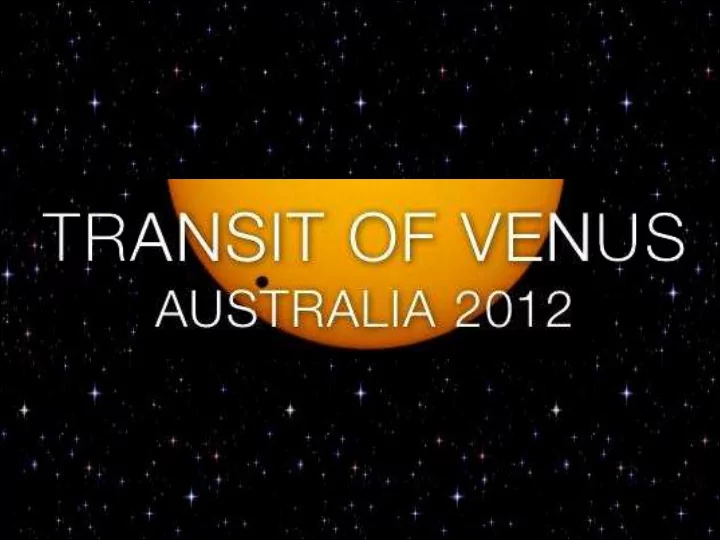
What is a Transit? A transit is when a planet passes directly - - PowerPoint PPT Presentation
What is a Transit? A transit is when a planet passes directly between the Earth and the Sun The solar eclipse is when the Moon passes between Earth and Sun and partially to totally blocks out Sun Venus and Mercury are the only planets
2
◊ A transit is when a planet passes directly between the Earth and the Sun ◊ The solar eclipse is when the Moon passes between Earth and Sun and partially to totally blocks out Sun ◊ Venus and Mercury are the only planets between Earth and the Sun so the only
Solar Eclipse 2004 Transit of Venus
3
4
◊ Venus passes directly between Earth and the Sun during its orbit ◊ Appears as a black disc, or silhouette moving across the Sun ◊ Takes around 6 hours ◊ Path of an upside down “U” because the Sun appears to rotate across sky
5
◊ Come in pairs separated by over a century ◊ Earliest recorded in 1639 ◊ 1769 Transit observed by Lieutenant James Cook
traditional Surveying, Mapping & Astronomical principles
mapped south-east Australia
◊ 1761 and 1769 observations calculated the size of the Solar System applying Kepler’s 3rd law of planetary motion
6
◊ Spherical Trigonometry used to plot & map the Universe ◊ Astronomical Unit (AU) is used to measure the distance from Earth to the Sun ◊ Calculated by measuring how long it takes Venus to transit across the Sun ◊ Two different locations ◊ Measure distance between locations ie Latitude & longitude ◊ Time the contacts 1 & 3
7
◊ Historical observations required Surveying and Astronomy skills ◊ Surveyors used stars to help identify positions on the earth ◊ Surveying skills were needed to make maps for navigation and exploration ◊ Most explorers were also Surveyors:
8
◊ Surveying is the measurement & mapping of the environment ◊ Use specialised tools and equipment ◊ Principles of
10
◊ Modern technology now uses Global Positioning Systems (GPS), satellite remote sensing and other space-based measuring techniques.
Astronomy and Mathematics principles to fix positions and take measurements.
provide more precise results.
11
12
◊ Never look directly at the Sun – serious damage can occur ◊ Safe viewing
SolarScope iPhone App
13
◊ Never look directly at the Sun – serious damage can occur ◊ Safe viewing
◊ Using the Solarscope
14
◊ Donated on behalf of Surveying and Spatial Science Industry, and Astronomical Association of Queensland ◊ Student education
Sources: