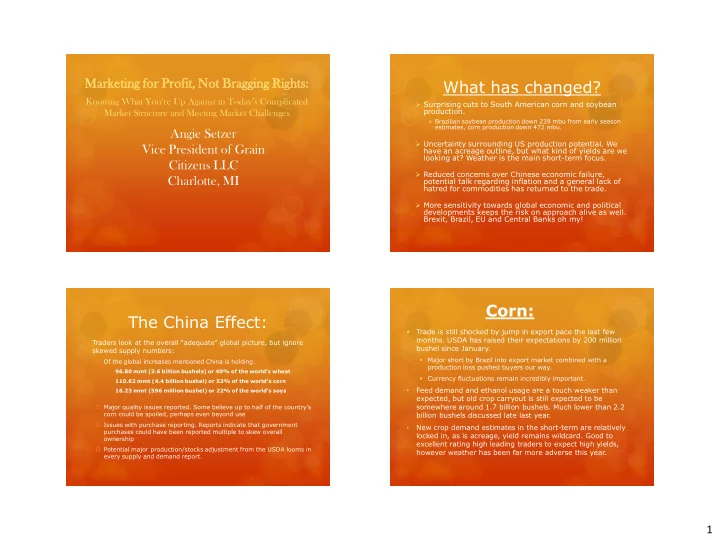
What has changed? Marketi rketing ng for Profit, t, Not Bragging - - PowerPoint PPT Presentation

what has changed
SMART_READER_LITE
LIVE PREVIEW

What has changed? Marketi rketing ng for Profit, t, Not Bragging - - PowerPoint PPT Presentation

What has changed? Marketi rketing ng for Profit, t, Not Bragging ng Right hts: s: Knowing What Youre Up Against in Todays Complicated Surprising cuts to South American corn and soybean production. Market Structure and Meeting


slide-1
SLIDE 1

1

Angie Setzer Vice President of Grain Citizens LLC Charlotte, MI Marketi rketing ng for Profit, t, Not Bragging ng Right hts: s:

Knowing What You’re Up Against in Today’s Complicated Market Structure and Meeting Market Challenges

What has changed?

  • Surprising cuts to South American corn and soybean

production.

  • Brazilian soybean production down 239 mbu from early season

estimates, corn production down 472 mbu.

  • Uncertainty surrounding US production potential. We

have an acreage outline, but what kind of yields are we looking at? Weather is the main short-term focus.

  • Reduced concerns over Chinese economic failure,

potential talk regarding inflation and a general lack of hatred for commodities has returned to the trade.

  • More sensitivity towards global economic and political

developments keeps the risk on approach alive as well. Brexit, Brazil, EU and Central Banks oh my!

The China Effect:

 Traders look at the overall “adequate” global picture, but ignore skewed supply numbers:

 Of the global increases mentioned China is holding:

 96.80 mmt (3.6 billion bushels) or 40% of the world’s wheat  110.62 mmt (4.4 billion bushel) or 53% of the world’s corn  16.23 mmt (596 million bushel) or 22% of the world’s soys

 Major quality issues reported. Some believe up to half of the country’s corn could be spoiled, perhaps even beyond use  Issues with purchase reporting. Reports indicate that government purchases could have been reported multiple to skew overall

  • wnership

 Potential major production/stocks adjustment from the USDA looms in every supply and demand report.

Corn:

  • Trade is still shocked by jump in export pace the last few
  • months. USDA has raised their expectations by 200 million

bushel since January.

  • Major short by Brazil into export market combined with a

production loss pushed buyers our way.

  • Currency fluctuations remain incredibly important.
  • Feed demand and ethanol usage are a touch weaker than

expected, but old crop carryout is still expected to be somewhere around 1.7 billion bushels. Much lower than 2.2 billion bushels discussed late last year.

  • New crop demand estimates in the short-term are relatively

locked in, as is acreage, yield remains wildcard. Good to excellent rating high leading traders to expect high yields, however weather has been far more adverse this year.

slide-2
SLIDE 2

2

Corn:

Supply and Demand

USDA July: Above Trendline Yield: Below Trendline Yield: Area Planted 94.1 94.1 94.1 Area Harvested 86.6 86.6 86.6 Yield per Harvested Acre 168 170 164 Beginning Stocks 1.701 1.701 1.701 Production 14.54 14.72 14.2 Imports 40 40 40 Total Supply 16.28 16.82 15.94 Total Usage 14.2 14.2 14.2

Ending Stocks 2.08 2.62 1.74

Soybeans:

  • Increases in demand cut old crop carryout 115 million

bushels from January expectations.

  • Loss of 239 million bushels of soybeans in the global picture in

Brazil combined with a 170 million increase in perceived Chinese demand has changed the global pipeline and pricing structure significantly from the first of the year.

  • Final carryout numbers will vary with export shipment pace slower

than average and crush numbers a little light (potential reporting issues in crush numbers remain)

  • Most critical production period in August. Traders will be

scouring every weather update.

  • Questions surrounding new crop production potentional for

South America remain.

  • When will La Nina form and how strong will it be?
  • What will farmers decide to plant?

Soybeans:

Supply and Demand:

USDA July Above Trendline Yield: Below Trendline Yield: Area Planted 83.7 83.7 83.7 Area Harvested 83 83 83 Yield per Harvested Acre 46.7 48.7 44.7 Beginning Stocks 350 350 350 Production 3.88 4.04 3.71 Imports 30 30 30 Total Supply 4.26 4.42 4.09 Total Usage 3.97 3.97 3.97

Ending Stocks 290 450 120

What to Do:

  • Use realistic target orders
  • Know what we’re up against in the futures market as well as what your local market structure looks

like.

  • Keep in mind a 10% rally in a bear market is phenomenal performance. 35-40 cents in corn, 80-90

cents in beans and 45-50 cents in wheat are values you should be selling into.

  • Scale sell into rallies, using different contract types that fit your operation
  • Keeping the 10% rally in mind, figure on what levels you would like to start selling. I generally look

to start with 10-20 cent rallies in corn, 20-25 cent rallies in beans and make incremental sales at those same levels from there

  • Know your target margin and be prepared to make sales when the opportunity

presents itself

  • Having solid target orders in place will remove the emotion from your marketing. Do not fall into the

“cancel when close” trap unless something significant has changed fundamentally

  • Have a plan, hope is not a marketing strategy
  • Know your cash flow needs and have sales in place accordingly. When looking at new crop know what

you’re capable of holding on the farm or what you will have to move off the combine and make those sales first

  • Relax, do not force something that isn’t there.
  • When making decisions understand the cost of peace of mind. Once a sale is made, log it, learn from

it and move on.

slide-3
SLIDE 3

3

Key Components of Your Marketing Plan:

  • Know your breakeven per acre. Yes yields may vary, but start

projecting B/E using insured yields, adjust from there as conditions warrant.

  • Know your space needs. Bushels you have to move at harvest should

be the first sold. As with figuring your breakeven, use APH to estimate space needs.

  • What are your cash flow needs? If you have bills due January 15th do

not wait until January 1 to sell. Selling when you absolutely have to generally results in selling at a value far below target values.

  • If storing grain at home do not disregard cost of carry as well as

what is shaping up in the spreads market. Learn to market your stored grain like an elevator .

  • Do not forget to sell new crop when you are selling old crop.

Ways to sell cash grain:

  • Cash Sale: Lock in cash price, move on with your life. Can

deliver immediately, or wait until an agreed upon time.

  • Basis Sale: Lock in your basis leaving futures risk open.
  • Hedge to Arrive: Lock in futures, wait for basis

improvement.

  • Delayed Price Contract
  • Other contracts with a variety of names meant to make

you feel cutting edge and liberated in your marketing decisions.

Cash Grain Sale:

  • Locks in both basis and futures.
  • Pro: You know what your final cash price is and

when you’re moving your grain.

  • Con: You’ve sold your grain. Without a secondary

strategy you will not catch any market moves in basis or futures (This is not always a bad thing)

Basis Sale:

  • Basis Sale: Locks in your basis only leaving you open to

futures movements. Allows for cash grain movement without having to lock in a solid price.

  • Pro: Allows you to capture any upside gains in the future
  • market. Lets you move grain when you want to move it,

not necessarily when the futures are where you want them to be. Allows for some cash flow too, depending on your end user .

  • Con: Leaves you open to futures risk and possible

negative equity. Locks in basis, any further basis gains will not be captured on the grain sold.

slide-4
SLIDE 4

4

An HTA:

  • Allows you to lock in a futures price for future grain
  • movement. Many times for a small fee.
  • Pro: Allows you to capture futures opportunities when the

basis may not be optimal. Also gives you the freedom to establish a basis, delivery point and delivery period at a later date.

  • Con: Open to basis risks. Cannot deliver grain until basis

is agreed upon

Delayed Price Contracts, Price Later Agreements:

  • Delayed Price: For a monthly charge you wait for both

basis and futures to improve until a potential cash sale

  • pportunity presents itself.
  • Pro: You can ship the grain and wait on potential pricing
  • pportunities down the road. Sometimes free DP

presents itself allowing for shipments in a time where cash grain movement is scarce.

  • Con: Most times by the time potential pricing
  • pportunities present themselves any gains are eaten up

by the cost of storage. You lose your control over the grain-less likely to see strong push in bids.

Minimum Price Contract:

  • Grower sells grain via cash contract or HTA (futures price

set) and purchases a call option of his or her choice.

  • Pro: You lock in your minimum price you’ll receive for the

grain (contract price less cost of option). Allows you to truly set a floor price in place while also allowing you to take part in some of the upside gains if the market rallies. You know exactly how much money you are risking.

  • Con: Option does not gain in a rally penny for penny until

futures contract exceeds strike price purchased. Having to then determine when to sell option is difficult for those who already struggle to pull the trigger on sales. If market doesn’t rally option cost is gone.

How to choose the right contract for your needs:

  • Keep. It. Simple.
  • If you don’t know, ask. There is no such thing as a

stupid question.

  • Follow your gut. If it doesn’t feel right, do not dive in

head first.

  • Spread your risk: Use multiple contract types, end users,

information sources etc.

  • Know your local market and its structure, be aware of

what you’re up against when it comes to local movement