What can we do with a quantum degenerate mixture ? v = 41, J = 1 - - PowerPoint PPT Presentation

what can we do with a quantum degenerate mixture
SMART_READER_LITE
LIVE PREVIEW

What can we do with a quantum degenerate mixture ? v = 41, J = 1 - - PowerPoint PPT Presentation

Nambu Symposium @OCU, Dec. 13, 2018 What can we do with a quantum degenerate mixture ? v = 41, J = 1 Shin Inouye (3) 1 S + Osaka City University 875nm 641nm v = 91, J = 0 X 1 S + v = 0, J=0 X 1 S + Ion counts [arb.units] 3.0 2.0 1.0


slide-1
SLIDE 1

3.0 2.0 1.0 0.0 Ion counts [arb.units] 15 10 5

  • 5

Time [µs]

v = 0, J=0 X1S+ 641nm v = 41, J = 1 (3)1S+ 875nm v = 91, J = 0 X1S+

Shin Inouye Osaka City University

Nambu Symposium @OCU, Dec. 13, 2018
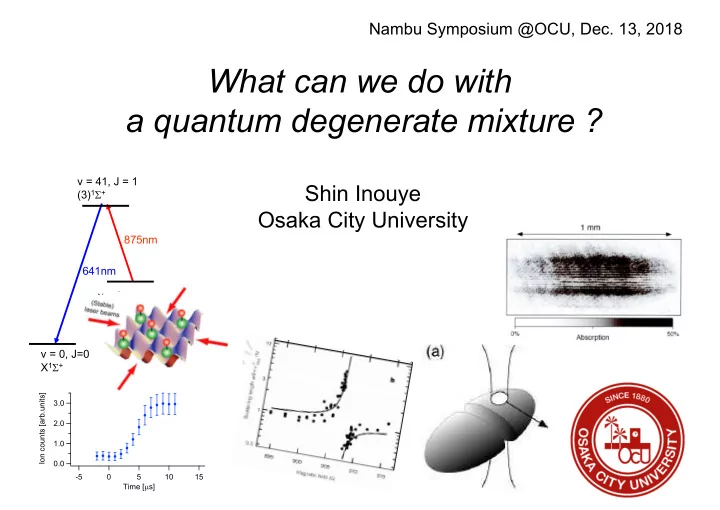
What can we do with a quantum degenerate mixture ?

slide-2
SLIDE 2

Outline How to cool atoms Properties of BEC Tuning interactions (Feshbach resonance) Cold molecules Conclusion and Outlook

Nambu Symposium @OCU, Dec. 13, 2018

slide-3
SLIDE 3

Everybody loves to cool liquids ... but, we are interested in cooling gases!

slide-4
SLIDE 4

“Ideal system” to study Condensed Matter Physics!

Significance of cold atom research

Awarded in 2001 Cornell, Ketterle, Wieman

Anderson et al., Science, 269 198 (1995)

Produced in 1995

slide-5
SLIDE 5
slide-6
SLIDE 6

phys.org March 3, 2017

slide-7
SLIDE 7

Bosons BEC

phase transition at TC

Fermions Fermi sea of atoms

gradually emerges for T<TF

E

F

Further lower temperature

What is ultracold quantum gas?

slide-8
SLIDE 8

Problem with gases: Typical Tc is quite low

0. 000 000 1K = 100nK

300K "Tokyo" Tc < 1mm

Tc = h2 2πmkB n 2.612 ! " # $ % &

2/3

absolute zero ”Osaka"

slide-9
SLIDE 9

Laser cooling

? ?

slide-10
SLIDE 10

laser cooling evaporative cooling

(MOT)

300 K to 1 mK 1 mK to 100 nK

(Magnetic trap)

Technological breakthroughs

  • > lowest man-made temperature
  • A. E. Leanhardt, T. A. Pasquini, M. Saba, A. Schirotzek, Y. Shin, D. Kielpinski, D. E. Pritchard, and W. Ketterle:

Adiabatic and Evaporative Cooling of Bose-Einstein condensates below 500 Picokelvin. Science 301, 1513-1515 (2003).

slide-11
SLIDE 11

Evaporative cooling

slide-12
SLIDE 12

Bose-Eintein condensation

Time-of-flight Release atoms from the trap, wait for tens of milli-seconds, and take shadow picture.

Anderson et al., Science, 269 198 (1995)

Suddenly momentum distribution becomes narrower. ↓ Bose-Einstein Condensation!

slide-13
SLIDE 13

Outline How to cool atoms Properties of BEC Tuning interactions (Feshbach resonance) Cold molecules Conclusion and Outlook

Nambu Symposium @OCU, Dec. 13, 2018

slide-14
SLIDE 14
  • Density: ~ 1014 cm-3
  • Temperature: < 100 nK
  • Number of atoms: < 107
  • Size: 20X20X200 µm
  • Life time> 10 s
  • Atomic speciesRb, Na, Li, …

Properties of a BEC

  • gaseous superfluid
  • macroscopic wavefunction

(Quantum depletion: alkali BEC < 1%, liq. He >90%)

Typical parameters

slide-15
SLIDE 15

What we are looking at?

It is useful to introduce y(r)

Kinetic energy Confining potential Interaction between atoms

c-number quantum fluctuation

slide-16
SLIDE 16

Hamiltonian is unchanged under global gauge transformation:

Nambu-Goldstone mode: phonon Order parameter and Spontaneous Symmetry Breaking

y(r) satisfies Penrose-Onsager relation: vanishes as |r-r'|→∞

w k

phonon (~k) particle (~k2)

slide-17
SLIDE 17
slide-18
SLIDE 18

Direct confirmation of macroscopic wavefunction? Classical mechanics Quantum mechanics Interference!

slide-19
SLIDE 19
  • M. R. Andrews et al., Science 275, 637 (1997)

|y1(r,t=0)|2 |y2(r,t=0)|2 |y1( r, t = T ) + y2( r, t = T ) |2

slide-20
SLIDE 20

Measurement of 1st-order spatial coherence

Extract matterwave from two separated points and make them interfere.

  • I. Bloch, T. W. Hänsch & T. Esslinger

Nature 403, 166–170 (2000)

slide-21
SLIDE 21

Vortex !

slide-22
SLIDE 22
  • K. W. Madison, F. Chevy, W. Wohlleben*, and J. Dalibard
  • Phys. Rev. Lett. 84, 806–809 (2000)

Vortex Formation in a Stirred Bose-Einstein Condensate

Rotate a BEC with a laser beam

slide-23
SLIDE 23

J.R. Abo-Shaeer, C. Raman, J.M. Vogels, and W. Ketterle: Observation of Vortex Lattices in Bose-Einstein Condensates. Science 292, 476-479 (2001).

Vortex lattice !

Abrikosov lattice

slide-24
SLIDE 24

sweeping a laser beam to generate vortex!

slide-25
SLIDE 25

(wavefronts of matterwaves realeased from two BECs)

slide-26
SLIDE 26

BEC with a vortex

slide-27
SLIDE 27

"Observation of vortex phase singularities in Bose-Einstein condensates."

  • S. Inouye et al., PRL, 87, 080402 (2001).

Interferometric detection of vortex pair

slide-28
SLIDE 28

Outline How to cool atoms Properties of BEC Tuning interactions (Feshbach resonance) Cold molecules Conclusion and Outlook

Nambu Symposium @OCU, Dec. 13, 2018

slide-29
SLIDE 29

Kinetic energy Confining potential Interaction between atoms

Can we tune the scattering length?

slide-30
SLIDE 30

colliding atoms

Tuning the interaction (Feshbach resonance)

Herman Feshbach

slide-31
SLIDE 31

Use nuclear spin

slide-32
SLIDE 32

Interference!

slide-33
SLIDE 33

"Observation of Feshbach resonances in a Bose-Einstein condensate."

  • S. Inouye et al., Nature 392, 151 (1998).

“U” is modified by factor of 20

slide-34
SLIDE 34

“U” is modified by seven orders of magnitude

"Extreme Tunability of Interactions in a 7Li Bose-Einstein Condensate“

  • S. E. Pollack, D. Dries, M. Junker, Y. P. Chen, T. A. Corcovilos, and R. G. Hulet,

Physical Review Letters 102, 090402 (2009).

slide-35
SLIDE 35

"Extreme Tunability of Interactions in a 7Li Bose-Einstein Condensate“

  • S. E. Pollack, D. Dries, M. Junker, Y. P. Chen, T. A. Corcovilos, and R. G. Hulet,

Physical Review Letters 102, 090402 (2009).

( ) ( ) ( )

r r m a r V m t r i

trap

y y p y ÷ ÷ ø ö ç ç è æ + + Ñ

  • =

¶ 

2 2 2 2

4 ) ( 2 ! ! !

slide-36
SLIDE 36

Outline How to cool atoms Properties of BEC Tuning interactions (Feshbach resonance) Cold molecules Conclusion and Outlook

Nambu Symposium @OCU, Dec. 13, 2018

slide-37
SLIDE 37

What can we do with two BECs?

41K 87Rb

Make molecules!?

slide-38
SLIDE 38

Blatt & Wineland, Nature 453 1008 (2008) Anderson et al., Science, 269 198 (1995)

Cold ions (trapped ions) Cold atoms Cold molecules?

Frequency standards Quantum Information Bose Condensation Strongly correlated gas Frequency standards

“New Frontier”

slide-39
SLIDE 39

“Indirect” method (2005~)

degenerate mixture Feshbach molecule (d:small) ground state (d: large) Feshbach resonance T~100nK (Still Quantum Degenerate)

Most difficult?

T~100nK

slide-40
SLIDE 40

STIRAP

No heating: 100nK out of 6000K will kill the sample!

100nK 6000 K

*Stimulated Raman Adiabatic Passage Find the right excited state Stabilize two laser frequencies in ~10-10 level (i.e. ~kHz level ) slowly

slide-41
SLIDE 41

v = 0, J=0 X1S+ 641nm v = 41, J = 1 (3)1S+ 875nm v = 91, J = 0 X1S+

0.16 0.12 0.08 0.04 0.00 Intensity [arb.units] 15 10 5

  • 5

Time [µs] 641nm pulse 875nm pulse 3.0 2.0 1.0 0.0 Ion counts [arb.units] 15 10 5

  • 5

Time [µs]

Achieving rovibrational ground state

  • K. Aikawa et al.,

PRL 105, 203001 (2010)

slide-42
SLIDE 42

There is a good news and bad news...

  • -- Good news is we produced ultracold

groundstate polar molecules!

  • -- Bad news is the density is really really low!
slide-43
SLIDE 43

Ultracold KRb molecules imaged by direct absorption D.S. Jin and J. Ye, Physics Today, May 2011

Ultracold polar molecules near degeneracy (by JILA)

slide-44
SLIDE 44

K.-K. Ni et al., Nature 464, 1324 (2010) same internal states AND dipoles aligned by an external field m=+1/2 1/2 Electric field (~kV/cm)

Directional chemistry (JILA)

slide-45
SLIDE 45

Measure time variation of fundamental constants!

  • accelerating expansion of universe
  • Cosmic Microwave Background
  • Large scale structure

Possible extensions to the L-CDM 1836 1 » =

p e

m m µ

c e !

2

4 1 pe a =

P

g

, etc. Quintessence →Fluctuation of fundamental constants??

45

We focused on electron-to-proton mass ratio µ General relativity + L-CDM model is successful in explaining following phenomena: However, origin of dark energy (and dark matter) is not understood.

slide-46
SLIDE 46

The limit of time variation of me/Mp(≡µ)

Radio-astronomical observations

7

10 ) . 1 . ( /

  • ´

± = D µ µ

Alcohol in the early universe (J. Bagdonaite et al, Science 339, 46 (2013)) (in 7109 years)

slide-47
SLIDE 47

The limit of time variation of me/Mp(≡µ)

Laboratory observations

year / 10 ) 6 . 5 8 . 3 ( /

14

  • ´

± = µ µ !

molecular spectroscopy of SF6

  • A. Shelkovnikov et al, PRL 100, 150801 (2008)

Optical Fiber link (~43km) Cs Fountain SYRTE frequency comb

+

rovibrational transition in SF6

slide-48
SLIDE 48

Why molecule?

Large m Small m

δE E = 1 2 δm m

Frequencies are directly related to the inertial mass of nucleus.

slide-49
SLIDE 49

FWHM50Hz

Ultracold molecule is ideal for precision spectroscopy!

634 963 783.4580.093 Hz Average of 5000 sweeps (6 hours) 634 963 781.5640.094 Hz Zeeman shift compensation S/N ~ 500 (c.f. Number of molecules used ~ 106)

slide-50
SLIDE 50

Calibration of the magnetic field

F = 0 F = 1 mF = 1 mF = 0 mF = 0

2.4 s 2.4 s 2.4 s 2.4 s

  • mF = 0

mF = 1 mF = 0 mF = 1 Time

Time (hour) Magnetic Field (mG)

slide-51
SLIDE 51

Good News: we broke the world record set by SF6!

  • A. Shelkovnikov et al.,

PRL 100, 150801(2008)

1 µ ∂µ ∂t = 3.8± 5.6

( )×10−14 / year

1 µ ∂µ ∂t = 0.30 ±1.00Stat ± 0.16Sys

( )×10−14 / year

Factor of five improvement

slide-52
SLIDE 52
  • J. Kobayashi, A. Ogino, and SI
slide-53
SLIDE 53
slide-54
SLIDE 54

Francesca Ferlaino and Rudolf Grimm, Physics 3, 9 (2010).

slide-55
SLIDE 55

What can we do with two BECs?

41K 87Rb

Phase separation!?

slide-56
SLIDE 56

36μm x 208μm(1pix.=2.6μm)

Phase separation after quenching the interaction

1D 2D

slide-57
SLIDE 57

Digital Mirror Device Holographically generated ring beam

slide-58
SLIDE 58

3.0 2.0 1.0 0.0 Ion counts [arb.units] 15 10 5

  • 5

Time [µs]

v = 0, J=0 X1S+ 641nm v = 41, J = 1 (3)1S+ 875nm v = 91, J = 0 X1S+

Conclusion

Cold atom is a versatile ground both for condensed matter physics precision measurement

... please stay tuned