What are Vital Conversations ? tough challenges, and enrich - - PDF document

what are vital conversations
SMART_READER_LITE
LIVE PREVIEW

What are Vital Conversations ? tough challenges, and enrich - - PDF document

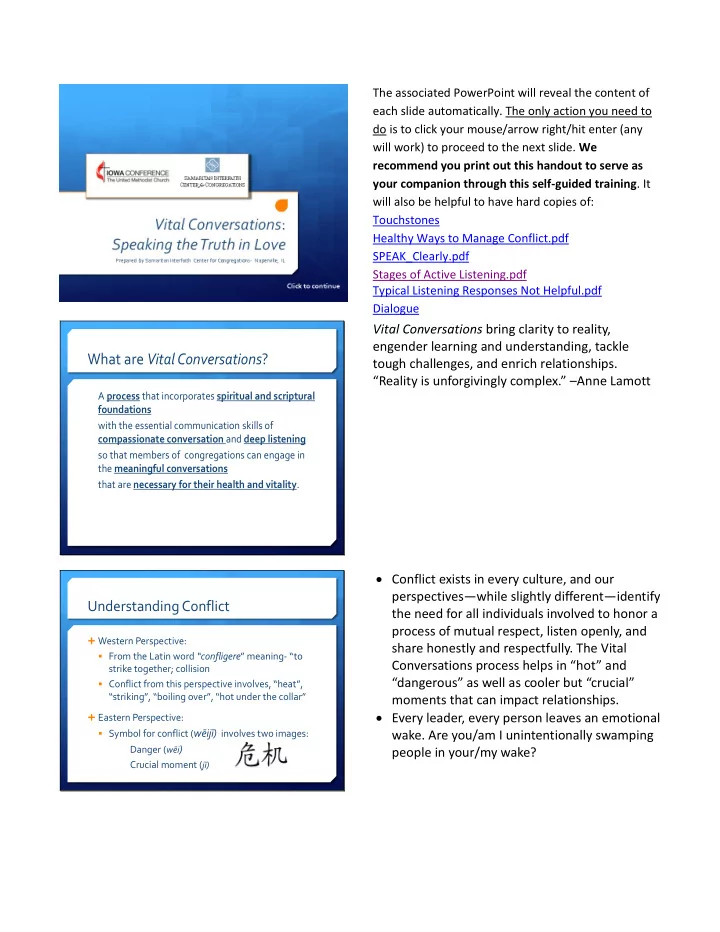
The associated PowerPoint will reveal the content of each slide automatically. The only action you need to do is to click your mouse/arrow right/hit enter (any will work) to proceed to the next slide. We recommend you print out this handout to


slide-1
SLIDE 1

The associated PowerPoint will reveal the content of each slide automatically. The only action you need to do is to click your mouse/arrow right/hit enter (any will work) to proceed to the next slide. We recommend you print out this handout to serve as your companion through this self-guided training. It will also be helpful to have hard copies of: Touchstones Healthy Ways to Manage Conflict.pdf SPEAK_Clearly.pdf Stages of Active Listening.pdf Typical Listening Responses Not Helpful.pdf Dialogue

What are Vital Conversations?

A process that incorporates spiritual and scriptural foundations with the essential communication skills of compassionate conversation and deep listening so that members of congregations can engage in the meaningful conversations that are necessary for their health and vitality.

Vital Conversations bring clarity to reality, engender learning and understanding, tackle tough challenges, and enrich relationships. “Reality is unforgivingly complex.” –Anne Lamott

Understanding Conflict

 Western Perspective:

  • From the Latin word “confligere” meaning- “to

strike together; collision

  • Conflict from this perspective involves, “heat”,

“striking”, “boiling over”, “hot under the collar”

 Eastern Perspective:

  • Symbol for conflict (wēijī) involves two images:

Danger (wēi) Crucial moment (jī)

 Conflict exists in every culture, and our perspectives—while slightly different—identify the need for all individuals involved to honor a process of mutual respect, listen openly, and share honestly and respectfully. The Vital Conversations process helps in “hot” and “dangerous” as well as cooler but “crucial” moments that can impact relationships.  Every leader, every person leaves an emotional

  • wake. Are you/am I unintentionally swamping

people in your/my wake?

slide-2
SLIDE 2

Levels of Conflict

Level One: Problems to be Solved Looking for solutions Complaints Level Two: Disagreements Parties move into a stance

  • f self-

protection Generaliza- tions begin to form Criticism Level Three: Contests Movement toward a win/lose perspective Defensive- ness Facilitator may be needed Level Four: Fight/Flight Purpose is to hurt the

  • ther person

Contempt Require mediated process Level Five: Intractable Situation Destroying each other Stonewalling Require mediated process

Mediator Resource: Des Moines Pastoral Counseling Center

 Levels One and Two are ideal for “Vital Conversations”.  Level Three conflict may involve a facilitator.  Level Four and Five a mediated process is essential. Resource: Des Moines Pastoral Counseling Center  The conversation is the relationship. The number of elephants in the room tells us about the health of a group/church/

  • rganization. The more elephants, the more

dis-ease in the group. Biblical Perspective on Managing Conflict

Matthew 18:15-22

15-17"If a fellow believer hurts you, go and tell him—work it out between the two of you. If he listens, you've made a friend. If he won't listen, take one or two others along so that the presence of witnesses will keep things honest, and try again. If he still won't listen, tell the church. If he won't listen to the church, you'll have to start over from scratch, confront him with the need for repentance, and offer again God's forgiving love. 18-20"Take this most seriously: A yes on earth is yes in heaven; a no on earth is no in heaven. What you say to one another is eternal. I mean this. When two

  • f you get together on anything at all on earth and make a prayer of it, my

Father in heaven goes into action. And when two or three of you are together because of me, you can be sure that I'll be there." 21At that point Peter got up the nerve to ask, "Master, how many times do I forgive a brother or sister who hurts me? Seven?" 22Jesus replied, "Seven! Hardly. Try seventy times seven.

 Matthew 18:15-20 (The Message)  Without Vital Conversations, churches are institutions masking as community.  Our faith gives us an alternative way to deal with the brokenness in the world. Our invitation is to engage in the conversation to give healing a chance.  We all have a specific style when it comes to

  • conflict. We handle conflict differently when

we are calm vs. when we are stressed. Knowing your tendencies when managing conflict is very important to be aware of. Resource: Thomas Kilman Conflict Style, and Style Matters-Kraybill  There is no way out of conflict but through.

slide-3
SLIDE 3

It’s a Matter of Perspective

[Make sure your speakers are on. Audio should play automatically.]  What colors my glasses? And from where did I learn to see that way? What ownership do I need to take for my colored glasses?  When we are real and find clarity/understanding within ourselves and with others, the change occurs before the conversation has ended.

Begin with a Spiritual Practice

Grounding the conversation spiritually is a critical component to Vital Conversations. As a group, begin by engaging in one or two of the suggested spiritual practices below: Lectio Divina Ignatian Examen

 When engaging by using Lectio Divina, we recommend Matthew 18:15-22.  Lectio Divina.pdf  Ignatian Awareness Examen.pdf

Determine Together What to Discuss

 Following the spiritual grounding exercise,

discuss as a group the following question:

What Vital Conversation do we need to have as a group?

 Record the responses as a group and get

consensus around the two critical questions to discuss.

slide-4
SLIDE 4

Invite Silent Reflection

Spend 10 minutes in silent reflection on

the two questions to be discussed.

Participants may want to journal their thoughts and reflections to the questions. A prayer read in unison can also be helpful as entry into silent reflection.

Prayer (said in unison) Holy One, Creator of Life: Ours is the peace that passes all understanding. Whether the battle is between countries, belief systems, varied upbringings, family members or churches, or within our hearts, Finding common ground is one way to start. For all who are searching, may your peace release

  • hope. For all who are aching, may your peace

bring relief. For all who are arguing, may your peace intercede. For all who are hating, may your peace cast our fear. May your love surround and envelope all who are Living with war, all who have been devastated by conflict, for all those who fear engagement over disagreement, and for all those who rest in the satisfaction of false peace. May your transforming love pervade our darkness. Amen.

Create a Safe Environment

 Empower a group covenant

The Center for Courage and Renewal offers a wonderful example—called “Circle of Trust Touchstones” –which is designed to create that sense of safety. The Touchstones should be reviewed before each Vital Conversations gathering.

 The leader of the group will agree to hold the

group accountable to the Touchstones.

 Engage in the Vital Conversation discussing the

agreed upon questions.

 Confidentialitymust be honored and maintained.

 Setting parameters for having safe, Vital Conversations is important.  It is suggested to use these “Touchstones” as a way to create a group covenant. More info about Touchstones can be found here.  We create a culture that supports this kind of conversation by practicing this skill for living

  • ver and over again.
slide-5
SLIDE 5

Health Ways to Manage Conflict

Skills for Vital Conversations

S.P.E.A.K. clearly

  • Situation Observed
  • Perceptions or Thoughts
  • Emotional Impact
  • Acknowledge Values
  • Kindly Request

“In the meeting when you said…” “I thought…” “I was aware of…” “I sensed people felt…” “The team was angry…” “What is important to me…” “What the team values is…” “It would be helpful if…” “What would you be willing to do?”

 Additional information about SPEAK and other skill sets can be found here:

Healthy Ways to Manage Conflict.pdf SPEAK_Clearly.pdf

Healthy Ways to Manage Conflict

Skills for Vital Conversations

Active Listening

  • Attend
  • Acknowledge
  • Invite
  • Summarize
  • Ask

A detailed explanation of each stage is found here.

 The practice of deep listening is under-rated. By listening, we provide another person a place of disclosure—this is a great gift when another’s words are taking seriously.  This kind of conversation levels the playing field to create common ground—regardless of positions of power. The power is in the relationship.

Stages of Active Listening.pdf

Typical Unhelpful Listening Responses

Type Advising Response Judging Response Analyzing Response Supporting Response Example

“Maybe you should try…” “You don’t have a very good attitude about this.” “You are really overreacting. That’s why you are so uptight.” “You did all you could do. Just let it go!”

More information is found here.

 All Vital Conversations are about telling the truth in love. All conversations are with myself, and sometimes they involve other people.

Typical Listening Responses Not Helpful.pdf

slide-6
SLIDE 6

Questions—Helpful or Not?

Helpful Questions

Create doorways into new levels of understanding.

 “What did you mean when

you said you felt sad?”

 “When have you

experienced something similar to this situation?”

 “How does this issue reach

you personally?”

Not Helpful Questions

Create right/wrong dichotomies,

  • r shut down communication.

 “What was that all about?”  “Why don’t you…”  “Are you really doing all you

can?”

Helpful questions:  Are brief, and open-ended (cannot be answered “yes” or “no”, and don’t have a right/wrong answer)  Are questions the questioner couldn’t possibly anticipate the answer to it.  Include the person and the issue: focuses on feelings and facts Not helpful questions:  Questions that come too fast may feel aggressive and cut of deep reflection.  Storytelling or questions that call attention to yourself  Long questions that allow for inserting your

  • pinion or advice

 Have a judgmental quality to them  Satisfy your own curiosity

Dialogue—

a process to work through conflict constructively

Sender Takes initiative Sends message Goes back and forth until you are

  • complete. Listens to summary

and gives accuracy check. Listens to validation

  • Listens. Shares what was missed

Creates with Receiver new way

  • f relating

Receiver Grants dialogue ASAP, if possible Mirrors and checks for accuracy Summarizes message and checks for accuracy Validates Empathizes and mirrors Listen for mutual creativity

Full description of process is found here

There are 3 reasons why you might want to use this dialogue process:

  • 1. You might want to be listened to and

understood.

  • 2. You are bothered by something and want to

discuss it.

  • 3. You want to discuss an issue that you think

might create tension between the two of you.  See the full explanation of the process here.  What are the most important conversations that I need to have?

slide-7
SLIDE 7

Concluding Practice

 At the conclusion of a Vital Conversations, ask each participant to

reflect on and respond to the following statements:

  • I felt…
  • When I heard…
  • I regret…
  • I agree to hold you as a Brother or Sister in Christ…
  • I commit to…

 Each group member will read their responses aloud. The group

agrees to the confidentiality committed to in the beginning of the gathering.

 Close with Prayer

Additional Resources and Final Thoughts

 Center for Courage and Renewal  Lombard Mennonite Peace Center  Des Moines Pastoral Counseling Center  Reconcile: Conflict Transformation for Ordinary Christians by

John Paul Lederach (2014) If nothing changes regarding the outcomes of the conversations within my church, what are the implications for my church? For our faith lives? For our future?

A complete list of resources can be found here.

 There are certain individuals who, in the process of resolving their own inner conflicts, become paradigms for broader groups.  It takes courage to speak the unspeakable; and when we do it in love it is transformative.

Center for Courage and Renewal Lombard Mennonite Peace Center Des Moines Pastoral Counseling Center Reconcile: Conflict Transformation for Ordinary Christians Link to full list of resources