What Are Tax Expenditures? Tax expenditures are subsidies that occur - - PDF document

what are tax expenditures
SMART_READER_LITE
LIVE PREVIEW

What Are Tax Expenditures? Tax expenditures are subsidies that occur - - PDF document

12/ 20/ 2016 Rhode I sland Revenue Roundtable Tax Expenditures: Shining a Bright Light on $ Billions in Hidden Spending December 20, 2016 What Are Tax Expenditures? Tax expenditures are subsidies that occur through the tax code,


slide-1
SLIDE 1

12/ 20/ 2016 1 Rhode I sland Revenue Roundtable Tax Expenditures: Shining a Bright Light on $ Billions in “Hidden Spending”

December 20, 2016

www.economicprogressri.org

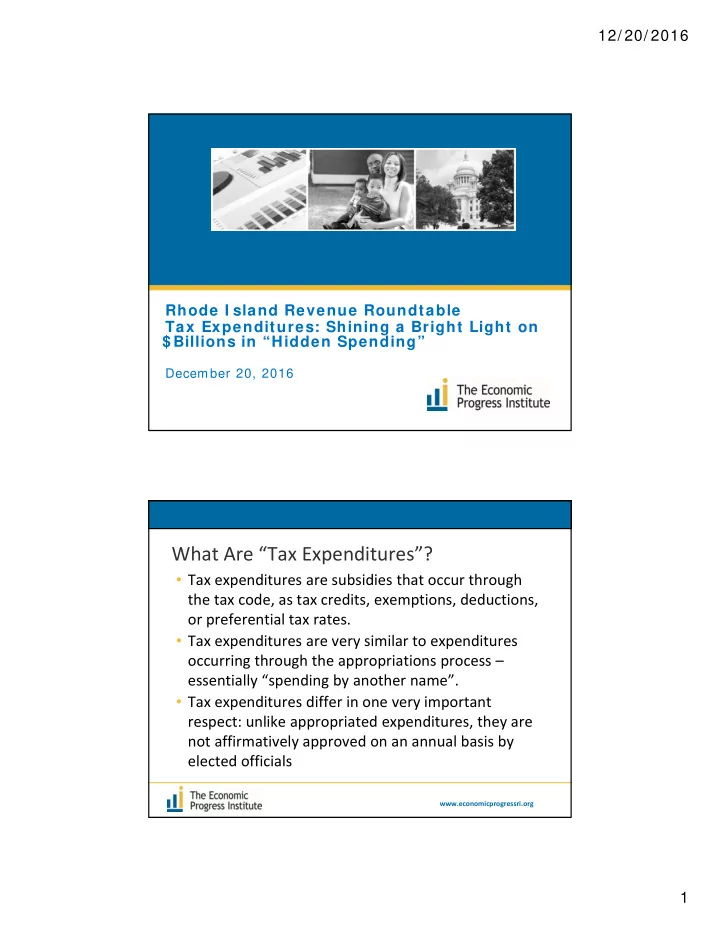
  • Tax expenditures are subsidies that occur through

the tax code, as tax credits, exemptions, deductions,

  • r preferential tax rates.
  • Tax expenditures are very similar to expenditures
  • ccurring through the appropriations process –

essentially “spending by another name”.

  • Tax expenditures differ in one very important

respect: unlike appropriated expenditures, they are not affirmatively approved on an annual basis by elected officials

What Are “Tax Expenditures”?

slide-2
SLIDE 2

12/ 20/ 2016 2

www.economicprogressri.org

Tax Expenditures and A Shared Vision for Rhode Island

Most Rhode Islanders share a vision of what the Ocean State should strive for: great schools for our children, safe roads and bridges, vibrant communities, prosperous families, and access to quality and affordable health care, housing and child care. The primary way we pay for these things is through our taxes…. …and tax expenditures are one of the m ain w ays w e erode our tax base.

www.economicprogressri.org

  • 1. Foregone revenues
  • 2. Transparency
  • 3. Accountability for tax incentives used as

primary tool for economic development

Three key reasons to focus on tax expenditures

slide-3
SLIDE 3

12/ 20/ 2016 3

www.economicprogressri.org

A Closer Look at Foregone Revenues

www.economicprogressri.org

slide-4
SLIDE 4

12/ 20/ 2016 4

www.economicprogressri.org www.economicprogressri.org

  • 1. The single tax expenditure with largest amount of

revenue foregone is a sales and use tax exemption for purchases used for manufacturing purposes.

  • Accounts for $341 million in foregone revenue
  • 18 percent of all revenue foregone
  • 2. Veterinary and testing lab services exempt from SUT

($4.4 million)

  • 3. Storage, maintenance, repair or sale of boats exempt

from SUT

  • 4. Sale of boats generally exempt from SUT ($6.1 million)

Examples of sales and use tax (SUT) tax expenditures ($1.251 Billion total)

slide-5
SLIDE 5

12/ 20/ 2016 5

www.economicprogressri.org

  • 5. Charitable, educational, or religious organizations

exempt from SUT ($104 million)

  • 6. Clothing and footwear (up to $250 per item) exempt

from SUT ($43.5 million)

  • 7. Food and food ingredients exempt from SUT ($151

million)

  • 8. Food items paid for by Food Stamps (aka SNAP)

exempt from SUT ($19 million)

Examples of sales and use tax (SUT) tax expenditures (continued)

www.economicprogressri.org

  • 1. Earned Income credit ($10.3 million)
  • 2. Tax credit for taxes paid to other states ($152

million)

  • 3. Standard deduction ($169 million)
  • 4. Railroad retirement benefits not subject to PIT due

to modification of gross income ($182,000)

Examples of personal income tax (PIT) tax expenditures ($470 million total)

slide-6
SLIDE 6

12/ 20/ 2016 6

www.economicprogressri.org

Tax Incentives as Primary Economic Development Tool

www.economicprogressri.org

Tax Credit and Incentive Report: Covers 5-7 (varying by year) specific tax incentives, providing firm- specific data identifying the name and address of credit recipient, and the size of credit received. Report on Commerce Corporation Incentive Programs* specific tax incentives, providing firm- specific data identifying the name and address of credit recipient, and the size of credit.** Annual Report of Tax Credits and Incentives Administered in Conjunction with the RI Commerce Corporation specific tax incentives, providing firm- specific data identifying the name and address

  • f credit recipient,

and the size of credit received. * The Report on Commerce Corporation Incentive Programs also includes information on incentives that do not operate through the tax code. We have not included them in this report * * The Report on Commerce Corporation Incentive Programs provides separate information on tax credits allocated and planned job creation, as well as credit amount dispersed, and actual job creation.

5 reports track tax expenditures in Rhode Island

Rhode Island Economic Development Tax Incentives Evaluation Act of 2013 This report will elevate our understanding

  • f economic development tax incentives

well beyond our current level. Under the provisions of this act, the Office of Revenue Analysis (ORA) will undertake analyses of 18 of RI’s economic development tax incentives (expanded to 21 credits with addition of new credits approved in 2015) to determine their efficiency and effectiveness at achieving their objectives. Initial analysis of all credits will be complete by June 30, 2017, a significant delay from initial schedule for completion, which indicated 1/3 of credits would be evaluated in each of FY15, FY16, and FY17. RI Department of Revenue, Office of Revenue Analysis (ORA): Biannual Tax Expenditure Report (TER): provides aggregate data on each tax expenditure. No information on tax expenditure recipients, and no information assessing effectiveness

  • f tax expenditure
slide-7
SLIDE 7

12/ 20/ 2016 7

www.economicprogressri.org

Name of Report Responsible Agency Tax Expenditures Covered Total $ Amount of tax expenditures included 2016 Tax Expenditures Report Department of Revenue, Office

  • f Revenue Analysis (ORA)

ALL Tax expenditures: 223 tax expenditures in 9 categories $1.941 Billion Tax Credit and Incentive Report – FY 2016 Department of Revenue, Division of Taxation 5 economic development tax incentives existing prior to 2015: dominated by Jobs Development Act ($23.5 million) $29.4 Million Annual Report of Tax Credit and Incentives Administered in Conjunction with the Rhode Island Commerce Corporation – FY 2016 Department of Revenue, Division of Taxation 5 new economic development tax incentives (Governor Raimondo’s “Economic Development Suite”: dominated by Rebuild Rhode Island Tax Credit ($31.8 million) $44.1 Million (approved by Commerce Corp – No credits issued) Report on Commerce Corporation Incentive Programs for Fiscal Year 2016 Rhode Island Commerce Corporation 4 of the 5 economic development tax incentives included in the Division of Taxation report on Governor Raimondo’s “economic development suite” $44.1 Million approved

www.economicprogressri.org

Name of Report Responsible Agency Tax Expenditures Covered Total $ Amount of tax expenditures included Rhode Island Economic Development Tax Incentives Evaluation Act of 2013 Department of Revenue, Office of Revenue Analysis (ORA) 21 economic development tax incentives, including the 5 incentives in the “Tax Credit and Incentive Report”, and Governor Raimondo’s 5 new economic development incentives ??

slide-8
SLIDE 8

12/ 20/ 2016 8

www.economicprogressri.org

Credits Covered by the Tax Credit and Incentive Report (FY2016)

Statute Tax Credit Name Total Amount

  • f Credit

Purpose of Credit 42‐64.3‐6 Enterprise Zone $856,932 Encourages development in designated “enterprise zones” 42‐64.5‐3 Jobs Development Act (Tax rate reduction) $23,532,893 Provides rate reduction for creation of new jobs, based on schedule 42‐64‐10 RI Economic Development Corporation Project Status $350,000 To encourage job creation, firms given “Project Status” are exempt from sales tax

  • n materials, equipment, furniture, etc.

44‐31.2‐5 Motion Picture Production Company Tax Credit $362,176 Provides a financial incentive to the film industry in order that the state might compete with other states for filming locations 44‐33.6 Historic Preservation Tax Credits $4,300,136 Provides financial incentives to address high vacancy rates and physical deterioration of historic buildings 44‐63‐3 Incentive for Innovation and Growth $0.00 [sunsets effective December 31, 2016, has not been used in recent years]

TOTAL FY2016 $29,401,138

www.economicprogressri.org

Credits Covered by the Annual Report of Tax Credit and Incentives Administered With RI Commerce Corporation

Statute Tax Credit Name Amount of Credit Approved

Purpose of Credit 42‐64.20 Rebuild RI Tax Credit $31,798,122

Provides tax credits for five years to qualifying firms to stimulate business development, retain or create good‐paying jobs.

42‐64.21 RI Tax Increment Financing $6,500,000

Encourages qualified development projects in qualifying TIF areas

42‐64.26 Stay Invested in RI Wavemaker Fellowship $0

Expands employment opportunities in RI, retains talented individuals by assisting with tuition loan repayment

42‐64.30 Anchor Institution Tax Credit $0

Rewards existing RI companies helping attract new businesses in their supply chain to RI

44‐48.3 New Qualified Jobs Incentive Act (2015) $5,805,971

Tax credits for up to 10 years to reward the creation of a designated number of jobs

TOTAL FY2016 $44,104,093
slide-9
SLIDE 9

12/ 20/ 2016 9

www.economicprogressri.org

FY2 0 1 6

www.economicprogressri.org

slide-10
SLIDE 10

12/ 20/ 2016 10

www.economicprogressri.org

Jobs Development Act (JDA) accounts for bulk of economic development tax incentives

$362,176 $350,000

www.economicprogressri.org

Com bined Revenue Loss, FY2 0 0 8 -FY2 0 1 6 : $ 2 7 1 .4 M

slide-11
SLIDE 11

12/ 20/ 2016 11

www.economicprogressri.org

Total = $271.4M

www.economicprogressri.org

Total = $69.5M

slide-12
SLIDE 12

12/ 20/ 2016 12

www.economicprogressri.org

Multiplier Effect for Business Tax Incentives a Fraction of Effect for Income‐Support Payments, Infrastructure Spending (CBO averages)

Type of Fiscal Activity Fiscal Multiplier GDP Growth from “fiscal impulse” of $340.9 M Employment Generated from $340.9 M Business Tax Incentive

0.2 $68.18

455

Income-Support Payments (eg EITC)

1.5 $511.35

3,409

Public Infrastructure Investment

1.8 $613.62

4,091

www.economicprogressri.org

Tax Incentive Patterns for a few of the “Top Ten” Incentive Recipients

  • Large credits, every year
  • Medium credits, periodically
  • Small credits, every year
slide-13
SLIDE 13

12/ 20/ 2016 13

www.economicprogressri.org www.economicprogressri.org

slide-14
SLIDE 14

12/ 20/ 2016 14

www.economicprogressri.org www.economicprogressri.org

slide-15
SLIDE 15

12/ 20/ 2016 15

www.economicprogressri.org

The Tax Incentive Evaluations Act requirements include:

  • assessment of the resulting # of jobs created, and

revenue generated for the state

  • the goals and intent of the tax incentive
  • A cost‐benefit comparison of the tax credit vs potential

impact of revenue foregone

  • A statement by the director of the economic

development corporation on whether goals being met

Implementing the provisions of the Economic Development Tax Incentive Evaluations Act of 2013 will provide critical information for assessing effectiveness of tax incentives

www.economicprogressri.org

  • An estimate of the portion of benefits generated by

the tax incentive that remained in Rhode Island (vs flowing outside the state)

  • The Governor’s budget proposal must include, for

every program for which evaluation has been completed, “a recommendation as to whether the tax incentive should be continued, modified, or terminated.” Economic Development Tax Incentive Evaluation Act of 2013 (cont’)

slide-16
SLIDE 16

12/ 20/ 2016 16

www.economicprogressri.org

The Center on Budget and Policy Priorities notes shortcomings of reliance on tax expenditures:

  • Most tax expenditures lack adequate scrutiny
  • Few states require evaluation of effectiveness of tax incentives for economic

development

  • Most tax expenditures are written into the tax code and thus will continue indefinitely
  • Policy makers, the media, and the public lack sufficient information to participate in

decisions about how to allocate state resources

  • Existing tax expenditure reports fail to analyze the distribution of benefits by income

level and size of business.

  • “race to the bottom” subsidy wars lead elected officials to put short‐term economic gains

ahead of long‐term investments in workers and communities, like better funding for schools and roads

What are the limitations of tax incentives as tools to promote state economic growth, increase employment, encourage broad‐based prosperity?

www.economicprogressri.org

Stay Connected with the Institute

  • Visit our website

www.economicprogressri.org/revenueroundtable

  • Sign up for our e‐newsletter
  • Like us: facebook.com/economicprogressri
  • Follow us: @EconProgressRI