Welcome to the Interprofessional Case Management Experience Please - - PowerPoint PPT Presentation

welcome to the interprofessional case management
SMART_READER_LITE
LIVE PREVIEW

Welcome to the Interprofessional Case Management Experience Please - - PowerPoint PPT Presentation

Welcome to the Interprofessional Case Management Experience Please log in to the iCCOA Portal at https://medapp.louisville.edu/iCCOA/iccoa.cgi and make sure you have registered for ICME and completed the pre-test. Specific instructions are


slide-1
SLIDE 1

Wi-Fi Information University of Louisville student, staff, or faculty: Network: ULSecure Username: ULINK User ID Password: ULINK Password.

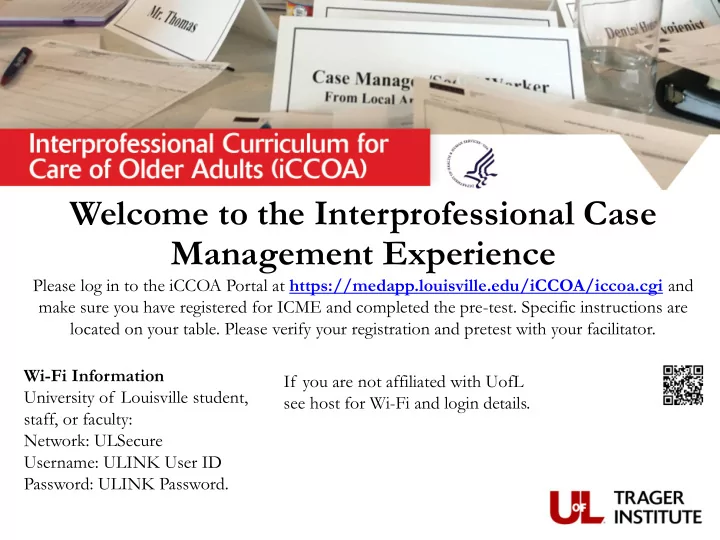
Welcome to the Interprofessional Case Management Experience

Please log in to the iCCOA Portal at https://medapp.louisville.edu/iCCOA/iccoa.cgi and make sure you have registered for ICME and completed the pre-test. Specific instructions are located on your table. Please verify your registration and pretest with your facilitator. If you are not affiliated with UofL see host for Wi-Fi and login details.

slide-2
SLIDE 2

ICME

Interprofessional Case Management Experience The Jim Thomas Case

Learners, go to this site and make sure you are registered for ICME and have taken the pretest.

https://medapp.louisville.edu/iCCOA/iccoa.cgi

This project is supported by the Health Resources and Services Administration (HRSA) of the U.S. Department of Health and Human Services (HHS) under grant number 1 U1QHP28732-01-00, Geriatric Workforce Enhancement Program.

slide-3
SLIDE 3

A Collaboration of Many

Trager Institute School of Medicine School of Nursing Kent School of Social Work Brandeis School of Law School of Dentistry College of Education & Human Development

slide-4
SLIDE 4

Activities for Today

  • You will:

– Participate in team discussions and activities representing a discipline as a team member involved in the care of Jim Thomas. – Observe videotaped interactions between members of

  • Mr. Thomas’ healthcare team

– Critique and discuss these interactions. – Participate in a family meeting. – Please turn off computers and phones – Have FUN!!

slide-5
SLIDE 5

Team Introductions

In your teams introduce yourself by NAME & DISCIPLINE and answer the following questions:

  • What do you want everyone to know about your

discipline?

  • What stereotype do you hate the most about your

discipline?

slide-6
SLIDE 6

Interprofessional Case Management Experience ICME

In this session you will learn about integrated patient-centered geriatric community care, conduct a goals of care/family meeting and “practice” working with an interprofessional team to plan the care of a patient with diabetes and multiple social issues.

slide-7
SLIDE 7
  • I. Interpersonal Communication
  • II. Collaboration & Teamwork
  • III. Screening & Assessment
  • IV. Care Planning & Care Coordination
  • V. Intervention
  • VI. Cultural Competency & Adaptation
  • VII. Systems Oriented Practice

SAMHSA Core Competencies

(Substance Abuse and Mental Health Services Administration)

This ICME Session Highlights These Competencies for Integrated Behavioral Health & Primary Care

slide-8
SLIDE 8

World Health Organization Definitions of Health

  • Health = “a state of complete physical, mental

and social well-being and not merely the absence of disease or infirmity”

  • Social determinants of health = the conditions

in which people are born, grow, live, work, and age

slide-9
SLIDE 9

Health Outcome Determinates

(2014) University of Wisconsin Population Health Institute

slide-10
SLIDE 10

What does that mean for older adults?

  • If we address only the physiological changes

and treatment of the disease, we are missing 80% of the factors impacting patient

  • utcomes
  • Holistic patient/family-centered care is

essential if we are to obtain desirable

  • utcomes
slide-11
SLIDE 11

An Example of the Model

WHAT IS INTEGRATED PATIENT-CENTERED GERIATRIC PRIMARY CARE?

slide-12
SLIDE 12

Health Determinants

Biological Psychological Health Behaviors Health Services Social Environmental

slide-13
SLIDE 13

Who should be the members of the Community Team?

slide-14
SLIDE 14

Multidisciplinary Team

  • Strong, focused

leadership

  • Individual

accountability

  • Individualized work

products

  • Efficient meetings
  • Success = influence on
  • thers

Crawford, G. B., & Price, S. D. (2003). Team working: Palliative care as a model of interdisciplinary practice. Medical Journal of Australia, 179(6 Suppl), S32-34. Kilgore, R. V., & Langford, R. W. (2009). Reducing the failure risk of interdisciplinary healthcare teams. Critical Care Nursing Quarterly, 32(2), 81-88. Youngwerth, J., & Twaddle, M. (2011). Cultures of interdisciplinary teams: How to foster good dynamics. Journal of Palliative Medicine, 14(5), 650-654.

slide-15
SLIDE 15

Interprofessional Team

  • Shared leadership
  • Individual and mutual

accountability

  • Open-ended

discussions, active problem-solving

  • Success = collective

work-products

Crawford, G. B., & Price, S. D. (2003). Team working: Palliative care as a model of interdisciplinary practice. Medical Journal of Australia, 179(6 Suppl), S32-34. Youngwerth, J., & Twaddle, M. (2011). Cultures of interdisciplinary teams: How to foster good dynamics. Journal of Palliative Medicine, 14(5), 650-654.

slide-16
SLIDE 16

16

slide-17
SLIDE 17

17

slide-18
SLIDE 18

Introducing:

Jim Thomas

Learners read case summary

slide-19
SLIDE 19

What social determinants of health will impact Mr. Thomas’s care?

Based upon the written summary, each team will explore different issues of Mr. Thomas’ case.

  • Identify Mr. Thomas’ main issues as

determinants in the area listed on your team’s chart paper.

  • List these on chart paper.
  • Select a reporter to share your ideas with the

full group.

slide-20
SLIDE 20

Who should be on the integrated community care team for

  • Mr. Thomas?
slide-21
SLIDE 21

Next Steps

  • Your team facilitator will assign you a role on

the team caring for Mr. Thomas in the community

  • Think about that role as you view video clips

related to Mr. Thomas’ care in the community

  • Remember – the patient and family are

essential members of the care planning team

slide-22
SLIDE 22
  • Mr. Thomas’ Care in the

Community-Video

There are 4 scenes:

  • First visit with Primary Care Provider
  • Dental visit
  • Health Navigator discussion with NP
  • Follow-up with NP

Learners should especially observe their assigned role.

slide-23
SLIDE 23

Discuss in Your Teams

  • What new information do we have about Mr.

Thomas that will inform his care planning?

slide-24
SLIDE 24

BREAK

slide-25
SLIDE 25

Optimal interdisciplinary team care includes a Plan of Care that:

  • is timely and patient-centered
  • is based on comprehensive interdisciplinary assessment of

patient and family

  • respects patient/family preferences, values, goals and needs
  • includes professional guidance and support for patient decision

making

  • ensures services provided in accordance with the plan of care
  • includes all disciplines important to patient/family care
  • allows for provision of care in the environment which best meets

the preferences, needs and circumstances of the patient and family

slide-26
SLIDE 26

Team Assignment

  • You will role play a care planning meeting between
  • Mr. Thomas and his healthcare team.
  • Your facilitator will assign you a role on this team
  • You will be given a description of that role and what

that team or family member will contribute to the meeting.

  • Based on your role, you will interact with the other

members of the team, Mr. Thomas and his granddaughter to develop a plan of care.

  • Your meeting will last 20 minutes (unless you finish

sooner

slide-27
SLIDE 27

Your Next Assignment

  • Based on what you now know as a result of the care

planning meeting, you are to develop a written interprofessional plan for care for Mr. Thomas.

  • Each team will select a scribe to complete the form

and develop one plan of care.

  • Your facilitator will observe your work and provide

feedback when you have completed the assignment.

slide-28
SLIDE 28
  • You will now debrief and evaluate how well

your team did with care planning.

  • Don’t forget to get the patient and family

members’ perspectives

slide-29
SLIDE 29

Thank you

TEAM FACILITATORS:

  • Collect one copy of the Interprofessional Plan
  • f Care (learners may keep other forms)
  • Thank the learners for their participation.

LEARNERS: Before leaving complete the survey & consent

  • https://medapp.louisville.edu:8081/