SLIDE 1 #rottoswim #s32rottoswim2021 @rottoswim
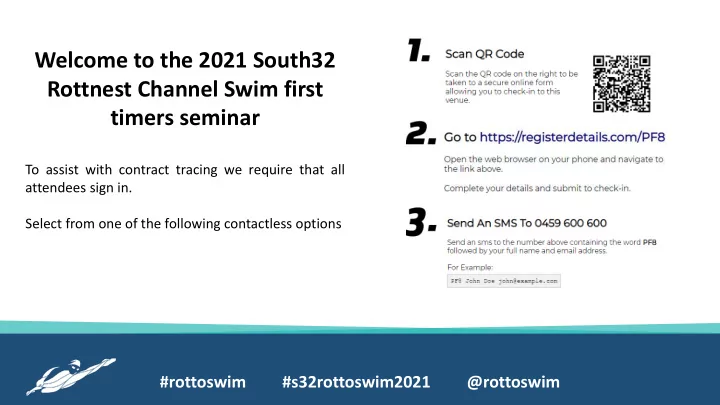
Welcome to the 2021 South32 Rottnest Channel Swim first timers seminar
To assist with contract tracing we require that all attendees sign in. Select from one of the following contactless options
SLIDE 2
RCSA President
SLIDE 3 VOLUNTEER COMMITTEE (7)
- President – Iain McCarrey
- Committee Members –Shane Cartwright, Bec Johnson, Rhys Spicer, Kirsty Bellombra, Tess Fisher, Joseph
Bennett, Olivia Williams Staff Members (2)
- Executive Officer: Nic Blackburn
Email: admin@rottnestchannelswim.com.au
- Event Officer: Michael Hodder
Email: info@rottnestchannelswim.com.au
SLIDE 4
- 2020 HIGHLIGHTS VIDEO
- NIC BLACKBURN– RCSA Executive Officer
- JULIAN MILLS – Past Solo Swimmer
- DANIEL RODGERS – Swim Coach
- PROF. IAN ROGERS – Hypothermia
- Q&A
SLIDE 5
RCSA Executive Officer
SLIDE 6
- Support Boat & Paddler
- Registrations
- Qualifying Swim
- Briefing
SLIDE 7 ALL SOLOS, DUOS AND TEAMS MUST HAVE ONE! Finding a Support Boat and Skipper
- Word of mouth
- Social media - Rottnest Channel Swim Facebook / Instagram sites (@rottoswim)
- Advertise in the local newspaper, Quokka or Gumtree
- Commercial Boat Hire. A quick web search is the best way to find boat hire businesses in Perth.
Support Boat Requirements
- Must be able to fit the number of people the skipper will be responsible for.
- Vessels >10m – must stay south or north edge of the fleet
(and use a tender to stay in close proximity to the swimmer)
SLIDE 8
SLIDE 9 FINDING A PADDLER
- Word of mouth
- Social media - Rottnest Channel Swim Facebook / Instagram sites
(@rottoswim)
- ‘Sea Kayak Club WA’ Forum – www.seakayakwa.asn.au
- Local Surf Clubs i.e. Fremantle, Cottesloe, North Cottesloe, Swanbourne
Nedlands and City Beach (may have their own Facebook page) - www.mybeach.com.au/get-involved/our-clubs/
SLIDE 10
SOLOS / LAVAN CHARITY CHALLENGE TEAMS:
Open: 8.30am (WST) on Monday, 26 October 2020 Close: 5.30pm (WST) on Sunday, 1 November 2020
DUOS / TEAMS:
Open: 8.30am (WST) on Wednesday, 4 November 2020
SLIDE 11
- SOLOS - Each solo registration will be guaranteed entry if
registered and paid within the registration period.
- DUO AND TEAM ENTRIES - First in first served basis. Teams will
need to be registered and paid within the registration period.
- LAVAN CHARITY CHALLENGE - There will be a maximum of 30 x
Lavan Charity Challenge Team spots available.
SLIDE 12
INTENDING SOLO SWIMMERS MUST HAVE EITHER: Completed a Rottnest Channel Swim solo crossing within the previous two (2) years;
OR
Must complete a 10km qualifying swim in 4 hours 15 minutes or less, between 30 October 2020 and 30 January 2021
SLIDE 13 Swimming WA – Open Water Series - www.openwaterswimming.com.au
Saturday, 28 November 2020
Saturday, 27 December 2020
Sunday, 26 January 2021 Christmas 10km - www.christmas10k.org.au
Saturday, 19 December 2020 INDIAN OCEAN - www.indianoceanswim.com.au
Saturday, 14 November 2020
SLIDE 14
#rottoswim #s32rottoswim2021 @rottoswim
SLIDE 15
- It is compulsory that all solo swimmers and a swimmer from each duo/team,
attend the briefing.
- It is highly recommended that your support boat skipper also attends with
you, as they are ultimately responsible for your wellbeing on swim day.
Saturday, 30 January 2021 HBF Stadium – Main Arena 2.30pm
- Collect registration pack (boat stickers, swim cap, T-shirt etc)
SLIDE 16
SLIDE 17
SLIDE 18
Tips For A Successful Crossing
SLIDE 19
#rottoswim #rottoswim2021 @rottoswim
SLIDE 20
- Almost 20 years of involvement having started as team member in 2002
- Eight solos
- First swim over 7 hours – Best 5:36
- 25km P2P
- 2006 Cancelled RCS
- 2018 Cancelled PTB then successful Out of Event Crossing
- 2019 Out of Event and 2020 Solo
- Duo with son
- 5 team crossings plus one team DNF due to weather
- Skippered 6 times in race and 4 times Out of Event
SLIDE 21
#rottoswim #s32rottoswim2021 @rottoswim
SLIDE 22
- The hardest part is deciding to do the swim, making the
commitment and dedicating the time to the training
- Overall its 60% training, 30% natural ability and 50% in the head
- Back yourself into a corner
- Tell everyone you are doing it
- Find a Gang/Mentor
SLIDE 23
- Join a Squad
- Make sure you do ocean/river swims
- Get used to swimming without a dotted line and experience waves,
salt and stingers
- Organised swims are good (OWS, surf clubs)
- 10k qualifier – try and get it over and done with and try to do more
than one
- Start training at least 3 months out
- The key goal of training is to find your “Rotto Pace”
SLIDE 24
SLIDE 25
SLIDE 26
SLIDE 27
SLIDE 28
- Training will be time consuming
- Expect to be tired and grumpy
- Vices should be foregone
- Overseas holidays used to make training difficult
- Appreciate your family’s patience
SLIDE 29
SLIDE 30
SLIDE 31
SLIDE 32
SLIDE 33
#rottoswim #s32rottoswim2021 @rottoswim
SLIDE 34
SLIDE 35
- Lock down logistics well in advance
- Skipper/Boat
- Paddlers/Canoes
- Food, drink, medication, music ….
- To suit up or not?
- Transport and Support at Cottesloe/boat
- Communication reduces stress
- Support/Accommodation at Rottnest
- Pack a post swim bag
SLIDE 36
SLIDE 37
SLIDE 38
SLIDE 39
SLIDE 40
SLIDE 41
SLIDE 42
SLIDE 43
What not to do
SLIDE 44
SLIDE 45
SLIDE 46
SLIDE 47
− Taper and Carbo load in last few days – its as good as life gets! − Big meal in morning – but try before − Protect against sunburn, chafing and seasickness
− Set a feeding schedule (maximum 30 minutes – some go 20 minutes) − Consider Medication – seasickness, stingers and soreness − Make sure crew only tells you precisely where you are − Get times for each kilometre swum
SLIDE 48
SLIDE 49
Anti-Histamine for Stingers Kwells for Seasickness Anti Inflammatories for soreness Zofran for last resort
SLIDE 50
#rottoswim #s32rottoswim2021 @rottoswim
SLIDE 51
SLIDE 52
SLIDE 53
SLIDE 54
SLIDE 55
SLIDE 56
Further Questions: jrsmills@iinet.net.au
SLIDE 57
Training and Preparation
SLIDE 58
#rottoswim #s32rottoswim2021 @rottoswim
SLIDE 59
- Start Early
- Both open water and swimming pool
- 3 - 4 swims per week
- Build to 4.5km – 5km+ per session
- Last stages have 1 x 8km – 10km swim per
week
SLIDE 60 Solo
- Start with 4 – 5 hours per week
- Progress to a base line 10 – 15 km p/w
- 3 weeks out: 25 – 35 km p/w
- Taper to 10 – 15 km
SLIDE 61 Duo
- Start with 4 – 5 hours per week
- Progress to a base line 8 – 10 km p/w
- 3 week out: 15 – 25 km p/w
- Taper to 10 – 15 km
SLIDE 62 Team
- Start with 2 – 4 hours per week
- Progress to a base line 5 – 8 km p/w
- 3 weeks out: 15 – 20 km p/w
- Taper to 6 – 10 km
SLIDE 63 Progressive Loading / Adaptation
Team Duo Solo Week 1-3 2 – 4 hours 4 – 5 hours 4 – 5 hours Week 4 4 km 6 km 10 km Week 5 6 km 8 km 13 km Week 6 8 km 10 km 15 km Week 7 6 km 8 km 13 km Week 8 8 km 10 km 15 km Week 9 10 km 12 km 17 km Week 10 8 km 6 km 15 km Week 11 10 km 12 km 17 km Week 12 12 km 6 km 20 km
SLIDE 64
- Sessions at sea with your paddler
- Practice feeding and sighting
- Mix your stroke styles
- Mix your training
5 x 400 5 x 200 5 x 100 8 – 4 x : 50 build 100 easy 4 – 5 x: 2 x 400 free 200 free/back 4 -5 x: 400 4 x 100 build to 80% 200 easy free/back
SLIDE 65 Measuring training
- Distance
- Time
- Effort – Heart Rate
- Threshold ≈ 20/30 beats below max
Aerobic Anerobic
SLIDE 66 Measuring training
Distance HR Beats Per Min Control Time/ speed Time p/100m Control HR Beats Per Min 50 m 140 bpm 50s 47s 155 bpm 100 m 155 bpm 1’40 1’40 155 bpm 200 m 160 bpm 3’20 3’28 155 bpm 300m 167 bpm 5’00 5’17 155 bpm 400 m 180 bpm 6’40 7’00 155 bpm 500 m 185 bpm 8’20 8’52 155 bpm 600m 190 bpm 10’00 11’09 155 bpm
SLIDE 67
- Fins – DMC Elite
- Kickboard – Any
- Pull buoy – Any
- Paddles – Finis Agility Paddles
- Snorkel - Finis Freestyle Snorkel
SLIDE 68
- Keep a training log
- Replenish fluids during and after training
- Have consistent pains checked out
- See a stroke specialist if needed
SLIDE 69
- 1 - 1.5 weeks
- Ease intensity
- Peak taper ≈ 50 % volume
- Don’t over taper
SLIDE 70 Injury Prevention
- Over training
- Progressive loading
- Safe Technique – Length & Volume
- Recover
- Sleep
- Appropriate strength and conditioning
- Pre-existing injuries
SLIDE 71
#rottoswim #s32rottoswim2021 @rottoswim
SLIDE 72
- Must have a plan
- Inform your team
- Tested swim suit
- Shave your beard
- Abundance of sunscreen
- Practice feeding and test food types
- DON’T do any new on the day
SLIDE 73
- Train smart
- Don’t listen to the hype
- Avoid alcohol
- Don’t drink the sea water
- Be sun smart
- Listen to your support team
- Hand the keys over
- Good Luck, train smart, have fun!
SLIDE 74
Hypothermia & Pulmonary Oedema
SLIDE 75
SLIDE 76 Spend long enough immersed in the channel and anyone will eventually become hypothermic The KEY FACTORS at play are:
- TEMPERATURE (of the water)
- TIME (in the water)
- INSULATION (ie body fat)
SLIDE 77
SLIDE 78
- Lots has been done to prevent hypothermia BUT…
- Hypothermia is still the most common important medical problem seen
most years
- Every year we treat many solo swimmers for hypothermia and in some it
is severe
- Race conditions and hypothermia incidence naturally vary from year to
year BUT
- Don’t be complacent - the hypothermia risk is ever present
SLIDE 79
- Mild
- Apathetic, lack of co-ordination, slurred speech
- Shivering (but that can be hard to detect in the water)
- Severe
- Confused & disorientated
- Eventually loss of consciousness and death by drowning
SLIDE 80
- Mild (if you recognise & intervene here, they are safe)
- Style and stroke rate going off
- Disinterested in conversation
- Loss of “sense of humour”
- Severe (if you don’t recognise here, they are at real risk)
- Nonsense conversation
- Disorientated (eg swimming well off course)
SLIDE 81
- Support crew must actively monitor and intervene early
- swimmers don’t know they are hypothermic
- Get them out of the water (gently)
- Minimise further heat loss
- dry, insulate, wind proof barrier (space blanket, garbag)
- “Fuel the engine” (sweet drinks, jelly beans, carboshotz)
- Call Channel Swim base urgently for medical assistance
SLIDE 82
- Recognise risk factors
- Especially slow, thin, first timers on a “tough day”
- Build up your insulation (? consult a sports dietitian)
- “Seals” are ideally suited to open water swimming
- Glycogen loading pre-race
- Regular glucose during the race (“fuel the engine”)
- Trust your skipper & support crew to think for you and pull you
- ut before your mild hypothermia becomes severe
- Your skipper takes ultimate responsibility for your welfare!
SLIDE 83
- Pulmonary oedema is fluid collecting within the airspaces (alveoli) of the
lungs causing low blood oxygen levels
- It is usually linked with hypothermia, probably because uncoordinated
breathing leads to salt water aspiration
- The major symptoms are cough with frothy sputum and shortness of
breath out of proportion to that which would be otherwise expected
- Unless they are very hypothermic, swimmers know when this is
happening to them and will typically ask for help
- Call Channel Swim base urgently for medical assistance
- In the meantime keep them warm, dry and sitting up
SLIDE 84