Welcome to Memphis Christian Brothers University: February 20, - - PowerPoint PPT Presentation

welcome to memphis
SMART_READER_LITE
LIVE PREVIEW

Welcome to Memphis Christian Brothers University: February 20, - - PowerPoint PPT Presentation

Welcome to Memphis Christian Brothers University: February 20, 2013 Our Friend from Cincinnati, OH You could have traveled from the Port of Greater Cincinnati. You would have traveled 740 miles and gone through 9 locks and dams


slide-1
SLIDE 1

Christian Brothers University: February 20, 2013
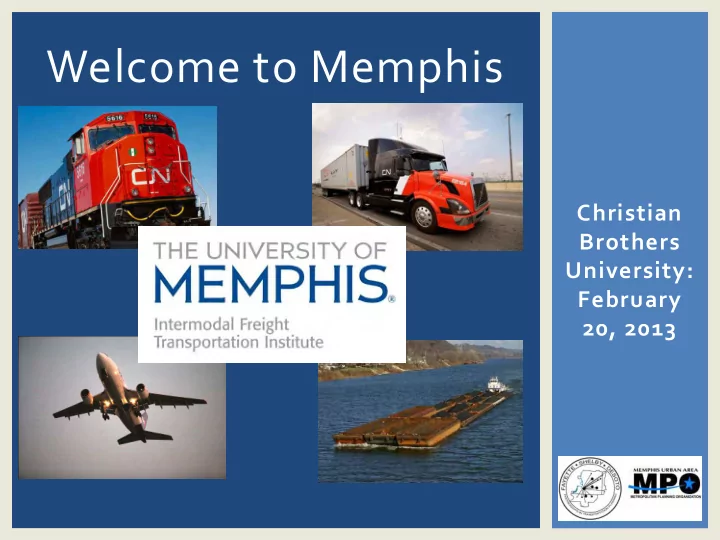
Welcome to Memphis

slide-2
SLIDE 2

You could have traveled from the Port of Greater Cincinnati. You would have traveled 740 miles and gone through 9 locks and dams before you reached the International Port of Memphis.

2

Our Friend from Cincinnati, OH

slide-3
SLIDE 3

3

Our Friend from Washington, DC

You could have traveled by rail on a CSX train to Memphis. It would have taken you to Huntington, WV Cincinnati, OH Louisville, KY and Nashville, TN before you reached Pigeon Park in downtown Memphis.

slide-4
SLIDE 4

You could have traveled from the Peach State to the Volunteer State by road. You could have driven US-78 through Birmingham or taken I-75 to Nashville and I-40 down to Memphis.

4

Our Friend from Atlanta, GA

slide-5
SLIDE 5

You could have flown out of either airport to Memphis. There are more than 115 flight combinations to get to Memphis International Airport from Chicago.

5

Our Friends from Chicago, IL

slide-6
SLIDE 6

6

Memphis has the highest % of its work force in transportation in the nation.

Memphis Freight Overview

slide-7
SLIDE 7

7

National Freight Truck Traffic over

the Mississippi Bridges

slide-8
SLIDE 8

8

National Rail Traffic over the

Mississippi Bridges

slide-9
SLIDE 9

9

Current Train Volumes Compared

to Current Train Capacity

slide-10
SLIDE 10

10

Future Rail Corridor Volumes Compared to Current Corridor Capacity - 2035

slide-11
SLIDE 11

11

Road, Rail & River

slide-12
SLIDE 12

12

Inbound and Outbound Freight

Tonnage by Mode

slide-13
SLIDE 13

RAIL RUNWAY RIVER ROADWAY

13

Quadra- Modal Strategy

slide-14
SLIDE 14

14

Rail Yards

Lif ift Capaci acity ty > 1.5 mil illi lion

  • n TEUS
slide-15
SLIDE 15

15

Road Congestion

slide-16
SLIDE 16

16

River Port Commodities

18% 19% 13% 37% 6% 7%

Coal Food and Farm Products Crude Material Petroleum Manufactured Goods Other

slide-17
SLIDE 17

17

Warehouse Facilities in the

Memphis Area

slide-18
SLIDE 18

Memphis Freight Challenges

slide-19
SLIDE 19
  • Capacity on Freight-Intensive

Corridors, i.e. Lamar Avenue/US 78

  • Accommodating Through Truck Flows
  • n I-40, I-55, and future I-69
  • Intermodal Connectivity, i.e., access

to rail, air, and water Roadways

slide-20
SLIDE 20

Connectivity between rail carriers Mississippi River Rail Capacity Containerized trade is a fast growing segment

  • f foreign trade

Rail

slide-21
SLIDE 21

Maintaining water access to ports, i.e., dredging Landside and rail access to ports Container-on-Barge shipments River

slide-22
SLIDE 22

Implementation of Aerotropolis Plan Roadway access to the airport Runway (Air)

slide-23
SLIDE 23

Doubling of freight transportation by 2035

  • Increased buying from and selling to global markets

Intermodal Connectivity and Coordination Understand forecasted growth for individual modes

  • Assess capacity bottlenecks

Congestion

  • Reliability and Costs concerns

Overall

slide-24
SLIDE 24

Coordination of local and state governments Incorporating Freight Planning into Long- Range regional planning efforts Coordinating private sector needs with public sector planning Evaluating the current freight transportation network and measuring performance

Tasks to Address Challenges