Week Thematic Content Readings Activities and Due Assignments - - PowerPoint PPT Presentation

week thematic content readings activities and due
SMART_READER_LITE
LIVE PREVIEW

Week Thematic Content Readings Activities and Due Assignments - - PowerPoint PPT Presentation

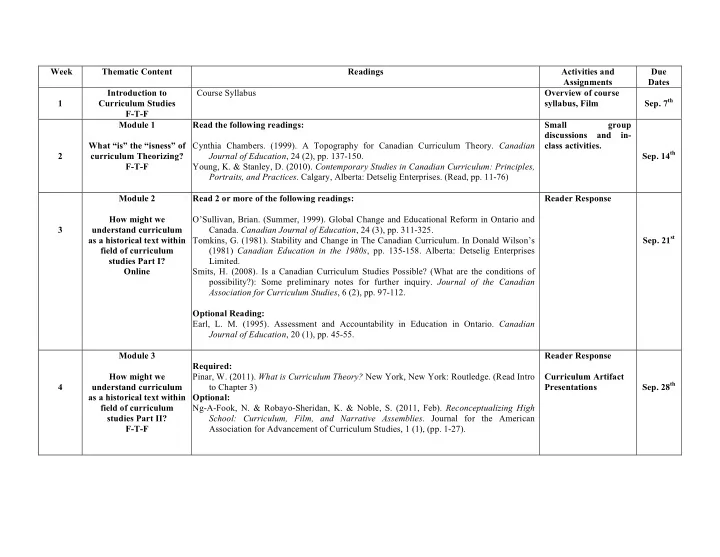
Week Thematic Content Readings Activities and Due Assignments Dates Introduction to Course Syllabus Overview of course Sep. 7 th 1 Curriculum Studies syllabus, Film F-T-F Module 1 Read the following readings: Small group discussions


slide-1
SLIDE 1

Week Thematic Content Readings Activities and Assignments Due Dates 1 Introduction to Curriculum Studies F-T-F Course Syllabus Overview of course syllabus, Film

  • Sep. 7th

2 Module 1 What “is” the “isness” of curriculum Theorizing? F-T-F Read the following readings: Cynthia Chambers. (1999). A Topography for Canadian Curriculum Theory. Canadian Journal of Education, 24 (2), pp. 137-150. Young, K. & Stanley, D. (2010). Contemporary Studies in Canadian Curriculum: Principles, Portraits, and Practices. Calgary, Alberta: Detselig Enterprises. (Read, pp. 11-76) Small group discussions and in- class activities.

  • Sep. 14th

3 Module 2 How might we understand curriculum as a historical text within field of curriculum studies Part I? Online Read 2 or more of the following readings: O’Sullivan, Brian. (Summer, 1999). Global Change and Educational Reform in Ontario and

  • Canada. Canadian Journal of Education, 24 (3), pp. 311-325.

Tomkins, G. (1981). Stability and Change in The Canadian Curriculum. In Donald Wilson’s (1981) Canadian Education in the 1980s, pp. 135-158. Alberta: Detselig Enterprises Limited. Smits, H. (2008). Is a Canadian Curriculum Studies Possible? (What are the conditions of possibility?): Some preliminary notes for further inquiry. Journal of the Canadian Association for Curriculum Studies, 6 (2), pp. 97-112. Optional Reading: Earl, L. M. (1995). Assessment and Accountability in Education in Ontario. Canadian Journal of Education, 20 (1), pp. 45-55. Reader Response

  • Sep. 21st

4 Module 3 How might we understand curriculum as a historical text within field of curriculum studies Part II? F-T-F Required: Pinar, W. (2011). What is Curriculum Theory? New York, New York: Routledge. (Read Intro to Chapter 3) Optional: Ng-A-Fook, N. & Robayo-Sheridan, K. & Noble, S. (2011, Feb). Reconceptualizing High School: Curriculum, Film, and Narrative Assemblies. Journal for the American Association for Advancement of Curriculum Studies, 1 (1), (pp. 1-27). Reader Response Curriculum Artifact Presentations

  • Sep. 28th
slide-2
SLIDE 2

5 Module 4 How might we understand curriculum as a political text? Online Required: Pinar, W. (2011). What is Curriculum Theory? New York, New York: Routledge. (Read Ch. IV) Read at least 1 of the following optional readings: Apple, M. & King, N. (1977). What do Schools Teach? Journal of Curriculum Inquiry, 6 (4),

  • pp. 341-358.

Dillon, J. T. (2009). The Questions of Curriculum. Journal of Curriculum Studies, 41 (3), pp. 343-359. Giroux, H. A. (1990). Perspectives and Imperatives Curriculum Theory, Textual Authority, and The Role of Teachers as Public Intellectuals. Journal of Curriculum and Supervision, 5 (4), pp. 361-383. Lather, P. (1986). Issues of Validity in Openly Ideological Research: Between a Rock and a Hard Place. Interchange, 17 (4), pp. 63-84. Reader Response

  • Oct. 5th

6 Module 5 How might we understand the concept

  • f “place” within field of

curriculum studies? F-T-F Required: Ng-A-Fook, N. (2007). An Indigenous Curriculum of Place. New York, New York: Peter

  • Lang. (Intro to chapter 2)

Read at least one of the following optional readings: Chambers, C. (1994). Looking for Home: Work in Progress. Frontiers: A Journal of Women Studies, 15 (2), pp. 23-50. Young, K. & Stanley, D. (2010). Contemporary Studies in Canadian Curriculum: Principles, Portraits, and Practices. Calgary, Alberta: Detselig Enterprises. (Ch. 5) Reader Responses Curriculum Artifact Presentations

  • Oct. 12th

7 Module 6 How might we understand life narrative and/or autobiographical research within the field

  • f curriculum studies

Part I? Online Required: Ng-A-Fook, N. (2007). An Indigenous Curriculum of Place. New York, New York: Peter

  • Lang. (Ch. 3-5)

Read 1 of the following readings: Young, K. & Stanley, D. (2010). Contemporary Studies in Canadian Curriculum: Principles, Portraits, and Practices. Calgary, Alberta: Detselig Enterprises. (Read Ch. 4 or 12) Reader Responses

  • Oct. 19th

No Classes Study Week

  • Oct. 23
slide-3
SLIDE 3

8 Module 7 How might we understand the aesthetics

  • f curriculum theorizing
  • ur lived experiences as

currere? F-T-F Required: Pinar, W. (2011). What is Curriculum Theory? New York, New York: Routledge. (Read V- VII) Reader Responses Curriculum Artifact Presentations

  • Nov. 2nd

9 Module 8 How might we provoke curriculum studies as eco-justice within the 21st Century? Online Read 3 or more of the following readings: Young, K. & Stanley, D. (2010). Contemporary Studies in Canadian Curriculum: Principles, Portraits, and Practices. Calgary, Alberta: Detselig Enterprises. (Ch. 13, 14, 15, 16) Optional Readings: Ng-A-Fook, N. (2010). Another Bell Ringing In The Empty Sky: Greenwashing, Curriculum, and Ecojustice. Journal for the Canadian Association of Curriculum Studies, 8 (1), pp. 41-67. Reader Responses Curriculum Artifact Paper Due

  • Nov. 9th

10 Module 9 What are some of the contemporary curricular challenges and/or movements are educators faced with in, and/or experiencing during, the 21st Century? F-T-F Read at least 3 of the following readings: Young, K. & Stanley, D. (2010). Contemporary Studies in Canadian Curriculum: Principles, Portraits, and Practices. Calgary, Alberta: Detselig Enterprises. (Ch. 6, 7, 8, 9, 10, 11) Reader Responses Curriculum Artifact Presentations

  • Nov. 16th

11 Module 10 How might we learn to take indigenous thought seriously as future curriculum theorists? Online Required Readings: Cole, P., & O’Riley, P. (2005). Coyote and raven talk about the business of education or how did Wall Street, Bay Street and Sesame Street get into the pockets of publicly funded universities or vice versa. Workplace: A Journal for Academic Labor, 7(1), pp. 15–28. Donald, D (2009b). Forts, Curriculum, and Indigenous Métissage: Imagining Decolonization

  • f Aboriginal-Canadian Relations in Educational Contexts. First Nations Perspectives:

The Journal of the Manitoba First Nations Education Resource Centre, 2 (1), pp. 1-24. Haig-Brown, C. (2008). Taking Indigenous Thought Seriously: A Rant on Globalization with Some Cautionary Notes. Journal of Canadian Curriculum Studies, 6 (2), pp. 8-24. Title and abstract for final paper conference due via e- mail. Reader Responses

  • Nov. 23rd
slide-4
SLIDE 4

12 Module 11 Re-visioning our Understanding of Curriculum Studies Online Required Readings: Pinar, W. (2011). What is Curriculum Theory? New York, New York: Routledge. (Read part V) First Draft of Final Paper Due in small discussion groups (5-6 pages and working bibliography)

  • Nov. 30

13 Module 12 How might we provoke curriculum theorizing anew? F-T-F No readings Graduate Student Provoking Curriculum Conference

  • Dec. 7