webMethods EntireX for ESB: Leveraging Platform and Application - - PDF document

webmethods entirex for esb leveraging platform and
SMART_READER_LITE
LIVE PREVIEW

webMethods EntireX for ESB: Leveraging Platform and Application - - PDF document

December 2008 webMethods EntireX for ESB: Leveraging Platform and Application Flexibility While Optimizing Service Reuse By Chris Pot t inger, S r. Manager Product Development , and Juergen Lind, S r. Product Manager, S oft ware AG With


slide-1
SLIDE 1

December 2008

webMethods EntireX for ESB: Leveraging Platform and Application Flexibility While Optimizing Service Reuse

By Chris Pot t inger, S

  • r. Manager Product Development , and Juergen Lind, S
  • r. Product Manager,

S

  • ft ware AG

“With the combined power of webMethods EntireX and the webMethods ESB Platform, our IT organization provides the comprehensive infrastructure essentials and adaptive flexibility such that when our business says: “Jump!” we can answer: “How high?”

  • IT Architect at large financial firm

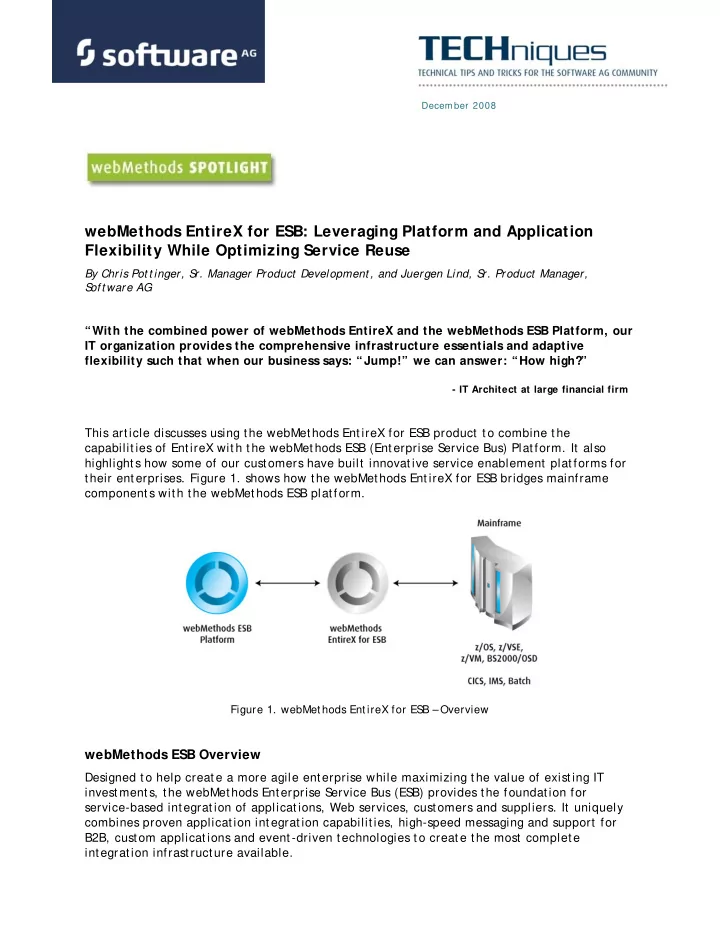
This article discusses using the webMethods Ent ireX for ES B product to combine the capabilities of EntireX with the webMethods ES B (Enterprise S ervice Bus) Platform. It also highlights how some of our customers have built innovative service enablement platforms for their enterprises. Figure 1. shows how the webMethods EntireX for ES B bridges mainframe components with the webMethods ESB platform.

Figure 1. webMethods EntireX for ES B – Overview

webMethods ESB Overview

Designed t o help create a more agile enterprise while maximizing the value of exist ing IT investments, the webMethods Enterprise S ervice Bus (ES B) provides the foundation for service-based integration of applications, Web services, customers and suppliers. It uniquely combines proven application integration capabilities, high-speed messaging and support for B2B, custom applications and event-driven technologies to create the most complete integration infrastructure available.

slide-2
SLIDE 2

The ES B is platform-neutral, code-neutral, messaging-neutral and application-server neutral, so any application can use any data. Further, sufficiently-described data enables intelligent brokering and routing. S

  • , if an application needs specific information, the webMethods ES

B delivers the information where it is needed. If an application needs several services that depend on data from stove-piped mainframe syst ems, that data gets there via the ESB. In addition t o connecting partners, customers and employees with business assets, the webMethods ES B Platform is the foundation for the webMethods product suite. And along with being integrated with webMethods EntireX, the ES B is the backbone for the webMethods BPMS, the BAM engine Optimize and the CentraSite S OA Governance solution.

webMethods EntireX for ESB

webMethods EntireX excels in extending heterogeneous processes to a wide variety of consumer technologies. It offers a scalable abstraction layer in the form of reusable services from which any consumer can call any process running on any platform. Using remote procedure call (RPC) methods, EntireX transparently provides transformation bet ween a wide variety of application environments and message transport across system environments.

Figure 2. webMethods EntireX for ES B – Capabilities Overview

The S

  • ftware AG RPC methodology provides a high-degree of granularity and application

inheritance that is easily leveraged through the EntireX for ES B.

Where Are Your Critical Processes Running?

Often the answer is: On the mainframe. High-transaction, 24x7 core business processes are performed on the mainframe in a highly reliable yet cost-effective manner. However, these critical processes are not easily combined with the S OA world of Web services, BPM and ES Bs.

How Can You Embrace and Combine Your Mainframe Core Systems with Your SOA?

How can you get true enterprise processes that span all of your systems? How can you easily provision your COBOL transactions to trigger an event being monitored as a key performance indicator in BAM? How can you get BPM to exploit your IMS

  • r CICS

transactions? How can you leverage your Natural-Adabas-based core systems to deliver value to your enterprise processes?

Leveraging Platform and Application Flexibility While Optimizing S ervice Reuse

Page 2 of 6

slide-3
SLIDE 3

Leveraging Platform and Application Flexibility While Optimizing S ervice Reuse

Page 3 of 6

The Answer: webMethods EntireX for ESB!

Regardless of whether you need to integrate with Batch, CICS

  • r IMS

environments, and regardless of whether you talk about Natural, COBOL or PL/ I, webMethods EntireX for ES B bridges the gap between your mainframe core systems and the S OA and BPM side of the

  • world. The simple and highly efficient runtime architecture and intuitive wizards support

make it quick and easy to connect both types of systems.

Service Interfaces

webMethods EntireX for ESB not only bridges the gap between mainframes and open systems, it also enables you to quickly deliver what your business unit is asking for! With its simple extract, generate, run and test cycles, you can achieve integration without any programming. For optimized integration with webMethods ES B, EntireX natively supports webMethods Flow

  • services. The choice bet ween Web services or webMethods Flow services -- or both -- gives

you extra flexibility for your architectural design. Whether you choose webMethods Flow services, Web services or the mainframe connect ivity, webMethods Ent ireX for ES B generates the assets necessary for integration.

Bi-Directional Service Calls

Most of our customers t oday run their businesses in a highly competitive and fast-moving

  • environment. There is no time for inflexible home-grown integration anymore. The business

processes are there. The backend services are there. Depending on your scenario, they simply need to be connected in one direction or the ot her, or even in both directions. webMethods EntireX for ES B provides you with bi-directional services, which means your backend core system is not only exploited as a service provider. Furthermore, your core system can easily consume webMethods ESB services as well as Web services transparently, as if they were local

  • programs. Since EntireX provides bi-directional connectivity, you can truly integrate your

backend core systems as full members of your enterprise processes.

Reliable Service Calls

Automated processes often span multiple systems and need to send service calls along a chain

  • f systems, e.g., contract data to be added to or updated in multiple systems, each of which

is designed for a specific purpose. For this kind of scenario a synchronous request-reply communicat ion model is inefficient. The original sender would need to wait for the answers

  • f the whole chain of receivers. Here an asynchronous, yet persistent type of messaging

would be ideal. webMethods EntireX for ES B supports reliable service calls. This kind of communicat ion model provides you with a persistent, store-and-forward type of service call. It allows you to decouple providers and consumers in a highly reliable manner using efficient “ fire-and-forget” client service calls.

Non-Invasive Mainframe Integration

Large organizations consist of many distinct business units. Some of them may even be geographically distribut ed. Imagine a data cent er being separate from business units. Imagine

  • ne of these units being outsourced to an external service provider. In such scenarios it is
  • ften difficult to realize integration that spans multiple systems in different departments.

EntireX for ES B supports non-invasive integration with your IMS

  • systems. Connectivity is
slide-4
SLIDE 4

established via IMS Connect so that there is zero footprint on your IMS system. Likewise, non- invasive int egration wit h CICS is planned for a subsequent version. Figure 2. summarizes the capabilities of webMethods EntireX for ES

  • B. The broad reach of

environments, its flexible architecture as well as its mainframe enablement features make webMethods EntireX for ES B and webMethods ESB complementary components in your S OA infrastructure.

Architecture

Let’ s take a closer look at webMethods EntireX for ES

  • B. A key component is the webMethods

EntireX Adapter for Integration S

  • erver. This adapter (referred to as Adapt er in Figure 3) plugs

into the webMethods integration server (shown as webMet hods ES B in Figure 3) and provides the communication basis between an integration server service and mainframe components. It technically supports Software AG RPC connect ivity as well as non-invasive connectivity with the mainframe. This way you can reach any existing RPC server from your integration server

  • services. Likewise, any RPC client can issue calls into the integration server. This is called bi-

directional integration.

Figure 3. webMethods EntireX for ES B – Technical Architecture

For non-invasive connectivity to mainframe environments, the adapter is calling respective service interfaces on the mainframe side. For IMS , e.g., the communication is established via IMS

  • Connect. Consequently, all EntireX components will completely run off the mainframe

host. Web services are supported directly by EntireX runtime. Whether you need to call a mainframe transaction from a Web service or a mainframe client program needs t o consume a Web service makes no difference to the bi-directional integration capabilities of EntireX. S een from a design-time perspective, all steps necessary for integration with the mainframe components are support ed by the EntireX Workbench. The EntireX Workbench is Eclipse-based and fits perfectly with other S

  • ftware AG design-time environments. With intuitive wizards,

generating all assets needed to integrate your mainframe with the webMethods integration server is a breeze.

Leveraging Platform and Application Flexibility While Optimizing S ervice Reuse

Page 4 of 6

slide-5
SLIDE 5

Figure 4. Mainframe S ervice in IS Flow

Customer Successes

Our first customer example is, as with most large financial institutions, a turn-of-the-century

  • rganization that has a wide variety of commercial products and services running on a variety
  • f large-scale systems with a heavy emphasis on IBM mainframes. Armed with a long list of

integration requirement s, S

  • ftware AG won this enterprise customer with innovation,

knowledge, and a proven track record to deliver effective customer solutions (even though the customer did not have any Adabas or Natural investments). At the end of the evaluation process, the cust omer chose Software AG because we provided the highest ROI while addressing all of their integration requirements. The customer’ s evaluation t eam had adhered to a set of criteria that enabled existing assets (including IMS, CICS , DB2 and VSAM) to be exposed to a shared and highly reusable orchestration layer that could be consumed by a wide variety of users. While several vendors fit the bill, the difference between offerings was how long it took the IT department to build and deploy business solutions. As a result of solid execution of ES B and EntireX, this customer has expanded its investment in Software AG solutions to include additional components of t he webMethods Suite: webMethods ApplinX, webMethods ConnecX and CentraSite, as well as BPM/ BAM. And most importantly, they believe that their services platform will allow them to increase their agility and build customer loyalty in the face of industry uncertaint y. Another customer example is a large energy company whose sophisticated and diverse inventory and customer information systems reside on large-scale IBM mainframes, resulting in hundreds of thousands of transactions being managed daily (24x7). This mainframe customer has hundreds of different CICS interfaces spread across 50 logical partitions, with many point-to-point interfaces across a broad and diverse user base. Managing all of these interfaces in the face of application changes, a demanding business environment for customer

Leveraging Platform and Application Flexibility While Optimizing S ervice Reuse

Page 5 of 6

slide-6
SLIDE 6

Leveraging Platform and Application Flexibility While Optimizing S ervice Reuse

Page 6 of 6

satisfaction and an economy that demands reuse, this company turned to S

  • ftware AG for

their ES B and mainframe solutions. Essentially, S

  • ftware AG provided an abstracted solution t hat allows changes to one

component without affecting the downstream components because the interfaces are now designed as autonomous services. By establishing and publishing a specific service signature through CentraS ite, these services are now governed and easily consumed by all constituents, even as applications are modified and updated. This cust omer found that by placing a modern service layer between mainframe applications, end consumers and other application assets, t hey can substantially lower the risk of re- engineering a tightly coupled solution between users and information sources while addressing new business requirements.

Summary

Given the recent economic climate and outlook, two areas commonly emerge as being most advantageous to many IT organizations and the businesses they support – application enablement and service orchestration. By combining the leading solutions for addressing each

  • f these disciplines, S
  • ftware AG delivers real advantages t o its customers, including making

them more productive. Taking advantage of innovation and leveraging existing asset s are proven methods in narrowing t he chasms between today’ s IT and business worlds. Software AG provides an innovative software solution to effectively share and deliver information across heterogeneous applicat ions and diverse platform environments common to most enterprise

  • rganizations. With webMethods Ent ireX for ES

B, S

  • ftware AG prepares its customers to

accelerate their business constituents’ next-generation initiatives and achieve competitive advantage.