Weathering Weathering Weathering Breaking down of rocks into - - PowerPoint PPT Presentation

weathering weathering
SMART_READER_LITE
LIVE PREVIEW

Weathering Weathering Weathering Breaking down of rocks into - - PowerPoint PPT Presentation

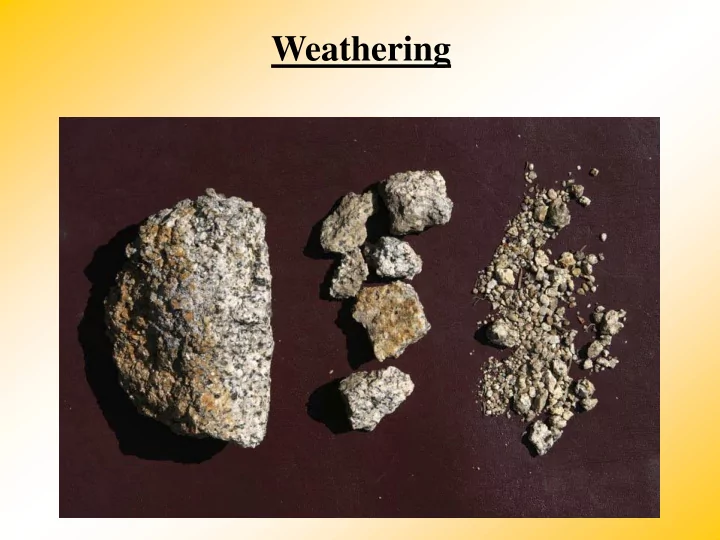
Weathering Weathering Weathering Breaking down of rocks into simpler components Size Composition Mechanical Weathering Changes size and shape of the rock but not its chemical composition Temperature Change Abrasion


slide-1
SLIDE 1

Weathering

slide-2
SLIDE 2

Weathering

Mechanical Weathering – Changes size and shape of the rock but not its chemical composition

  • Temperature Change
  • Abrasion
  • Unloading
  • Biological Activity

Weathering – Breaking down of rocks into simpler components

  • Size
  • Composition
slide-3
SLIDE 3

Weathering

Chemical Weathering – Changes the rock into one or more new compounds (changes its chemical composition) Water - most important agent of chemical weathering Dissolved gases in water react with chemicals in rock

  • O2
  • CO2
  • NO2
  • SO2

Acid Rain

slide-4
SLIDE 4

Importance of Weathering

Mechanical Weathering

  • Easier to move
  • More prone to chemical weathering

Chemical Weathering

  • Make new raw materials

Mechanical & Chemical Weathering Together

  • Changes landforms
  • Makes soil (sand, silt, and clay)
  • Increases rate of weathering
slide-5
SLIDE 5

Factors Affecting the Rate of Weathering

When analyzing weathering, look at:

  • Rock Material
  • Composition
  • Surface Area
  • Climate
  • Temperature
  • Precipitation
slide-6
SLIDE 6

Factors Affecting the Rate of Weathering

Rock Composition

  • Mineral composition and solubility
  • Minerals that make up the rocks
  • Physical features such as shape, joints, and cracks

Surface Area

  • Strongly tied to rock composition
  • Increase surface area = increased exposure to

environment

slide-7
SLIDE 7
slide-8
SLIDE 8

Factors Affecting the Rate of Weathering

Temperature

  • Increased temperature = increased chemical

weathering (chemical reactions more active in higher temperatures)

  • Temperate (mix of cold and warm) temperatures

are required for effective mechanical weathering Precipitation

  • Increased precipitation = increased weathering
  • Need contact of rock with water for chemical

weathering

  • Water is required for most mechanical weathering
slide-9
SLIDE 9

Chemical Physical Weathering

slide-10
SLIDE 10

http://transcripts.cnn.com/2000/US/08/08/wildfires.03/colorado.mesa.ve

slide-11
SLIDE 11

http://www.gorzow.mm.pl/~bebelebe/Anasazi%20Ruins,%20Mesa%20Verde%20National%20Park,%20Colorado.jpg

slide-12
SLIDE 12

http://www.dustydavis.com/blogimages/mesa_verde_close_large.jpg

slide-13
SLIDE 13

http://www.russfinley.com/stockphotography/mesaverde/mesaverde01.j

slide-14
SLIDE 14

Effects of Weathering