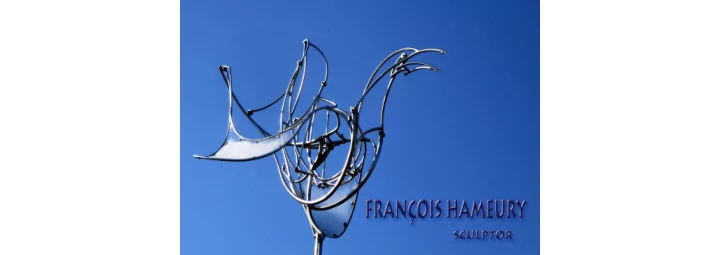
We are all made of contradictions, inconsistencies, frustrations and - - PowerPoint PPT Presentation

we are all made of contradictions inconsistencies
SMART_READER_LITE
LIVE PREVIEW

We are all made of contradictions, inconsistencies, frustrations and - - PowerPoint PPT Presentation

We are all made of contradictions, inconsistencies, frustrations and desires. The hopes to be balanced and tolerant are dubious, and still we are standing up, more or less, and only movement gives us some balance. The essence of my work is


slide-1
SLIDE 1
slide-2
SLIDE 2

François Hameury L’Atelier 3 rue Yves Moal 29620 LANMEUR France www.hameury.com 33 6 72 82 91 85 Registered Professional Artist (France): H198318 2 2 ‘We are all made of contradictions, inconsistencies, frustrations and desires. The hopes to be balanced and tolerant are dubious, and still we are standing up, more or less, and only movement gives us some balance. The essence of my work is to make structures at their best, which are built of incompatible elements, opposing materials and paradoxical volumes. None the less, these structures work; they are balanced in dynamics. Each one of the sculptures needs to exist in itself, be different, but in agreement with the others. Each structure in some way is an expression of

  • balance. It must have its own personality.

It must be. Art, really, is it ever anything but a pretext? Do the form it takes and the medium being used have any significance? The important thing is the story it tells, a well-built story, and if possible with a touch of humour. Art should be an opening not a closure; it extrapolates equilibrium and takes us somewhere else.’ July 2014 3 3 Acknowledgements I wish to thank the friends who hold my hand and lifted my spirit during all these years. I can't name them all, but they will understand whom I'm thin- king about. Special thanks to Jean Gaudrat who left us too soon, Michel Le Bourhis and Peter O'Dwyer who never failed me, Richard Upton who sometimes gave me the means to produce quality work, Corine Fegan for her editorial assistance and competence in English, and Andy-Pan-Wollee for the chinese version.

slide-3
SLIDE 3

Settled in Lanmeur, Brittany (France), not far from the sea-shore, the Gallery

  • ffers 20 years of work to the visitors.

There are different periods : wood or stone carving, steel, brass, mixed

  • mediums. The peaces have always a four dimentional effect, using move-

ment, vibrations, kinetic and dynamic equilibriums. Colours and paintings have been introduced recently.

Th he e Ga al ll le er ry y

4

Th he e S St tu ud di io

  • The Studio is set right

underneath the Gallery. It is like a real black- smith workshop of 200m², which allows the production of large scale sculptures. 5 5 ‘Do the best you can with what you have. With “Tig” and “Mig” combined with classic limited tools, they are the best way to stimulate your mind for creative solutions, which drives you to unexpected results. The only limits are your mind and your hands.’

slide-4
SLIDE 4

François Hameury is born by accident in Paris in 1953. In 1960, François starts to build robots with his Meccano set. Then, in 1968, his interest goes towards detonating chemistry and propulsion. He develops some rather curious reactions that end up in disaster, sending one of his friends to hospital. After that, he learns mechanics, turning rusty nails into bolts. He really starts to study hard in senior high school, from which he majored in Mathematics. He graduates as an engineer from the Arts et Metiers school in 1976, and he begins in 1977 to build with someone else a 14KW high temperature solar oven for metallurgical and ceramic usage. Then from 1978 to 1985, he becomes head of the Batna University Experimental Centre (Algeria). He organises the practical sessions for mechanical, optical, electrical, kinetic, thermic, electrical and vibration curricu-

  • lums. He starts photography as well, and will exhibit his work

for the first time in Morlaix in 1987. Between 1985 and 1995, he is an Engineer Consultant in energetic, aeraulic and thermic regulations and manages several projects. He develops as well numerical analysis and simulation softwares. The sea has always had a big influence on François’s life. He can sail, swim or dive at leisure. He is a real salty dog and has done many ocean crossings.

Cu ur rr ri ic cu ul lu um m

6 Maniac-obsessive sculptor polarised by the search of impossible equilibriums between con- traries and a strong application of kinetics, he uses any available materials like iron, copper, wood, stones, sands and pigments. Since 2004, he admits having a special fancy for brass. He thinks that art is probably the last refuge in which any freedom is possible, that the major criterion resides in the challenge that the creator throws to himself, and that the discourse on cre- ation doesn’t always fit properly with the dis- course’s concept. The materialisation of his rant and rave is pre- sented in his Gallery in Lanmeur. President of Scupteurs Bretagne Association between 1999 and 2003 (www.sculpteurs-bretagne.org), Commissioner at the Salon de Sculpture Contemporaine de Bretagne in Landivisiau from 1998 to 2003, he organises as well varied exchanges between Brittany, Catalogna, Ireland and Wales . He feels a peculiar enjoyment at finding solu- tions to insoluble problems, which he resolves sometimes, and is particularly motivated when dealing with desperate cases. He believes that to survive, mankind must search for an individual balance, without structural crutches, and must respect his environment. He thinks that “The important thing is to go beyond oneself and not farther than the other” (A Jacquard). 7 7

slide-5
SLIDE 5

8

‘To start with, the location is a histo- rical place, charged with power, sufferings and human aspirations. It represents for me a symbol of historic England.’ Devonport House King William Walk Greenwich London UK It is also a place where live and work students, running after graduation, to become powerful one day, to be part of the elite, but to do what? It is a site that needs something that suits the grandeur

  • f the nearby Maritime Museum and University. It is the

specific place from where England has built its empire. The location is also a cross-point between all these historic sites, the Cutty Sark and the Park. So, it is impossible to install there a common sculpture just for its look or its design. It must reflect the spirit of the place. It must be a door to the future, a place to pause, from which you can contemplate the universe. It must symbolise the loneliness of power that you may test, sitting in a Zen position in this Wagnerian situation. Therefore, only a throne could fit, a beautiful one, made of brass, in a space protected from the elements and the noise, facing the street, the outside world. Anybody can sit on it and have a rest in a comfortable manner, in a position of power, where one can ruminate: 'What shall I do with my life?' The envelope combines maritime symbols and movements spouting from the ground. And like in a warrior's helmet lying on the battlefield, you enter the screaming cavity and you sit, snuggled like a brain in a skull. It had to be a contemporary sculpture with a classic touch: handmade, spot-welded, and made of brass to last.

2003/2004

Th he e T Th hr ro

  • n

ne e

  • f

f E Ea ar rt th hl ly y K KI IN NG GS S

9

slide-6
SLIDE 6

“Horus” Lanmeur 2010 Ploumilliau 2003-2004

“La Venus”

“The Fidgety Fish” Kent - UK 2008 “The Weatherclock” St Jean du Doigt 2007

Th he e F Fo

  • u

un nt ta ai in ns s

10 11 1

slide-7
SLIDE 7

Ve eh hi ic cl le es s

The Challenge: The revamping of a Land Rover Light-Weight by a master handcrafter, keeping the spirit of the constructor while creating a sculpture. 2008-2009 “Max the Bike” 2008 “Leo the Car” 2009 12 2

Me ec ca an ni ic ca al l P Pl la ay ye er rs s

Articulated sculptures “Ece Homo” “Parade” “Bip Bip” and “Bucephale” Steel rods & ball-bearings

2009/2012

‘I’ve once heard a friend introducing me as a “mechanic-sculptor”. Why not? It is an interesting short cut. Mechanics is remarkable in the sense that it has no state of mind, but still, it has a philosophy.’ ‘There is no good or bad mechanics. It works more or less or it doesn’t, whether for a short or a long time. The deciding factor emerges from the choice of its creator, and from the means accessible to him to those he decides to employ. Mechanics is a universal knowledge, even if cultural differences call for as many different options. Therefore, the realm of mechanics is linked to a philosophical

  • concept. Like language, music or any

artistic expression, mechanics belongs to humanity’s wellbeing and progress.’ 13 3

slide-8
SLIDE 8

Wi in nd d P Pl la ay ye er rs s

Ma ai is si ie e is a working wind turbine,

which has been created by François Hameury and commissioned by Grow Brighton (UK). The stunning sculpture was displayed in Madeira Drive on Friday 22 September 2006 as part of Brighton's Car Free Day. Maisie is an intricate mechanical sculpture, made of brass, which operates on the principal of harnessing wind power to provide clean energy from this natural resource. Her three wings spin on a vertical shaft moving an inside wheel and belt, which in turn moves a kinetic clutch capable of producing an output of 12/18 v AC at 15rpm. East Sussex - UK 2006 14 4 “Magma” Brittany - 2012 “Spinning” Brittany 2007 “Flame” Brittany 2006 ‘Personally, I consider sculpturing as an art with multi-dimensional means of

  • expression. The intrusion of movement,

and therefore of mechanics, gives spatial and temporal dimensions to the piece. Then, sound knowledge and craftsmanship bring a cultural depth inherent to my own heritage. Most artistic endeavours possess these dimensions, but in this instance, the piece has to work as well.’ ‘The means useful to its implementation go from zero to infinite according to the referential in which its creator situates himself and places the piece. In my case, the chosen frame, or fundamental referential, would be similar to the one employed at the Cistercian Abbey of Thoronet: minimal means, and a deep understanding of the features that are roughly cut but finely adjusted, in which the master formula is Balance.’ 1 15 5

slide-9
SLIDE 9

Bi ir rd ds s

“Phoenix” 2009 “Horus” 2010 “Emir” 2010 The Birds are inspired by the sea, the wind, and the voyages across the oceans that François has done the last few years. They represent his frame of mind since 2010 and are the fruit

  • f his experience as a meticulous engineer and a

"mechanic-sculptor". 1 16 6 The synchronisation of the movement is calculated with precision and the junction between the moving parts is smooth thanks to ball bearings and tie rods. The frame is made of tubular stainless steel welded together with Tig. The wings and other foils are in cotton canvas, polycarbonate sheets or Cor-Ten steel. Each one of these Birds combines balance and movement. They look like taking-off or soaring into the sky. They invite to fly towards infinite space. 17 7 “Aquarius” 2013 “Horus” 2010

slide-10
SLIDE 10

18 8 "Gone with the Wind" is François's latest work in the Birds' range, and commemorates 20 years of craftsmanship. It really floats in the air with more ease than ever. Slowly, his work slips towards a more figurative expression, leading the

  • nlooker to experience

weightlessness and to fly without wondering what this sculpture could be or should be. The formal aspect is just a pretext, dynamic equilibrium is the purpose, and movement gives the balance. What will be next is

  • unknown. The question

remains open. And what about swimming motion? Undulating action? “Gone with the Wind” 2014 1 19 9 François knows that people need to dream, to imagine a boundless future shaped by their hands and their mind. A sculpture in a public space has a specific responsibility in this quest. This is the purpose of Art. When he sees the public's sparkling eyes beaming in the Gallery, he wishes that he might have managed to transmit this message. One day, records will tell if he has succeeded.

slide-11
SLIDE 11