Watson and Jeopardy Lecture 23: November 27, 2013 CS886 2 Natural - - PDF document

watson and jeopardy lecture 23 november 27 2013
SMART_READER_LITE
LIVE PREVIEW

Watson and Jeopardy Lecture 23: November 27, 2013 CS886 2 Natural - - PDF document

2013 11 27 Watson and Jeopardy Lecture 23: November 27, 2013 CS886 2 Natural Language Understanding University of Waterloo CS886 Lecture Slides (c) 2013 P. Poupart 1 Watson at Jeopardy CS886 Lecture Slides (c) 2013 P. Poupart 2 1 2013

slide-1
SLIDE 1

2013‐11‐27 1

Watson and Jeopardy Lecture 23: November 27, 2013

CS886‐2 Natural Language Understanding University of Waterloo

CS886 Lecture Slides (c) 2013 P. Poupart 1

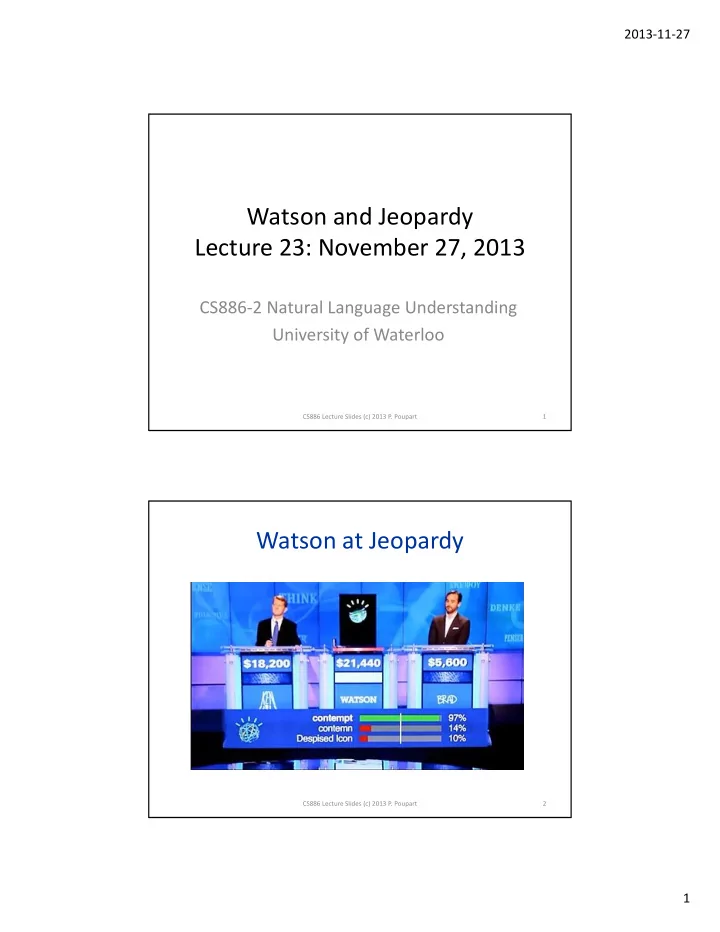
Watson at Jeopardy

CS886 Lecture Slides (c) 2013 P. Poupart 2

slide-2
SLIDE 2

2013‐11‐27 2

Jeopardy

  • Host reads a clue in the form of an answer

– But it is really a question

  • Contestants respond with a question

– But it is really an answer

  • Clue: When hit by electrons, a phosphor gives off

electromagnetic energy in this form.

– What form of electromagnetic energy does a phosphor give when hit by electrons?

  • Response: What is a photon?

– Photon

CS886 Lecture Slides (c) 2013 P. Poupart 3

QA Systems in 2007

  • Designed for TREC (not Jeopardy)
  • Two state of the art QA systems

– IBM: PIQUANT (Practical Intelligent QUestion ANswering Technology) – CMU: OpenEphyra (Open source QA framework)

CS886 Lecture Slides (c) 2013 P. Poupart 4

slide-3
SLIDE 3

2013‐11‐27 3

PIQUANT vs Jeopardy Champions

CS886 Lecture Slides (c) 2013 P. Poupart 5

Jeopardy vs TREC

Jeopardy

  • No specific corpus
  • No internet access
  • 1‐6 seconds per question
  • Complex questions
  • Confidence is critical

TREC

  • Corpus: 1 million docs
  • Internet access
  • 1 week: answer 500 quest.
  • Simple questions
  • Confidence not measured

CS886 Lecture Slides (c) 2013 P. Poupart 6

slide-4
SLIDE 4

2013‐11‐27 4

DeepQA Architecture

CS886 Lecture Slides (c) 2013 P. Poupart 7

Key Aspects

  • 1. Ensemble framework

– Multiple techniques for each component – Combine/rank hypotheses produced by each technique

  • 2. Pervasive confidence measures

– All algorithms produce a hypothesis and a score

CS886 Lecture Slides (c) 2013 P. Poupart 8

slide-5
SLIDE 5

2013‐11‐27 5

Content Acquisition

  • No set corpus and no internet access
  • Acquisition of relevant content

– Manual and automated steps – encyclopedias, dictionaries, thesauri, newswire articles, literary works – Freebase, WordNet, DBPedia, etc. – Passages of some web pages

CS886 Lecture Slides (c) 2013 P. Poupart 9

Question Analysis

  • Compute shallow parses, deep parses, logical forms,

semantic role labels, coreference, relations, named entities

  • Question Classification:

– puzzle question, math question, definition question, named entity, lexical answer type detection

CS886 Lecture Slides (c) 2013 P. Poupart 10

slide-6
SLIDE 6

2013‐11‐27 6

Lexical Answer Type

  • When hit by electrons, a phosphor gives off

electromagnetic energy in this form.

– Answer type:

  • This title character was the crusty and tough city

editor of the Los Angeles Tribune

– Answer type:

CS886 Lecture Slides (c) 2013 P. Poupart 11

Hypothesis Generation

  • Generate candidate hypotheses from content

sources

  • text search engines with different approaches
  • document search as well as passage search
  • knowledge base search
  • named entity recognition
  • Focus on recall: generate lots of possible hypotheses

CS886 Lecture Slides (c) 2013 P. Poupart 12

slide-7
SLIDE 7

2013‐11‐27 7

Hypothesis scoring

  • Focus on precision: filter and rank hypotheses
  • Many scoring techniques to verify different

dimensions

– Taxonomic, Geospatial (location), Temporal, Source Reliability, Gender, Name Consistency, Relational, Passage Support, Theory Consistency

CS886 Lecture Slides (c) 2013 P. Poupart 13

Example

  • Chile shares its longest land border with this country.

CS886 Lecture Slides (c) 2013 P. Poupart 14

slide-8
SLIDE 8

2013‐11‐27 8

Ranking

  • Combine scores to rank hypotheses

– Supervised learning – Ensemble and hierarchical models

CS886 Lecture Slides (c) 2013 P. Poupart 15

Improvements

CS886 Lecture Slides (c) 2013 P. Poupart 16