Watershed-Based Restoration and Salmon Recovery in Tukwila Local - - PowerPoint PPT Presentation

watershed based restoration and salmon
SMART_READER_LITE
LIVE PREVIEW

Watershed-Based Restoration and Salmon Recovery in Tukwila Local - - PowerPoint PPT Presentation

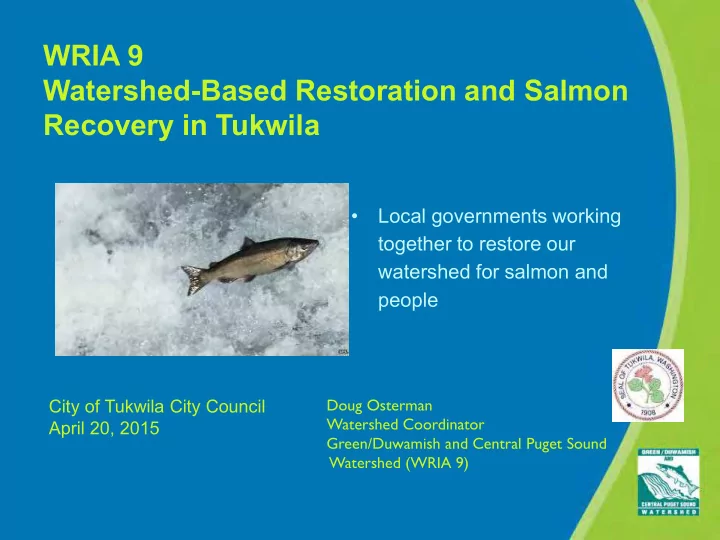
WRIA 9 Watershed-Based Restoration and Salmon Recovery in Tukwila Local governments working together to restore our watershed for salmon and people Doug Osterman City of Tukwila City Council Watershed Coordinator April 20, 2015


slide-1
SLIDE 1

WRIA 9 Watershed-Based Restoration and Salmon Recovery in Tukwila

  • Local governments working

together to restore our watershed for salmon and people

City of Tukwila City Council April 20, 2015

Doug Osterman Watershed Coordinator Green/Duwamish and Central Puget Sound Watershed (WRIA 9)

slide-2
SLIDE 2

Purpose and Outline

Purpose:

  • Update Council on salmon recovery progress at 10-year mark
  • f recovery plan implementation
  • Provide context for Tukwila’s consideration of renewed 2016-

2025 interlocal agreement I. Watershed geography II. Salmon recovery timeline III. Watershed-based recovery plans IV. Governance/leadership V. Funding VI. Accomplishments

  • VII. Tukwila priorities
  • VIII. Interlocal agreement renewal next steps
slide-3
SLIDE 3

What’s a WRIA?

  • Water Resource

Inventory Area

  • WRIA 9 is:

Green/Duwamish Central Puget Sound Watershed

  • One of the most

urban and populated watersheds in the state

slide-4
SLIDE 4

Green/Duwamish & Central Puget Sound Watershed (WRIA 9)

slide-5
SLIDE 5

The Road to Recovery

1999 Chinook salmon listed as threatened 2001 Jurisdictions sign interlocal agreement (ILA) to recover salmon 2005 Watershed recovery plan completed – chapter of Puget Sound Salmon Recovery Plan 2006 Begin first 10 years of implementation 2007 Federal adoption of Puget Sound Recovery Plan ILA renewed 2015 First 10 years of implementation Initial ILA sunsets

slide-6
SLIDE 6

Salmon Recovery Plans: Watersheds as Part of Puget Sound

Approved 2005

WRIA 9 Plan

Approved 2007 Puget Sound Salmon Recovery Plan Approved 2008 (updated 2014) Action Agenda for Puget Sound Recovery

slide-7
SLIDE 7

Governance / Leadership: WRIA 9 Watershed Ecosystem Forum

  • Stakeholders representing:
  • 17 Local governments
  • Community and environmental organizations
  • Business
  • Port of Seattle
  • King Conservation District
  • Water and sewer districts
  • State and federal agencies
  • Citizens
  • Fostering strong regional collaboration and

governance

  • Leveraging individual jurisdiction dollars for

watershed benefits

slide-8
SLIDE 8

Role of the WRIA 9 Watershed Ecosystem Forum

  • Directing implementation

and funding

  • Providing policy direction
  • Educating and

engaging

  • Building capacity
slide-9
SLIDE 9

Integrating Other Efforts

  • Fish passage at Howard Hanson Dam and

Tacoma Diversion Dam

  • Hatchery & harvest management
  • Lower Green River System-Wide

Improvement Framework

  • Providing education and stewardship services

in partnership with Environmental Science Center, King Conservation District, Flood Control District, and community

  • rganizations.
  • Regional stormwater management
  • Riparian area stewardship and noxious

weed treatment

  • Puget Sound recovery
slide-10
SLIDE 10

Funding for Salmon Recovery

WRIA 9 grant rounds allocate $2.5 million annually

  • State and federal grants:
  • Salmon Recovery Funding Board
  • Puget Sound Acquisition and Restoration
  • EPA National Estuary Program – Puget Sound recovery
  • Local funding sources:
  • King Conservation District
  • Cooperative Watershed Management Grants

(through King County Flood Control District)

slide-11
SLIDE 11

Interlocal Agreement Funding

Local government partners share costs of coordination and implementation Cost share formula: jurisdiction area / population / assessed value Tukwila cost shares:

  • Total WRIA 9 2015 ILA costs = $411,961
  • Tukwila 2015 cost share = $11,762
slide-12
SLIDE 12

What have we accomplished?

WRIA 9

  • 918 acres protected through acquisition or

easement

  • 80 acres of riparian area planted
  • 1.2 miles of levees removed or set back
  • 57 acres of floodplain reconnected
  • 3,370 feet of marine shoreline restored
  • $137 million in grant funds leveraged by 2015
slide-13
SLIDE 13

Tukwila Projects

  • Chinook Wind and Duwamish Gardens

acquisition and rehabilitation: Creating shallow water habitat in the transition zone

  • North Winds Weir: Developed two acres of
  • ff-channel, shallow water, resting and

rearing habitat

  • Outstanding leadership from the Tukwila

City Council and Mayors

slide-14
SLIDE 14

What’s Next?

Renewing Interlocal Agreement and Memorandum of Understanding

  • September 2014 – April/May: Presentations to partner jurisdictions; ILA partners review

and provide feedback on drafts

  • April/May: Integrate feedback on draft ILA and MOU for approval by Watershed

Ecosystem Forum (WEF)

  • May: WEF-approved ILA distributed to jurisdictions
  • July 14: The 2015 Yellow Bus Tour – mark your calendar
  • July 31: Goal for jurisdictions to approve WRIA 9 ILA
  • December 31: Absolute final ILA approval deadline
slide-15
SLIDE 15

Ongoing Recovery

The future of salmon and watershed health is in the hands

  • f every community.

Salmon recovery faces numerous challenges:

  • Public support and political will
  • Adequate funding
  • Climate change and ocean conditions
  • Land use pressures

Local governments working together do make a difference!