Wastewater Management The The Case of UN-HABITAT and UNEP under - - PowerPoint PPT Presentation

wastewater management
SMART_READER_LITE
LIVE PREVIEW

Wastewater Management The The Case of UN-HABITAT and UNEP under - - PowerPoint PPT Presentation

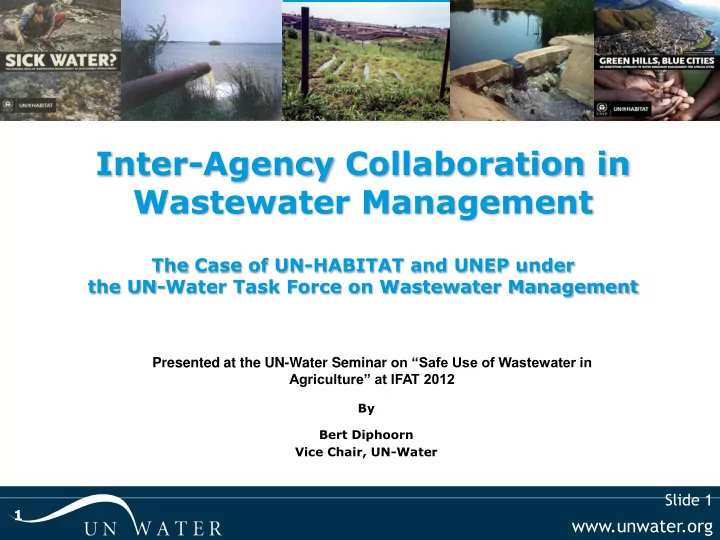
Inter-Agency Collaboration in Wastewater Management The The Case of UN-HABITAT and UNEP under the UN-Water Task Force on Wastewater Management Presented at the UN-Water Seminar on Safe Use of Wastewater in Agriculture at IFAT 2012 By


slide-1
SLIDE 1

www.unwater.org

Slide 1

1

The

Inter-Agency Collaboration in Wastewater Management

The Case of UN-HABITAT and UNEP under the UN-Water Task Force on Wastewater Management

By Bert Diphoorn Vice Chair, UN-Water

Presented at the UN-Water Seminar on “Safe Use of Wastewater in Agriculture” at IFAT 2012

slide-2
SLIDE 2

www.unwater.org

Slide 2

What is

  • UN-Water is the United Nations coordination

mechanism for all freshwater related issues

– E.g. water supply, water resources management, sanitation, wastewater, water related climate change adaptation, ecosystems, water related disasters

  • UN-Water is not an agency or organization
  • Activities are implemented by Members, Partners

and Programmes

slide-3
SLIDE 3

www.unwater.org

Slide 3

UN-Water strategic directions

1. Bring further coherence amongst its Members and Partners 2. Play a major role in ensuring that water is included in global policy debates 3. Support its Members and Partners at all levels, but with a particular focus on the country level

slide-4
SLIDE 4

www.unwater.org

Slide 4

28 UN-Water Members

slide-5
SLIDE 5

www.unwater.org

Slide 5

25 UN-Water Partners

Partners with Special Status

slide-6
SLIDE 6

www.unwater.org

Slide 6

3+1 UN-Water Programmes

  • World Water Assessment Programme (WWAP)

– UNESCO, Perugia

  • UN-Water Decade Programme on Advocacy

and Communications (UNW-DPAC)

– UNDESA, Zaragoza

  • UN-Water Decade Programme on Capacity

Development (UNW-DPC)

– UNU, Bonn

  • WHO/UNICEF Joint Monitoring Programme for

Water Supply and Sanitation (JMP)*

– WHO and UNICEF, Geneva and New York

* Affiliated to UN-Water

slide-7
SLIDE 7

www.unwater.org

Slide 7

Thematic Priority Areas and Task Forces

  • Thematic Priority Areas
  • Water and Climate Change (WMO)
  • Transboundary Waters (UNECE, UNESCO)
  • Water Quality (UNEP)
  • Drinking Water and Sanitation (UNICEF)
  • Task Forces
  • Wastewater Management (UNEP, UN

HABITAT)

  • Regional Level Coordination (UN ESCAP, UN

ESCWA)

  • Country Level Coordination (UNDP, UNW-DPC)
  • Water Resources Management (UNEP)
slide-8
SLIDE 8

www.unwater.org

Slide 8

8

2.6 billion people, including almost one billion children, in the developing world, don’t have access to sanitation facilities 1 out of 4 city residents worldwide, 794 million in total, lives without access to improved sanitation facilities

The global sanitation challenge

slide-9
SLIDE 9

www.unwater.org

Slide 9

9

Raising the profile of sanitation

The continuing high level advocacy by the United Nations and development partners has contributed significantly to raising the profile of sanitation issues

  • n the international development

agenda

However, little effort has been put in wastewater management – also called “the other side of sanitation”

The international community is determined to make a difference

slide-10
SLIDE 10

www.unwater.org

Slide 10

10

The statistics are stark!

  • Globally, 2 million tons of sewage,

industrial and agricultural waste is discharged into the world’s water ways everyday

  • Up to 90 % of all wastewater in

developing countries is discharged untreated directly into rivers, lakes or the oceans

  • An estimated 245,000 km2 of marine

ecosystems are affected with impacts on fisheries, livelihoods and the food chain

  • At least 1.8 million children under five

years-old die every year from water-related disease (1 in every 20 seconds)

slide-11
SLIDE 11

www.unwater.org

Slide 11

11

Strategy - Moving from waste to resource

Moving beyond the question of how to remove waste from homes and workplaces to issues revolving around what to do with it – wastewater treatment and conversion of waste into useful products such as fertilizers, briquettes or building materials

slide-12
SLIDE 12

www.unwater.org

Slide 12

12

Global picture of the current status

The Global Atlas (2008) was UN-HABITAT’s first effort to catalogue this problem on a worldwide scale The Atlas provides a global picture of the current status of information and

  • pportunities for wastewater

biosolids/sludge disposal and reuse, including trends and regional comparisons

slide-13
SLIDE 13

www.unwater.org

Slide 13

13

Wastewater management challenges

  • low prestige and recognition
  • weak policies and institutional

frameworks

  • lack of adequate funding and

political will

  • low public awareness
  • inadequate or lack of

wastewater treatment facilities Direct discharge of wastewater into surface and groundwater systems with little or no treatment is one of the most serious threats to water resources

slide-14
SLIDE 14

www.unwater.org

Slide 14

14

What is needed?

  • A revolution in wastewater management – in light of urbanization, climate change,

food-energy nexus

  • Better understanding of wastewater – a framework for classification and review of

sources and treatment of wastewater

  • Promoting multi-sectoral approaches– include other sectors in wastewater

management

  • Increasing political support and understanding of the value of wastewater

management

  • Supportive policies – legal and regulatory structures that promote wastewater

management – both technical and institutional

  • Continued research and demonstrations – discover new management solutions
  • Appropriate technology for cost-efficient excreta, wastewater sludge, and biosolids

management.

  • Innovative and sustained financing – main focus should be mobilizing national /local

resources to compliment external support.

  • Planning against future scenarios – the scale of what we are up against in terms of

future urban growth is not factored into planning.

slide-15
SLIDE 15

www.unwater.org

Slide 15

15

The UN Water Task Force on Wastewater management

  • Creates synergies from

independent work on wastewater by the respective agencies

  • Link with other contemporary

issues, such as climate change, food security and the reduction of poverty

  • Proactive and constructive

role in the formulation and implementation of wastewater management policies

slide-16
SLIDE 16

www.unwater.org

Slide 16

16

Task Force objectives

  • Highlight issues

surrounding wastewater management

  • Increase awareness by

governments

  • Strengthen UN-System

collaboration on activities related to wastewater management

slide-17
SLIDE 17

www.unwater.org

Slide 17

17

Achievements to date

  • Launch of the Rapid Assessment Report
  • n Wastewater Management (Sick Water)

during the 2010 World Water Day celebrations in Nairobi, Kenya

  • Launch of the Rapid Assessment Report
  • n Green Hills, Blue Cities during the

2011 World Water Day Celebrations in Cape Town, South Africa

  • Co-convening of the 2010 and 2011 World

Water Days

slide-18
SLIDE 18

www.unwater.org

Slide 18

18

Way Forward – A Collaborative Agenda on Sustainable Wastewater Management

  • A deliberate and targeted effort by UN-Water and its partners to revolutionize

wastewater management over the decade 2010 – 2020

  • It embodies both immediate and longer-term initiatives that directly address the

policy recommendations outlined in the 2010 “Sick Water?” report.

  • It aims to position sustainable wastewater management on the political and

development agenda at a global level.

  • It elaborates how the UN System, in partnership with governments, industry,

NGOs and International Financial Institutions, can:

  • Communicate the important and central role of sustainable wastewater

management in public health, environmental protection and economic development;

  • Expand the knowledge base on sustainable wastewater management;
  • Accelerate the formulation and implementation of sustainable wastewater

management policies; and

  • Improve the construction, maintenance and efficiency of site-appropriate

wastewater infrastructure.
slide-19
SLIDE 19

www.unwater.org

Slide 19

Thank you

www.unwater.org