Warren Snelling, U.S. Meat Animal Research June 19, 2019 Center - - PDF document

warren snelling u s meat animal research june 19 2019
SMART_READER_LITE
LIVE PREVIEW

Warren Snelling, U.S. Meat Animal Research June 19, 2019 Center - - PDF document

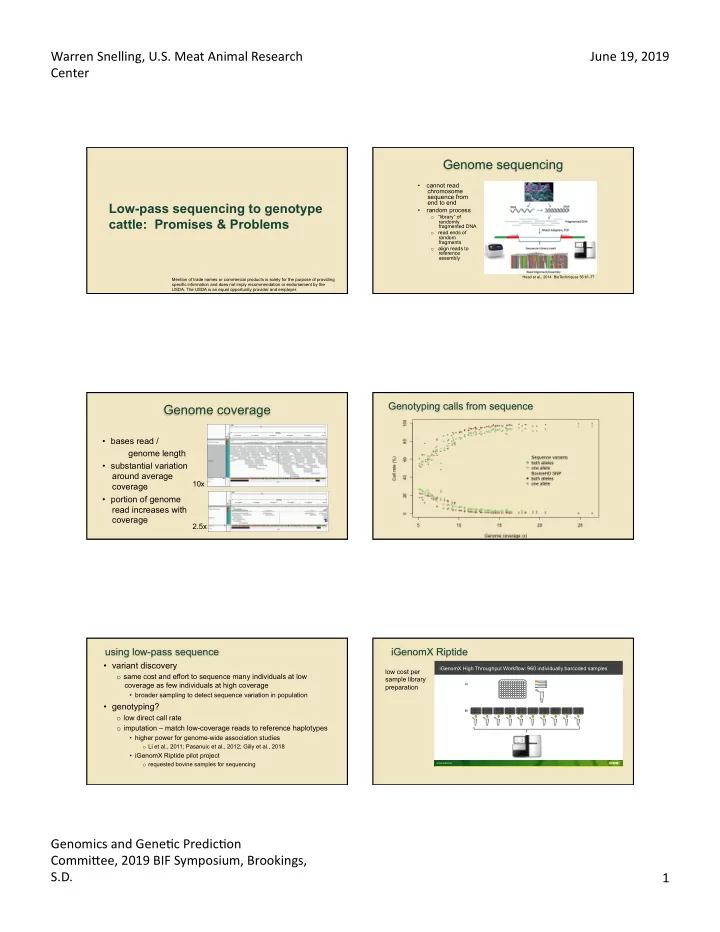
Warren Snelling, U.S. Meat Animal Research June 19, 2019 Center Genome sequencing cannot read chromosome sequence from end to end Low-pass sequencing to genotype random process library of o cattle: Promises & Problems


slide-1
SLIDE 1

Warren Snelling, U.S. Meat Animal Research Center June 19, 2019 Genomics and Gene@c Predic@on CommiBee, 2019 BIF Symposium, Brookings, S.D. 1

Low-pass sequencing to genotype cattle: Promises & Problems

Mention of trade names or commercial products is solely for the purpose of providing specific information and does not imply recommendation or endorsement by the

  • USDA. The USDA is an equal opportunity provider and employer.

Genome sequencing

  • cannot read

chromosome sequence from end to end

  • random process
  • “library” of

randomly fragmented DNA

  • read ends of

random fragments

  • align reads to

reference assembly

Head et al., 2014 BioTechniques 56:61-77

Genome coverage

10x 2.5x

  • bases read /

genome length

  • substantial variation

around average coverage

  • portion of genome

read increases with coverage

Genotyping calls from sequence using low-pass sequence

  • variant discovery
  • same cost and effort to sequence many individuals at low

coverage as few individuals at high coverage

  • broader sampling to detect sequence variation in population
  • genotyping?
  • low direct call rate
  • imputation – match low-coverage reads to reference haplotypes
  • higher power for genome-wide association studies
  • Li et al., 2011; Pasanuic et al., 2012; Gilly et al., 2018
  • iGenomX Riptide pilot project
  • requested bovine samples for sequencing

iGenomX Riptide

CONFIDENTIAL

iGenomX High Throughput Workflow: 960 individually barcoded samples

A) B)

low cost per sample library preparation

slide-2
SLIDE 2

Warren Snelling, U.S. Meat Animal Research Center June 19, 2019 Genomics and Gene@c Predic@on CommiBee, 2019 BIF Symposium, Brookings, S.D. 2

Riptide pilot project

CONFIDENTIAL

Datasets

1. Wheat (300 samples) 2. Corn (n=96): 4 Parents, 92 RILs 3. Bovine (n=54): 3 sire families, 9-29 samples per 4. Human (n=96): 32 Trios 5. Canine (n=96): 29 cases, 54 Controls (GWAS)

Riptide pilot project – bovine sequence

2.00 (ng/ uL)

DNA concentration Genome coverage

Riptide pilot project – bovine sequence

  • variant discovery
  • 13M variants detected
  • 11.4M match GPE bull sequence variants
  • 1.6M new
  • genotype calls
  • 6.9 ± 6.3 animals called / variant (1 to 53)
  • 1.7M ± 2.1M variants called / animal (14.5K to 11.4M)
  • genome coverage, variant detection, genotype calling

similar to previous low-coverage data sets

  • iGenomX Riptide worth considering for future GPE sequencing

Riptide pilot project – Gencove imputation

  • genotypes called for 48M variants
  • variants detected in reference panel of

publicly available bull sequence

  • predominantly

Holstein and Angus

  • many breeds

represented by small samples

Riptide pilot project – Gencove imputation

>1M interesting variants – UCD-ARS 1.2 annotation

  • 11K loss-of-function
  • 220K non-synonymous

SNP

  • 800K regulatory?

Riptide pilot project – Gencove imputation

Imputation from low coverage Imputation from low density chips

slide-3
SLIDE 3

Warren Snelling, U.S. Meat Animal Research Center June 19, 2019 Genomics and Gene@c Predic@on CommiBee, 2019 BIF Symposium, Brookings, S.D. 3

Riptide pilot project – Gencove imputation

  • 21 animals in first set imputed by Gencove
  • 2 sire-progeny pairs
  • zero parentage SNP exclusions between Charolais bull and

progeny (6 replicates)

  • 15 or 16 parentage SNP exclusions between Angus bull and

progeny (6 replicates)

  • 6 to 17 exclusions between Angus-sired progeny and other animals
  • zero exclusions between pair using chip genotypes

64% concordance between progeny Gencove & chip calls sample ID mixup? 92% to 99% concordance between replicated sire Gencove & chip

Riptide pilot project – Gencove imputation

Agreement between Gencove and HD+F250 genotypes

  • good agreement

possible

  • why not all samples?
  • sample ID
  • contamination
  • imputation reference

GPE sequence – Gencove imputation

GPE sequence downsampling

  • ne bull from each Cycle VII

breed, indicus-influenced composites, Brahman

  • downsampled to

0.4x, 0.6x, 0.8x, 1x, 2x

0.9 0.91 0.92 0.93 0.94 0.95 0.96 0.97 0.98 0.99 1 4000000 6000000 8000000 10000000 20000000 50000000

Concordance with HD + F250 calls

Brahman Santa Gertrudis Brangus Beefmaster Charolais Angus Red Angus Gelbvieh Hereford Limousin Simmental

GPE sequence – Gencove ancestry

Breed composition of downsampled bulls

GPE sequence – Gencove

  • Strong agreement between between GPE HD+F250 genotypes and

Gencove calls from downsampled British-breed bulls shows genotype accuracy possible for imputing from low-pass sequence

  • Weaker agreement for Continental and indicus-influenced breeds

suggests need for broader representation of those breeds in the reference panel

  • Unexpected ancestry suggests need for broader reference of all

breeds?

  • GPE sequence available
  • hybrid taurus – indicus genome?

GPE vs Riptide – Gencove imputation

  • Lower agreement between for Gencove calls from Riptide sequence

suggests sample contamination

  • physical contamination – low level sample mixing?
  • “index hopping” - sequence barcodes mis-assigned, reads for one barcode may

represent more than one sample

  • exacerbated by variation in DNA concentration
  • mitigated by up-front QC of input DNA, steps added to library prep
slide-4
SLIDE 4

Warren Snelling, U.S. Meat Animal Research Center June 19, 2019 Genomics and Gene@c Predic@on CommiBee, 2019 BIF Symposium, Brookings, S.D. 4

low-pass sequencing & imputation

  • Promises
  • genotype calls for comprehensive set of known sequence variants
  • 50K, HD, functional variant panels can be extracted
  • replace 50K with variants more likely to affect phenotypic variation
  • reduce dependence on LD between 50K & QTL
  • enable more accurate genomic predictions across breeds and crosses
  • lower cost than current chips
  • encourage complete genotyping of all seedstock calves
  • reduce bias in genetic evaluations due to selective genotyping
  • justify genotyping commercial calves
  • genomic predictions to support calf management and marketing decisions
  • heifer retention; genetic potential for growth, meat quality

low-pass sequencing & imputation

  • Problem
  • genotype call accuracy too low
  • addressable
  • imputation reference – broader sampling of all cattle
  • DNA QC and library preparation
  • tests with human samples underway
  • planning further bovine tests

Acknowledgments

Entire crew involved with GPE, tissue sampling & repository, sequencing, … (too many to name)

Paul Doran Keith Brown Joe Pickrell Jeremy Li Tomaz Berisa Stewart Bauck

Questions?