
SLIDE 1
Warmup
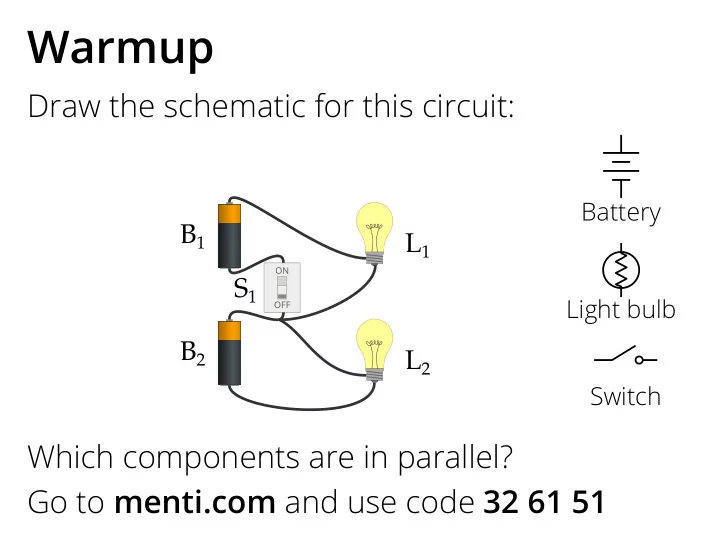
Draw the schematic for this circuit:
ON OFF
Which components are in parallel?
Battery Light bulb Switch
B1 B2 L1 L2 S1
Go to menti.com and use code 32 61 51
Warmup Draw the schematic for this circuit: Battery B 1 L 1 ON S 1 - - PowerPoint PPT Presentation
Warmup Draw the schematic for this circuit: Battery B 1 L 1 ON S 1 Light bulb OFF B 2 L 2 Switch Which components are in parallel? Go to menti.com and use code 32 61 51 ENGR 40M, Lecture 2: KVL, KCL, Ohm's law, and power Steven Bell 28
Draw the schematic for this circuit:
ON OFF
Which components are in parallel?
Battery Light bulb Switch
B1 B2 L1 L2 S1
Go to menti.com and use code 32 61 51
KVL, KCL, Ohm's law, and power
Steven Bell
28 June 2017
Fill out the lab section signup by Friday Lab 1 will be posted online tomorrow Sign up on Piazza! Go to a soldering lab, if you haven't already
By the end of class, you should be able to:
Explain Kirchoff's Voltage Law and Kirchoff's Current Law qualitatively and mathematically. Given a circuit of block elements with known voltages and/
using KVL/KCL. Use Ohm's law with KVL/KCL to find unknown voltages and currents. Calculate the power supplied or dissipated by a device.
quercettistore.com
3 marbles/sec
quercettistore.com
3 marbles/sec
2A 2A
Labels alone do not indicate direction. You must also consider the sign!
quercettistore.com
2.4 cm
(top) (bottom)
(top) (bottom)
quercettistore.com
2.4 cm
(top) (bottom)
(top) (bottom)
5V
(top) (bottom)
(top) (bottom)
Go to menti.com and use code 32 61 51 What is the voltage V1 and the current i1?
V1 1.5 V i1 0.2 A
Current that goes in must come out. It can't pile up anywhere or just disappear. 5 marbles 3 marbles 2 marbles
The sum of currents going into a node is zero.
i1 i2 i3 i6 i5 i4 Write all the KCL equations you can:
If you go around a complete loop, the total height must be zero (because you're back where you started).
The sum of voltages around any loop is zero.
The only tricky part is being consistent with the signs.
v1 v3 v2
v1 v2 v3 v6 v5 Write all the KVL equations you can: v7 v4
Find the voltage V2 and current i2:
3V
v2 i2
50 mA 120 mA
Challenge question: is the gray element absorbing or supplying electrical energy?
Find the voltage V2 and current i2
ON OFF
A) the one on the le lights up first. B) the one on the right lights up first. C) both light up at exactly the same time. D) this is a trick question; neither bulb lights up.
A B A B When the switch is closed (turned on):
The filament gets hot and glows because:
A) the current is used up in the light bulb, becoming heat. B) the voltage accelerates electrons and they collide with the metal, losing their energy as heat. C) charges pile up inside the filament, and the repulsion of their electric fields creates heat. D) this is a trick question; the light bulb doesn't light up.
What determines how much energy I get?
How much power does a light bulb use, if it is connected to 120V and draws 0.5 A?
Joules/sec is called a Watt, abbreviated W.
How much power does the source absorb?
120V
This is called the "passive sign convention".
When calculating power, current references should match voltage references: Then positive power is always power absorbed, and negative power is always power supplied.
Which of these are absorbing electrical power?
A B C D E F
1A
2V 2V 2V 1A 1A
2V
Watch the signs!
woodgears.ca
R is the resistance, measured in Ohms
For a resistor (and only a resistor):
Represented with the schematic symbol:
What is the current i?
Challenge: what would happen to the current if we added a second 1kΩ resistor in parallel?
How do you feel about this material?