Vocabulary HOMEWORK Requirements You will choose YOUR BEST 4 WORDS - - PowerPoint PPT Presentation

vocabulary homework requirements
SMART_READER_LITE
LIVE PREVIEW

Vocabulary HOMEWORK Requirements You will choose YOUR BEST 4 WORDS - - PowerPoint PPT Presentation

Vocabulary HOMEWORK Requirements You will choose YOUR BEST 4 WORDS (rating 10 or higher) per week from your independent reading or our class reading. At least 3 of those words must come from your current class reading or your current reading


slide-1
SLIDE 1

Vocabulary HOMEWORK Requirements

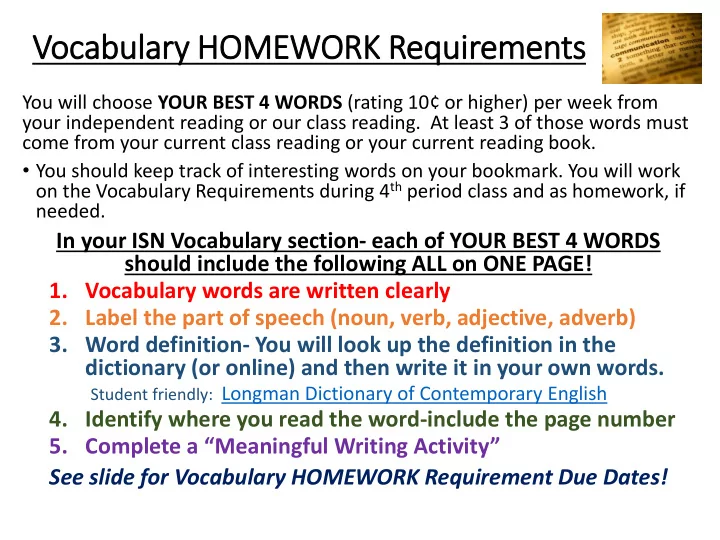
You will choose YOUR BEST 4 WORDS (rating 10¢ or higher) per week from your independent reading or our class reading. At least 3 of those words must come from your current class reading or your current reading book.

  • You should keep track of interesting words on your bookmark. You will work
  • n the Vocabulary Requirements during 4th period class and as homework, if

needed.

In your ISN Vocabulary section- each of YOUR BEST 4 WORDS should include the following ALL on ONE PAGE!

  • 1. Vocabulary words are written clearly
  • 2. Label the part of speech (noun, verb, adjective, adverb)
  • 3. Word definition- You will look up the definition in the

dictionary (or online) and then write it in your own words.

Student friendly: Longman Dictionary of Contemporary English

  • 4. Identify where you read the word-include the page number
  • 5. Complete a “Meaningful Writing Activity”

See slide for Vocabulary HOMEWORK Requirement Due Dates!

slide-2
SLIDE 2

YOU are responsible for completing YOUR BEST 4 WORDS Vocabulary HOMEWORK Requirements EACH WEEK by your 4th Period ELA Academic lab.

REQUIREMENTS DUE WEEKLY DURING ACADEMIC LAB

Example of Vocabulary DUE DATES

Period 1 ELA- Due Monday Academic Lab

START Collecting & Completing Requirements on Monday, August 8th Vocabulary HW Requirements DUE Monday, August 15th

Period 2 ELA- DUE Tuesday Academic Lab

START Collecting & Completing Requirements on Monday, August 8th Vocabulary HW Requirements DUE Tuesday, August 16th

Period 5 ELA- DUE Thursday Academic Lab

START Collecting & Completing Requirements on Monday, August 8th Vocabulary HW Requirements DUE Thursday, August 18th

Period 6 ELA- DUE Friday Academic Lab

START Collecting & Completing Requirements on Monday, August 8th Vocabulary HW Requirements DUE Friday, August 19th

slide-3
SLIDE 3

Vocabulary Collector Bookmark

Fr From you

  • ur Boo
  • okmark, you will

ill se sele lect YOUR BEST 4 4 WORDS.

  • Spell the words correctly
  • n your bookmark and

record the page number.

  • Focus in on words that—when you look

them up—have interesting meanings and have additional forms of the word and are rated 10¢ -50¢ in worth.

  • You shouldn’t be able to tell the word’s

meaning without re-reading the sentence

  • r using the dictionary.
  • AVOID collecting words that aren’t in the

dictionary; this means they are either foreign words or they are too old fashioned to be in the modern

  • dictionary. Salao is an example.
  • AVOID collecting words that are

specialized words for certain trades or

  • situations. Harpoon is an example.

Green handout with FOUR bookmarks lasting FOUR weeks

slide-4
SLIDE 4

Partner Rating of Collected Words

Before you select your BEST 4 WORDS, a peer will rate the worth of your words has either 1¢, 5¢, 10¢, 25¢ and 50¢.

YOUR BEST 4 WORDS need a rating of 10¢ OR HIGHER!

What kind of words to collect…

The older you grow, the more sophisticated your vocabulary should

  • become. Discuss with a partner the rationale for placing the following

words in the different columns of this “word classification system.”

1¢ words 5¢ words 10¢ words 25¢ words 50¢ words The a/an I is

  • f

in me was she big fun nice walk run hit dog tree cup delicate useless violet blame dislike polish teen-ager doctor unicorn idealistic perplexed convivial banter circumscribe daunt exuberance despot whimsy graupel hypermetropia crepescular nunatak

  • mbrophobia

philatelist autotroph acrolith quidnunc

slide-5
SLIDE 5

This Week’s Designated Meaningful Writing Activity

SHOWING SENTENCES

A creative "showing" sentence that makes use of the word in such a context that someone could guess the word's

  • meaning. A showing sentence has an

action verb, not a telling verb, like was, is, are, am, were, be, been.

slide-6
SLIDE 6

Voc

  • cabulary

ry HOMEWORK Req equir irement

Completion Poin ints

฀ ฀ ฀ ฀ =_____/4 Vocabulary words are written clearly ฀ ฀ ฀ ฀ =_____/4 Part of speech is included for each word ฀ ฀ ฀ ฀ =_____/4 Student-friendly definition included for each word ฀ ฀ ฀ ฀ =_____/4 Where the word was found is included for each word ฀ ฀ ฀ ฀ =_____/4 Meaningful Writing Activity is complete ฀ ฀ ฀ ฀ =_____/4 Work is neatly done

(Add all the points earned)

=__________________ / 24 Total points

Peer Review Comment, Compliment, and/or Concern: __________________________________________________________________________________ __________________________________________________________________________________ Reviewed by: ______________________________________________________________________

Name: ___________________________ ELA Period: ______________ Date: ____________________________

slide-7
SLIDE 7

Vocabulary Collectors

Like Selig, YOU will always be in search of new words this school year.

While reading for class, you’ll write down several vocabulary words every week on a bookmark. Once a week, you’ll select YOUR BEST 4 WORDS and add them to your ISN Vocabulary section and complete several

  • activities. Your words for your collection may come from
  • ther sources, but 3 words every week need to come from

the book you’re currently reading or what we’re reading as a class.

slide-8
SLIDE 8

Partner Rating of Collected Words

Before you select your BEST 4 WORDS, a peer will rate the worth of your words has either 1¢, 5¢, 10¢, 25¢ and 50¢.

YOUR BEST 4 WORDS need a rating of 10¢ OR HIGHER!

What kind of words to collect…

The older you grow, the more sophisticated your vocabulary should

  • become. Discuss with a partner the rationale for placing the following

words in the different columns of this “word classification system.”

1¢ words 5¢ words 10¢ words 25¢ words 50¢ words The a/an I is

  • f

in me was she big fun nice walk run hit dog tree cup delicate useless violet blame dislike polish teen-ager doctor unicorn idealistic perplexed convivial banter circumscribe daunt exuberance despot whimsy graupel hypermetropia crepescular nunatak

  • mbrophobia

philatelist autotroph acrolith quidnunc

slide-9
SLIDE 9

Looking for 25-cent words

25-cent words are those words you don’t know unless you look in the dictionary or reread the sentence to decipher meaning from context

  • clues. At least three of your four 25-cent words each week must come

from our reading.

25¢ words idealistic perplexed convivial banter circumscribe daunt exuberance despot whimsy If we read something in class together, you may collect 25-cent words from it. If you find it in a whole class novel, you may collect 25-cent words from it. If you find it in a book you’re reading for fun, you may collect 25-cent words from it. If you hear it or see it written somewhere, you may collect it.

slide-10
SLIDE 10

25-cent words

He was an old man who fished alone in a skiff in the Gulf Stream and he had gone eighty-four days now without taking a fish. In the first forty days a boy had been with him. But after forty days without a fish the boy’s parents had told him that the old man was now definitely and finally salao, which is the worst form of unlucky and the boy had gone at their orders in another boat which caught three good fish the first week. It made the boy sad to see the old man come in each day with his skiff empty and he always went down to help him carry either the coiled lines or the gaff and harpoon and the sail that was furled around the mast. The sail was patched with flour sacks and, furled; it looked like the flag of permanent defeat. The old man was thin and gaunt with deep wrinkles in the back of his neck. The brown blotches of the benevolent skin cancer the sun brings from its reflection on the tropic sea were on his cheeks. The blotches ran well down the sides of his face and his hands had the deep-creased scars from handling heavy fish on the cords. But none of these scars were fresh. They were as old as erosions in a fishless desert. Focus in on words

that—when you look them up—have interesting meanings and have additional forms of the word. Chances are with one

  • f these three words

you can’t tell me its meaning without re- reading the sentence

  • r using the
  • dictionary. Which
  • ne do you like best?

(Click here to open a printable version of this text.)

slide-11
SLIDE 11

Do not collect…

He was an old man who fished alone in a skiff in the Gulf Stream and he had gone eighty-four days now without taking a fish. In the first forty days a boy had been with him. But after forty days without a fish the boy’s parents had told him that the old man was now definitely and finally salao, which is the worst form of unlucky and the boy had gone at their orders in another boat which caught three good fish the first week. It made the boy sad to see the old man come in each day with his skiff empty and he always went down to help him carry either the coiled lines or the gaff and harpoon and the sail that was furled around the mast. The sail was patched with flour sacks and, furled; it looked like the flag of permanent defeat. The old man was thin and gaunt with deep wrinkles in the back of his neck. The brown blotches of the benevolent skin cancer the sun brings from its reflection on the tropic sea were on his cheeks. The blotches ran well down the sides of his face and his hands had the deep-creased scars from handling heavy fish on the cords. But none of these scars were fresh. They were as old as erosions in a fishless desert. Avoid collecting

words that aren’t in the dictionary; this means they are either foreign words

  • r they are too old

fashioned to be in the modern

  • dictionary. Salao is

an example. Also avoid collecting words that are specialized words for certain trades or

  • situations. Here are

three examples.

(Click here to open a printable version of this text.)

slide-12
SLIDE 12

Vocabulary Collector Bookmark

Fr From you

  • ur Boo
  • okmark, you will

ill se sele lect YOUR BEST 4 4 WORDS.

  • Spell the words correctly
  • n your bookmark and

record the page number.

  • Focus in on words that—when you look

them up—have interesting meanings and have additional forms of the word and are rated 10¢ -50¢ in worth.

  • You shouldn’t be able to tell the word’s

meaning without re-reading the sentence

  • r using the dictionary.
  • AVOID collecting words that aren’t in the

dictionary; this means they are either foreign words or they are too old fashioned to be in the modern

  • dictionary. Salao is an example.
  • AVOID collecting words that are

specialized words for certain trades or

  • situations. Harpoon is an example.

Green handout with FOUR bookmarks lasting FOUR weeks

slide-13
SLIDE 13

Parts of speech…

Practice your parts of speech while collecting. Teach yourself to identify (or guess intelligently) your vocabulary word’s part of speech before you look in the dictionary. Challenge yourself! How many can you get right this week?

These three parts of speech are the ones that will contribute the most if you are making the best collection. Nouns, verbs and adjectives are your “power words” for reading and writing. Adverbs are great too, but we’ll talk about them later; for now, these are the big three. The four other parts of speech—prepositions, pronouns, conjunctions, and interjections—these are your 1-cent and 5-cent words (under, into, him, we, and, when, wow, gosh), and you already know them.

slide-14
SLIDE 14

__ persons, places, things, and ideas all serve as nouns in our language

Some nouns are “touchable,” which means they’re concrete nouns because they have physical forms.

Can you think of some examples?

Some nouns—like thought and happiness—are bodiless, and that means they’re abstract nouns because they don’t have physical forms.

Can you think of some examples?

slide-15
SLIDE 15

__ persons, places, things, and ideas all serve as nouns in our language

Learn your noun suffixes. They are a smart tool.

Seeing that there’s a pattern to identifying a noun will help you discover new nouns and you’ll know when you’re using a noun, not a verb. adjective/verb + noun suffix = noun Replace + ment = replacement kind + ness = kindness ready + ness = readiness Creating nouns using this pattern will help you spot spelling patterns too. These are smart tools.

Noun Suffixes:

  • ment
  • ship
  • ness
  • ance/-ancy
  • ence/-ency
  • ion/-sion/-tion
  • ism
slide-16
SLIDE 16

Verb Tense Suffixes:

  • ed
  • ing
  • s/-es/-ies

That’s pretty much all of them. They should be easy to practice.

action words…

(like throw, laugh, and scream)

…and state of being words

(like was, is, and are)

Important: When collecting a verb, you’ll need to remove the tense suffix in order to look up your verb in the dictionary. If you find the verb quantifying, you’ll want to record it as just quantify on your bookmark. If you find the word ensconced, what do you think you’ll record/look up?

slide-17
SLIDE 17

Adjective Suffixes:

  • ous (as in sonorous)
  • al (as in pivotal)
  • y (as in muggy)
  • ive (as in elective)

Important: When defining an adjective,

  • ften the dictionary will do so using the

noun or verb form of the same word. For example… If you look up perilous, and it is defined as full of or involving peril, you can’t write that as your definition because peril is the same word as perilous, just in noun form. You need to look up the noun form— peril—and borrow words from that definition to replace the word peril in the definition you found.

perilous – (adj.) full of or involving danger

slide-18
SLIDE 18

Vocabulary HOMEWORK Requirements

You will choose YOUR BEST 4 WORDS (rating 10¢ or higher) per week from your independent reading or our class reading. At least 3 of those words must come from your current class reading or your current reading book.

  • You should keep track of interesting words on your bookmark. You will work
  • n the Vocabulary Requirements during 4th period class and as homework, if

needed.

In your ISN Vocabulary section- each of YOUR BEST 4 WORDS should include the following ALL on ONE PAGE!

  • 1. Vocabulary words are written clearly
  • 2. Label the part of speech (noun, verb, adjective, adverb)
  • 3. Word definition- You will look up the definition in the

dictionary (or online) and then write it in your own words.

Student friendly: Longman Dictionary of Contemporary English

  • 4. Identify where you read the word-include the page number
  • 5. Complete a “Meaningful Writing Activity”

See slide for Vocabulary HOMEWORK Requirement Due Dates!

slide-19
SLIDE 19

YOU are responsible for completing YOUR BEST 4 WORDS Vocabulary HOMEWORK Requirements EACH WEEK by your 4th Period ELA Academic lab.

REQUIREMENTS DUE WEEKLY DURING ACADEMIC LAB

Example of Vocabulary DUE DATES

Period 1 ELA- Due Monday Academic Lab

START Collecting & Completing Requirements on Monday, August 8th Vocabulary HW Requirements DUE Monday, August 15th

Period 2 ELA- DUE Tuesday Academic Lab

START Collecting & Completing Requirements on Monday, August 8th Vocabulary HW Requirements DUE Tuesday, August 16th

Period 5 ELA- DUE Thursday Academic Lab

START Collecting & Completing Requirements on Monday, August 8th Vocabulary HW Requirements DUE Thursday, August 18th

Period 6 ELA- DUE Friday Academic Lab

START Collecting & Completing Requirements on Monday, August 8th Vocabulary HW Requirements DUE Friday, August 19th

slide-20
SLIDE 20

Vocabulary Examples

From your bookmark words, you will select four “Vocabulary Words of the Week:” …and present them proudly each

  • week. These

are YOUR words!

bulwark

25

hummock

27

incandescence

28

speculation

32

benediction

34

subjugation

35

From your bookmark, choose four

  • f the more

useful words… Spell the words correctly on your bookmark and record the page number. I can’t tell you how many students will have to look back in their books to find the sentence where the vocabulary word sat because they carelessly misspelled it when they wrote it down.

slide-21
SLIDE 21

More Vocabulary Examples

Your Four Vocabulary Words of the Week. Like Selig from the book, take pride in the type of words you collect; choose words you know you should use more often. Like these students’ collection pages, take pride in the way you present your words of the week.

slide-22
SLIDE 22

Showing sentences

  • Mr. Stick Drawing
slide-23
SLIDE 23

This is an example

  • f a magazine cut-
  • ut. This student is

missing an EXPLANATION of why/how the image relates to the word.

slide-24
SLIDE 24

Meaningful Writing Ac Activities

You will be introduced to a new activity every few weeks.

  • A creative "showing" sentence that makes use of the word in

such a context that someone could guess the word's meaning. A showing sentence has an action verb, not a telling verb, like was, is, are, am, were, be, been.

  • A "Mr. Stick" drawing with a dialogue bubble or caption; the bubble or

caption must correctly use the word.

  • Three different-but-related words. This does not mean adding a prefix or

suffix to the word, like un- or -ing or -s. A different-but-related word means the vocabulary word shares a common root with three other

  • words. If my vocabulary word is fortitude, for example, then the related

words might be fortress, fortify, and forte.

  • Two synonyms and two antonyms for the vocabulary word.
  • A magazine cut-out, sticker, or taped-in clip art with an explanation of

why the image somehow relates to the vocabulary word.

  • An acrostic poem or acrostic sentence based on all the word's letters; the

poem/sentence must have something to do with the word's meaning.

  • A haiku or rhyming couplet that contains the word.
slide-25
SLIDE 25

This Week’s Designated Meaningful Writing Activity

SHOWING SENTENCES

A creative "showing" sentence that makes use of the word in such a context that someone could guess the word's

  • meaning. A showing sentence has an

action verb, not a telling verb, like was, is, are, am, were, be, been.

slide-26
SLIDE 26

Voc

  • cabulary

ry HOMEWORK Req equir irement

Completion Poin ints

฀ ฀ ฀ ฀ =_____/4 Vocabulary words are written clearly ฀ ฀ ฀ ฀ =_____/4 Part of speech is included for each word ฀ ฀ ฀ ฀ =_____/4 Student-friendly definition included for each word ฀ ฀ ฀ ฀ =_____/4 Where the word was found is included for each word ฀ ฀ ฀ ฀ =_____/4 Meaningful Writing Activity is complete ฀ ฀ ฀ ฀ =_____/4 Work is neatly done

(Add all the points earned)

=__________________ / 24 Total points

Peer Review Comment, Compliment, and/or Concern: __________________________________________________________________________________ __________________________________________________________________________________ Reviewed by: ______________________________________________________________________

Name: ___________________________ ELA Period: ______________ Date: ____________________________