Vitamin D and the Skeleton: Conflict of Interest Statement- Whats - - PowerPoint PPT Presentation

vitamin d and the skeleton
SMART_READER_LITE
LIVE PREVIEW

Vitamin D and the Skeleton: Conflict of Interest Statement- Whats - - PowerPoint PPT Presentation

7/11/2019 Vitamin D and the Skeleton: Conflict of Interest Statement- Whats New is Old Corporate NO STOCKS or EQUITY Editor- UpToDate, New England Journal of Medicine, and Endocrine Reviews Clifford J Rosen MD Speakers bureaus


slide-1
SLIDE 1

7/11/2019 1

Vitamin D and the Skeleton: What’s New is Old

Clifford J Rosen MD Maine Medical Center Research Institute rosenc@mmc.org

Conflict of Interest Statement- Corporate

  • NO STOCKS or EQUITY
  • Editor- UpToDate, New England Journal of

Medicine, and Endocrine Reviews

  • Speakers bureaus

– None – no consulting fees

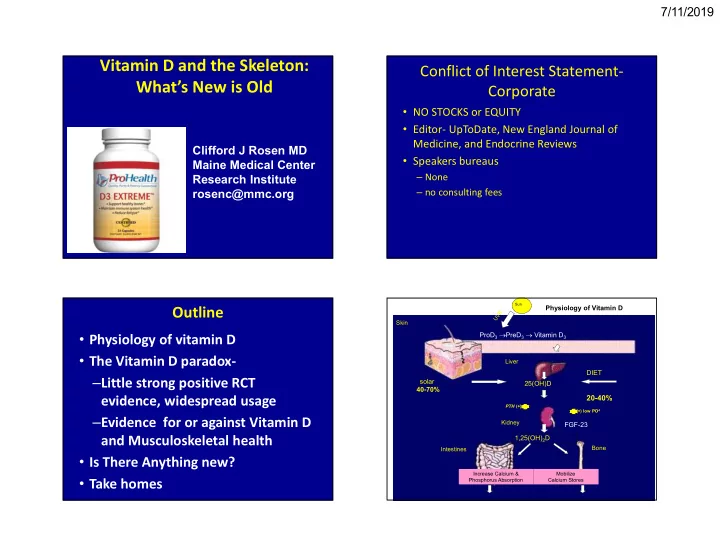
Outline

  • Physiology of vitamin D
  • The Vitamin D paradox-

–Little strong positive RCT evidence, widespread usage –Evidence for or against Vitamin D and Musculoskeletal health

  • Is There Anything new?
  • Take homes

Skin

Sun

ProD3 PreD3  Vitamin D3

Liver Kidney

25(OH)D 1,25(OH)2D

Intestines Bone

PTH (+)  (+) low PO4

Increase Calcium & Phosphorus Absorption Mobilize Calcium Stores

DIET

20-40%

40-70% solar Physiology of Vitamin D FGF-23

slide-2
SLIDE 2

7/11/2019 2

Hollis et al 2013

Revised

Vitamin D works through the VDR which is expressed in many tissues

Hormones circulating bound to albumin or circulating in a free form (collectively known as Bioavailable Vitamin D) are more readily available to enter cells than hormones bound to their traditional binding proteins Albumin

  • 1. ‘Bioavailable’ D is consistent with other hormones

Vitamin D Binding Protein- Re-emerging

Does DBP concentration vary by ethnicity ?

* Ethnic difference P<0.05 ** No ethnic difference Study Black White Assay Schwartz et al, 2014 152 ± 107 (SD) mg/L 301 ± 210 (SD)* mg/L R&D Powe et al, 2013 168 ± 3 (SE) 337 ± 5 (SE)* R&D Denburg et al, 2013 100 240* R&D Bhan et al, 2012 75 189* R&D Powe et al, 2011 144 ± 102 (SE) 248 ± 122 (SE)* R&D Winters et al, 2009 491 ± 128 (SD) 529 ± 202 (SD)** ALPCO Bouillon et al, 1977 329 ± 54 (Zaire/Congo) 329 ± 43 (Belgium)** RID Study Black White Assay Schwartz et al, 2014 152 ± 107 (SD) mg/L 301 ± 210 (SD)* mg/L R&D Powe et al, 2013 168 ± 3 (SE) 337 ± 5 (SE)* R&D Denburg et al, 2013 100 240* R&D Bhan et al, 2012 75 189* R&D Powe et al, 2011 144 ± 102 (SE) 248 ± 122 (SE)* R&D Study Black White Assay Powe et al, 2013 168 ± 3 (SE) 337 ± 5 (SE)* R&D African Americans White Americans Powe et al, 2013 NEJM Bouillon NEJM 2015

slide-3
SLIDE 3

7/11/2019 3

Summary-Part I

  • Vitamin D circulates in the 25OHD form

although 1,25OHD is present in smaller concentrations and is the active compound

  • 25OHD is bound to D binding protein (DBP)

and albumin

  • Dissociation of 25OHD from DBP may be a

determinant of cellular action

  • D binding protein assays are still being

validated, but it is likely that there are no differences in DBP by race

  • serum 25OHD is really low in AA

What Supports the Widespread Use

  • f Vitamin D Supplementation?
  • Evidence from clinical trials
  • Observational data
  • Expert opinion
  • Case Reports
  • Magical Thinking

So What is the evidence for Vitamin D and Fractures? There are now more than 2 meta-analyses published for every 1 RPCT of calcium/vitamin D and fracture risk

STEENBOCK 1920s

slide-4
SLIDE 4

7/11/2019 4

Vitamin D and Calcium Reduces Fracture Risk (800IU+1200 mg/d)

Tang Lancet 2007 USPSTF: No Risk Reduction for Calcium/ Vitamin D and Hip Fracture- 2014

2018 Met Analysis Ca/VitD for hip fractures

JCEM, March 2019 Total Fractures 0.90-1.04

Why the Difference? A Closer Look at the Randomized Controlled Trials

slide-5
SLIDE 5

7/11/2019 5

Placebo Ca 1000mg+400 IU D

Risk of Hip Fracture by Age Group in WHI: Age and Fall Interaction

Calcium and Vitamin D with hormone therapy reduces hip fractures by nearly 50%! But Calcium and Vitamin D alone do not reduce hip fracture risk JAMA Int Med 2015 100,000/mo 800 IU/d Placebo Target to > 30 ng/ml serum 25OHD- 21 ng/ml at baseline:

slide-6
SLIDE 6

7/11/2019 6

Bone Mineral Density Unchanged

But, is there a place for targeted vitamin D therapy?

Chapuy et al NEJM 1992

  • 1200 mg Ca + 800 IU Vitamin D
  • Nursing home patients (n=1600)
  • RPCT-
  • 33% reduction in hip fractures

800 IU per day Vitamin D

slide-7
SLIDE 7

7/11/2019 7

Why Might Vitamin D Supplementation Protect Against Fractures in the Elderly?

Micro Archictectural Changes in the Skeleton with Low Vitamin D SciTransl 2013

Primel Study of 1200 Subjects

Osteomalacia in some subjects with low Vit D

slide-8
SLIDE 8

7/11/2019 8

Cortical Porosity is increased in D Deficiency as is Haversian Canal Diameter and Osteocyte Lacunae Volume

Osteomalacia and Cortical Porosity Are Associated with Micro Cracks and Propagation in Severe Vit D Deficiency

Secondary Hyperparathyroidism: A Case for Vit D prevention of fractures?

Summary-Part II

  • Vitamin D promotes calcium absorption in the

gut

  • Vitamin D binding protein is important in

carrying 25OHD and is genetically determined

  • Vitamin D supplementation with calcium may

reduce hip fracture risk but only in a subgroup

  • f individuals, likely those who are deficient
  • Vitamin D is important for prevention of

rickets in susceptible populations

slide-9
SLIDE 9

7/11/2019 9

So what’s wrong with taking more vitamin D?

JAMA 2010 303 1815-25 Dose was single annual dose of 500,000 IU (daily equivalent IF/365 = 1370 IU; Sanders et al , 2010

High Dose Vitamin D increases serum levels of 25OHD levels in 75-125 nmol range

90 nmol/l

slide-10
SLIDE 10

7/11/2019 10

Prevalence of Vitamin D Levels from Commerical Lab Mayo’s Experience

30 60 90

J u l 6 S e p 6 N

  • v

6 J a n 7 M a r 7 M a y 7 J u l 7 S e p 7 N

  • v

7 J a n 8 M a r 8 M a y 8 J u l 8 S e p 8 N

  • v

8 J a n 9 M a r 9 M a y 9 J u l 9 S e p 9 N

  • v

9 J a n 1 M a r 1 M a y 1 J u l 1 S e p 1 N

  • v

1 J a n 1 1

Month Patients (%)

25-80 10-24 <10 >80

5 year pattern has changed very little

Is there truly a vitamin D epidemic?

How should we use vitamin D supplementation in management

  • f osteoporosis?

Oral Dosing of Vitamin D Depends on Baseline Levels of 25OHD

10,000 IU D/d 5,000 IU D/d 1,000 IU/d IU/d *Heaney et al., AJCN 2003

slide-11
SLIDE 11

7/11/2019 11

  • DR. MICHAEL HOLICK

The Leading Authority on Vitamin D His new book, The Vitamin D Solution is now available!

Vitamin D upcoming trials

slide-12
SLIDE 12

7/11/2019 12

2423 randomized 1211 Assigned to 4,000 IU of vitamin D daily 1211 Received vitamin D as randomized

D2D Flow of participants

45

1212 Assigned to placebo daily 1211 Received placebo as randomized 3 Had no contact after randomization 5 Died 34 Withdrew 1 Withdrawn administratively 5 Had no contact after randomization 5 Died 28 Withdrew Withdrawn administratively 1211 Included in the intention-to-treat analysis 1212 Included in the intention-to-treat analysis 1201 Completed at least one follow-up encounter (99.2%) 1199 Completed at least one follow-up encounter (98.9%) 1131 Met primary outcome, died or completed last follow-up encounter (93.3%) 1130 Met primary outcome, died or completed last follow-up encounter (93.2%)

  • No. at risk

6m 12 m 18 m 24 m 30 m 36 m 42 m 48 m 54 m Vitamin D 4000 IU/d 121 1 117 1 108 9 100 1 812 625 466 283 141 21 Placebo 121 2 117 1 109 1 975 779 577 419 258 121 13

Hazard ratio 0.88 (95%CI 0.75 to 1.04); p = 0.12

Cumulative survival rates free of diabetes

0.38 (0.18, 0.80) 0.92 (0.78, 1.08)

Hazard Ratio

Subgroup Serum 25-hydroxyvitamin D < 20 ng/mL >= 20 ng/mL Race White Black / African American Other Glycemic risk by pre-diabetes criteria Met all three criteria Met two criteria Body Mass Index, kg/m2 < 30 >= 30 Glycemic risk Met 2hPG criterion Met FPG/A1c only Ethnicity Hispanic Non-Hispanic Sex Women Men Waist circumference < median of 104.2 cm >= median of 104.2 cm Age, years < median of 60.9 >= median of 60.9 Geographic location Above 37o N latitude Below 37o N latitude Calcium intake from supplements, mg/day < median of no intake >= median of any intake Vitamin D n/N 73/276 220/935 207/810 64/301 22/100 143/427 150/784 82/435 211/776 191/604 102/607 36/120 257/1091 131/541 162/670 127/620 166/591 158/622 135/589 205/892 88/319 198/826 95/385 Placebo n/N 66/249 256/962 227/806 69/315 27/91 163/429 160/783 105/429 218/783 215/635 108/577 27/105 296/1107 127/545 196/667 135/585 188/627 153/587 170/625 235/898 88/314 216/793 107/419 0.5 0.75 1 1.25 1.5

Subgroup analysis

D< 12 ng/ml all subjects

Take Home Messages

  • Vitamin D is a hormone that promotes calcium

absorption in the gut

  • Impaired calcium absorption due to low

vitamin D reduces mineralization and leads to changes in bone microstructure

  • There is minimal RPCT data to support

calcium/ vitamin D supplementation to prevent most chronic disease-except in the frail with OM, high risk of falls, or low 25OHD

  • Basic studies of vitamin D are essential to fully

understand its actions
slide-13
SLIDE 13

7/11/2019 13

Conclusions

  • Vitamin D supplementation for the general

population is not warranted

  • Vitamin D + calcium probably does not

prevent fractures, except in a subgroup of elderly institutionalized individuals

  • Vitamin D supplemetation does not prevent

cardiovascular disease nor Type 2 diabetes