Vision Vision and interprets the input form our senses into - - PDF document

vision vision
SMART_READER_LITE
LIVE PREVIEW

Vision Vision and interprets the input form our senses into - - PDF document

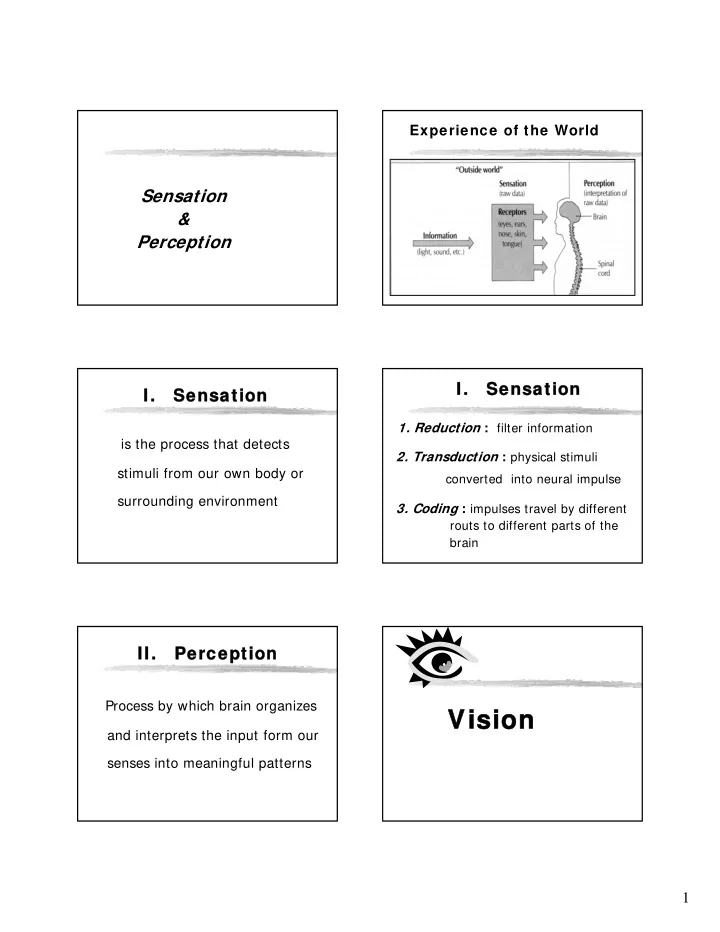
Experience of the World Sensation & Perception I. Sensation I. Sensation I. Sensation I. Sensation 1. Reduction : filter information is the process that detects 2. Transduction : physical stimuli stimuli from our own body or


slide-1
SLIDE 1

1

Sensation & Perception

Experience of the World

  • I. Sensation
  • I. Sensation

is the process that detects stimuli from our own body or surrounding environment

  • I. Sensation
  • I. Sensation
  • 1. Reduction : filter information
  • 2. Transduction : physical stimuli

converted into neural impulse

  • 3. Coding : impulses travel by different

routs to different parts of the brain

II

  • II. Perception

. Perception

Process by which brain organizes and interprets the input form our senses into meaningful patterns

Vision Vision

slide-2
SLIDE 2

2

Light Waves Light Waves

Electromagnetic energy 3 wave lengths

  • short
  • middle
  • long

Retina:

Photoreceptors: extremely sensitive to light

Retina

Cones (~ 5ml) near center of retina (fovea) fine detail and color vision daylight or well-lit conditions Rods (~ 120ml) peripheral retina detect black, white and gray twilight or low light

Transduction Transduction

Visual Pathw ay Visual Pathw ay

  • Light
  • Eye
  • Retina
  • Optic nerve
  • Blind spot
  • Optic chiasm
  • Thalamus
  • Visual cortex
  • Association area
slide-3
SLIDE 3

3

Color Vision: Trichromatic Theory

3 types of cones that are sensitive to a particular range of light wave-length:

  • Short: Blue
  • Medium: Green
  • Long: Red

Color Vision: The Opponent-Process Theory

  • 2. The Opponent-Process Theory

We code color by using 2 complimentary pairs

  • f cones that work in

pairs:

  • Red/Green
  • Blue/Green+ Red

Color-Deficient Vision

People who suffer red-green blindness have trouble perceiving the number within the design

Sense of Touch: Sense of Touch: Pain

Experience of pain = Sensation + Emotion Placebo effect Nocebo effect

slide-4
SLIDE 4

4

Gate-Control Theory

(Melzack & Wall): impulses compete for entrance into the brain

Mechanism of Decreasing Pain Neurotransmitters:

  • 1. Substance P :

“read” the pain

  • 2. Endorphins :

inhibit the release

  • f substance P