Vision to Action Direct attention to relevant activities Affect - - PDF document

vision to action
SMART_READER_LITE
LIVE PREVIEW

Vision to Action Direct attention to relevant activities Affect - - PDF document

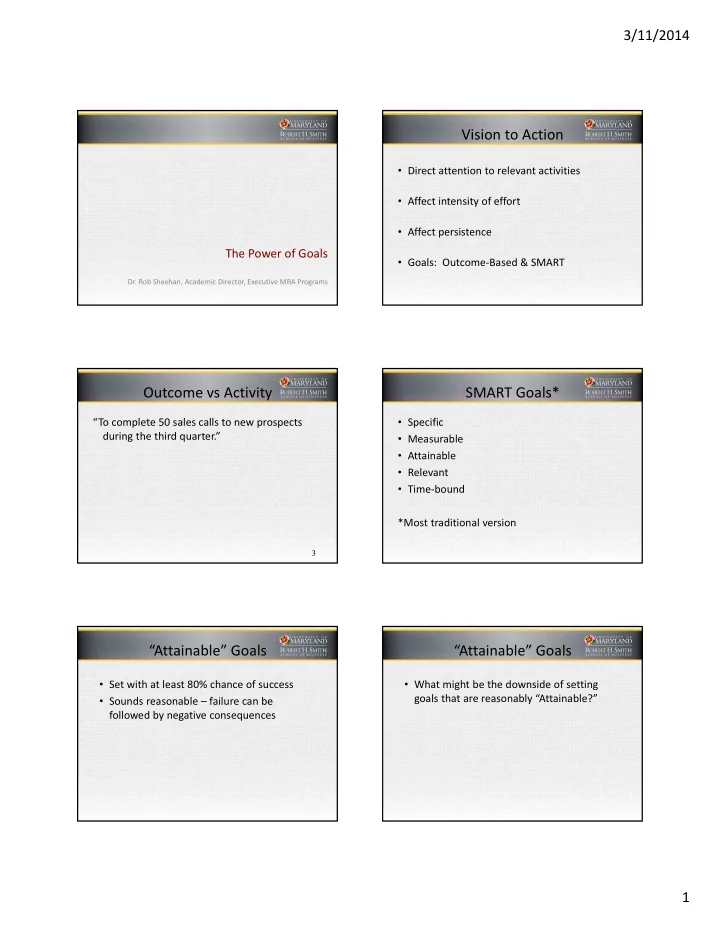
3/11/2014 Vision to Action Direct attention to relevant activities Affect intensity of effort Affect persistence The Power of Goals Goals: Outcome Based & SMART Dr. Rob Sheehan, Academic Director, Executive MBA Programs


slide-1
SLIDE 1

3/11/2014 1

The Power of Goals

  • Dr. Rob Sheehan, Academic Director, Executive MBA Programs

Vision to Action

  • Direct attention to relevant activities
  • Affect intensity of effort
  • Affect persistence
  • Goals: Outcome‐Based & SMART

Outcome vs Activity

“To complete 50 sales calls to new prospects during the third quarter.”

3

SMART Goals*

  • Specific
  • Measurable
  • Attainable
  • Relevant
  • Time‐bound

*Most traditional version

“Attainable” Goals

  • Set with at least 80% chance of success
  • Sounds reasonable – failure can be

followed by negative consequences

“Attainable” Goals

  • What might be the downside of setting

goals that are reasonably “Attainable?”

slide-2
SLIDE 2

3/11/2014 2

“Attainable” Goals?

  • What might be the downside of setting

goals that are reasonably “Attainable?”

  • Goal research:

– The more difficult the goal, the higher the level

  • f performance.

The Performance Paradox

SMART Goals*

  • Specific
  • Measurable
  • Aggressive
  • Relevant
  • Time‐bound

*Doug Smith version

Aggressive

  • Allows you to maximize performance, but with

a higher chance of failure

  • If you are a boss & you want to use Aggressive

goals, check your rewards system. If you punish failure, people will not want to be

  • aggressive. Reward “performance” vs. goal

accomplishment

SMART Goals

ATTAINABLE vs. AGGRESSIVE Which SMART formula is best?

11

Attainable Goals

  • Best when the priority is to accurately

predict performance of the current system

  • Good for generating “quick wins”
  • Good for Learning Goals in new domains
  • Good for a team that needs to build

confidence

slide-3
SLIDE 3

3/11/2014 3

Aggressive Goals

  • Best when the priority is to maximize the

performance of the current system

  • Maximize intensity of effort
  • Maximize persistence
  • Performance vs Goal Attainment must be

rewarded

Think of a Goal Think of a goal you are working on right now which meets the SMART criteria. A New A for SMART*

  • Specific
  • Measurable
  • *Almost Impossible
  • Relevant
  • Time‐bound

*Rob Sheehan version

Great Leaders “Great Leaders Have a Healthy Disregard for the Impossible” Impossible . . . . .

“Space travel is utter bilge.”

‐Sir Richard Van Der Riet Wooley, The Astronomer Royal, 1956

Impossible . . . . .

“While theoretically and technically television may be feasible, commercially and financially I consider it an impossibility.”

‐Lee Deforest, American Inventor (1873‐1961)

slide-4
SLIDE 4

3/11/2014 4

Impossible . . . . .

“Well informed people know it is impossible to transmit the voice over wires and that were it possible to do so, the thing would be of no practical value.”

‐The Boston Post, Editorial, 1865

Impossible . . . . .

“We must not be misled to our own detriment to assume that the untried machine can displace the proved and tried horse.”

‐Maj. Gen. John Kerr, U.S. Army (1878‐1955)

Impossible . . . . .

“Rail travel at high speeds is not possible because passengers, unable to breathe, would die of asphyxia.”

‐Dionysius Lardner, English Scientist (1793‐1859)

Bullet Train Thinking

  • It used to take more than six hours to travel by train

from Tokyo to Osaka. If the Japanese executives had said to their engineers: “I want you to reduce the time to six hours,” the engineers would have instinctively thought in terms of small improvements, perhaps in the way they boarded passengers and unloaded

  • baggage. But instead, the Japanese executives set out a

challenge to reduce the time of the journey to three and a half hours. Faced with such an “impossible” goal, the engineers and designers were forced to reexamine the most fundamental assumptions governing rail travel in Japan. The result of this reexamination was the bullet train. (Jack Welch)

Traditional Analytical Goals

“This is a forecast of the result we should be able to produce if we work hard at it.”

Almost Impossible Goals

“This is the very best result we can imagine possible (1% chance) and we have no idea how to make it happen.”

You can’t think outside of the box while you are standing in it!

slide-5
SLIDE 5

3/11/2014 5

Stretch Goals

  • You use stretch goals, they don’t use you.

They do not exist to dominate you and stress you out. They exist to give you something to shoot for, to have fun trying to see if you can make it.

Stretch Goals

  • Fully achieving a stretch goal is not the main

focus of your attention. You are interested in being creative, progress, and learning.

Moon Shot & Cancer

  • 1961: President Kennedy sets the goal to send

a man to the moon and return him safely by the end of the decade.

  • 1970: Congress passes a resolution to cure

cancer by 1976 as a fitting celebration for the bicentennial.

Stretch Goals

  • You need to create a “safe‐fail” situation with

a stretch goal. You can’t treat failure as an

  • issue. You have to play.

Safe Fail

  • “‘The fastest way to succeed, IBM’s Thomas Watson,

Sr., once said, ‘is to double your failure rate.’ In recent years, more executives have embraced this point of view, coming to understand that failure is a prerequisite to invention. A business cannot develop a breakthrough product or process if it is not willing to encourage risk‐taking and learn from subsequent mistakes.”

The Failure Tolerant Leader Harvard Business Review, 2002

29

slide-6
SLIDE 6

3/11/2014 6

Stretch Goals

  • You have to set your own boundaries on

resources you will use to achieve the goal— including the amount of time you spend on it. Make this all part of the “game.” Otherwise, you stress out and/or turn your 70 hour weeks into 90 hour weeks.

Pessimists & Optimists Unite Use “Flexible Optimism”

32

Stretch Goals

  • Since the prospects of failing at the stretch

goal are high and failure at some goals can have real life implications—when you set a stretch goal, ask yourself “Am I willing to live with the worst probable outcome?” If not, don’t set it that high.

Strategic Intent

"Creating stretch, a misfit between resources and aspirations, is the single most important task senior management faces.“ ‐Gary Hamel & C.K. Prahalad

The Wall Street Journal

“Stretch is a concept that would have produced smirks, if not laughter, in the GE

  • f three or four years ago, because it

essentially means using dreams to set business targets – with no real idea of how to get there . . . . If you do know how to get there then it is not a stretch target.”

‐ Jack Welch, March 8, 1994 35

Challenges

  • Everyone else operates on the forecasting

mindset so you have to be careful about with whom you share your stretch goals.

slide-7
SLIDE 7

3/11/2014 7

Challenges

  • You may fall back into the old mindset and get

stressed or feel bad if you fail. Watch for that.

Challenges

  • The stretch goal approach does not

guarantee you good creativity. It will unleash creativity, but some creative ideas will sound good and not work. You need to decide when to try it again or differently or try something else.

The biggest challenge is setting Almost Impossible Goals is overcoming the Fear of Failure that has been bred within us.

39

Failure

  • We need to transform our relationship with

failure in order to leverage the aspirational mind‐set and the Power of Almost Impossible Goals.

  • What is your relationship with failure?

Failure

  • “I am as worthless as the slugs who creep in

the crevices of the deepest, darkest parts of the ocean!”

Transform Your Relationship with Failure

“We Celebrate Noble Failure.”

slide-8
SLIDE 8

3/11/2014 8

Accomplishment:

Any result of positive Magnitude

Success:

Any accomplishment which meets or exceeds its intended result

Failure:

To fall short of an intended result

43

Fundraising Project

Goal Result 1988 $40,000 $48,000 1989 $25,000 $24,000 1990 $25,000 $17,000

Fundraising Project

Goal Result 1988 $40,000 $48,000 1989 $25,000 $24,000 1990 $25,000 $17,000 1991 $50,000

Fundraising Project

Goal Result 1988 $40,000 $48,000 1989 $25,000 $24,000 1990 $25,000 $17,000 1991 $50,000 $62,000

Fundraising Project

Goal Result 1988 $40,000 $48,000 1989 $25,000 $24,000 1990 $25,000 $17,000 1991 $50,000 $62,000 1992 $150,000

Fundraising Project

Goal Result 1988 $40,000 $48,000 1989 $25,000 $24,000 1990 $25,000 $17,000 1991 $50,000 $62,000 1992 $150,000 $143,000

slide-9
SLIDE 9

3/11/2014 9

LeaderShape

Number of Participants

500 1000 1500 2000 2500 1992 1993 1994 1995 1996 1997 1998 1999 2000 2001

10X Thinking

Larry Page lives by the gospel of 10x. Most companies would be happy to improve a product by 10 percent. Not the CEO and cofounder of Google. The way Page sees it, a 10 percent improvement means that you’re basically doing the same thing as everybody else. You probably won’t fail spectacularly, but you are guaranteed not to succeed wildly. That’s why Page expects his employees to create products and services that are 10 times better than the competition. Thousand‐percent improvement requires rethinking problems entirely, exploring the edges of what’s technically possible, and having a lot more fun in the

  • process. (Wired.com)

“A Healthy Disregard . . .”

Page thought big even when he was little—he has said he always wanted to be an inventor, not just to produce gadgetry but to change the

  • world. As an undergrad at the University of

Michigan, he found inspiration in a student leadership‐training program called LeaderShape, which preached “a healthy disregard for the impossible.” By the time he got to grad school at Stanford, it was a natural step for him to 10X his potential thesis idea—a tool to annotate web pages—into a search engine that transformed the web and the world.

Failure with Traditional Goals

“We messed up.”

Failure with Almost Impossible Goals

“Look at our results!” “What could we have done differently?” “I’m glad we went for it, but I wish we had accomplished it 100%”

Creative Tension

“Mastery of creative tension transforms the way

  • ne views ‘failure.’ Failure is, simply, a

shortfall, evidence of the gap between vision and current reality. Failure is an opportunity for learning . . . Failures are not about our unworthiness or powerlessness.”

‐Peter Senge, The Fifth Discipline

slide-10
SLIDE 10

3/11/2014 10

Failure & Innovation

“Failure is just a part of the culture of

  • innovation. Accept it and grow stronger.

‐Albert Yu, SVP, Intel Corp

“The only real stumbling block is fear

  • f failure. In cooking, you’ve got to

have a what‐the‐hell attitude.”

‐Julia Child

Getting Smarter Faster

“ . . . there’s no substitute for getting smarter

  • faster. And the way you get smarter is to

screw around vigorously. Try stuff. See what

  • works. See what fails miserably. Learn. Rinse.

Repeat.” ‐Tom Peters, Fast Company, December 2001

Goals Recap

  • Attainable Goals: 80% attainable; good if the

priority is high predictability

  • Aggressive Goals: 35% attainable; good for

improving performance

  • Almost Impossible: 1% attainable; good for

innovation and breakthrough performance

Thanks!

  • Dr. Rob Sheehan
  • Academic Director, Executive MBA Programs
  • RSheehan@rhsmith.umd.edu
  • 301‐523‐1864