VISABIO : French Biometric Visa System 1 CONTENTS Lessons learnt - - PowerPoint PPT Presentation

visabio french biometric visa system
SMART_READER_LITE
LIVE PREVIEW

VISABIO : French Biometric Visa System 1 CONTENTS Lessons learnt - - PowerPoint PPT Presentation

VISABIO : French Biometric Visa System 1 CONTENTS Lessons learnt from the BIODEV 1 Pilot Project The VISABIO project : Perimeter, schedule, challenges Toward the future : connecting to the VIS project and automates at the border,


slide-1
SLIDE 1

1

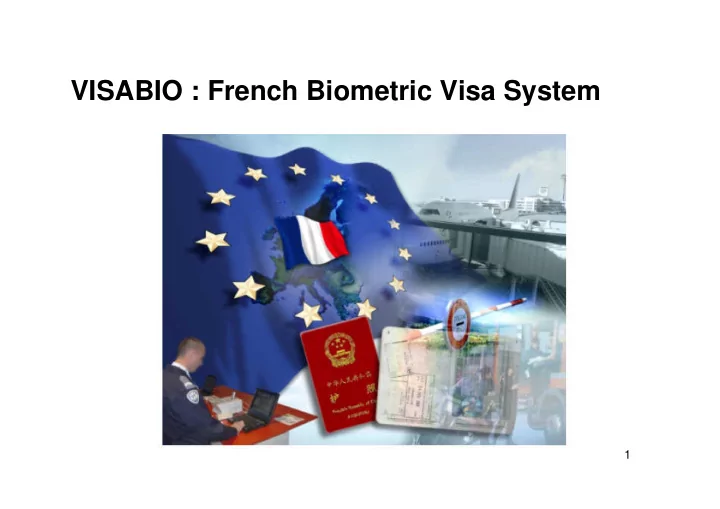
VISABIO : French Biometric Visa System

slide-2
SLIDE 2

2

CONTENTS

  • Lessons learnt from the BIODEV 1 Pilot Project
  • The VISABIO project : Perimeter, schedule, challenges
  • Toward the future : connecting to the VIS project and

automates at the border, how to reduce the error rate of biometric comparison

slide-3
SLIDE 3

3

Lessons learnt from the BIODEV 1 Pilot Project

  • A few facts :

– First biometric visa issued and controlled in march 2005 – More than 550,000 travellers enrolled – 57 consulates equipped – Controls performed daily

slide-4
SLIDE 4

4

Consulates : fingerprint capture

French consulate of France in Minsk (Belarus) French consulate of France in Bamako (Mali)

slide-5
SLIDE 5

5

Lessons learnt from the BIODEV 1 Pilot Project

  • Good acceptability by the travellers and the

foreign authorities

  • Constraint of a change management structure for

the Border police agents

  • Feasability of the data capture in the consulates
  • Criticity of the points of entry: fluidity is not only a

key issue, but the main one

slide-6
SLIDE 6

6

The VISABIO project

  • VISABIO is first of all, a national system to process and

store the biometric visas, including an AFIS

  • Its main purposes are:

– Fight against illegal immigration – Fight against terrorism – Preparation of the connection to the european VIS system

  • Five French ministries are involved

– Immigration and integration – Foreign affairs – Interior – Defence/ gendarmerie – Finance/customs

slide-7
SLIDE 7

7

The VISABIO project: main features

  • AFIS 15M records
  • More than 2,000 capture stations and 5,000 workstations
  • Integrated border control workstation
  • Simulator for all staff in charge of biometric control
  • High level of data protection (privacy)
  • Integration within the technical environment
  • VIS compatible interface design
slide-8
SLIDE 8

8

The VISABIO project: schedule

  • Spring 2006: call for tender
  • November 2006: contract notified to SAGEM security
  • 2007: functional and technical specifications
  • T1 2008: tests on the central system, migration of BIODEV

data and specification of new generation integrated border control and territory control

  • T2 2008: central system operational
  • T3 2008: new generation of border control stations
  • T4 2008: upgrade of the Foreign Affairs system and

connection to the VIS (with NS-VIS and VIS simulator)

  • June 2009: connecting VIS
slide-9
SLIDE 9

9

The VISABIO project: general architecture

slide-10
SLIDE 10

10

The VISABIO project: human factors

  • A view of the of the border control station screen, able to

process all types of travel documents

slide-11
SLIDE 11

11

The VISABIO project: a modular approach

slide-12
SLIDE 12

12

Toward the future: connection to e-gates

  • Growing traffic and peaks (e.g. Airbus A380)
  • E-Gates allow a better management of the

Police resource and reduce the average time to cross the border

  • Project « PARAFES »: equipment of main

airports and harbours with automatic gates for UE residents

slide-13
SLIDE 13

13

Toward the future: multimodal biometrics to reduce the error rate of fingerprint verification

  • Observation: 1,5% of people controlled at the first border

line are not authenticated and must be controlled at the second border line for a strong authentication [10: 10] or an identification:

– Among these persons, some have been rejected wrongly. A second biometric data [1:1] should confirm or not the no hit.

  • When a visa applicant is stored in the system, the AFIS

controls if this applicant has a unique identity:

– If there is a hit with another identity, a comparison with a second biometric data [1:1 would confirm the hit and avoid a manual expertise.