Virtualizzazione Corso di Sistemi Distribuiti e Cloud Computing - - PDF document

virtualizzazione
SMART_READER_LITE
LIVE PREVIEW

Virtualizzazione Corso di Sistemi Distribuiti e Cloud Computing - - PDF document

Macroarea di Ingegneria Dipartimento di Ingegneria Civile e Ingegneria Informatica Virtualizzazione Corso di Sistemi Distribuiti e Cloud Computing A.A. 2019/20 Valeria Cardellini Laurea Magistrale in Ingegneria Informatica Virtualizzazione


slide-1
SLIDE 1

Corso di Sistemi Distribuiti e Cloud Computing A.A. 2019/20 Valeria Cardellini Laurea Magistrale in Ingegneria Informatica

Virtualizzazione

Macroarea di Ingegneria Dipartimento di Ingegneria Civile e Ingegneria Informatica

Valeria Cardellini - SDCC 2019/20

Virtualizzazione

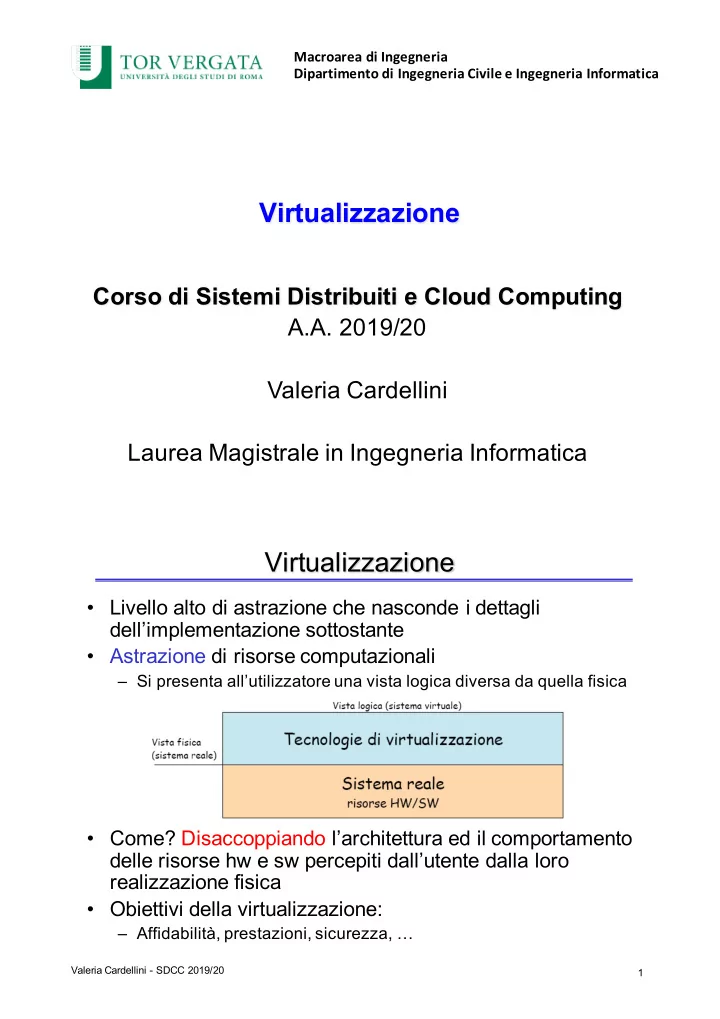
  • Livello alto di astrazione che nasconde i dettagli

dell’implementazione sottostante

  • Astrazione di risorse computazionali

– Si presenta all’utilizzatore una vista logica diversa da quella fisica

  • Come? Disaccoppiando l’architettura ed il comportamento

delle risorse hw e sw percepiti dall’utente dalla loro realizzazione fisica

  • Obiettivi della virtualizzazione:

– Affidabilità, prestazioni, sicurezza, …

1

slide-2
SLIDE 2

Virtualizzazione di risorse

  • Virtualizzazione di risorse (hw e sw) di sistema

– Macchina virtuale, container, …

  • Virtualizzazione di storage

– Storage Area Network (SAN), …

  • Virtualizzazione di rete

– Virtual LAN (VLAN), Virtual Private Network (VPN), …

  • Virtualizzazione di data center

Valeria Cardellini - SDCC 2019/20 2

Components of virtualized environment

  • Three major components:

– Guest – Host – Virtualization layer

  • Guest: system

component that interacts with the virtualization layer rather than with the host

  • Host: original

environment where the guest is supposed to be managed

Valeria Cardellini - SDCC 2019/20 3

  • Virtualization layer: responsible for recreating the same
  • r a different environment where the guest will operate
slide-3
SLIDE 3

Taxonomy of virtualization techniques

  • Execution environment virtualization is the oldest,

most popular and most developed area we will mostly investigate it

Valeria Cardellini - SDCC 2019/20 4 Valeria Cardellini - SDCC 2019/20

Macchina virtuale

  • Una macchina virtuale (VM, Virtual Machine)

permette di rappresentare le risorse hw/sw di una macchina diversamente dalla loro realtà

– Ad es.: risorse hw della VM (CPU, scheda di rete, …) diverse dalle risorse fisiche della macchina reale – Ad es.: risorse sw (sistema operativo, …) diverse dalle risorse sw della macchina reale

  • Una singola macchina fisica può essere usata come

differenti ambienti di elaborazione

– Molteplici VM su una singola macchina fisica

5

Virtualization layer VM1 VM2 VM3 Hardware

slide-4
SLIDE 4

Valeria Cardellini - SDCC 2019/20

Virtualizzazione: cenni storici

  • Il concetto di VM è un’idea “vecchia”, essendo

stato definito negli anni ’60 in un contesto centralizzato

– Ideato per consentire al software legacy (esistente) di essere eseguito su mainframe molto costosi e condividere in modo trasparente le (scarse) risorse fisiche – Ad es. il mainframe IBM System/360-67

  • Negli anni ’80, con il passaggio ai PC il problema

della condivisione trasparente delle risorse di calcolo viene risolto dai SO multitasking

– L’interesse per la virtualizzazione svanisce

6 Valeria Cardellini - SDCC 2019/20

Virtualizzazione: cenni storici

  • Alla fine degli anni '90, l’interesse rinasce per rendere

meno onerosa la programmazione hw special- purpose

– VMware fondata nel 1998

  • Si acuisce il problema dei costi di gestione e di

sottoutilizzo di piattaforme hw e sw eterogenee

– L’hw cambia più velocemente del sw (middleware e applicazioni) – Aumenta il costo di gestione e diminuisce la portabilità

  • Diventa nuovamente importante la condivisione

dell’hw e delle capacità di calcolo non usate per ridurre i costi dell’infrastruttura

  • E’ una delle tecnologie abilitanti del Cloud computing

7

slide-5
SLIDE 5

Virtualizzazione: vantaggi

  • Facilita la compatibilità, portabilità, interoperabilità e

migrazione di applicazioni ed ambienti

– Indipendenza dall’hw – Create Once, Run Anywhere – VM legacy: eseguire vecchi SO o vecchie applicazioni su nuove piattaforme

Valeria Cardellini - SDCC 2019/20 8

Virtualizzazione: vantaggi

  • Permette il consolidamento dei server in un data center,

con vantaggi economici, gestionali ed energetici

– Multiplexing di molteplici VM sullo stesso server – Obiettivo: ridurre il numero totale di server usati, utilizzandoli in modo più efficiente – Vantaggi:

  • Riduzione di costi, consumi energetici e spazio occupato
  • Semplificazione nella gestione, manutenzione ed upgrade dei

server

  • Riduzione dei tempi di downtime, tramite live migration di VM

Valeria Cardellini - SDCC 2019/20 9

slide-6
SLIDE 6

Virtualizzazione: vantaggi

  • Permette di isolare componenti malfunzionanti o

soggetti ad attacchi di sicurezza, incrementando affidabilità e sicurezza delle applicazioni

– Macchine virtuali di differenti applicazioni non possono avere accesso alle rispettive risorse – Bug del software, crash, virus in una VM non possono danneggiare altre VM in esecuzione sulla stessa macchina fisica

  • Permette di isolare le prestazioni di diverse VM

– Tramite lo scheduling delle risorse fisiche che sono condivise tra molteplici VM in esecuzione sulla stessa macchina fisica

  • Permette di bilanciare il carico sui server

– Tramite la migrazione della VM da un server ad un altro

Valeria Cardellini - SDCC 2019/20 10 Valeria Cardellini - SDCC 2019/20

Uso di ambienti di esecuzione virtualizzati

  • In ambito personale e didattico

– Per eseguire simultaneamente diversi SO sulla stessa macchina – Per semplificare l’installazione di sw

  • In ambito professionale

– Per debugging, testing e sviluppo di applicazioni

  • In ambito aziendale

– Per consolidare l’infrastruttura del data center – Per garantire business continuity: incapsulando interi sistemi in singoli file (system image) che possono essere replicati, migrati o reinstallati su qualsiasi server

11

slide-7
SLIDE 7

An application uses library functions (A1), makes system calls (A2), and executes machine instructions (A3)

Hardware Operating System ISA Libraries ABI API

System calls

Applications

System ISA User ISA A1 A2 A3

Interfaces in computer system

Valeria Cardellini - SDCC 2019/20 12 Valeria Cardellini - SDCC 2019/20

Interfaces in computer system and virtualization

A che livello realizzare la virtualizzazione?

  • Dipende fortemente dalle interfacce offerte dai vari

componenti del sistema

– Interfaccia tra hw e sw (user ISA: istruzioni macchina non privilegiate, invocabili da ogni programma) [interfaccia 4] – Interfaccia tra hw e sw (system ISA: istruzioni macchina invocabili solo da programmi privilegiati) [interfaccia 3] – Chiamate di sistema [interfaccia 2]

  • ABI (Application Binary Interface):

interfaccia 2 + interfaccia 4

– Chiamate di libreria (API) [interfaccia 1]

  • Obiettivo della virtualizzazione

– Imitare il comportamento di queste interfacce

Source: “The architecture of virtual machines”

13

slide-8
SLIDE 8

Valeria Cardellini - SDCC 2019/20

Levels of virtualization

  • Five levels of virtualization:

– ISA level

  • ISA emulation can be done through interpretation of

instructions (slow) or dynamic binary translation (converts in blocks rather than instruction by instruction)

– Hardware level (aka system VMs)

  • Based on virtual machine monitor (VMM), also called

hypervisor

– Operating system level (aka containers) – Run-time library level – User application level (aka process VMs)

14

Our focus Our focus

Valeria Cardellini - SDCC 2019/20

Levels of virtualization

15

  • Relative merits of virtualization at different levels
slide-9
SLIDE 9

Valeria Cardellini - SDCC 2019/20

Process Virtual Machine

  • Abstract (virtual) computer for a process

– Virtual platform that executes an individual process – Provides a virtual ABI or API environment for user applications – The application is compiled into an intermediary, portable code (e.g., Java bytecode), executed in the runtime environment provided by process VM

  • Examples: JVM, .NET CLR

Multiple instances of combinations <application, runtime system>

16 Valeria Cardellini - SDCC 2019/20

System Virtual Machine

  • Provides a complete environment in which an OS

and many processes can coexist

– The virtual machine monitor (VMM) manages the set of hardware resources and shares them among multiple VMs and provide isolation and protection of VMs – When a VM performs a privileged instruction or operation that directly interacts with shared hardware, VMM intercepts the operation, checks it for correctness, and performs it

  • Examples: VMware, KVM, Xen, Parallels, VirtualBox

Multiple instances of combinations <application, operating system>

17

Our focus

slide-10
SLIDE 10

System-level virtualization: terminology

  • Let’s now focus on system-level virtualization

(achieved through a VMM or hypervisor)

  • Host: base platform on top of which VMs are

executed; made of

– Physical machine – Possible host OS – VMM

  • Guest: everything inside a single VM

– Guest OS and applications executed inside the VM

Valeria Cardellini - SDCC 2019/20 18

System-level virtualization: classification

  • We distinguish according to:

– Where to deploy the VMM

  • System VMM (also called type-1, native or bare-metal

hypervisor)

  • Hosted VMM (also called type-2 hypervisor)

– How to virtualize the execution of sensitive, non- virtualizable instructions

  • Full virtualization

– Software-assisted full virtualization – Hardware-assisted full virtualization

  • Para-virtualization

Valeria Cardellini - SDCC 2019/20 19

slide-11
SLIDE 11

System-level virtualization: classification

Valeria Cardellini - SDCC 2019/20 20

Virtualization OS level Hardware level Type-2 Full virtualization Para-virtualization Type-1 Micro-kernel Monolithic Sw-assisted Hw-assisted Where? How?

Valeria Cardellini - SDCC 2019/20

VMM di sistema o VMM ospitato

VMM di sistema VMM ospitato host guest host

In quale livello dell’architettura di sistema si colloca il VMM?

– Direttamente sull’hardware: VMM di sistema – Sopra il SO host: VMM ospitato

guest

21

slide-12
SLIDE 12

VMM di sistema o VMM ospitato

  • VMM di sistema (type-1): eseguito direttamente sull’hw,
  • ffre funzionalità di virtualizzazione integrate in un SO

semplificato

– L’hypervisor può avere un’architettura a micro-kernel (solo funzioni di base, no device driver) o monolitica – Esempi: Xen, KVM, VMware ESX, Hyper-V

  • VMM ospitato (type-2): eseguito sul SO host, accede

alle risorse hw tramite le chiamate di sistema del SO host

– Interagisce con il SO host tramite l’ABI ed emula l’ISA di hw virtuale per i SO guest – Vantaggio: può usare il SO host per gestire le periferiche ed utilizzare servizi di basso livello (es. scheduling delle risorse) – Vantaggio: non occorre modificare il SO guest – Svantaggio: degrado delle prestazioni rispetto a VMM di sistema – Esempi: Bochs, Parallels Desktop, VirtualBox

Valeria Cardellini - SDCC 2019/20 22 Valeria Cardellini - SDCC 2019/20

Virtualizzazione completa o paravirtualizzazione

Quale modalità di dialogo tra la VM ed il VMM per l’accesso alle risorse fisiche, ovvero come gestire l’esecuzione di istruzioni privilegiate? – Virtualizzazione completa – Paravirtualizzazione

23

Confronto qualitativo di diverse soluzioni di virtualizzazione

https://en.wikipedia.org/wiki/Comparison_of_platform_virtualization_software

slide-13
SLIDE 13

Valeria Cardellini - SDCC 2019/20

Virtualizzazione completa o paravirtualizzazione

  • Virtualizzazione completa (full)

– Il VMM espone ad ogni VM interfacce hw simulate funzionalmente identiche a quelle della sottostante macchina fisica – Il VMM intercetta le richieste di accesso privilegiato all’hw (ad es. istruzioni di I/O) e ne emula il comportamento atteso – Esempi: KVM, VMware ESXi, Microsoft Hyper-V

  • Paravirtualizzazione

– Il VMM espone ad ogni VM interfacce hw simulate funzionalmente simili (ma non identiche) a quelle della sottostante macchina fisica – Non viene emulato l’hw, ma viene creato uno strato minimale di sw (Virtual Hardware API) per assicurare la gestione delle VM ed il loro isolamento – Esempi: Xen, Oracle VM (basato su Xen), PikeOS

24

Virtualizzazione completa: pro e contro

  • Vantaggi

– Non occorre modificare il SO guest – Isolamento completo tra le istanze di VM: sicurezza, facilità di emulare diverse architetture

  • Svantaggi

– VMM più complesso – Necessaria la collaborazione del processore per implementazione efficace: perché?

Valeria Cardellini - SDCC 2019/20 25

slide-14
SLIDE 14

Problemi per realizzare la virtualizzazione di sistema

  • L’architettura del processore opera

secondo almeno 2 livelli (ring) di protezione: supervisor e user

– Ring 0: privilegi massimi – Ring 3: privilegi minimi

Valeria Cardellini - SDCC 2019/20 26

Architettura x86 senza virtualizzazione

  • Con la virtualizzazione:

– Il VMM opera in supervisor mode (ring 0) – ll SO guest e le applicazioni (quindi la VM) operano in user mode (ring 3 o ring 1 per SO guest) – Problema del ring deprivileging: il SO guest opera in un ring che non gli è proprio è non può eseguire istruzioni privilegiate (e.g., lidt in x86, load interrupt descriptor table) – Problema del ring compression: poiché applicazioni e SO guest eseguono allo stesso livello, occorre proteggere lo spazio del SO

Virtualizzazione completa: soluzioni

  • Come risolvere il ring deprivileging?

– Trap-and-emulate: quando il SO guest tenta di eseguire un’istruzione privilegiata, occorre notificare un’eccezione (trap) al VMM e trasferirgli il controllo; il VMM controlla la correttezza dell’operazione richiesta e ne emula il comportamento – Le istruzioni non privilegiate eseguite dal SO guest sono invece eseguite direttamente

  • Come realizzare il meccanismo di trap?

– A livello hardware se il processore fornisce supporto alla virtualizzazione: è hardware-assisted CPU virtualization – A livello software se il processore non fornisce supporto alla virtualizzazione è fast binary translation

Valeria Cardellini - SDCC 2019/20 27

slide-15
SLIDE 15

Hardware-assisted CPU virtualization

  • Hardware-assisted CPU virtualization (Intel VT-x and

AMD-V) provides two new forms of CPU operating modes, called root mode and non-root mode, each supporting all four x86 protection rings

Valeria Cardellini - SDCC 2019/20

  • VMM runs in root mode

(Root-Ring 0), while all guest OSes run in guest mode in their original privilege levels (Non-Root Ring 0): no longer ring deprivileging and ring compression problems

  • VMM can control guest

execution through control data structures in memory

28

X86 architecture with full virtualization and hardware-assisted CPU virtualization

Fast binary translation

  • Ma il meccanismo di trap al VMM per le istruzioni privilegiate

è offerto solo dai processori con supporto hardware per la virtualizzazione (Intel VT-x e AMD-V)

– IA-32 non lo è: come realizzare la virtualizzazione completa in mancanza del supporto hw?

  • Fast binary translation: il VMM scansiona il codice prima

della sua esecuzione per sostituire blocchi contenenti istruzioni privilegiate con blocchi funzionalmente equivalenti e contenenti istruzioni per la notifica di eccezioni al VMM

Valeria Cardellini - SDCC 2019/20

Architettura x86 con virtualizzazione completa e binary translation

  • I blocchi tradotti sono

eseguiti direttamente sull’hw e conservati in una cache per eventuali riusi futuri

  • Maggiore complessità del

VMM e minori prestazioni

29

slide-16
SLIDE 16

Paravirtualization

Valeria Cardellini - SDCC 2019/20

  • Non-transparent virtualization solution
  • Guest OS kernel must be modified to let it invoke the virtual API

exposed by the hypervisor

  • Nonvirtualizable instructions are replaced by hypercalls

that communicate directly with the hypervisor

  • A kind of system call from guest kernel to hypervisor

hypercall : hypervisor = syscall : kernel

X86 architecture with paravirtualization

30

Paravirtualization: hypercall execution

Valeria Cardellini - SDCC 2019/20

  • When an application running in the VM issues a guest OS system

call, through the hypercall the control flow jumps to hypervisor, which then passes control back to the guest OS

Source: “The Definitive Guide to XEN hypervisor”

31

slide-17
SLIDE 17

Paravirtualization: pros & cons

Valeria Cardellini - SDCC 2019/20

  • Pros (vs full virtualization):

– Relatively easier and more practical implementation – Reduced overhead with respect to fast binary translation – Does not require virtualization extensions from the host CPU as hw-assisted virtualization does

  • Cons:

– Requires source code of OSes to be available

  • OSes that cannot be ported (e.g., Windows) can use ad-hoc

device drivers that remap the execution of critical instructions to the virtual API exposed by the VMM

– Cost of maintaining paravirtualized OSes

  • Paravirtualized OS cannot longer run on hardware directly

32

Summing up the different approaches

Valeria Cardellini - SDCC 2019/20 33

slide-18
SLIDE 18

VMM reference architecture

  • Three main modules

– Dispatcher: VMM entry point that reroutes the privileged instruction issued by the VM to one of the other two modules – Allocator (or scheduler): decides about the system resources to be provided to the VM – Interpreter: executes a proper routine when the VM executes a privileged instruction

34 Valeria Cardellini - SDCC 2019/20

VMM reference architecture: scheduler

Valeria Cardellini - SDCC 2019/20 35

  • VMM scheduler: an additional scheduling layer with

respect to the classic CPU scheduling

  • How to efficiently schedule virtual CPUs?

– We will study scheduling in Xen

slide-19
SLIDE 19

Memory virtualization

  • In a non-virtualized environment

– One-level mapping: from virtual memory to physical memory provided by page tables – MMU and TLB hardware components to optimize virtual memory performance

  • In a virtualized environment

– All VMs share the same machine memory and VMM needs to partition it among VMs – Two-level mapping: from guest virtual memory to guest physical memory to host physical memory

  • Terminology

– Guest virtual memory: memory visible to applications; continuous virtual address space presented by guest OS to applications – Guest physical memory: memory visible to guest OS – Host physical memory: actual hw memory visible to VMM

Valeria Cardellini - SDCC 2019/20 36

Two-level memory mapping

Valeria Cardellini - SDCC 2019/20

  • Going from guest virtual memory to host physical memory

requires a two-level memory mapping: Guest VA (virtual address) è guest PA (physical address) è host MA (machine address)

  • Guest physical address ≠ host machine address

37

slide-20
SLIDE 20

Shadow page table

  • To avoid an unbearable performance drop due to the

extra memory mapping, VMM maintains shadow page tables (SPTs) and uses them to accelerate the mapping

– Direct guest virtual-to-host physical address mapping

Valeria Cardellini - SDCC 2019/20 38

  • SPT maps guest virtual address to host

physical address

– Guest OS maintains its own virtual memory page table (PT) in the guest physical memory frames – For each guest physical memory frame, VMM should map it to host physical memory frame – SPT maintains the mapping from guest virtual address to host machine address – VMM needs to keep the SPTs consistent with changes made by each guest OS to its PTs

Memory mapping with SPTs

Valeria Cardellini - SDCC 2019/20

  • The VMM uses TLB hardware to map the virtual memory

directly to the machine memory to avoid the two levels of translation on every access (red arrow)

  • When the guest OS changes the guest virtual memory to

guest physical memory mapping, the VMM updates the SPTs to enable a direct lookup

39

slide-21
SLIDE 21

Challenges in memory virtualization with SPT

Valeria Cardellini - SDCC 2019/20

  • Address translation

– Guest OS expects contiguous, zero-based physical memory, but the underlying machine memory may be discontiguous: VMM must preserve this illusion

  • Page table shadowing

– SPT implementation is complex – VMM intercepts paging operations and constructs copy of PTs

  • Overheads

– VM exits add to execution time – SPTs consume significant host memory – SPTs need to be kept synchronized with guest PTs

40

Hw support for memory virtualization

  • SPT is a software-managed solution; let’s also

consider a more efficient hardware solution

– Second Level Address Translation (SLAT) is the hardware- assisted solution for memory virtualization (Intel EPT and AMD RVI) to translate guest virtual address into machine’s physical address

Valeria Cardellini - SDCC 2019/20

– Using SLAT there is a significant performance gain with respect to SPT: around 50% for MMU intensive benchmarks

41

slide-22
SLIDE 22

Case study: Xen

  • The most notable example of paravirtualization

www.xenproject.org (developed at University of Cambridge) – Open-source type-1 (system VMM) hypervisor with microkernel design – Offers to guest OS a virtual interface (hypercall API) to whom guest OS must refer to access machine physical resources – Supports both paravirtualization (PV) and hardware-assisted virtualization (HVM)

  • With paravirtualization Xen requires PV-enabled guest OSs and

PV drivers (part of Linux kernel and other OSs) – OSs ported to Xen: Linux, NetBSD, FreeBSD and OpenSolaris

  • With HVM also unmodified guest OSs (e.g., Windows)

– Foundation for commercial virtualization products (e.g., Oracle VM and Qubes OS) – Powers some IaaS providers (Alibaba, Amazon, Rackspace)

  • In 2017 Amazon began a shift to KVM for new EC2 instance types

42 Valeria Cardellini - SDCC 2019/20 Valeria Cardellini - SDCC 2019/20

Xen: pros and cons

  • Pros

– Thin hypervisor model

  • 300K lines of code on x86, 65K on Arm
  • Small footprint and interface (around 1MB in size)
  • Scalable: up to 4,095 host CPUs with 16Tb of RAM
  • More robust and secure than other hypervisors, see

https://youtu.be/sjQnAIJji4k

  • But still vulnerable to attacks https://xenbits.xen.org/xsa/

– Continuously improved – Flexibility in management

  • Tuning for performance

– Low overhead (within 2%) with respect to bare metal machine without virtualization – Supports VM live migration

  • Cons
  • I/O performance still remains challenging

43

slide-23
SLIDE 23

Valeria Cardellini - SDCC 2019/20

Xen architecture

  • Goal of the Cambridge group (late 1990s)
  • Design a VMM capable of scaling to about 100 VMs running

applications and services without any modifications to ABI

  • First public release in 2003
  • Microkernel design
  • What can be paravirtualized?
  • Disk and network devices
  • Interrupts and timers
  • Emulated motherboard and legacy boot
  • Privileged instructions and page tables (memory access)
  • Privileged instructions issued by a guest OS are replaced with

hypercalls

44

Xen architecture

https://wiki.xen.org/wiki/Xen_Project_Software_Overview

Valeria Cardellini - SDCC 2019/20 45

slide-24
SLIDE 24

Xen architecture: hypervisor

  • In charge of scheduling, memory management,

interrupt and device control

  • Per-domain and per-vCPU info management

Valeria Cardellini - SDCC 2019/20 46 Valeria Cardellini - SDCC 2019/20

Xen architecture: domains

  • Domains
  • Represent VM instances, each running their own OS system

and apps

  • Runs on virtual CPUs
  • DomU (unprivileged domain): guest VMs
  • Totally isolated from hw (i.e., no privilege to access hw or I/O

functionality)

  • Dom0 (control domain): special domain devoted to

execution of Xen control functions and privileged instructions

  • Mandatory, initial domain started by Xen on boot
  • Contains the drivers for all devices and some services (DE, XS,

TS)

  • Special privileges: can access hw directly and system’s I/O

functions, can interact with other VMs

47

slide-25
SLIDE 25

Dom0 components: XenStore and Toolstack

  • XenStore: information storage space shared between

domains managed by xenstored daemon

– Stores configuration and status information – Implemented as hierarchical key-value storage

  • When values are changed in the store, a watch function notifies listeners

(e.g., drivers) of changes of the key they have subscribed to

– Communicates with guest VMs via shared memory using Dom0 privileges

  • Toolstack: allows to manage VM lifecycle (create, shutdown,

pause, migrate)

– To create a new VM, a user provides a configuration file describing memory and CPU allocations and device configurations – Toolstack parses this file and writes this information in XenStore – Takes advantage of Dom0 privileges to map guest memory, to load kernel and virtual BIOS and to set up initial communication channels with XenStore and with virtual console when a new VM is created

Valeria Cardellini - SDCC 2019/20 48

Xen architecture and guest OS management

  • Xen hypervisor runs in the most privileged mode and

controls the access of guest OSs to underlying hw

– Domains are run in ring 1 – Applications in ring 3

Valeria Cardellini - SDCC 2019/20 49

slide-26
SLIDE 26

CPU schedulers in Xen

  • Hypervisor scheduler decides, among all the virtual

CPUs (vCPUs) of the various VMs, which ones should execute on the physical CPUs (pCPUs)

  • Further scheduling level with respect to those provided by OS

(scheduling of processes and scheduling of user-level threads within processes)

  • Xen allows to choose among different CPU schedulers

– We consider the Credit scheduler (default scheduler in Xen)

  • Scheduling algorithm goals:

– Make sure that domains get fair share of CPU

  • Proportional share algorithm: allocates pCPU in proportion to the

number of shares (weights) assigned to vCPUs

– Keep the CPU busy

  • Work-conserving algorithm: does not allow the CPU to be idle

when there is work to be done

– Schedule with low latency

Valeria Cardellini - SDCC 2019/20 50

Credit scheduler

  • Proportional fair share and work-conserving scheduler
  • Each domain is assigned a weight and optionally a cap

(tunable parameters)

– Weight: relative CPU allocation per domain (default 256) – Cap: maximum amount of CPU a domain can use. If cap is 0 (default), then vCPU can receive any extra CPU (i.e., work-conserving); non-zero cap limits the amount of CPU a vCPU receives (e.g., 100 = 1 pCPU, 50 = 0.5 pCPU) – The scheduler transforms the weight into a credit allocation for each vCPU; as a vCPU runs, it consumes credits

  • For each pCPU, the scheduler maintains a queue of vCPUs,

with all the under-credit vCPUs first, followed by the over- credit vCPUs; the scheduler picks the first vCPU in the queue

  • Automatically load balances vCPUs across pCPUs on SMP

host

– Before a pCPU goes idle, it will consider other pCPUs in order to find any runnable vCPU; this approach guarantees that no pCPU idles when there is runnable work in the system

Valeria Cardellini - SDCC 2019/20

wiki.xen.org/wiki/Credit_Scheduler

51

slide-27
SLIDE 27

Performance comparison of hypervisors

  • Developments in virtualization techniques and CPU

architectures have reduced the performance cost of virtualization but still some overheads

– Especially when multiple VMs compete for hw resources

  • We consider two performance comparison studies

– Papers on the course site – “Old” studies but overall message still valid

  • Take-home message

– No one-size-fits-all solution exists – Different hypervisors show different performance characteristics for varying workloads

Valeria Cardellini - SDCC 2019/20 52

Performance comparison of hypervisors

A component-based performance comparison of four hypervisors (IM 2013) http://bit.ly/2igBGZX

– Microsoft Hyper-V, KVM, VMware vSphere and Xen, all with hardware-assisted virtualization settings – Analyzed components: CPU, memory, disk I/O and network I/O

  • Overall results

– Performance can vary between 3% and 140% depending on the type of hw resource, but no single hypervisor always

  • utperforms the others
  • vSphere performs the best, but the others perform respectably
  • CPU and memory: lowest levels of overhead
  • I/O and network: Xen overhead for small disk operations
  • Takeaway: consider application type because different

hypervisors may be best suited for different workloads

Valeria Cardellini - SDCC 2019/20 53

slide-28
SLIDE 28

Performance comparison of hypervisors

Performance overhead among three hypervisors: an experimental study using Hadoop benchmarks (BigData 2013) http://bit.ly/2ziKCZM

  • Use Hadoop MapReduce apps to evaluate and

compare the performance impact of three hypervisors

– A commercial one (not disclosed), Xen, and KVM

  • For CPU-intensive benchmarks, negligible

performance difference among the hypervisors

  • Significant performance variations for I/O-intensive

benchmarks

– Commercial hypervisor best at disk writing, KVM best for disk reading – Xen best when there combination of disk reading and writing with CPU-intensive computations

Valeria Cardellini - SDCC 2019/20 54

Portability of virtual machines

  • VM image: copy of the VM, which contains an OS,

data files, and applications

  • How to import and export VM images and avoid

vendor lock-in?

  • Open Virtualization Format (OVF)

– Open industry standard for packaging and distributing VMs

  • Virtual-platform agnostic

– VM configuration specified in XML format within a file – Supported by many (but not all) virtualization products (VMware, VirtualBox, …)

Valeria Cardellini - SDCC 2019/20 55

slide-29
SLIDE 29

VM resizing and migration

  • Two useful techniques to deploy and

manage large-scale virtualized environments

– Dynamic resizing for vertical scaling (scale up, scale down) – Live migration

  • Move VM between different physical machines (or data

centers) without stopping it

Valeria Cardellini - SDCC 2019/20 56

VM dynamic resizing

  • Fine-grain mechanism with respect to migrate or

reboot a VM

– Example: application running on a VM starts consuming a lot

  • f resources and the VM starts running out of RAM and CPU

resize the VM

  • Pros: more cost-effective and faster than VM reboot
  • Cons: not supported by all virtualization products and

guest OSs

  • What can be resized without powering off and

rebooting the VM?

– Number of virtual CPUs – Memory

Valeria Cardellini - SDCC 2019/20 57

slide-30
SLIDE 30

VM dynamic resizing: CPU

  • To add or remove virtual CPUs (without switching off

the machine)

  • In Linux-based systems support for CPU hot-plug/hot-

unplug (e.g., KVM)

– Uses information in virtual file system sysfs (processor info in /sys/devices/system/cpu) – /sys/devices/system/cpu/cpuX for cpuX (X=0, 1, 2, …) – To turn on cpu #5:

echo 1 > /sys/devices/system/cpu/cpu5/online

– To turn off cup #5:

echo 0 > /sys/devices/system/cpu/cpu5/online

Valeria Cardellini - SDCC 2019/20 58

VM dynamic resizing: memory

  • Based on memory ballooning

– Mechanism used by many hypervisors (e.g., KVM, Xen and VMware) to pass memory back and forth between hypervisor and guest OSs – In KVM: virtio_balloon driver

Valeria Cardellini - SDCC 2019/20

  • When balloon deflates:

more memory for the VM

– Anyway, VM memory size cannot exceed maxMemory

  • When balloon inflates

– Swap memory pages to disk

59

slide-31
SLIDE 31

Migrazione di VM

  • Vantaggi della migrazione

– Utile in cluster e data center virtuali per:

  • Consolidare l’infrastruttura
  • Avere flessibilità nel failover
  • Bilanciare il carico
  • Svantaggi e problemi

– Supporto da parte del VMM – Overhead di migrazione non trascurabile – Migrazione in ambito WAN non banale

Valeria Cardellini - SDCC 2019/20 60

Migrazione di VM

  • Approcci per migrare istanze di macchine virtuali tra

macchine fisiche:

– Stop and copy: si spegne la VM sorgente e si trasferisce l’immagine della VM sull’host di destinazione, ma il downtime può essere troppo lungo

  • L’immagine della VM può essere grande e la banda di rete limitata

– Live migration: la VM sorgente è in funzione durante la migrazione

Valeria Cardellini - SDCC 2019/20 61

Live migration largamente usata da Google: più di 1M di migrazioni al mese

slide-32
SLIDE 32

Migrazione live di VM

  • Prima di avviare la migrazione live

– Fase di setup: si seleziona l’host di destinazione (ad es. con

  • biettivo di load balancing, energy efficiency, oppure server

consolidation)

  • Cosa migrare? Memoria, storage e connessioni di

rete

  • Come? In modo trasparente alle applicazioni in

esecuzione sulla VM

– Costo della migrazione live: vi è comunque un downtime dell’applicazione

Valeria Cardellini - SDCC 2019/20 62

Migrazione live di VM: storage e rete

  • Per migrare lo storage:

– Usare storage condiviso da host sorgente e destinazione

  • SAN (Storage Area Network) o più economico NAS (Network

Attached Server) o file system distribuito (e.g., NFS, GlusterFS o CEPH

– In assenza di storage condiviso: il VMM sorgente salva tutti i dati della VM sorgente in un file di immagine, che viene trasferito sull’host di destinazione

  • Per migrare le connessioni di rete:

– La VM sorgente ha un indirizzo IP virtuale (eventualmente anche un indirizzo MAC virtuale)

  • Il VMM conosce il mapping tra IP virtuale e VM

– Se sorgente e destinazione sono sulla stessa sottorete IP, non

  • ccorre fare forwarding sulla sorgente
  • Invio di risposta ARP non richiesta da parte della destinazione per

avvisare che l’indirizzo IP è stato spostato in una nuova locazione ed aggiornare quindi le tabelle ARP

63 Valeria Cardellini - SDCC 2019/20

slide-33
SLIDE 33

Migrazione live di VM: memoria

  • Per migrare la memoria (inclusi registri della CPU e

stato dei device driver):

1. Fase di pre-copy: il VMM copia in modo iterativo le pagine da VM sorgente a VM di destinazione mentre la VM sorgente è in esecuzione

  • All’iterazione n copiate le pagine modificate durante iterazione n-1

2. Fase di stop-and-copy: la VM sorgente viene fermata e vengono copiate pagine dirty, stato della CPU e dei device

  • Tempo di downtime: da qualche msec a qualche sec, in funzione di

dimensione della memoria, tipo di app e banda di rete

3. Fasi di commitment e reactivation: la VM di destinazione carica lo stato e riprende l’esecuzione; la VM sorgente viene rimossa (ed eventualmente spento l’host sorgente)

  • Noto come approccio pre-copy

– La memoria è copiata prima che l’esecuzione della VM riprenda a destinazione – Soluzione comune (es. KVM, VMWare, Xen, Google CE)

Valeria Cardellini - SDCC 2019/20 64

VM live migration: overall process

Valeria Cardellini - SDCC 2019/20 65

Source: C. Clark et al., “Live Migration of Virtual Machines”, NSDI’05.

slide-34
SLIDE 34

VM live migration: alternatives for memory

  • Pre-copy cannot migrate in a transparent manner

workloads that are CPU and/or memory intensive

  • 1. Alternative approach: post-copy

– Post-copy moves the execution to the destination host at the beginning of the migration process and then transfers the memory pages in an on-demand manner as they are requested by the VM

  • 2. Alternative approach: hybrid

– Special case of post-copy migration: post-copy preceded by a limited pre-copy stage – Idea: a subset of the most frequently accessed memory pages is transferred before the VM execution is switched to the destination, so to reduce performance degradation after the VM is resumed

  • No standard implementation of post-copy and hybrid

approaches in current hypervisors

Valeria Cardellini - SDCC 2019/20 66

Approaches for migrating memory

Valeria Cardellini - SDCC 2019/20 67

Courtesy of C.Vojtech, http://bit.ly/2h7wSWB

slide-35
SLIDE 35

Live VM migration and hypervisors

  • Live VM migration is supported by open-source and

commercial hypervisors

– E.g., KVM, Hyper-V, Xen, VirtualBox

  • Can be controlled using virsh CLI tool with different
  • ptions

$> virsh migrate --live [--undefinesource] [--copy- storage-all] [--copy-storage-inc] domain desturi $> virsh migrate-setmaxdowntime domain downtime $> virsh migrate-setspeed domain bandwidth $> virsh migrate-getspeed domain

Valeria Cardellini - SDCC 2019/20 68

VM migration in WAN environments

  • How to achieve live migration of VMs across multiple

geo-distributed data centers?

– Key challenge: maintain network connectivity and preserve

  • pen connections during and after migration

– Limited support in open-source and commercial hypervisors

Valeria Cardellini - SDCC 2019/20 69

slide-36
SLIDE 36

VM migration in WAN environments: storage

  • Approaches to migrate storage in WAN

– Shared storage

  • Cons: storage access time can be too slow

– On-demand fetching

  • Transfer only some blocks on the destination and then fetch

remaining blocks from the source only when requested

  • Cons: it does not work if the source crashes

– Pre-copy/write throttling

  • Pre-copy the disk image of the VM to the destination whilst

the VM continues to run, keep track of write operations on the source (delta) and then apply the delta on the destination

  • If the write rate at the source is too fast, use write throttling to

slow down the VM so that migration can proceed

Valeria Cardellini - SDCC 2019/20 70

VM migration in WAN environments: network

  • Approaches to migrate network connections in WAN

– IP tunneling

  • Set up an IP tunnel between the old IP address at the source

and the new VM IP address at the destination

  • Use the tunnel to forward all packets that arrive at the source

for the old IP address

  • Once the migration has completed and the VM can respond at

its new location, update the DNS entry with the new IP address

  • Tear down the tunnel when no connections remain that use the
  • ld IP address
  • Cons: it does not work if the source crashes

– Virtual Private Network (VPN)

  • Use MPLS-based VPN to create the abstraction of a private

network and address space shared by multiple data centers

– Software-Defined Networking

  • Change the control plane, no need to change IP address!

Valeria Cardellini - SDCC 2019/20 71

slide-37
SLIDE 37

Virtualizzazione a livello di SO

  • Finora abbiamo considerato la virtualizzazione a livello

di sistema

  • Analizziamo ora la virtualizzazione a livello di

sistema operativo (o container-based virtualization)

  • Permette di eseguire molteplici ambienti di esecuzione

tra di loro isolati all’interno di un singolo SO

– Tali ambienti sono chiamati:

  • container
  • jail
  • zone
  • virtual execution environment (VE)

Valeria Cardellini - SDCC 2019/20 72

Virtualizzazione a livello di SO

  • Ogni container ha:
  • il proprio insieme di processi, file system, utenti, interfacce

di rete con indirizzi IP, tabelle di routing, regole del firewall, …

  • I container condividono il kernel dello stesso SO

(e.g., Linux)

Valeria Cardellini - SDCC 2019/20 73

slide-38
SLIDE 38

Virtualizzazione a livello di SO: meccanismi

  • Quali meccanismi offerti dal kernel di un SO Unix-like

sono usati per realizzare i container?

– chroot – cgroups e namespaces (Linux)

  • chroot (change root directory)

– Comando per cambiare la directory di riferimento dei processi in esecuzione

  • cgroups (control groups)

– Meccanismo che permette di limitare, misurare ed isolare l’utilizzo delle risorse (CPU, memoria, I/O a blocchi, rete) di un insieme di processi

Valeria Cardellini - SDCC 2019/20 74

Virtualizzazione a livello di SO: meccanismi

  • namespaces

– Meccanismo che permette di isolare ciò che un insieme di processi può vedere dell'ambiente operativo (processi, porte, file, …) – 6 namespace

Valeria Cardellini - SDCC 2019/20 75

slide-39
SLIDE 39

Virtualizzazione a livello di SO: vantaggi

  • VMM-based (type 1 and type-22) vs container-

based virtualization

Valeria Cardellini - SDCC 2019/20 76

Virtualizzazione a livello di SO: vantaggi

  • Rispetto a virtualizzazione basata su VMM

ü Degrado di prestazioni pressoché nullo

Le applicazioni invocano direttamente le chiamate di sistema, senza indirezione del VMM

ü Tempi minimi di startup e shutdown/cleanup

Secondi per container, minuti per VM

ü Densità elevata

Centinaia di istanze su una singola macchina fisica (PM, physical machine), ad es. con Solaris Containers fino a 8191

ü Immagine (footprint) di dimensioni minori

Non comprende il kernel del SO

ü Possibilità di condividere pagine di memoria tra molteplici container in esecuzione sulla stessa PM ü Maggiore portabilità e interoperabilità per applicazioni cloud

App nel container indipendente da ambiente di esecuzione

Valeria Cardellini - SDCC 2019/20 77

In a nutshell: lightweight vs. heavyweight

slide-40
SLIDE 40

Virtualizzazione a livello di SO: svantaggi

  • Rispetto a virtualizzazione basata su VMM

– Minore flessibilità

  • Non si possono eseguire contemporaneamente kernel di SO

differenti sulla stessa PM

  • Solo applicazioni native per il SO supportato (e.g., applicazioni

native per Linux)

– Minore isolamento – Maggiore rischio di vulnerabilità

  • Una singola vulnerabilità nel kernel del SO può compromettere

l’intero sistema

Valeria Cardellini - SDCC 2019/20 78

OS-level virtualization: products

  • Docker

– Our case study

  • FreeBSD Jail
  • Solaris Zones/Containers
  • LXC (LinuX Containers)

– Supported by the mainline Linux kernel – For full system containers (full OS image) – LXD

  • Built on top of LXC, it is a system container manager
  • Virtuozzo
  • OpenVZ (for Linux)
  • IBM LPAR
  • rkt

– Application container engine

Valeria Cardellini - SDCC 2019/20 79

slide-41
SLIDE 41

OS-level virtualization: only Linux?

  • Windows and OS X support container-based

virtualization

– See Docker Desktop

  • Alternative: install a VM with Linux as guest OS and

use a container-based virtualization product inside the VM

– Cons: performance loss – Cons: containerized apps must run on Linux (no OS X or Windows native applications)

Valeria Cardellini - SDCC 2019/20 80

Containers and DevOps

  • Containers provide a new way to build, package,

share, and deploy apps

  • Containers help in the shift to DevOps and CI/CD

(Continuous Integration and Continuous Deployment)

Valeria Cardellini - SDCC 2019/20 81

⎼ Containers (more than VMs) allow developers to build code collaboratively by sharing images while simplifying deployment to different infrastructures

  • DevOps = Development and

Operations

– Development methodology with a set of practices aimed at bridging the gap between Development and Operations, emphasizing communication and collaboration, continuous integration, quality assurance and delivery with automated deployment

slide-42
SLIDE 42

Containers and DevOps

Valeria Cardellini - SDCC 2019/20 82

  • Some tools for DevOps

Containers, microservices, serverless

  • Using containers:
  • Application and all its dependencies into a single package

that can run almost anywhere

  • Use fewer resources than traditional VMs
  • Containers as key enabling technology for

microservices and serverless computing

– Future Cloud-native applications will consist of both microservices and functions, that can be wrapped as containers

Valeria Cardellini - SDCC 2019/20 83

slide-43
SLIDE 43

Container dynamic resizing and migration

  • As for VMs, we can resize and migrate containers
  • Dynamic resizing (CPU, memory, I/O) of container

limits

– Possibly without restarting the container – Low-level solution: cgroups limits can be changed on the fly

Valeria Cardellini - SDCC 2019/20 84

Container live migration

  • What about live migration of containers?
  • As for VM migration, we need to:

– Save state – Transfer state – Restore from state

  • State saving, transferring and restoring happen with tasks

frozen (migration downtime)

– Use memory pre-copy or memory post-copy

  • More complicated than VM migration

– No direct support, need to use additional tools

Valeria Cardellini - SDCC 2019/20 85

slide-44
SLIDE 44

Container live migration

Valeria Cardellini - SDCC 2019/20 86

  • Use CRIU and P.Haul tools
  • CRIU: dump and restore in user space
  • P.Haul (Process HAULer): on top of CRIU, for pre-checks,

memory pre-copy and post-copy, and file system migration

Containers in the Cloud

  • Containers and container development platforms as

first-class Cloud services

– Amazon Elastic Container Service (ECS)

  • Two launch modes: EC2 and Fargate

– Azure Container – Google Container Engine – Alauda (Container-as-a-Service solution) https://www.alauda.io – Docker Cloud

Valeria Cardellini - SDCC 2019/20 87

slide-45
SLIDE 45

Hypervisors and containers in the Cloud

  • Which virtualization technology for IaaS providers?

– Hypervisor-based virtualization: greater security, isolation, and flexibility (different OSs on same PM) – Container-based virtualization: smaller-size deployment, reduced startup and shutdown times

  • Some questions

– Containers inside VMs or on top of bare metal? – Will containers replace VMs in Cloud offering or the other way? – New trend: combine security and isolation properties provided by hypervisors with speed and flexibility of containers

  • Firecracker: open source virtualization technology by Amazon

built for creating and managing secure, multi-tenant container and function-based services. Based on KVM but with minimalist

  • design. Runs workloads in lightweight VMs, called micro VMs

https://firecracker-microvm.github.io

Valeria Cardellini - SDCC 2019/20 88

New lightweight approaches to virtualization

  • Deployment strategies examined so far

Valeria Cardellini - SDCC 2019/20 89

slide-46
SLIDE 46

New lightweight approaches to virtualization

  • Microservices, serverless computing, IoT, fog/edge

computing and NFV (Network Function Virtualization) increasingly demand for low-overhead (or lightweight) virtualization techniques

– OS-level virtualization is not enough – Most apps do not require many of the services and tools coming with common OSs (shells, editors, core utils, and package managers) – How to have tiny, one-shot VMs that run on hypervisors with great density and self-scale their resource needs? – How to improve security?

  • Lightweight OSs and unikernels

– Basic idea: avoid OS overhead and reduce attack surface

Valeria Cardellini - SDCC 2019/20 90

Lightweight operating systems

  • Minimal, container-focused OSs, typically with a

monolithic kernel architecture

– E.g.,: Container Linux, Atomic Host, Rancher OS

  • CoreOS Container Linux https://coreos.com/os/docs/latest/

– Smaller, more compact Linux distribution

  • Only minimal functionalities required for deploying apps inside

containers, together with built-in mechanisms for service discovery, container management and process management

– Designed for large-scale deployments, mostly targeting enterprises, with focus on automation, ease of application deployment, security, and scalability – Runs also on bare metal servers – Merged with Atomic Host (Fedora CoreOS)

Valeria Cardellini - SDCC 2019/20 91

slide-47
SLIDE 47

Unikernels

  • Unikernel (or library OS) http://unikernel.org

– Single-purpose, single-language virtual machine hosted on a minimal environment

  • Specialized OS with minimal set of libraries which

correspond to OS constructs required for app to run, all in a single address space

Valeria Cardellini - SDCC 2019/20 92

Unikernels: pros and cons

  • Pros:

– Lightweight and small (minimal memory footprint) – Fast (no context switching) – Secure (reduced attack surface) – Fast boot (measured in ms)

  • Cons:

– Only work in hypervisor-based virtual environments – Poor debugging – Single language runtime

See https://www.youtube.com/watch?v=oHcHTFleNtg

Valeria Cardellini - SDCC 2019/20 93

slide-48
SLIDE 48

Unikernels: products

  • Some unikernel products (and supported programming

language):

– OSV – LinuxKit – IncludeOS (C++) – ClickOS – Xen MirageOS (OCaml)

  • OSV http://osv.io

– Unikernel designed for the Cloud – Run only on top of hypervisor (e.g., KVM, Xen, Firecracker) – Goals: isolation benefits of hypervisors without overhead of guest OS – Requires to build an image by fusing OSv kernel and application files together

Valeria Cardellini - SDCC 2019/20 94

Unikernels: products

  • MirageOS

– Code can be developed on a normal OS and then compiled into a fully- standalone, specialised unikernel that runs on top of Xen or KVM – Code can be developed in OCaml, a high-level functional programming language https://ocaml.org/

Valeria Cardellini - SDCC 2019/20 95

slide-49
SLIDE 49

Performance of LV approaches

Some performance studies

[1] “Time provisioning evaluation of KVM, Docker and Unikernels in a cloud platform”, IEEE CCGrid 2016 [2] “My VM is lighter (and safer) than your container”, SOSP 2017

  • Performance comparison: hypervisor (KVM) vs.

lightweight virtualization (Docker and OSv)

  • Overhead introduced by containers is almost

negligible

– Fast instantiation times (at least 1 order of magnitude less than VMs) – Small per-instance memory footprints – High density

  • … but paid in terms of security

Valeria Cardellini - SDCC 2019/20 96

Performance of LV approaches

Valeria Cardellini - SDCC 2019/20 97

  • VM boot times grow linearly with

VM size

  • Instance and OS/container startup

for 10, 20 and 30 instances

  • Includes the overhead of the overall

provisioning time caused by the cloud platform (OpenStack)

  • Difficulties in securing containers due

to the unrelenting growth of Linux syscall API over the years From [1] From [2]

slide-50
SLIDE 50

Performance of LV approaches

  • A summary of properties

– “Consolidate IoT edge computing with lightweight virtualization”, IEEE Network, 2018.

Valeria Cardellini - SDCC 2019/20 98

Container orchestration

  • Platforms for managing the deployment of multi-

container packaged applications in large-scale clusters

  • Allow to configure, provision, deploy, monitor, and

dynamically control containerized apps

– Used to integrate and manage containers at scale

  • Examples

– Docker Swarm – Kubernetes – Amazon Elastic Container Service – Google Kubernetes Engine – Marathon – Nomad (container orchestration platform for Mesos)

99 Valeria Cardellini - SDCC 2019/20

Fully managed Cloud services

slide-51
SLIDE 51

Container management systems at Google

  • Application-oriented shift

“Containerization transforms the data center from being machine-oriented to being application-oriented”

  • Goal: let container technology operate at Google

scale

– Everything at Google runs as a container – Google launches more than 2 billion containers per week

  • Borg -> Omega -> Kubernetes

– Borg and Omega: purely Google-internal systems, precede Kubernetes – Kubernetes: open-source

100 Valeria Cardellini - SDCC 2019/20

Kubernetes

  • Google’s open-source platform for automating

deployment, scaling, and management of containerized apps across clusters of hosts

http://kubernetes.io

  • Features:

– Portable: public, private, hybrid, multi-cloud – Extensible: modular, pluggable, hookable, composable – Self-healing: auto-placement, auto-restart, auto-replication, auto-scaling of containers

  • Can run on public or private cloud platforms (AWS,

Azure, OpenStack, Apache Mesos), and also on bare metal machines

  • Offered as Cloud service on GCP

– Kubernetes management and deployment on underlying infrastructure is up to Cloud provider

Valeria Cardellini - SDCC 2019/20 101

slide-52
SLIDE 52

Kubernetes: pod

  • Pod: basic unit scheduled in

Kubernetes

– A collection of (tightly coupled) containers with shared storage/network, and a specification for how to run the containers – Pod containers are bundled and scheduled together, and run in a shared context

102

⎼ Kubernetes gives pods their own IP addresses and a single DNS name for a set of pods, and can load-balance across them

  • Users organize pods using labels

– Label: arbitrary key/value pair attached to pod – E.g., role=frontend and stage=production

Valeria Cardellini - SDCC 2019/20

Kubernetes: architecture

103 Valeria Cardellini - SDCC 2019/20

https://kubernetes.io/docs/concepts/overview/components/

slide-53
SLIDE 53

Kubernetes architecture

104

  • Organized according to master-worker pattern
  • Kubernetes master: cluster’s control plane, takes

global decision about the cluster (e.g., scheduling)

⎼ Multiple master nodes to provide a cluster with failover and high availability ⎼ kube-apiserver: API server that exposes Kubernetes API ⎼ etcd: highly available distributed key-value store, used as Kubernetes’ backing store for all cluster data ⎼ kube-scheduler: decides how to assign pods to nodes

  • Kubernetes nodes: worker machines, can be VM or

physical machines

⎼ kubelet: agent on each node, ensures that pods running on node are healthy and running

Valeria Cardellini - SDCC 2019/20

Sharing resources in clusters

105

  • How to share cluster resources among multiple and

non homogeneous frameworks run concurrently in the cluster?

  • The classical solution:

Static partitioning

  • Is it efficient?

Valeria Cardellini - SDCC 2019/20

slide-54
SLIDE 54

Apache Mesos

106 Valeria Cardellini - SDCC 2019/20

Dynamic partitioning

  • Open-source cluster manager that provides a

common resource sharing layer over which diverse frameworks can run

  • Abstracts the entire datacenter into a single pool of

computing resources, simplifying running distributed systems at scale

  • A distributed system to run distributed systems on top
  • f it

Apache Mesos: architecture

Valeria Cardellini - SDCC 2019/20 107

  • Master-worker

architecture

  • Workers publish

available resources to master

  • Master sends

resource offers to frameworks

  • Master election

and service discovery via ZooKeeper

slide-55
SLIDE 55

Mesos vs Kubernetes

  • Not entirely fair to compare Kubernetes with Mesos

directly

– Container orchestration features on top of Mesos provided by Marathon

  • Kubernetes can be run onto a cluster managed by

Mesos

Valeria Cardellini - SDCC 2019/20 108

Storage virtualization

  • Decouple the physical organization of storage from its

logical representation

– “Storage virtualization means that applications can use storage without any concern for where it resides, what the technical interface is, how it has been implemented, which platform it uses, and how much of it is available” (R. van der Lans)

  • Two primary types of storage virtualization

– Block level

  • Aggregate multiple network storage devices into a single

block-level substrate, present to users a logical space for data storage and handle the process of mapping it to the actual physical location

– File level

  • Decouple data access from location where files are

physically stored (e.g., distributed file system)

Valeria Cardellini - SDCC 2019/20 109

slide-56
SLIDE 56

Storage virtualization: SAN

  • Storage Area Networks (SAN): most common solution

for block-level storage virtualization

– SAN uses a network-accessible device through a large bandwidth connection to provide storage facilities

  • Fiber Channel (FC): high-speed

network technology primarily used to connect storage

– Requires special-purpose cabling – For high performance requirements

  • Internet SCSI (iSCSI): IP-based

protocol for linking data storage facilities

– Uses existing network infrastructures – For moderate performance requirements

110 Valeria Cardellini - SDCC 2019/20